A will trust beneficiary is a person or entity entitled to receive income or capital from a testamentary trust established under a will after the testator’s death. This role is distinct from a direct beneficiary who inherits assets outright. Instead, a trustee manages the trust assets on behalf of the beneficiary, distributing income or capital according to the terms set out in the will. Understanding this distinction matters because the rights, tax treatment, and protections available to a trust beneficiary differ significantly from those of a direct heir. Simons George Legal helps Sydney families navigate exactly these questions.
What is a will trust beneficiary and how does a testamentary trust work?
A testamentary trust is created by a will and comes into effect only after the testator dies and probate is granted. The will sets out who the trustee is, who the beneficiaries are, and what rules govern distributions. The trust does not exist during the testator’s lifetime. It activates at death, which is what separates it from a living trust or a family trust set up during one’s lifetime.

The trustee holds legal title to the trust assets. The beneficiary holds the right to benefit from those assets. These two roles are legally separate, though in some structures the same person can fill both. A testamentary discretionary trust beneficiary can act as both trustee and appointor, retaining significant decision-making power over investments and distributions. That flexibility makes testamentary trusts particularly useful for families who want to keep control within the family while still protecting assets.
Beneficiaries can receive two types of distributions:
- Income distributions: Regular payments from earnings generated by trust assets, such as rent, dividends, or interest.
- Capital distributions: Transfers of the underlying trust assets themselves, often at the end of the trust or on a specific event such as a beneficiary reaching a certain age.
The trustee decides when and how much to distribute, unless the will specifies fixed entitlements. Beneficiaries typically do not have day-to-day control over trust assets. That separation is deliberate. It protects assets from a beneficiary’s creditors, poor financial decisions, or relationship breakdowns.
Pro Tip: Ask your solicitor whether the will should include a “letter of wishes” alongside the testamentary trust. This non-binding document guides the trustee on how you would like distributions handled, without locking them into rigid legal obligations.
What are the different types of beneficiaries in a will trust?
Not all beneficiaries hold the same rights. The type of beneficiary you are determines what you can expect to receive and when.
| Beneficiary type | Entitlement | Key feature |
|---|---|---|
| Primary beneficiary | First in line for distributions | Usually a spouse or child of the deceased |
| Contingent beneficiary | Receives benefits only if primary beneficiary cannot | Activated by death, incapacity, or disclaimer |
| Income beneficiary | Entitled to income generated by trust assets | May not receive capital |
| Capital beneficiary | Entitled to trust assets on distribution or wind-up | May differ from the income beneficiary |
| Discretionary beneficiary | No automatic entitlement; trustee decides | Common in discretionary testamentary trusts |
| Fixed beneficiary | Receives a set share as specified in the will | Less flexible but more predictable |
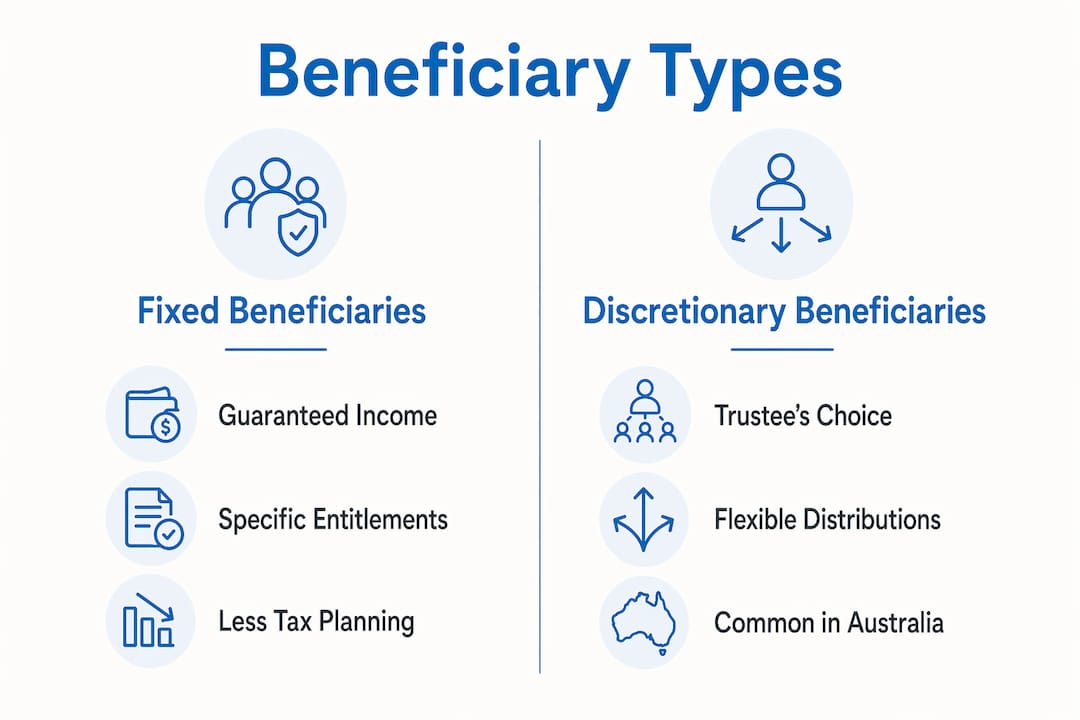
Discretionary beneficiaries are the most common in Australian testamentary trusts. They rely entirely on the trustee’s judgement for distributions. This gives the trustee flexibility to direct income to family members in lower tax brackets, which can reduce the overall tax burden on the estate. Income distributed to minors from a testamentary trust is often taxed at adult marginal rates rather than the punitive penalty rates that apply to other trust income for children. That tax advantage is one of the primary reasons Australian families choose testamentary trusts.
Fixed beneficiaries, by contrast, have a guaranteed entitlement written into the will. There is less room for tax planning, but the beneficiary has greater certainty and legal recourse if the trustee fails to distribute correctly.
Pro Tip: If you have a beneficiary with special needs, a fixed entitlement may affect their eligibility for government support payments. Simons George Legal can advise on special needs beneficiary structures that protect both the inheritance and the support entitlements.
What rights and responsibilities does a will trust beneficiary have?
Beneficiaries hold real legal rights, even when they have no control over day-to-day trust management. Beneficiaries are entitled to receive information about the trust and its administration. That includes trust accounts, asset valuations, and the basis on which distributions are calculated. If a trustee refuses to provide this information, a beneficiary can apply to a court to compel disclosure.
Key rights and responsibilities include:
- Right to information: You can request trust accounts and records from the trustee at any time.
- Right to distributions: In a fixed trust, you have a legal entitlement. In a discretionary trust, you have the right to be considered for distributions, not to receive them automatically.
- Tax obligations: Distributions you receive form part of your assessable income. You must declare them in your tax return. Understanding your deceased estate tax obligations is critical to avoiding penalties.
- Responsibility to communicate: You must provide the trustee with your tax file number and any information needed to process distributions correctly.
- Right to challenge: If a trustee breaches their duties, you can seek legal remedies including removal of the trustee or compensation.
Beneficiaries often underestimate the importance of staying engaged with the trust. Reviewing annual accounts, understanding what assets the trust holds, and knowing the trust’s vesting date all protect your long-term interests. Testamentary trusts can operate for up to 80 years in some Australian jurisdictions. That is a long time to remain passive.
How do trustees influence the experience of will trust beneficiaries?
The trustee is the single most important variable in a beneficiary’s experience. A capable, impartial trustee protects and grows the trust assets. A poor trustee can deplete them, create family conflict, or expose beneficiaries to legal risk.
The trustee must always act in the beneficiaries’ best interests under Australian law, performing fiduciary duties. Those duties include acting honestly, avoiding conflicts of interest, keeping proper accounts, and investing prudently. A trustee who fails these duties is personally liable to the beneficiaries for any loss.
Common trustee-beneficiary issues include:
- Conflicts of interest: A trustee who is also a beneficiary may favour their own distributions over others.
- Poor record-keeping: Beneficiaries cannot exercise their right to information if the trustee has not maintained proper accounts.
- Delayed distributions: Some trustees hold back distributions unnecessarily, which can cause financial hardship for income-dependent beneficiaries.
- Mismanagement of investments: Trustees who invest trust assets poorly may reduce the capital available to beneficiaries over time.
Careful selection of trustees is critical to safeguarding beneficiary interests, especially when beneficiaries may not manage assets responsibly themselves. Appointing a neutral or professional trustee, such as a trustee company or an independent solicitor, removes the risk of family bias and reduces the likelihood of disputes. The role of the executor of a will is related but distinct. Understanding what an executor does helps clarify how the trust is established and handed over to the trustee after probate.
How to designate and protect beneficiaries in a will trust
Getting the beneficiary designations right in your will is not a formality. Errors or vague language create disputes, delay distributions, and can result in assets passing to unintended recipients.
- Name beneficiaries precisely. Use full legal names and, where possible, dates of birth. Descriptions like “my children” can cause ambiguity if family circumstances change.
- Define the trustee’s powers clearly. Specify whether the trustee can invest in shares, property, or other assets. Broad trustee powers give flexibility; narrow powers reduce risk of mismanagement.
- Set distribution terms. Decide whether distributions are at the trustee’s discretion or fixed. Consider milestone-based distributions, such as a capital payment when a beneficiary turns 25.
- Use the trust for asset protection. A well-drafted testamentary trust can protect beneficiaries from creditors, bankruptcy, and relationship breakdowns by legally holding assets in trust rather than transferring them outright.
- Review your will regularly. Births, deaths, divorces, and changes in financial circumstances all affect whether your beneficiary designations still reflect your intentions. Separation can affect inheritance rights in ways that surprise families. Understanding the impact of separation on inheritance is part of keeping your estate plan current.
- Get professional advice. Testamentary trusts involve tax law, trust law, and succession law simultaneously. Simons George Legal drafts testamentary trusts tailored to each family’s circumstances, ensuring the structure works as intended from day one.
Testamentary trusts distributed $8.5 billion in beneficiary income in 2022–23 across Australia. That figure reflects how widely families use these structures. The administrative effort involved is real, but the long-term tax efficiencies and asset protection benefits consistently outweigh it.
Funding your legal matter — no win, no fee
Simons George Legal offers No Win, No Fee arrangements for eligible estate matters, including contested wills, family provision claims, and estate litigation. This means you can pursue a legitimate claim without paying legal fees upfront. Eligibility is assessed during a complimentary 30-minute consultation, where the firm reviews your situation and advises whether your matter qualifies.
The No Win, No Fee model removes the financial barrier that stops many people from protecting their inheritance rights. If your claim does not succeed, you do not pay the firm’s professional fees. That gives you access to experienced legal representation without the risk of an unaffordable bill.
Book your free case assessment with Simons George Legal today to find out whether your matter is eligible.
No Win, No Fee arrangements are subject to case eligibility and a written costs agreement. Liability limited by a scheme approved under Professional Standards Legislation.
Key takeaways
A will trust beneficiary’s rights, tax treatment, and protections depend entirely on the type of trust, the trustee appointed, and the clarity of the will that creates the structure.
| Point | Details |
|---|---|
| Beneficiary vs direct heir | A trust beneficiary receives managed distributions, not outright ownership of assets. |
| Types of beneficiaries | Discretionary beneficiaries rely on trustee decisions; fixed beneficiaries have guaranteed entitlements written into the will. |
| Tax advantages | Income from a testamentary trust distributed to minors is often taxed at adult marginal rates, reducing the family’s overall tax burden. |
| Trustee selection matters | A neutral or professional trustee reduces conflict and protects all beneficiaries equally. |
| Asset protection | A properly drafted testamentary trust shields assets from creditors, bankruptcy, and relationship breakdowns. |
What I have seen families get wrong about trust beneficiaries
After working with families across Sydney on wills and estate matters, the pattern I see most often is this: people assume that being named a beneficiary of a trust is the same as inheriting money outright. It is not, and that misunderstanding causes real problems.
Beneficiaries sometimes wait years for distributions they expected to receive immediately, because the will gave the trustee broad discretion and no timeline. Others are blindsided by the tax implications of trust income, having assumed the money would arrive tax-free. A few have discovered, too late, that the trustee appointed in the will had a conflict of interest that no one addressed at the drafting stage.
The families who avoid these problems share one thing in common. They sat down with a solicitor before the will was finalised, asked hard questions about trustee powers, distribution terms, and beneficiary protections, and got the answers in writing. A testamentary trust is a powerful tool. Used well, it protects wealth across generations. Used carelessly, it creates the very disputes it was meant to prevent. Proactive estate planning, not reactive legal action, is always the better path.
— George
How Simons George Legal can help with your testamentary trust
Simons George Legal advises individuals and families across Sydney on all aspects of wills and estate planning, including testamentary trust drafting and beneficiary protection strategies.

Whether you are setting up a testamentary trust for the first time, reviewing an existing will, or dealing with a dispute as a beneficiary, the firm provides clear, practical advice tailored to your family’s circumstances. Simons George Legal’s wills and estates lawyers in Bondi offer a complimentary 30-minute consultation to new clients. That first conversation costs you nothing and gives you a clear picture of your options. You can also learn more about making or amending a will to include a testamentary trust structure that protects the people you care about most.
FAQ
What is a will trust beneficiary in Australia?
A will trust beneficiary is a person or entity named in a will to receive income or capital from a testamentary trust established after the testator’s death. The trustee manages the assets; the beneficiary receives the distributions.
Can a beneficiary also be the trustee of a testamentary trust?
Yes. In a testamentary discretionary trust, a beneficiary can act as both trustee and appointor, giving them significant control over investment decisions and distributions within the trust.
How is trust income taxed for beneficiaries in Australia?
Trust income distributed to beneficiaries forms part of their assessable income and is declared in their tax return. A key advantage of testamentary trusts is that income distributed to minor beneficiaries is often taxed at adult marginal rates rather than penalty rates.
What can a beneficiary do if the trustee is not acting properly?
A beneficiary can request trust accounts and records, and if the trustee refuses or has breached their fiduciary duties, the beneficiary can apply to a court for disclosure, removal of the trustee, or compensation for any loss caused.
How long can a testamentary trust last in Australia?
Testamentary trusts can operate for up to 80 years in some Australian jurisdictions, allowing long-term asset protection and management across multiple generations of beneficiaries.