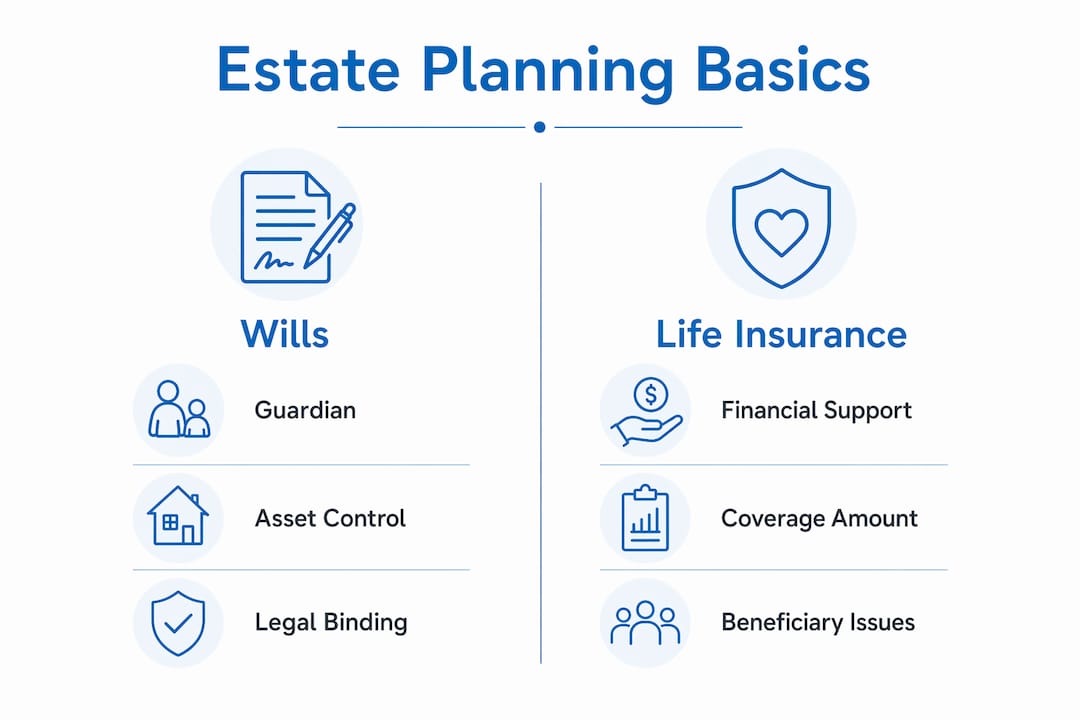
A will is the legal document that lets you name a guardian for your child and decide exactly how your assets are distributed after your death. Without one, an Australian court makes those decisions for you. Only around 29% of parents with minor children have a will or basic estate plan in place. That gap is striking, because a new parent estate plan does not need to be complicated. A will, term life insurance, a power of attorney, and a healthcare proxy cover the vast majority of risks most young families face. Getting these legal documents for new parents sorted is one of the most direct acts of care you can take for your child.
What do wills for new parents actually need to cover?
A foundational estate plan for new parents includes four documents: a will, term life insurance, a durable power of attorney, and a healthcare proxy. Each one serves a distinct purpose, and together they cover almost every scenario a young family is likely to face.
- Will: Names your chosen guardian for your child, appoints an executor to administer your estate, and sets out how your assets are distributed.
- Term life insurance: Provides the financial resources your nominated guardian needs to actually raise your child. A will without life insurance leaves guardianship provisions hollow.
- Durable power of attorney: Authorises a trusted person to manage your financial affairs if you are incapacitated but still alive.
- Healthcare proxy: Grants a nominated person authority to make medical decisions on your behalf if you cannot do so yourself.
Medical and financial proxies are not just backup documents. They protect your family in scenarios short of death, such as a serious accident or sudden illness. Most families can complete all four documents within a few weeks of their child’s birth.
Pro Tip: Do not let the perfect be the enemy of the good. Three documents cover the majority of protection most young families need. Start with a will, power of attorney, and healthcare proxy, then add life insurance immediately after.
Why naming a guardian is the most critical decision in your will
Naming a guardian is the single most consequential choice in any parent’s will. Without a legally executed nomination, state courts decide guardianship, and their decision may directly contradict your values, your cultural preferences, and your wishes for your child’s upbringing.
Informal family agreements carry no legal weight. A conversation at Christmas dinner does not bind anyone. Only a properly executed will creates a legally recognised nomination that courts are obliged to consider.
Follow these steps to get guardianship right:
- Identify your preferred guardian. Consider who shares your values, has the capacity to raise a child, and lives in a location that works for your child’s schooling and relationships.
- Have an honest conversation first. Confirm willingness before you nominate anyone. A guardian who is surprised by the responsibility is a problem waiting to happen.
- Name a backup guardian. Circumstances change. Your first choice may predecease you or become unable to serve.
- Appoint a separate trustee. The person best suited to raise your child is not always the best person to manage money. Separating these roles protects your child’s financial interests.
- Execute the will correctly. In New South Wales, a will must be signed in the presence of two adult witnesses who are not beneficiaries. A defective will can be challenged or set aside.
Pro Tip: Keep a letter of wishes alongside your will. It is not legally binding, but it gives your guardian context about your parenting values, your child’s routines, and your preferences for education and religion.
How to coordinate life insurance and wills to protect your child financially
A will names a guardian. Life insurance funds the guardianship. Having one without the other is a frequent and costly mistake that leaves families exposed.

The coverage question is straightforward. Industry guidance recommends term life insurance of 10–12 times your annual income. That figure accounts for mortgage repayments, childcare, education, and living costs over the years your guardian would be raising your child.
The beneficiary question is more complex. Many parents name their child directly as the beneficiary on a life insurance policy. That is a serious error.
| Approach | What happens | Risk level |
|---|---|---|
| Child named directly as beneficiary | Court appoints a conservator to manage funds | High |
| Spouse named as sole beneficiary | Funds pass to spouse; child unprotected if spouse also dies | Medium |
| Trust named as beneficiary | Trustee manages funds per your instructions | Low |
Naming a minor as a direct beneficiary triggers court-mandated conservatorship. That process is slow, expensive, and removes your control over how funds are used. The solution is to name a trust within your will as the beneficiary, with a trustee you appoint managing the funds until your child reaches an age you specify.
Pro Tip: Review your life insurance beneficiary designations every time you update your will. The two documents must work together. A mismatch between them can undo careful planning.
Practical steps to create and maintain your estate plan in Australia
Starting a will does not require a law degree. It requires clear decisions about four things: who raises your child, who administers your estate, who receives your assets, and who acts for you if you are incapacitated.
- Choose your executor carefully. Your executor handles probate, pays debts, and distributes your estate. Pick someone organised, trustworthy, and willing to take on the role.
- List your assets and liabilities. Include superannuation, property, bank accounts, investments, and any business interests. Superannuation does not automatically form part of your estate, so a binding death benefit nomination is a separate step.
- Consider your drafting options. Online will kits exist, but they carry real risk if your circumstances are anything other than straightforward. A solicitor at a firm like Simons George Legal can identify issues a template will miss, such as blended family complications or assets held in trust.
- Avoid the six most common mistakes in estate planning, including failing to execute documents correctly, not updating beneficiary designations, and relying on a will alone without complementary documents.
- Understand intestacy rules. If you die without a valid will in NSW, the Succession Act 2006 determines who inherits and in what proportions. Courts decide guardianship and asset distribution, often causing delays and significant legal costs for families.
- Schedule a review. Estate plans should be reviewed every five years or after major life changes, including the birth of another child, a significant change in assets, separation, or remarriage.
When do trusts fit into a new parent’s estate plan?
A children’s trust is a legal structure within your will that names a trustee to manage inheritance funds on behalf of your child until they reach an age you set, commonly 21, 25, or 30. The trustee has discretion to release funds for education, health, and living expenses in the meantime.
| Trust feature | What it means for your child |
|---|---|
| Age condition | Funds held until child reaches a specified age |
| Distribution standards | Trustee can release funds for education, health, and welfare |
| Separate trustee | Financial management kept separate from day-to-day guardianship |
| Court oversight avoided | No conservatorship required for minor beneficiaries |
Trusts are not necessary for every family. For parents with modest assets and straightforward circumstances, a well-drafted will with clear distribution instructions is sufficient. Trusts become worth considering when your estate is large, when you have a child with a disability or special needs, or when you want to impose conditions on how and when your child receives an inheritance.
The administrative overhead of a trust is real. Trustees have legal obligations, and ongoing management takes time and sometimes money. Do not add complexity without a clear reason.
Common mistakes new parents make with wills and estate planning
Most estate planning errors among new parents come down to delay, assumption, and poor coordination between documents.
- Treating beneficiary designations as a substitute for a will. Superannuation and life insurance pass outside your estate via beneficiary nominations. A will does not override them. Both must be reviewed together.
- Delaying because the process feels complex. A basic will can be drafted and executed in a matter of days. The perceived complexity is almost always greater than the actual effort required.
- Failing to coordinate life insurance and the will. A will that names a guardian but no life insurance leaves that guardian without financial support. The two documents must be planned together.
- Not updating documents after major life events. A will written before your second child was born may not reflect your current wishes. The same applies after a divorce, a property purchase, or a significant inheritance.
- Leaving guardianship vague or unaddressed. Naming a guardian without also naming a backup, or without having the conversation with your nominee, creates problems that surface at the worst possible moment.
Pro Tip: Store your will in a safe, known location and tell your executor where it is. A will that cannot be found creates the same problems as no will at all.
Funding your legal matter — No Win, No Fee
Simons George Legal offers No Win, No Fee arrangements for eligible matters, including contested wills and family provision claims. Eligibility is assessed during a free initial consultation, so there is no cost to finding out where you stand.
This arrangement removes the upfront financial barrier for parents and families who have a legitimate legal claim but are concerned about the cost of pursuing it. If your matter qualifies, you pay legal fees only if the outcome is successful.
Book a free case assessment with Simons George Legal to understand your options and get clear advice on the next step.
No Win, No Fee arrangements are subject to case eligibility and a written costs agreement. Liability limited by a scheme approved under Professional Standards Legislation.
How Simons George Legal helps new parents with wills and estate planning
New parents in Sydney can get clear, practical advice on wills and estate planning from Simons George Legal, a dedicated wills and estates practice based in Bondi.

The firm drafts and amends wills, advises on guardian and trustee nominations, and helps families structure their estate plans around their specific circumstances. Whether you need a straightforward will or guidance on incorporating a children’s trust, the team at Simons George Legal gives you advice that fits your family, not a generic template. New clients receive a complimentary 30-minute consultation. Contact Simons George Legal’s wills and estates lawyers to get your estate plan sorted with confidence.
Key takeaways
A will is the only legal document that lets new parents name a guardian for their child and control how their estate is distributed after death.
| Point | Details |
|---|---|
| Will is the foundation | Every new parent needs a valid, executed will naming a guardian and executor. |
| Four documents cover most risks | A will, life insurance, power of attorney, and healthcare proxy address the majority of scenarios young families face. |
| Guardianship must be legally documented | Informal agreements have no legal force; courts decide guardianship without a valid will. |
| Coordinate life insurance with your will | Name a trust, not your minor child, as the life insurance beneficiary to avoid court conservatorship. |
| Review every five years | Update your estate plan after each major life event, including the birth of additional children or significant asset changes. |
A straightforward plan beats a perfect one that never gets done
The parents I speak with most often are not confused about what a will does. They are stuck because they think they need to get everything perfect before they start. That instinct is understandable, and it is also the reason so many families remain unprotected years after their first child is born.
The truth is that a simple, properly executed will does more for your child’s future than any amount of planning that stays in your head. I have seen families spend months researching trust structures and tax implications while their child has no nominated guardian at all. That is the wrong order of priorities.
Get the basics done first. A will, a power of attorney, and a healthcare proxy cover the ground that matters most. Add life insurance with the right beneficiary structure. Then, if your circumstances warrant it, revisit the plan and add complexity where it genuinely helps.
Good estate plans are not finished documents. They are living records that grow with your family. The goal is not a perfect plan today. The goal is a plan that exists, that is legally sound, and that you update as your life changes.
— George
FAQ
What happens if I die without a will in NSW?
Without a valid will, NSW intestacy laws under the Succession Act 2006 determine who inherits your estate. Courts also decide guardianship for your children, which may not reflect your wishes.
When should new parents create a will?
New parents should create a will as soon as possible after their child is born. A foundational estate plan can be completed within a few weeks and provides immediate legal protection.
Can I name a guardian in my will without telling them first?
You can, but it creates serious practical problems. Confirming willingness with your nominated guardian before formalising the nomination is strongly recommended to avoid complications.
Does life insurance replace the need for a will?
No. Life insurance provides financial resources, but a will is the only document that legally nominates a guardian for your child and directs how your estate is distributed.
How often should I update my will after having children?
Estate plans should be reviewed every five years or after major life events, including the birth of additional children, significant changes in assets, separation, or remarriage.