You cannot leave money or property directly to a pet in Australia. Instead, you use a specific gift, a legacy to a carer, or a testamentary trust to direct a human agent to look after your animal. Start by identifying a willing carer and getting their written consent, then work out funding and backup plans with your solicitor. Everything else is detail that supports that one relationship.
TL;DR:
- Most pet provisions rely on appointing a willing human carer, with written consent and clear funding plans, since animals cannot be beneficiaries under Australian law.
- A specific gift to a carer, a legacy with a request, or a testamentary trust are the main options, but trusts are usually non-binding and hard to enforce.
- Practical arrangements like naming substitute carers, calculating realistic funding, and keeping detailed, updatable pet care memoranda are crucial for success.
- Intermediary safeguards such as enduring powers of attorney and explicit executor powers help manage pet care during incapacity or delays in probate.
- Correct legal wording is less important than ensuring the chosen caregiver genuinely wants and can perform the care, with professional advice reducing dispute risks.
Table of Contents
- What are your options for pet provisions in a will?
- Practical drafting checklist: what to put in the will and supporting documents
- Planning for incapacity and interim care before the estate is administered
- Common pitfalls and how to reduce the risk of disputes
- Legal requirements and formalities for valid pet provisions
- Examples of clauses to include for pet care provisions
- Vetting a trusted carer for your pet
- Updating pet provisions as circumstances change
- Tax implications for legacies or trusts involving pets
- Practitioner perspective: what actually determines the outcome
- Funding Your Legal Matter — No Win, No Fee
- Getting your pet provisions drafted properly
- Sources
- FAQ
What are your options for pet provisions in a will?
Under Australian law, pets are personal property, the same legal category as furniture or a car. That single fact shapes every option available to you. You cannot name your dog as a beneficiary. You can only direct what happens to the dog, and back that direction with money for whoever takes it on.
Three approaches cover most situations:
- Specific gift. You leave the animal itself to a named person, who must consent beforehand. A gift with no willing recipient just becomes a problem for your executor.
- Legacy with a request. You leave a sum of money to the carer along with a wish, not a legal condition, that they use it for the pet. Courts generally cannot force the carer to spend it that way, so the arrangement leans entirely on trust.
- Testamentary trust. You set up a trust that holds funds for the pet’s care, with a trustee who manages payments to the carer. It sounds more binding than a simple legacy, but the Law Society notes these trusts are usually non-binding in practice because an animal cannot enforce its own rights.
Charities such as the RSPCA and Animal Welfare League run legacy or rehoming programs for owners without a suitable carer, though the Law Society flags that older animals or those with behavioural issues are less likely to be accepted. Contact the organisation directly before you rely on it in your will, because acceptance conditions vary.
Practical drafting checklist: what to put in the will and supporting documents
Getting the legal wording right matters less than getting the practical arrangements right first. Work through this before you sit down with a solicitor:
- Name a primary carer and at least one substitute, and get written consent from both before the will is signed.
- Specify the transfer wording clearly: does acceptance of the pet depend on the carer also receiving the legacy, or are the two separate?
- Calculate the funding amount. Public Trustee guidance recommends multiplying expected life span by annual running costs (food, vet visits, insurance) to reach a realistic figure.
- Decide what happens to unspent funds once the pet dies. Most owners direct the remainder to the residual estate or a nominated charity.
- Keep an updatable memorandum outside the will itself, listing microchip number, vet clinic, medication, feeding routine, and a spare set of keys.
- Give your executor express power to arrange interim boarding, transport, and veterinary treatment, and to pay for it from the estate immediately.
Pro Tip: Keep the pet care memorandum as a separate, easily updated document rather than baking every detail into the will itself. Wills are slow to change; your dog’s medication schedule is not.
A step-by-step estate planning checklist can help you organise these documents alongside the rest of your estate paperwork.
Planning for incapacity and interim care before the estate is administered
A will only takes effect after death, which leaves a gap if you lose capacity or your pet needs care while probate is being sorted out. Close that gap with a few simple safeguards:
- An enduring power of attorney can authorise someone to make decisions and pay for your pet’s care immediately, without waiting for probate.
- Make sure a trusted neighbour or friend holds a spare key and knows how to reach your vet.
- Draft the will so the executor has express authority to pay reasonable interim expenses, since locating the will and obtaining probate can take weeks.
Common pitfalls and how to reduce the risk of disputes
Most problems with pet provisions come down to three things: trust, generosity, and vague wording.
- Non-binding trusts fail when the trustee walks away. The arrangement only works if the person you choose is genuinely willing and capable of following through.
- Overly generous pet legacies can invite a family provision claim. If a beneficiary feels the estate favoured an animal over people with a legitimate call on it, contestability risk rises sharply. Document your reasoning and keep the legacy proportionate to the rest of the estate.
- Conditional wording creates administration headaches. Clauses that tie a gift to vague conditions (“only if properly cared for”) are hard for an executor to police and easy for a disgruntled relative to challenge.
Professional drafting reduces ambiguity considerably, and it’s one area where a short consultation saves years of grief later.
Legal requirements and formalities for valid pet provisions
Pet provisions don’t need special legal status. They follow the same formalities as any other clause in an Australian will: it must be in writing, signed by you, and witnessed by two people who are present at the same time and are not beneficiaries.
What makes pet clauses different is not the formality, it’s the enforceability. Because animals lack legal personality, a clause directing a trustee to “care for my dog Max” is a moral instruction more than a legal one. The Law Society’s guidance is blunt about this: courts can enforce a trust’s existence, but they struggle to police how well a trustee looks after an animal day to day.
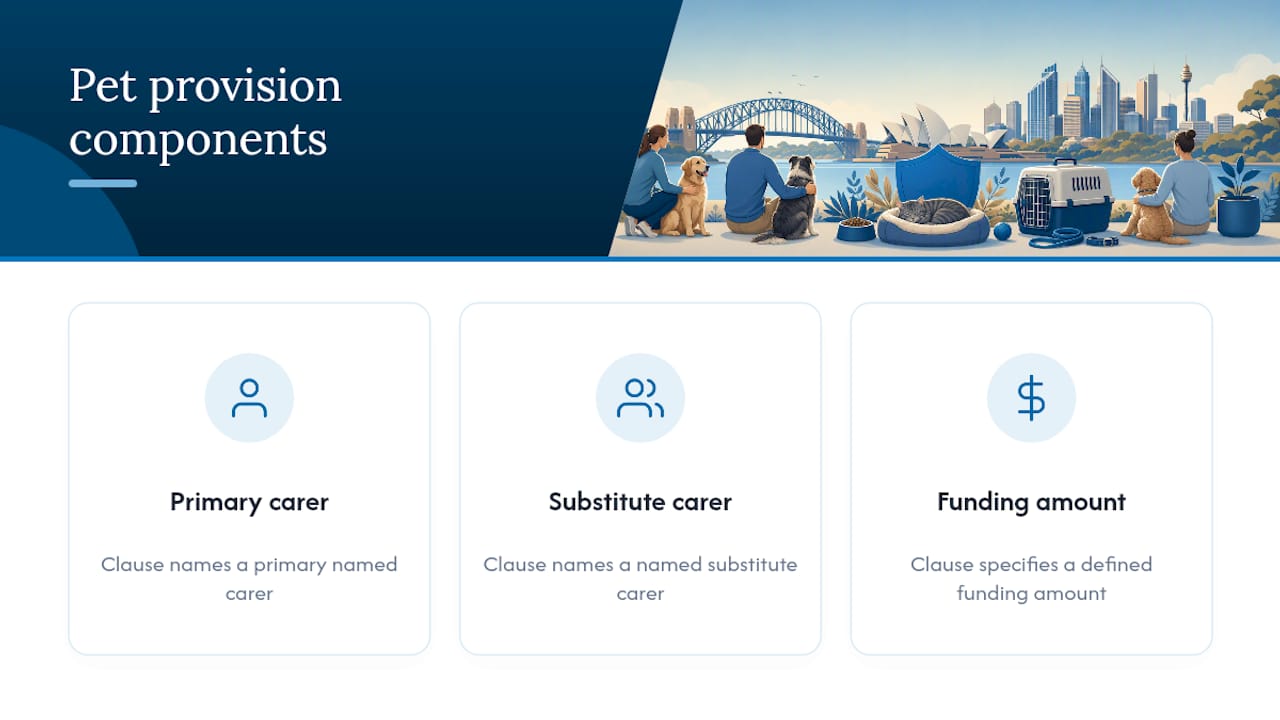
That’s why the practical elements matter more than the legal ones. A clause naming a named carer, a named substitute, and a defined funding amount gives an executor something concrete to act on. A vague clause hoping “someone will do the right thing” gives them nothing to work with, no matter how carefully it’s worded.
If your estate includes a testamentary trust structure for other purposes, such as a special disability trust or a trust for minor beneficiaries, your solicitor can usually fold pet provisions into the same framework rather than creating a separate structure. That keeps administration simpler for your executor and cuts down on drafting costs.
Examples of clauses to include for pet care provisions
You don’t need to memorise legal Latin to get this right, but a few structural elements consistently show up in workable clauses:
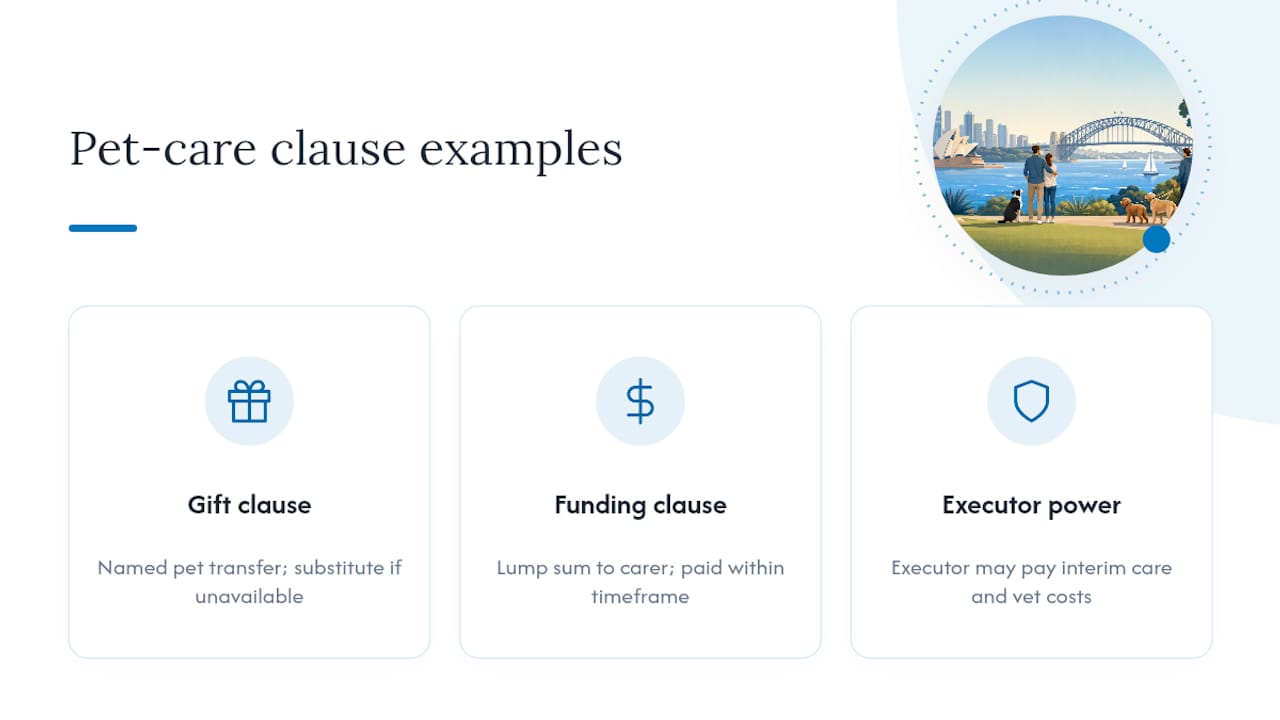
A gift clause typically reads along the lines of: “I give my dog [name], microchip number [X], to [carer’s full name] of [address], if they survive me and are willing and able to accept this gift. If [carer] is unable or unwilling to accept, I give [dog’s name] to [substitute carer].”
A funding clause sits alongside it: “I give the sum of $[amount] to [carer’s name] to assist with the costs of caring for [pet’s name], such sum to be paid within [timeframe] of the grant of probate. Any part of this sum not required for the care of [pet’s name] following their death is to form part of my residuary estate.”
An executor power clause covers the gap before distribution: “My executor may, in their absolute discretion, incur and pay from my estate any reasonable expenses for the interim care, boarding, transport, and veterinary treatment of [pet’s name] pending the transfer of ownership under this will.”
These are structural templates, not off-the-shelf legal wording you should paste into a will unedited. Every clause needs to match your specific pet, carer, and estate, which is exactly the kind of detail a solicitor checks before you sign anything.
Vetting a trusted carer for your pet
The single biggest point of failure in any pet provision isn’t the legal drafting. It’s picking the wrong carer.
Start with a direct conversation, not an assumption. Ask the person outright whether they’re willing to take on your pet permanently, not just in an emergency, and be specific about the animal’s needs, temperament, and any medical conditions. If they hesitate, that hesitation is useful information; don’t write them into the will anyway and hope it works out.
Check practical compatibility too. Someone with three cats already might struggle to add a fourth. A carer who travels constantly for work might not be realistic for a dog with separation anxiety. Visit their home if you can, and see how your pet reacts to spending time there before you commit anything to paper.
Always name at least one substitute carer in case your first choice becomes unable or unwilling to act when the time comes. Revisit the conversation periodically, life circumstances change, and someone who was happy to take on your cat five years ago might have since had children, moved overseas, or developed allergies. An annual check-in with your named carers costs you nothing and prevents a nasty surprise for your executor down the track.
Updating pet provisions as circumstances change
Pet provisions go stale faster than most other parts of a will, because pets have shorter lives and more variable circumstances than the humans around them.
Review your will whenever you get a new pet, lose one, or your named carer’s situation changes materially, marriage, relocation, new children, or a falling out. A codicil can update a single clause without redrafting the whole document, though for anything beyond a minor change, a full update is usually cleaner and less prone to error.
Keep the supporting memorandum, the one with microchip numbers, vet details, and feeding routines, separate from the will itself and update it as often as needed. There’s no reason to involve a solicitor every time your dog changes vet clinics. Save the formal update for changes that affect who gets the pet, how much funding is provided, or who’s named as trustee or substitute carer.
Tax implications for legacies or trusts involving pets
A cash legacy left to a carer to help fund a pet’s upkeep is treated the same as any other cash gift under a will: generally, no capital gains tax or income tax applies to the beneficiary simply receiving it. The complexity, where it exists, tends to show up in how a testamentary trust is structured and administered rather than in the pet provision itself.
If you set up a broader testamentary trust that happens to include pet care funding as one purpose, income generated by the trust’s assets (interest, dividends) may be taxable to the trust or its beneficiaries depending on how distributions are structured. This is a standard trust taxation question, not something unique to pets, and it’s worth raising directly with your solicitor or accountant if your estate is large enough to justify a trust structure in the first place.
For most Australian pet owners, a straightforward legacy to a named carer avoids this complexity entirely. Trusts earn their keep in more complex estates, not in a simple one-dog, one-carer arrangement.
Practitioner perspective: what actually determines the outcome
The legal mechanism you choose matters far less than whether your chosen carer genuinely wants the job. I’ve seen beautifully drafted trusts fail because nobody asked the trustee first, and simple legacies work perfectly because the carer loved the animal already. Reserve a trust for complex families or larger sums; a straightforward gift and legacy handles most situations. Get advice early if your family is blended, the legacy is substantial, or you’re unsure your executor will follow through.
— George
Funding Your Legal Matter — No Win, No Fee
If a family member later disputes your estate, including provisions you made for a pet, cost shouldn’t stop you from defending what you intended. Simons George Legal offers No Win, No Fee arrangements for eligible contested matters, so you’re not carrying the financial risk alone if you have a legitimate claim.
Eligibility is assessed during a free initial consultation, where we look at the facts of your situation and give you an honest read on whether a claim or defence is likely to succeed. That removes the upfront cost barrier that stops many people from getting advice when they need it most. Book a complimentary case assessment to talk through your circumstances before you decide on next steps.
No Win, No Fee arrangements are subject to case eligibility and a written costs agreement. Liability limited by a scheme approved under Professional Standards Legislation.
Getting your pet provisions drafted properly
Reading a guide gets you halfway. The other half is having someone check your specific wording, your carer’s consent, and your executor’s powers actually hold up. Simons George Legal handles will drafting and updates for Sydney and NSW clients, including pet care clauses, funding calculations, and executor powers tailored to your family.

If your estate involves a blended family, a sizeable pet legacy, or any chance of a family provision claim down the track, our wills and estates team can structure the whole will to reduce that risk from the outset, not just the pet clause. New clients get a complimentary 30 minute consultation, which is the enough time to assess your situation and tell you plainly whether a simple gift and legacy will do the job or whether a trust structure is worth the extra cost. Book your consultation and bring your carer’s name, your pet’s details, and any questions about funding.
Sources
For state-specific detail, check NSW Trustee & Guardian’s guidance on pets in wills, the Law Society’s pets and wills factsheet, and your state’s Public Trustee office. These sources underpin the legal points made throughout this guide.
- Don’t forget about Fido when making your will — NSW Trustee & Guardian
- Pets and wills — Law Society guidance
- Your pet and your will — Public Trustee Tasmania
- Pet provisions and contestability — Lexology (Australia perspective)
- Who will care for your pet when you die? — Practical Legal (Australia)
FAQ
Can I leave money directly to my pet in my will?
No. Pets are personal property under Australian law and cannot be named as beneficiaries. You leave the pet and any supporting funds to a human carer or trustee instead.
Is a pet trust legally enforceable in Australia?
Pet trusts are often treated as non-binding directions because an animal can’t enforce its own rights in court. The arrangement works only if the trustee is genuinely willing to follow your instructions.
How much money should I leave for my pet’s care?
Estimate your pet’s remaining life expectancy multiplied by annual running costs, including food, vet visits, and insurance, as recommended by Public Trustee guidance. Decide upfront what happens to any funds left over after your pet dies.
What happens to my pet while my estate is being administered?
Probate can take weeks, so give your executor express power in the will to pay for interim boarding, transport, and veterinary care. Keep a memorandum with your vet’s details, microchip number, and feeding routine somewhere accessible immediately, not locked away with the will.
Does Simons George Legal help draft pet provisions in wills?
Yes. Simons George Legal drafts wills that include pet care provisions as part of its broader will drafting and estate planning services for Sydney and NSW clients, with pricing available on request following a consultation.