Mirror wills are two separate wills with matching terms, and each partner can change theirs at any time. Mutual wills rest on an agreement not to revoke, which equity can enforce against a surviving partner. For most Australian couples, mirror wills plus proper legal advice is the sensible starting point. Blended families or complex assets often call for a testamentary trust instead.
TL;DR:
- Mirror wills are revocable by either partner at any time, whereas mutual wills are based on a formal agreement not to revoke after the first death, creating legal enforceability issues.
- A typical mirror will includes appointment of the surviving partner, guardians for minor children, specific gifts, and powers for the executor, with drafting usually taking one to three weeks for simple cases.
- Mutual wills require clear proof of an agreement, often a deed, and carry a higher risk of disputes because enforcement depends on proving intent many years later.
- Most blended families benefit more from testamentary trusts, which offer flexibility and asset protection without the rigidity of mutual wills, especially to avoid dispute risks or unintended restrictions.
- Climate digital assets, superannuation nominations, and international holdings must be coordinated with your will to prevent unintended distributions or complications during probate.
Table of Contents
- What is a mirror will for couples?
- What is a mutual will?
- Mirror wills vs mutual wills: the practical differences
- Alternatives to mutual wills in Australia
- How to make mirror wills in Australia
- Where couples get caught out: risks and pitfalls
- How Simons George Legal helps couples with mirror wills
- Typical cost and timeline for mirror wills
- Digital assets and online accounts in mirror wills
- Superannuation and binding death benefit nominations
- Tax implications of mirror wills in Australia
- Updating or revoking mirror wills
- The role of executors and administrators
- International assets and mirror wills
- Funding Your Legal Matter — No Win, No Fee
- Quick summary and your next steps
- Getting your mirror wills drafted properly
- Sources
- FAQ
What is a mirror will for couples?
A mirror will is exactly what it sounds like: two nearly identical wills, one for each partner, that leave assets to each other first and then to the same beneficiaries, usually children. Each document remains revocable by its own maker, which means either partner can update, revoke, or completely rewrite their will at any point, even without telling the other person.
That flexibility is exactly why mirror wills dominate Australian couple estate planning. They suit straightforward families, cost less to draft than bespoke individual wills, and cover the essentials most couples need.
A typical pair of mirror wills includes:
- Appointment of the surviving partner as primary beneficiary and executor
- A substitute gift to children or other named beneficiaries if the partner has already died
- Guardianship clauses for minor children
- Specific gifts (jewellery, vehicles, sentimental items) and residual estate clauses
- Powers granted to the executor to manage the estate, including sale of property if needed
What is a mutual will?
A mutual will only exist where two people make an agreement, before signing, not to revoke or alter their wills after the first partner dies. That agreement is what separates a mutual will from a mirror will, not the wording of the document itself.
Courts don’t take this lightly. To find a mutual will binding, a judge needs solid proof: a clear agreement, an intention that both parties be bound by it, and ideally something in writing. A Deed of Mutual Wills is the strongest evidence available, and courts consistently favour documented agreements over verbal claims made after the fact.
Where the agreement is proven, equity can step in and impose a constructive trust on the survivor’s estate, forcing the estate to be distributed as originally agreed even if the survivor tried to change their will.
Because enforcement depends on proving intent years or decades later, often after one partner has died and can’t give evidence, mutual wills generate real litigation risk. That’s why:
- Solicitors recommend them sparingly, and usually only alongside a formal deed
- Independent legal advice for each partner strengthens the case for enforceability
- They work best where the family situation is unusually rigid and both partners genuinely want that rigidity
Mirror wills vs mutual wills: the practical differences
Choosing between the two comes down to one question: do you want flexibility or a binding promise? Here’s how they stack up against each other.
- Revocability. Mirror wills can be changed or cancelled by either maker at any time, with no need to consult the other partner. Mutual wills are intended to bind the survivor once the first partner dies.
- Evidence required. Mirror wills need no special proof beyond the usual will formalities. Mutual wills need clear evidence of an agreement, ideally a signed deed, or a court may simply treat them as two ordinary mirror wills.
- Best use case. Mirror wills suit couples with simple, aligned wishes and no complicated family dynamics. Mutual wills are sometimes floated for blended families wanting to lock in protection for children from a first relationship, but that protection often comes with serious downsides.
- Cost and dispute risk. Mirror wills are cheap to draft and rarely contested on structural grounds. Mutual wills raise both the drafting cost (a deed adds legal work) and the risk of a dispute later, because someone has to prove the agreement existed.
Alternatives to mutual wills in Australia
Most Australian estate lawyers steer blended families toward a testamentary trust rather than a mutual will, and for good reason. A testamentary trust is created within a will and only comes into effect on death. It can hold assets for a surviving partner’s benefit, often giving them income or a right to live in the family home, while preserving the capital for children from a first marriage or relationship.
Practitioners commonly view testamentary trusts as more flexible and less litigious than mutual wills, because the survivor isn’t locked into an unchangeable will. They can still update their own will for new circumstances, while the trust structure protects the children’s eventual inheritance. A life-interest arrangement, where the survivor has the right to use an asset (commonly the house) for their lifetime with the capital passing to named beneficiaries afterward, achieves a similar result without a deed of mutual wills.
Some structures worth discussing with a solicitor:
- A testamentary trust for children from an earlier relationship
- A life interest in the family home for the surviving partner
- Staged distributions tied to a beneficiary’s age or milestones
Mutual wills still get considered in narrow, specific circumstances, usually where both partners are adamant about binding certainty and understand the trade-offs going in.
Pro Tip: Before locking in a mutual will, ask your solicitor to model what a testamentary trust would achieve for the same family situation. Most couples are surprised how much flexibility they can keep while still protecting their children’s inheritance.
How to make mirror wills in Australia
Getting mirror wills right starts well before you sit down with a solicitor. Follow these steps to keep the process efficient and avoid a second round of amendments.
- Agree on the essentials together. Discuss beneficiaries, guardians for minor children, executors, and any special gifts or conditions before your appointment.
- Gather your financial picture. List assets, debts, superannuation death benefit nominations, and life insurance policies. Your solicitor needs the full picture to draft wills that actually work with the rest of your estate.
- Decide on joint or separate meetings. Couples with straightforward affairs often meet together. If you’re contemplating a mutual will instead, independent advice for each partner is essential to make the agreement defensible later.
- Sign with proper formalities. Both wills need to be signed and witnessed correctly under NSW law. From first consult to signed wills, most straightforward couple matters take one to three weeks, longer if trusts or complex assets are involved.
Where couples get caught out: risks and pitfalls
The biggest risk with mirror wills is the one built into their design: nothing stops a surviving partner from changing their will after the first death. If your partner passes away and you remarry or have a falling out with your stepchildren, you’re free to rewrite your will entirely, even if the original mirror wills clearly intended your children to inherit equally.
Lifetime gifts create a similar problem. A surviving partner can give away assets, transfer property, or restructure their finances while alive, quietly reducing what’s left for the beneficiaries the couple originally agreed on. Even a binding mutual will doesn’t fully protect against this, because the constructive trust only bites on death, not on lifetime decisions.
Neither will type stops a family provision claim. Eligible people can apply under state Succession Acts regardless of what the will says, and a court treats any mutual wills agreement as just one factor among several.
Finally, remember that joint bank accounts, jointly owned property, and superannuation death benefit nominations often bypass the will entirely. Plan them alongside your wills and estates strategy, not as an afterthought.
- Survivor remarriage or new partner after first death
- Lifetime gifts reducing what’s actually left in the estate
- Family provision claims from children, former partners, or dependants
- Jointly held assets and super nominations sitting outside the will
— George
How Simons George Legal helps couples with mirror wills
Simons George Legal drafts mirror wills, testamentary trusts, and full estate plans for couples across Sydney, the Eastern Suburbs, and regional NSW. New clients receive a complimentary 30-minute consultation to map out their family situation and recommend a realistic structure, whether that’s straightforward mirror wills or a trust-based solution for a blended family.
The firm will only raise a mutual will as an option after weighing the alternatives, because in most cases a testamentary trust gets couples the protection they want without the rigidity. If contested estate work later arises, the same team handles inheritance disputes and family provision claims.
Typical cost and timeline for mirror wills
Mirror wills sit at the affordable end of estate planning because the two documents share most of their structure, so drafting time doesn’t double the way it would for two unrelated wills. A straightforward pair, no trusts, no complex assets, generally moves from initial consult to signed documents within one to two weeks.
Add a testamentary trust and the timeline stretches, usually to two or three weeks, because the trust deed needs to be tailored to your family and assets. Blended family situations, farm succession planning, or business interests can push a matter out further still, sometimes a month or more, particularly if multiple family members need to be consulted or independent advice arranged for each partner.
Cost follows a similar pattern. Fixed-fee pricing is common for simple mirror wills, since the scope of work is predictable. Once you add testamentary trusts, powers of attorney, or guardianship provisions for young children, expect the quote to shift from a flat fee to a scoped estimate based on the complexity of your assets and family structure.
The process itself typically runs in four stages: an initial meeting to gather your objectives and asset information, a drafting stage where the solicitor prepares both wills for review, a revision round if either partner wants changes, and a signing appointment with witnesses present. Couples who arrive to the first meeting with a clear asset list, superannuation details, and a settled view on guardians and executors move through the process noticeably faster than those working it out on the fly.

Ask your solicitor upfront for a written scope and fee estimate before work begins. It removes surprises and lets you compare what’s included, drafting only, or drafting plus advice on structuring assets around the will.
Digital assets and online accounts in mirror wills
Most couples still leave digital assets out of their wills entirely, and it’s becoming a genuine gap. Email accounts, cloud photo storage, social media profiles, cryptocurrency wallets, and online business accounts all need to be dealt with somehow after death, yet very few standards will templates address them.
A well-drafted mirror will, can include a schedule or clause identifying key digital assets and appointing your executor with authority to access, manage, or close them. This doesn’t mean listing every password in the will itself, which becomes a public document during probate. Instead, keep a separate, secure record of accounts and access instructions, and reference its existence in the will so your executor knows to look for it.
Cryptocurrency deserves particular attention. Unlike a bank account, there’s often no institution to contact if a password or private key is lost, meaning coins can become permanently inaccessible. If either partner holds crypto assets, make sure the will or an accompanying letter of wishes explains exactly how the executor can recover access.
Photos, family videos, and personal correspondence stored only in cloud accounts also carry real sentimental value that families regret losing. Naming a digital executor, or giving your named executor explicit authority over digital assets, is worth raising when you make or amend a will rather than leaving it to guesswork later.
Superannuation and binding death benefit nominations
Superannuation sits outside your estate by default, which surprises a lot of couples when they first hear it. Your mirror will has no automatic say over who receives your super death benefit. That’s controlled separately by your fund’s trustee, guided by any death benefit nomination you’ve lodged.
A binding death benefit nomination tells your super fund exactly who should receive your balance and in what proportions, and the fund is legally required to follow it if the nomination is valid and current. Without one, the trustee decides who qualifies as a dependant and how to split the benefit, which can produce a result completely different from what your will says.
This matters enormously for couples doing mirror wills, because a mismatch between your will and your super nomination can undo careful estate planning. If your will leaves everything to your partner but your binding nomination still names an ex-partner or lapsed years ago, the super fund may pay out to the wrong person entirely, or route the benefit through your estate in a way you didn’t intend.
Check your nomination every time you review your will, particularly after a relationship change, a new child, or a major shift in your super balance. Most binding nominations lapse after three years unless renewed, so a nomination made at 35 might be years out of date by the time it matters. Coordinating your super nomination with your mirror will is one of the simplest, most overlooked steps in estate planning for couples.
Tax implications of mirror wills in Australia
Australia doesn’t have an inheritance tax or estate tax, so beneficiaries generally don’t pay tax simply for receiving an inheritance under a mirror will. That said, tax consequences can still flow through in specific ways, and couples doing estate planning shouldn’t assume everything passes tax free.
Capital gains tax is the main one to watch. If a beneficiary later sells an inherited asset, such as an investment property or shares, capital gains tax may apply based on the asset’s cost base and the date it was acquired by the deceased, not simply the date of inheritance. The family home usually qualifies for a main residence exemption, but investment properties and share portfolios often don’t.
Superannuation death benefits can also attract tax depending on who receives them. Payments to a spouse or dependent child are typically tax free, but payments to non-defendants, such as adult children who weren’t financially dependent on the deceased, can be taxed at a different rate. This is another reason to align your super nomination with your broader estate plan rather than treating it as a separate decision.
Testamentary trusts carry a specific tax advantage worth knowing about: income distributed to minor beneficiaries through a testamentary trust is taxed at ordinary adult rates rather than the higher penalty rates that normally apply to minors receiving income. That’s one of the practical reasons couples with young children sometimes prefer a testamentary trust over a straightforward mirror will, on top of the asset protection it offers.
None of this replaces a proper conversation with your accountant or solicitor about your specific assets, but it’s worth raising tax consequences of the same appointment where you’re drafting your mirror wills, not as a separate afterthought months later.
Updating or revoking mirror wills
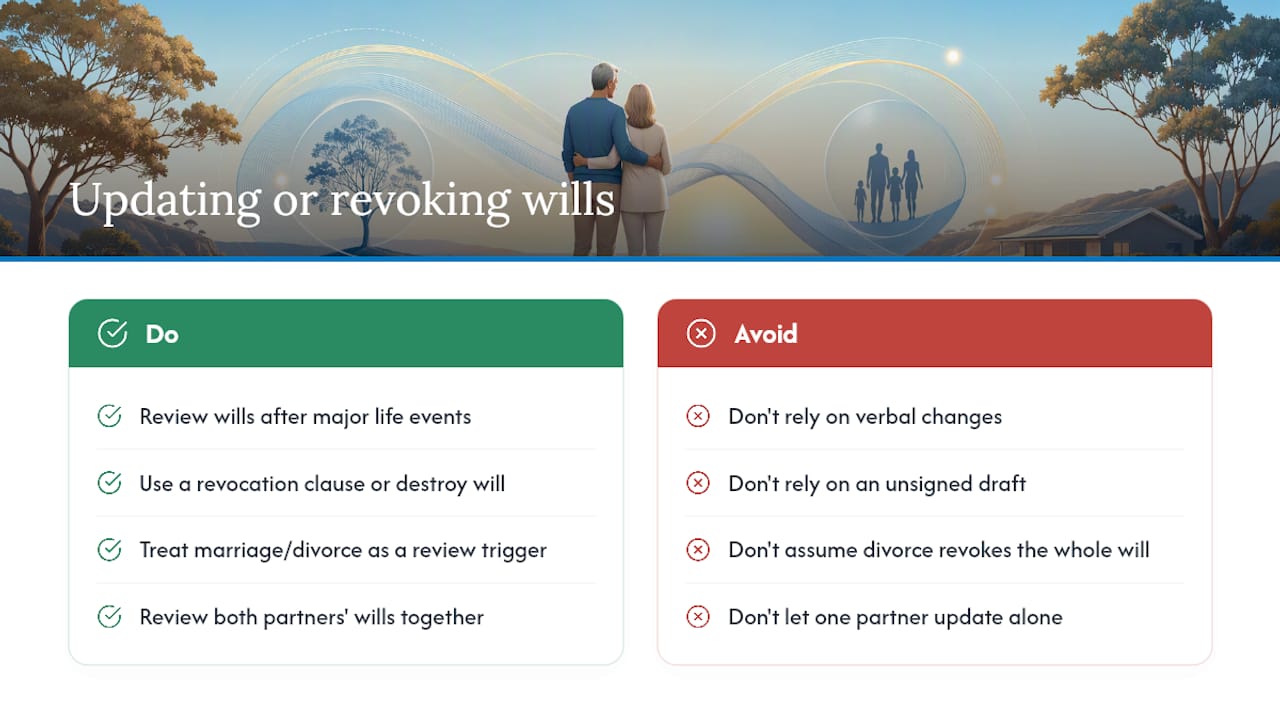
One of the genuine advantages of mirror wills is how easily they can be changed. Because each will is entirely separate, either partner can update theirs whenever their circumstances shift, a new grandchild arrives, an asset gets sold, a falling out with a beneficiary, without needing the other partner’s permission or even their knowledge.
The formal way to revoke a will is either through a written revocation clause in a new will (the standard approach) or by physically destroying the original with the intention of revoking it. Simply telling someone you’ve “changed your mind” isn’t enough, and an unsigned draft sitting on a laptop won’t override a properly executed will.
Marriage automatically revokes an earlier will in NSW unless the will was made specifically in contemplation of that marriage. Divorce, on the other hand, doesn’t revoke a will entirely, but it does cancel any gift to the former spouse and their appointment as executor, unless the will says otherwise. Couples going through either event should treat it as a trigger to review their mirror wills immediately, not something to get around to eventually.
A good habit is reviewing your will every few years, or after any major life event: a new child, a property purchase, a relationship change, or a significant shift in assets. Because mirror wills are meant to match, if one partner updates theirs and the other doesn’t, the wills stop mirroring each other and can create confusion or unintended gaps in coverage. Keep both wills reviewed together, even though they’re legally independent documents.
The role of executors and administrators
Every mirror will needs an executor, the person legally responsible for carrying out the will’s instructions after death. In most couple mirror wills, each partner names the other as primary executor, with a backup named in case the first-named executor has already died or can’t act.
An executor’s job includes locating the will, applying for a grant of probate through the Supreme Court, identifying and valuing assets, paying any debts and taxes owed by the estate, and distributing what remains to the beneficiaries named in the will. It’s a genuine responsibility, not just a formality, and it carries legal liability if handled poorly.
Choosing a backup executor matters more than most couples realise. If both partners die together, or if the named executor is unable or unwilling to act, the backup steps in. Where no valid executor is available, the court appoints an administrator instead, and the process shifts from probate to letters of administration, which can take longer and involves different paperwork.
For couples with more complex estates, testamentary trusts, business interests, or blended family dynamics, some solicitors recommend appointing an independent professional executor alongside or instead of a family member, purely to keep the administration impartial and reduce the chance of disputes among beneficiaries. It’s worth discussing during your will appointment rather than defaulting automatically to your partner or eldest child.
International assets and mirror wills
Couples with assets overseas, an investment property in another country, an offshore bank account, or family land inherited from relatives abroad, need to think beyond a single Australian will. Different countries have different rules about which law governs the distribution of assets located within their borders, and an Australian mirror will doesn’t automatically control what happens to foreign property.
Some countries require a separate local will to deal with assets in that jurisdiction, particularly for real estate. Others will recognise a foreign will provided it meets certain formalities, but the probate process can still involve additional cost, translation, and delay compared to dealing with Australian assets alone.
The safest approach for couples with meaningful overseas holdings is to get advice in both jurisdictions, an Australian solicitor for local assets and a lawyer in the relevant country for foreign ones, and make sure the two wills don’t contradict each other. A poorly coordinated pair of wills can accidentally revoke each other or create competing claims over the same asset.
If your overseas assets are modest, a single clause in your Australian mirror will identifying the asset and your intentions for it may be sufficient, but that’s a judgment call worth making with a solicitor rather than assuming it’ll sort itself out. Raise any international assets clearly at your first meeting so it can be factored into the will structure from the start.
Funding Your Legal Matter — No Win, No Fee
Cost shouldn’t stop someone with a legitimate estate dispute from getting proper representation. Simons George Legal offers No Win, No Fee arrangements for eligible matters, including contested wills and family provision claims, so you’re not carrying the financial risk alone while pursuing what you’re rightfully owed.
Eligibility gets assessed during a free initial consultation, where the firm looks at the strength of your claim and whether a conditional arrangement makes sense for your circumstances. This removes the upfront cost barrier that stops many people with a genuine claim from acting at all.
If you think you have grounds for a dispute, book a free case assessment and find out where you stand before deciding anything.
No Win, No Fee arrangements are subject to case eligibility and a written costs agreement. Liability limited by a scheme approved under Professional Standards Legislation.
Quick summary and your next steps
Mirror wills suit most couples: flexible, affordable, and easy to update as life changes. Mutual wills bind the survivor but carry real litigation risk, and testamentary trusts usually deliver better protection for blended families without that rigidity.
Your next move is practical: gather your asset list, agree on beneficiaries and guardians with your partner, and book a consultation before drafting begins. If you’re worried about a former partner’s children, a new relationship, or protecting assets long term, raise a testamentary trust at that same meeting. Simons George Legal’s wills and inheritance law page is a straightforward place to start arranging that advice.
Getting your mirror wills drafted properly
If you’ve read this far, you already understand the trade-off better than most couples do when they first ask about wills: flexibility versus certainty, and which one your family actually needs. That’s exactly the conversation worth having with a solicitor before you sign anything.
Simons George Legal drafts mirror wills, testamentary trusts, and full estate plans for couples across Sydney, the Eastern Suburbs, and regional NSW, and every new client starts with a complimentary 30-minute consultation rather than a sales pitch.

Where the firm differs from a generic will-writing service is in what happens if things get complicated later. Because the same team handles contested wills, family provision claims, and estate litigation, your mirror wills get drafted with an eye on how they’d actually hold up if challenged, not just whether they look correct on paper. That matters more than most couples realise until a dispute actually lands on their desk.
If your situation involves a blended family, overseas assets, or a business you want to pass on cleanly, the making and amending a will page outlines what to expect from the process, and testamentary trust structures can be discussed at the same appointment. Book your free 30 minute consultation and get a clear, practical plan instead of a generic template.
This article is general information, not a substitute for advice from a qualified lawyer. Consult a qualified legal professional about your own circumstances before acting on anything here.
Sources
- What is the difference between a Mirror Will and a Mutual Will? – Wills/ Intestacy/ Estate Planning – Australia
- Mutual wills and practical tips (Lexology extract)
- Family provision (Legal Aid NSW)
FAQ
What are the disadvantages of a mirror will?
Mirror wills offer no guarantee the survivor won’t change their will later, so children from a first relationship or agreed beneficiaries could be left out if the surviving partner remarries or has a change of heart. They also don’t stop lifetime gifts or transfers that quietly reduce the estate before death.
Can married couples in Australia have joint wills?
Australian law recognises mirror wills (two separate matching documents) and mutual wills (bound by agreement), but a single joint will covering both partners in one document is rare and generally avoided because it creates practical and legal complications on the first death.
Should married couples have their own wills?
Yes. Each partner should have their own will, even where the terms mirror each other, because each maker needs to retain the ability to update their will as circumstances change, something a single joint document doesn’t allow for cleanly.
Can my partner take half my house if we’re not married?
There’s no automatic entitlement, but a de facto partner can potentially make a family provision claim against your estate or a property claim under family law if the relationship meets the legal threshold for a de facto relationship. Federal resources outline how de facto status is assessed, and outcomes depend heavily on your specific circumstances, including how assets are held and for how long you’ve lived together.
Do mirror wills protect against family provision claims?
No. Eligible people, spouses, children, and certain dependants, can bring a family provision claim under state Succession Acts regardless of whether the will is a mirror will or a mutual will, because these claims exist independently of what the will itself says.