A Will kit bought from Australia Post or a newsagent is often insufficient for most estates. For anything beyond the simplest estate, a DIY kit leaves your family exposed to intestacy, probate delays, and litigation costs that dwarf what a solicitor would have charged. The cases of Sorati v Sorati and Barnes v Pope show exactly how far courts will go to scrutinise a homemade document, and how much of an estate can disappear in the process.
If you need to act now, here is where to start:
- If your Will is urgent, sign a kit correctly today as a stopgap, then book a solicitor review within 30 days.
- Store any signed Will in a fireproof location and tell your executor exactly where it is.
- Book a free 30-minute consult with Simons George Legal to confirm whether your estate genuinely needs professional drafting.
Table of Contents
- At-a-glance: what your family actually gets from each option
- What DIY Will kits usually include — and what they leave out
- Common kit mistakes and real consequences families have faced
- Australian legal issues to watch: intestacy, state rules, super, and joint property
- When a DIY Will kit may be reasonable
- What a lawyer gives you that a kit cannot
- If you must use a kit: a practical checklist to reduce the most common risks
- What our practice sees: common triggers for disputes and how we resolve them
- Funding your legal matter — no win, no fee
- Key takeaways: the short checklist for deciding today
- Why precise drafting matters more than people expect
- Simons George Legal: wills, estates, and disputes in Sydney
- Useful sources and places to check the law
- FAQ
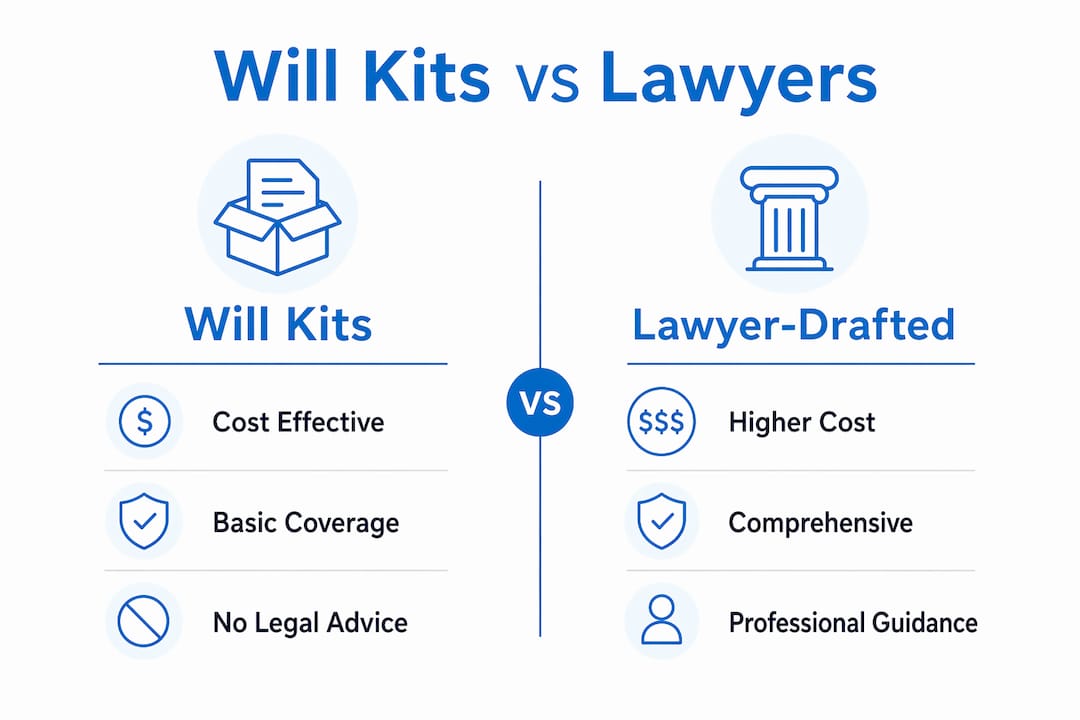
At-a-glance: what your family actually gets from each option
| Dimension | DIY Will kit | Lawyer-drafted Will |
|---|---|---|
| What it covers | Standard gifts, executor appointment, basic residuary clause | Bespoke clauses, life interests, testamentary trusts, disaster planning |
| Enforceability risk | High — execution errors or vague language can void the Will | Low — solicitor verifies formalities and drafts with precision |
| Complex situations (blended families, business, trusts) | Not addressed; templates use generic language | Tailored to your specific family and asset structure |
| Liability and remedies | None — kit providers carry no professional accountability | Solicitor holds professional indemnity insurance; file notes protect the estate |
| Cost to produce | Low upfront cost but potential for significant hidden downstream costs | Costs typically vary depending on estate complexity and services provided |
| Time to produce | Minutes to hours | One to two appointments over one to two weeks |
| Support available | Instructions only; no legal advice | Advice on super nominations, trusts, executor duties, and capacity evidence |
For a single person with a modest estate, one beneficiary, and no business or blended-family complications, a kit may be a defensible short-term measure. For everyone else, the table above tells you what your family is actually getting.
What DIY Will kits usually include — and what they leave out
Most kits, including those sold by Australia Post and Safewill’s entry-level product, cover the legal basics: appointing an executor, naming beneficiaries for your personal property, and setting out a residuary clause for whatever is left over. They also include witnessing instructions, though those instructions may not reflect your state’s current requirements.
What they do not cover is where the real risk sits:
- Superannuation. Your super does not automatically pass under your Will. Without a valid Binding Death Benefit Nomination, your fund’s trustee decides who receives it, and the outcome may not match your wishes.
- Jointly held property. Assets held as joint tenants pass by survivorship, not by Will. A kit cannot change that, and most people do not realise it until it is too late.
- Testamentary trusts. If you want to protect a beneficiary’s inheritance from a future divorce or creditors, a testamentary trust is the tool. No kit template includes one.
- Business succession clauses. A kit cannot address what happens to your share of a business, a partnership agreement, or a buy-sell arrangement.
- Customised disaster clauses. What happens if your executor and your beneficiary die in the same accident? A kit’s generic backup provision may not reflect your actual wishes.
- Blended family protections. Step-children, former partners, and competing claims require precise language. Generic terms like “my children” can trigger exactly the kind of dispute a Will is meant to prevent.
Pro Tip: Before you sign any Will, list every asset you own and check whether it passes under your Will at all. Superannuation, jointly held property, and life insurance policies usually do not. A solicitor can audit this in a single appointment.
Common kit mistakes and real consequences families have faced
The courts have seen enough homemade Wills to fill a casebook. Two cases illustrate what goes wrong.
The mistakes that trigger this scrutiny are rarely dramatic. They are usually small and technical:
- Faulty witnessing. A beneficiary who witnesses the Will loses their gift in most Australian states. A spouse who witnesses may invalidate the entire document.
- Different-coloured pens or alterations. Any amendment made after signing must be re-executed. A correction in a different pen can void the clause it touches.
- Vague beneficiary language. Phrases like “my family” or “my children” force expensive court proceedings when the deceased had stepchildren, estranged relatives, or children from multiple relationships.
- Missing backup gifts. If a named beneficiary dies before you and there is no alternate gift, that share may fall into residue or trigger a partial intestacy.
- Outdated Wills after separation. In most Australian states, divorce revokes a Will, but separation alone does not. A former de facto partner may still inherit.
The downstream cost is the part most people miss. Executors who discover a defective Will may need to apply to the Supreme Court for probate of an informal Will, run contested proceedings, or deal with family provision claims that a well-drafted Will might have discouraged. Those costs come out of the estate before your beneficiaries see a dollar.
Australian legal issues to watch: intestacy, state rules, super, and joint property
Australian Will law is state-based, and that matters more than most people realise.
- Intestacy. If your Will is declared invalid, state intestacy laws apply and your estate passes to relatives in a fixed statutory order, regardless of your actual wishes. A former partner, an estranged sibling, or a relative you have never met may inherit ahead of the people you intended to provide for.
- State-specific execution rules. The Wills Act 1997 (Vic) sets witnessing requirements that differ from NSW and Queensland. A kit printed for a national market may not reflect the rules in your state, which means a technically defective Will that looks fine on paper.
- Superannuation. Super sits outside your estate entirely. Without a binding nomination, the fund trustee exercises discretion. With a lapsed or non-binding nomination, the result is the same.
- Joint tenancy. Property held as joint tenants passes automatically to the surviving owner. If you intended to leave your share to your children rather than your co-owner, a Will alone cannot achieve that without first severing the tenancy.
To check your state’s rules, start with the relevant Public Trustee website (NSW, QLD, SA, WA, ACT, NT) or MoneySmart’s wills guide. For anything beyond a basic check, a solicitor’s local knowledge is necessary, not optional.
Key figure: A Will that fails execution formalities is treated as though it does not exist. The estate then distributes under intestacy rules, which in NSW follow a strict statutory order that may leave a de facto partner or stepchild with nothing.
When a DIY Will kit may be reasonable
A kit is a defensible option only when every one of the following is true:
- Your estate is modest and consists mainly of personal property and a single bank account.
- You have one beneficiary and no competing claims from former partners, stepchildren, or estranged relatives.
- You have no children under 18 and no blended family.
- You own no business interests, no trust assets, and no investment properties.
- Your superannuation has a current, valid binding nomination already in place.
- You are using the kit as a short-term measure and have a solicitor review booked within 30 days.
Five-minute decision check:
- Do you have children from more than one relationship? If yes, see a lawyer.
- Do you own property jointly? Check whether it is joint tenancy or tenants in common.
- Is your super nomination current and binding? Log in and confirm today.
- Do you own any part of a business? A kit cannot address this.
- Have you separated from a partner in the last two years? See a lawyer before signing anything.
If you answered yes to any of questions 1, 4, or 5, a kit is not appropriate. For questions 2 and 3, a kit may be acceptable only after you have resolved those issues separately.
What a lawyer gives you that a kit cannot
The difference between a solicitor-drafted Will and a kit is not just quality of language. It is a fundamentally different level of protection for your estate and your family.
Professional accountability. Solicitors carry professional indemnity insurance and are bound by professional conduct rules. If negligent drafting causes loss to your estate, there is a remedy. A kit provider offers none of that.
File notes and capacity evidence. When a Will is contested, the solicitor’s contemporaneous notes about your capacity, your instructions, and the signing process become crucial evidence. A blank form provides nothing. Legal Aid Victoria notes that these records are often the difference between a Will being upheld and being set aside.
Bespoke drafting. Testamentary trusts, life interests, gift-over clauses, and specific disaster planning for executors require tailored language that no template can replicate. For blended families or high-value estates, these clauses are not optional extras. They are the mechanism by which your wishes actually take effect.
Practical estate audit. A solicitor will ask about your super, your jointly held property, your business interests, and your family structure. That audit, which takes one appointment, often reveals assets and risks the client had not considered. For a deeper look at how a Will fits into a broader estate plan, see estate plans, Wills and powers of attorney.
If you must use a kit: a practical checklist to reduce the most common risks
- Check your state’s witnessing rules before you sign. Two independent adult witnesses who are not beneficiaries and not your spouse. Confirm the current rule for your state on the relevant Public Trustee website.
- Use a single pen, single ink colour, throughout. Any alteration after signing must be initialled by you and both witnesses at the point of change.
- Do not let a beneficiary witness the Will. In most states, the gift to that person is void. In some circumstances, the entire Will may be affected.
- Store the original in a fireproof location. Tell your executor exactly where it is. Consider registering it with your state’s Will registry if one is available.
- Attach a signed, dated letter of wishes. This is not legally binding, but it provides context for your executor and can assist a court if the Will’s meaning is disputed.
- Book a paid 30-minute solicitor review. Ask the solicitor to confirm execution formalities, check for any obvious drafting gaps, and advise on your super nominations.
- Set a calendar reminder to review the Will after any major life change. Marriage, separation, the birth of a child, a property purchase, or a business acquisition each warrant a review.
Pro Tip: Write a brief, signed, and dated note on the day you sign your Will describing your state of mind, your reasons for the gifts you have made, and the fact that you signed without pressure. Keep it with the Will. If the document is ever challenged, that note can support a finding of testamentary capacity.
What our practice sees: common triggers for disputes and how we resolve them
At Simons George Legal, the matters that arrive at our door most often share a handful of common features.
The patterns we see regularly include:
- Failure to update after separation. In NSW, separation alone does not revoke a Will. A former de facto partner named as sole beneficiary may still inherit unless the Will is updated or revoked.
- Missing backup gifts. A beneficiary who predeceases the testator, with no alternate gift named, creates a partial intestacy that can divert assets to unintended relatives.
- Unmanaged superannuation. Executors frequently discover that the deceased’s super, often the largest single asset, has no valid binding nomination and passes outside the estate entirely.
- Ambiguous language in blended families. The word “children” in a kit-drafted Will has generated significant litigation where the testator had biological children, stepchildren, and adopted children.
Remediation depends on how far the problem has progressed. Where a Will is ambiguous but valid, a solicitor can prepare a short-form affidavit of the testator’s known intentions to assist the executor. Where a Will is defective, an application to admit it as an informal Will may be possible. Where a family provision claim has been filed, early negotiation is almost always less costly than a hearing. Simons George Legal offers a complimentary 30-minute consultation to assess which path applies to your situation.

Funding your legal matter — no win, no fee
If you have discovered a problem with a loved one’s Will or believe you have been unfairly left out of an estate, cost should not stop you from getting proper advice. Simons George Legal offers No Win, No Fee arrangements for eligible inheritance disputes and contested estate matters. Eligibility is assessed during a free initial consultation, so you can understand your position before committing to anything.
This arrangement removes the upfront cost barrier for people with a legitimate claim, whether that is a family provision application, a contested Will, or an executor removal. If the matter does not succeed, you do not pay legal fees under the arrangement.
Book a free case assessment with Simons George Legal today to find out whether your matter qualifies.
No Win, No Fee arrangements are subject to case eligibility and a written costs agreement. Liability limited by a scheme approved under Professional Standards Legislation.
Key takeaways: the short checklist for deciding today
A Will kit will likely leave your family exposed to intestacy, probate delays, and litigation costs unless your estate is genuinely simple and you follow every execution formality correctly.
| Point | Details |
|---|---|
| Kits suit only the simplest estates | Acceptable only when the estate is modest, there is one beneficiary, no blended family, no business, and super nominations are already in place. |
| Execution errors void Wills | Wrong witnesses, different-coloured pens, or a beneficiary signing as witness can render a Will invalid under state law. |
| Super and joint property bypass your Will | Without a binding death benefit nomination and correct property tenure, major assets may pass to unintended recipients regardless of what your Will says. |
| Solicitors provide accountability kits cannot | Professional indemnity insurance and file notes protect your estate; kit providers offer neither. |
| Simons George Legal offers a free first consult | Book a complimentary 30-minute consultation to confirm whether your estate needs professional drafting or to resolve an existing dispute. |
- If your estate is straightforward, use a kit as a stopgap only and book a solicitor review within 30 days.
- If you have a blended family, a business, or significant super, see a lawyer before signing anything.
- If you suspect an existing Will is defective, contact Simons George Legal for a free initial assessment.
Why precise drafting matters more than people expect
People often ask me whether a kit is really that risky for a “simple” estate. My honest answer is that most people significantly underestimate how complex their estate actually is. Super, jointly held property, and a blended family each introduce complications that a template cannot resolve, and the cost of getting it wrong falls entirely on the people you were trying to protect. Precise drafting is not a luxury for wealthy families. It is the mechanism by which your actual wishes take legal effect. If you are not certain your estate is genuinely simple, the cost of a solicitor’s appointment is trivial compared to what a defective Will can cost your family.
Simons George Legal: wills, estates, and disputes in Sydney
Simons George Legal is a Bondi-based wills and estates practice that works with individuals and families across Sydney, the Eastern Suburbs, Northern Rivers, and regional NSW. The firm handles everything from straightforward Will drafting and updates to complex estate litigation, family provision claims, and contested probate matters.

For readers who need a Will drafted or updated, fixed-fee options are available for straightforward matters. For those facing a dispute or a defective Will, conditional funding arrangements apply to eligible cases. Either way, the starting point is the same: a complimentary 30-minute consultation where the firm assesses your situation and recommends practical next steps.
Book your free consultation with Simons George Legal today.
Useful sources and places to check the law
The following primary sources are worth bookmarking if you are researching Will validity, intestacy rules, or state-specific execution requirements.
| Source | What to look for |
|---|---|
| MoneySmart — Wills and powers of attorney | Plain-language overview of Will basics, super nominations, and joint property rules |
| Queensland Public Trustee — About Wills | QLD-specific Will requirements, intestacy rules, and free Will service information |
| Legal Aid Victoria — Making a valid Will | Victorian witnessing rules, capacity requirements, and what makes a Will informal |
| Wills Act 1997 (Vic) | Primary legislation for Victorian Will execution formalities |
| Simons George Legal — Wills and estates | Local solicitor contact for Sydney, Eastern Suburbs, and regional NSW |
- For NSW intestacy rules specifically, see the NSW intestacy guide at Simons George Legal.
- For a deeper look at how DIY Wills fail in practice, the DIY Wills buyer beware article covers the most common traps.
- For the role a solicitor plays in estate planning more broadly, the partner article on Will attorney in estate planning is a useful external reference.
FAQ
Are Will kits legally binding in Australia?
Yes, a correctly executed Will kit is legally valid in Australia, but execution errors — wrong witnesses, alterations, or a beneficiary signing as witness — can void it entirely. Courts apply strict formality rules that vary by state.
Are Australia Post Will kits any good?
Australia Post Will kits cover the basic formalities for a simple estate, but they do not address superannuation, jointly held property, testamentary trusts, or blended family situations. For anything beyond a genuinely straightforward estate, the gaps are significant.
What is the most common mistake people make with a Will?
Faulty witnessing is the most frequent technical error, but the most consequential mistake is failing to update a Will after separation, a new relationship, or the birth of a child. An outdated Will can divert assets to unintended beneficiaries under intestacy rules.
How do I stop a son-in-law or daughter-in-law from getting my child’s inheritance in Australia?
A testamentary trust is the most effective tool. Assets held in a testamentary trust for your child are generally protected from a future divorce settlement because they are trust assets, not the child’s personal property. A kit cannot create a testamentary trust; this requires a solicitor. Simons George Legal can advise on the right structure during an initial consultation.
What happens if my DIY Will is declared invalid?
If a Will is declared invalid, state intestacy laws apply and your estate passes to relatives in a fixed statutory order, which may not reflect your wishes at all. The estate may also face Supreme Court proceedings to determine whether the document can be admitted as an informal Will, which takes time and reduces what beneficiaries ultimately receive.