When you are named executor of an estate, you inherit more than administrative paperwork. If the deceased had estranged children, you may be stepping into a legal dispute before you have even applied for probate. Will challenges from estranged children present some of the most complex situations an executor can face, and the common assumption that estrangement disqualifies a child from contesting a will is simply wrong under NSW law. Family provision claims, as they are formally known, give eligible persons a statutory right to seek adequate provision from an estate regardless of how fractured the relationship was.
Table of Contents
- Key takeaways
- Will challenges from estranged children: the legal framework
- Practical administration steps when disputes loom
- Strategies to prepare for and respond to challenges
- Common pitfalls executors face in these disputes
- Executor readiness: key responsibilities at a glance
- Funding your legal matter: No Win, No Fee
- My perspective on managing these disputes
- How Simons George Legal can help executors
- FAQ
Key takeaways
| Point | Details |
|---|---|
| Estrangement does not bar claims | Estranged children retain statutory rights to file family provision claims in NSW courts. |
| Timing is critical for executors | Do not distribute estate assets until at least six months after death and after publishing proper notices. |
| Personal liability is a real risk | Premature distribution before claims are resolved can expose executors to personal financial liability. |
| Early legal advice is non-negotiable | Engaging a specialist solicitor before any dispute escalates protects both the executor and the estate. |
| Supporting documents strengthen defence | Letters of wishes and section 100 statements help defend the testator’s decisions against challenges. |
Will challenges from estranged children: the legal framework
Under NSW law, the Succession Act 2006 governs family provision claims. An eligible person can apply to the Supreme Court of NSW seeking provision or increased provision from a deceased estate when they believe the will fails to make adequate provision for their proper maintenance, education, or advancement in life.
Estranged children sit squarely within the definition of eligible persons. Courts do not automatically treat estrangement as a reason to dismiss a claim. Instead, they weigh a detailed factual picture, including the nature and length of the estrangement, who was responsible for the breakdown, the claimant’s current financial circumstances, and the moral duty the deceased owed. As the Law Society Journal confirms, court decisions weigh dependency and moral duty, not just the existence of a family relationship.
You may have seen a will that includes a no-contest clause, sometimes called a forfeiture clause. These clauses attempt to penalise any beneficiary who challenges the will by stripping them of their bequest. They are a legitimate drafting tool, but their reach is limited. The Law Society Journal also notes that no-contest clauses can deter claims but are not guaranteed protection, since courts can void them if enforcing them would be contrary to public policy. In practical terms, an estranged child with little or nothing to lose under the will has no incentive to stay silent regardless of the clause.
As executor, your key obligations when a challenge arises include:
- Preserving estate assets until all claims are resolved
- Maintaining strict neutrality between beneficiaries and claimants
- Complying with statutory timeframes for distribution
- Seeking legal advice promptly when a claim is notified or anticipated
- Keeping detailed records of every decision and communication
The executor’s role encompasses complex creditor, tax, and family provision claim management, not just paperwork. Underestimating that scope is where many executors get into difficulty.
Practical administration steps when disputes loom
The moment you suspect an estranged child may challenge the estate, your approach to administration needs to shift from routine to risk-aware. The good news is that NSW law gives you a structured framework to work within.
Here is the core process to follow:
- Obtain probate promptly. Delay in obtaining the grant of probate creates uncertainty and prolongs the window during which disputes can unfold without a formal legal structure in place.
- Publish a Notice of Intention to Distribute. This formal notice must be published before you distribute any assets. It alerts potential creditors and claimants to come forward.
- Observe the six-month buffer. You must not distribute the estate earlier than six months after the date of death. This protects you from being caught distributing assets while a valid family provision claim is still live.
- Monitor the twelve-month claim window. Family provision claims must be filed in the NSW Supreme Court within 12 months of the date of death. If a claim is lodged, distribution must wait until the matter is resolved.
- Manage creditor claims in parallel. Creditor obligations run alongside family provision claim exposure. Do not conflate the two, but do treat them simultaneously.
- Document every action you take. Detailed records of your decisions, communications with beneficiaries, and steps taken to identify debts and claimants are your strongest protection if your conduct is ever scrutinised.
The risk of personal liability arises specifically when estate assets are distributed prematurely and a later claim reduces the estate value. If beneficiaries have already received their share and there is nothing left to satisfy the claimant, the shortfall can fall on you personally. That is not a theoretical risk. It happens.
Pro Tip: Do not rely on a beneficiary’s assurance that they will repay funds if a claim succeeds. That promise is unenforceable in most practical circumstances. Hold assets until the claim window closes or a court order is made.
Strategies to prepare for and respond to challenges
Preparation is far more effective than reaction. If you are executor of an estate involving an estranged child, start building your position before any claim is formally filed.

Review the will and all supporting documents. Wills should ideally be accompanied by documents explaining the testator’s reasoning for excluding or limiting provision for estranged children. Letters of wishes and section 100 statements provide valuable context that helps executors and courts understand the testator’s intentions. If these documents exist, locate them early and share them with your solicitor.
Engage legal counsel before the claim is made. Waiting until a formal claim lands before seeking advice is a common and costly mistake. Early engagement allows your solicitor to assess the estate’s exposure, advise on whether to approach estranged parties proactively, and structure the administration process to minimise risk. Legal costs to defend claims from the estate are generally paid from the estate rather than by the executor personally, provided the defence is proper and reasonable.
Communicate carefully with all parties. You are not a mediator and you are not a family counsellor. Your communication with estranged claimants should be measured, factual, and ideally channelled through your solicitor. Every conversation is a potential exhibit in later proceedings.
Key strategies to consider include:
- Seeking a family provisions claim assessment early to understand potential exposure
- Considering whether mediation could resolve the dispute before it reaches court, saving time and estate funds
- Reviewing whether the estate can support interim distributions to uncontested beneficiaries while disputed portions are held
- Assessing the strength of the estranged child’s claim honestly rather than dismissing it, since underestimating a claim leads to poor strategic decisions
- Understanding the hierarchy of competing claims if multiple parties are challenging the estate
Pro Tip: Treat family provision claim risk as a parallel process running alongside standard estate administration. Claims can arise even after probate is granted, so vigilance needs to extend well beyond the grant date.
Common pitfalls executors face in these disputes
Even well-intentioned executors make mistakes when estranged family members enter the picture. Knowing where the traps are helps you avoid them.
Emotional involvement is perhaps the most underrated risk. Many executors are themselves family members. You may have strong feelings about the estranged child’s claim. The moment those feelings influence your administrative decisions, you are exposed. Neutrality is not just advisable, it is a legal obligation. If you cannot maintain it, consider whether renouncing your role or seeking a co-executor is appropriate.
Ambiguous will clauses create genuine difficulty. If the will’s language is unclear about the testator’s intentions toward the estranged child, that ambiguity becomes a battleground. Courts interpret ambiguous language against the background of surrounding circumstances, and that process is unpredictable. Identifying ambiguity early and getting legal advice on its likely interpretation is far better than discovering the problem in court.
Common pitfalls to watch out for include:
- Accepting a beneficiary’s characterisation of the estranged child’s claim without independent assessment
- Distributing even small interim amounts without legal clearance, since partial distributions still carry risk
- Allowing estranged sibling inheritance issues to create factional conflict among the beneficiaries you are managing
- Failing to account for blended family complications where step-children and biological children may all have competing claims
- Underestimating how long contested estates take to resolve, leading to cash flow problems and pressure to distribute prematurely
The right time to seek professional help is before you feel you need it. By the time an executor is certain they are in trouble, the options have usually narrowed.
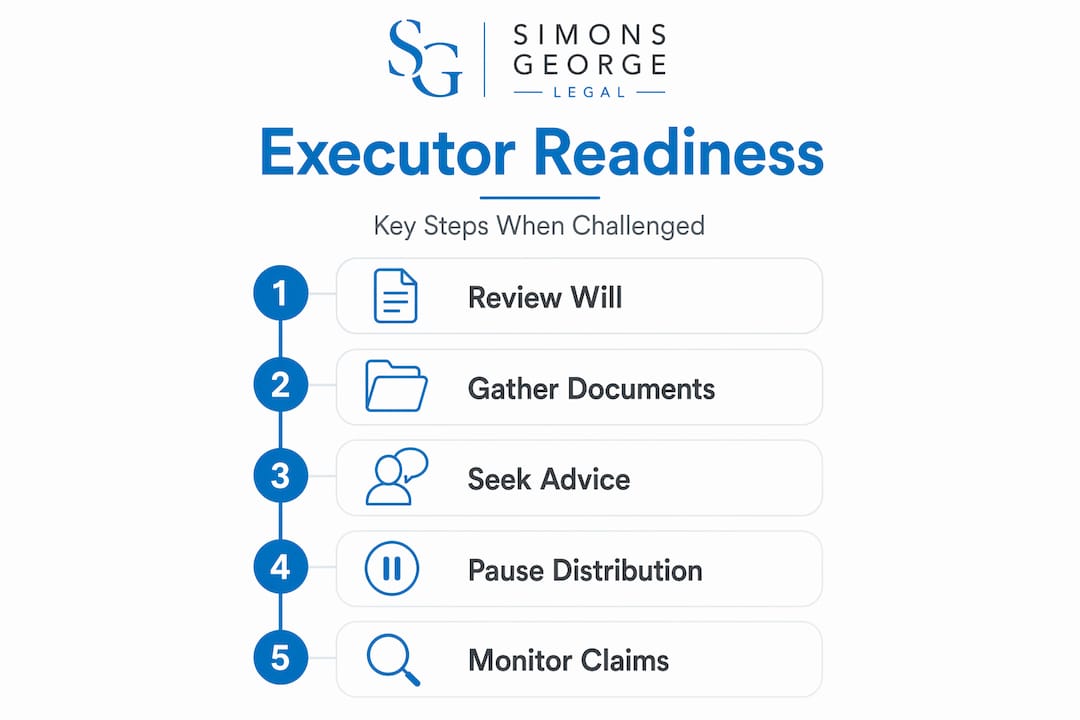
Executor readiness: key responsibilities at a glance
Being executor in a contested estate is demanding, but it becomes far more manageable when you have a clear picture of your responsibilities and the framework around them. The table below summarises the core areas.
| Responsibility | Key consideration |
|---|---|
| Statutory timeframes | No distribution before six months from death; monitor the 12-month claim window |
| Notice obligations | Publish Notice of Intention to Distribute and wait 30 days before distribution |
| Legal exposure | Personal liability risk if assets are distributed before claims or debts are resolved |
| Documentation | Maintain detailed records of all decisions, communications, and steps taken |
| Professional support | Engage a specialist solicitor early to protect both yourself and the estate |
The rights of estranged children in NSW are grounded in statute, which means they cannot be wished away by the terms of any will. Your best protection as executor is knowledge, process, and professional support.
Funding your legal matter: No Win, No Fee
Managing a contested estate can feel financially daunting, particularly when you did not expect to be dealing with a formal dispute. Simons George Legal offers No Win, No Fee arrangements for eligible cases, which means you do not need to find significant upfront funds to defend or advance a legitimate claim.
Eligibility for this arrangement is assessed during a free initial consultation, giving you a clear picture of your options before you commit to anything. It removes the barrier of upfront legal costs for executors and beneficiaries with genuine cases.
If you are facing a will challenge from an estranged child or are concerned about your exposure as executor, book a free case assessment with Simons George Legal today.
No Win, No Fee arrangements are subject to case eligibility and a written costs agreement. Liability limited by a scheme approved under Professional Standards Legislation.
My perspective on managing these disputes
I have worked with executors across a wide range of contested estates, and there is a pattern I see repeatedly. Executors arrive convinced that the estranged child’s claim has no merit because the relationship broke down years ago and the testator made their wishes clear. That confidence is understandable but often misplaced.
What I have learned is that courts are not judging the quality of the relationship. They are asking whether the will made adequate provision given all the circumstances. That is a broader question than most executors expect, and the answer is rarely as clear-cut as it first appears.
The executors who navigate these matters best are the ones who treat the legal process seriously from day one. They engage a solicitor before the dispute escalates, they maintain meticulous records, and they resist the urge to take sides within the family. The ones who struggle are usually those who delay getting advice because they want to believe the problem will resolve itself.
My honest advice: get specialist input early, even if the situation seems manageable. The cost of that advice is almost always less than the cost of correcting a mistake made without it.
— George
How Simons George Legal can help executors
Executors dealing with challenges to an estate are navigating one of the most technically demanding areas of NSW law. Simons George Legal offers dedicated support across every stage of this process, from probate and estate administration through to complex estate litigation involving contested family provision claims.

The firm’s team understands the pressure executors are under, and provides clear, practical advice that is tailored to the specific circumstances of each estate. Whether you need guidance on whether to distribute, support responding to a filed claim, or representation in the Supreme Court of NSW, Simons George Legal has the expertise to protect you and the estate throughout the process.
New clients are welcomed with a complimentary 30-minute consultation. Speak with the team at Simons George Legal to get a frank assessment of your situation and a clear path forward. Visit simonsgeorgelegal.com.au/wills-and-estates-lawyers to get started.
FAQ
Can estranged children contest a will in NSW?
Yes. Estranged children are eligible persons under the Succession Act 2006 and can file a family provision claim in the NSW Supreme Court. Estrangement affects how the court weighs the claim but does not bar the application.
What is the time limit for contesting a will in NSW?
Family provision claims must be filed within 12 months of the date of death. Executors who have not received a claim after this period are generally safer to proceed with distribution, subject to legal advice.
Can an executor be personally liable for distributing assets too early?
Yes. If you distribute estate assets before resolving outstanding claims or debts and the estate cannot meet a later court order, personal liability can arise. Always wait at least six months and publish the required notices before distributing.
Do no-contest clauses stop estranged children from challenging a will?
Not reliably. No-contest clauses can discourage challenges but courts can void them if enforcement would conflict with public policy. An estranged child with little to lose under the will has limited incentive to comply with such a clause.
Who pays the legal costs in a contested estate?
Legal costs to defend a properly conducted claim are generally paid from the estate rather than by the executor personally. Executors who act reasonably and in accordance with their duties are well-positioned to have costs covered this way.