A will is challenged when someone disputes either its legal validity or the adequacy of provision it makes for eligible persons. Under Australian law, the most common grounds for contesting a will include lack of testamentary capacity, undue influence, improper execution, fraud, and inadequate family provision. These are not casual complaints about fairness. Each ground requires specific legal proof, assessed by courts including the Supreme Court of New South Wales. Knowing why wills get challenged helps beneficiaries and family members make informed decisions, whether they are considering a claim or trying to protect an estate they stand to inherit.
What legal grounds justify challenging a will’s validity?
Challenging a will’s validity means arguing that the document itself should not stand as a lawful expression of the deceased’s wishes. Australian courts recognise four primary grounds for this type of challenge.
Lack of testamentary capacity is the most frequently argued ground. The willmaker must have understood the nature of making a will, the extent of their estate, and the claims of those who might reasonably expect to benefit. Courts assess capacity at the time the will was signed, not at the time of death. Medical evidence, witness statements, and contemporaneous records all play a role in this assessment. Simons George Legal regularly advises clients on testamentary capacity disputes and what evidence courts find persuasive.
Undue influence arises when someone pressures or manipulates the willmaker into signing a document that does not reflect their true intentions. Proving undue influence is difficult because courts require evidence of actual coercion, not merely persuasion or persistent requests. The influence must have overpowered the willmaker’s free will at the moment of signing.

Improper execution is a straightforward but often overlooked ground. A will not properly signed or witnessed according to the relevant legislation may be invalidated entirely. In New South Wales, the Succession Act 2006 sets out strict requirements for signing and witnessing. Courts do have a discretion to admit an informal document, but that discretion is not guaranteed.
Fraud and forgery require the challenger to prove that the will was fabricated or that the willmaker was deceived into signing something other than what they believed it to be. The evidentiary bar is high, and these cases often involve handwriting experts and forensic document analysis.
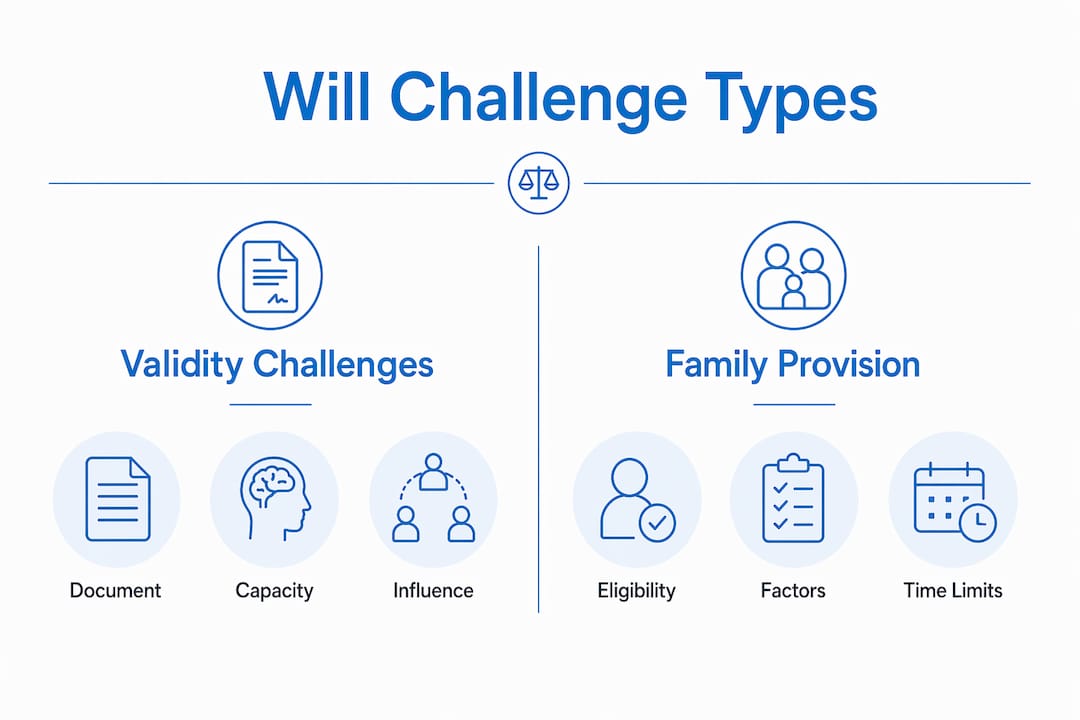
The distinction between validity challenges and family provision claims is legally significant. Validity challenges attack the document itself. Family provision claims accept the will as valid but argue that it fails to make adequate provision for certain people.
Pro Tip: Gather contemporaneous evidence early. Medical records, emails, and witness accounts from around the time the will was signed carry far more weight than recollections formed years later.
How do family provision claims lead to wills being challenged?
A family provision claim does not argue that the will is invalid. It argues that the will fails to make adequate provision for the maintenance, education, or advancement in life of an eligible person. This is the most common reason wills are disputed in Australia, and the legal framework sits primarily in the Succession Act 2006 in New South Wales and equivalent legislation in other states.
Eligible persons who can bring a family provision claim typically include:
- Spouses and de facto partners
- Children, including adopted children
- Former spouses in some circumstances
- Grandchildren who were financially dependent on the deceased
- Carers and others who lived in a close personal relationship with the deceased
Eligibility alone does not guarantee success. Courts assess a range of factors when deciding whether to make an order and how much to award. Family provision claims consider the claimant’s financial resources, their relationship with the deceased, any special needs such as disability or illness, and contributions made to the deceased’s estate or welfare during their lifetime.
The court’s objective is not to divide the estate equally among all claimants. The court aims for a just and equitable outcome that reflects the deceased’s moral duty to each eligible person, the size of the estate, and the competing needs of all beneficiaries. A successful claim can reduce what other beneficiaries receive, sometimes substantially.
Pro Tip: Time limits apply strictly. In New South Wales, a family provision claim must generally be filed within 12 months of the date of death. Missing this deadline can end your claim before it begins.
What practical and legal steps are involved in contesting a will?
Understanding the process helps families set realistic expectations and avoid costly mistakes. The steps differ depending on whether you are pursuing a validity challenge or a family provision claim, but the general framework in New South Wales follows a clear sequence.
- Confirm your standing. Only persons with legal standing can bring a challenge. For validity challenges, this includes any person with a financial interest in the estate. For family provision claims, standing is limited to eligible persons under the Succession Act 2006.
- Seek legal advice promptly. Time limits are strict. For family provision claims in New South Wales, the deadline is commonly 12 months after death, though courts may allow late claims with strong justification and no unfair prejudice to other parties.
- Gather evidence. Medical records, financial documents, correspondence, and witness statements form the foundation of most claims. The strength of your evidence often determines whether a matter settles or proceeds to a full hearing.
- File in the Supreme Court. Both validity challenges and family provision claims in New South Wales are heard in the Supreme Court. Procedural rules govern how documents are filed and served.
- Attend mediation. Most contested estate matters in New South Wales go through a formal mediation process before a hearing. Many disputes resolve at this stage, saving time and legal costs for all parties.
- Proceed to hearing if necessary. If mediation fails, a judge decides the outcome. Court decisions on family provision claims consider all competing interests and can result in orders that significantly alter the estate’s distribution.
The table below summarises the key differences between the two main types of will challenges.
| Feature | Validity challenge | Family provision claim |
|---|---|---|
| What is disputed | The will document itself | The adequacy of provision made |
| Legal basis | Testamentary capacity, undue influence, execution, fraud | Succession Act 2006 (NSW) and equivalents |
| Who can bring it | Anyone with a financial interest | Eligible persons only |
| Typical outcome | Will set aside or upheld | Additional provision ordered from estate |
| Time limit | No fixed limit, but delay can prejudice a claim | Generally 12 months from date of death in NSW |
What are common misconceptions about why wills get challenged?
The most persistent misconception is that feeling treated unfairly is enough to challenge a will. It is not. Unfairness alone does not justify overturning a will. Applicants must prove eligibility and demonstrate that the deceased had a moral duty that the will failed to meet. Courts apply legal criteria, not community standards of fairness.
A second misconception is that courts rewrite wills to reflect what seems reasonable. Courts do not simply rewrite wills because family members disagree with the distribution. The judicial focus is on whether specific legal thresholds have been crossed, not on substituting the court’s judgment for the willmaker’s.
Conduct also matters more than many claimants expect. Courts may refuse relief entirely if the claimant’s own conduct disentitles them, such as a history of violence toward the willmaker or dishonesty in dealings with the estate. Financial need does not override this equitable discretion.
- A will that seems harsh is not automatically invalid
- Estrangement from the deceased can reduce but does not always eliminate a claim
- Successful claims affect all beneficiaries, not just the person being challenged
- Mediation often produces better outcomes than contested hearings for all parties
Pro Tip: If you are making or updating a will, document your reasons for any unusual decisions in a separate letter of wishes. This does not bind the court but gives strong evidence of your intentions and capacity.
How can understanding will challenges help families and beneficiaries?
Legal knowledge changes how families approach estate disputes. Beneficiaries who understand the grounds for contesting a will can assess whether a challenge has genuine merit before investing time and money in litigation. Testators who understand these grounds can take steps to reduce the risk of a successful challenge against their own estate.
Recognising early warning signs matters. Significant changes to a will late in life, particularly when the willmaker’s health is declining or when a new person has entered their life, often precede disputes. Families who notice these signs and seek early legal advice are better placed to act within time limits and preserve evidence.
Clear communication within families also reduces the likelihood of disputes reaching court. Testators who explain their decisions to family members during their lifetime, and who document those explanations, give their executors a stronger foundation to defend the estate if challenged.
Dispute resolution options outside court, including mediation and negotiated settlements, are available at every stage of a contested estate matter. These options are faster, cheaper, and less damaging to family relationships than a full Supreme Court hearing. Understanding that litigation is a last resort, not a first step, helps families make better decisions under pressure.
Funding your legal matter — no win, no fee
Cost is the most common reason people with legitimate claims do not pursue them. Simons George Legal offers No Win, No Fee arrangements for eligible contested estate matters, removing the upfront financial barrier for claimants who have a genuine case.
Eligibility is assessed during a free initial consultation. Simons George Legal reviews the facts, identifies the applicable legal grounds, and advises whether a No Win, No Fee arrangement is appropriate for your situation. There is no obligation to proceed after that first conversation.
If you believe a will has been made without proper capacity, under undue influence, or that you have been inadequately provided for, contact Simons George Legal to book your complimentary case assessment.
No Win, No Fee arrangements are subject to case eligibility and a written costs agreement. Liability limited by a scheme approved under Professional Standards Legislation.
Key takeaways
Wills are successfully challenged only when specific legal grounds are proven, not simply because a beneficiary feels the distribution is unfair.
| Point | Details |
|---|---|
| Two distinct legal paths | Validity challenges attack the will document; family provision claims seek greater provision from a valid will. |
| Capacity is assessed at signing | Courts examine the willmaker’s understanding at the time the will was executed, not at death. |
| Eligibility limits who can claim | Only spouses, children, dependants, and certain others can bring a family provision claim. |
| Time limits are strict | In New South Wales, family provision claims must generally be filed within 12 months of death. |
| Conduct can bar a claim | Courts may refuse relief if the claimant’s own behaviour disentitles them, regardless of financial need. |
From the desk of George: what estate disputes have taught me
The cases that stay with me are rarely the ones involving large estates. They are the ones where a small inheritance became the flashpoint for years of unresolved family tension. A will does not create conflict. It reveals it.
What I have observed consistently is that families who are surprised by a will’s contents are usually families where the deceased never explained their reasoning. A parent who quietly changes their will to favour one child over another, without any conversation, almost guarantees a dispute. The legal grounds may or may not be there, but the emotional fuel certainly is.
The other thing I have learned is that people often overestimate how much the court will do for them. The court applies law, not equity in the popular sense. Feeling wronged is not a legal argument. The clients who achieve the best outcomes are those who come in early, with clear facts, and realistic expectations about what the process can deliver.
If you are sitting with a will that does not reflect what you expected, get advice before you act. The time limits are unforgiving, and the evidence you need is often perishable.
— George
Simons George Legal: wills and estate disputes in Sydney

Simons George Legal is a dedicated wills and estates practice based in Bondi, serving individuals and families across Sydney. The firm handles the full range of contested estate matters, from validity challenges grounded in testamentary capacity or undue influence, to complex estate litigation involving multiple claimants and significant assets.
Every new client receives a complimentary 30-minute consultation. Simons George Legal uses that time to assess the facts, identify the applicable legal grounds, and recommend practical next steps. The firm’s approach combines technical expertise with clear, honest communication, so clients understand their position and their options at every stage.
Contact Simons George Legal to book your free consultation and find out where you stand.
FAQ
What are the main reasons wills get challenged?
The main reasons wills get challenged are lack of testamentary capacity, undue influence, improper execution, fraud or forgery, and inadequate provision for eligible family members. Each ground requires specific legal evidence to succeed.
Who can contest a will in Australia?
Eligible persons include spouses, de facto partners, children, grandchildren who were financially dependent on the deceased, and carers or others in a close personal relationship with the deceased. Eligibility varies slightly between states.
How long do you have to contest a will in NSW?
Family provision claims in New South Wales must generally be filed within 12 months of the date of death. Courts may allow late claims in limited circumstances, but missing the deadline puts the claim at serious risk.
Does feeling treated unfairly mean you can challenge a will?
Feeling treated unfairly is not sufficient grounds to challenge a will. Applicants must prove legal eligibility and demonstrate that the deceased failed to meet a moral duty owed to them under Australian law.
Can a successful will challenge affect other beneficiaries?
A successful family provision claim can reduce the inheritance of other beneficiaries. Courts balance the needs of all claimants and beneficiaries to achieve a just and equitable outcome across the whole estate.