When someone dies in NSW, a defined series of legal and practical steps must be taken promptly to protect the deceased’s affairs and support those left behind. The process covers registering the death with the NSW Registry of Births, Deaths and Marriages, applying for probate, managing the deceased estate, and notifying government agencies. Executors carry real legal responsibility under NSW law, including strict waiting periods before distributing assets. Knowing the correct sequence reduces mistakes, avoids personal liability, and gives you the space to grieve without unnecessary legal stress.
What to do when someone dies in NSW: the first steps
The first priority after a death is obtaining a medical certificate of cause of death from the attending doctor or hospital. This document is the foundation of everything that follows. Without it, you cannot register the death, arrange the funeral, or begin estate administration. If the death was unexpected or unattended, the NSW State Coroner may be involved, and the certificate may take longer to issue.
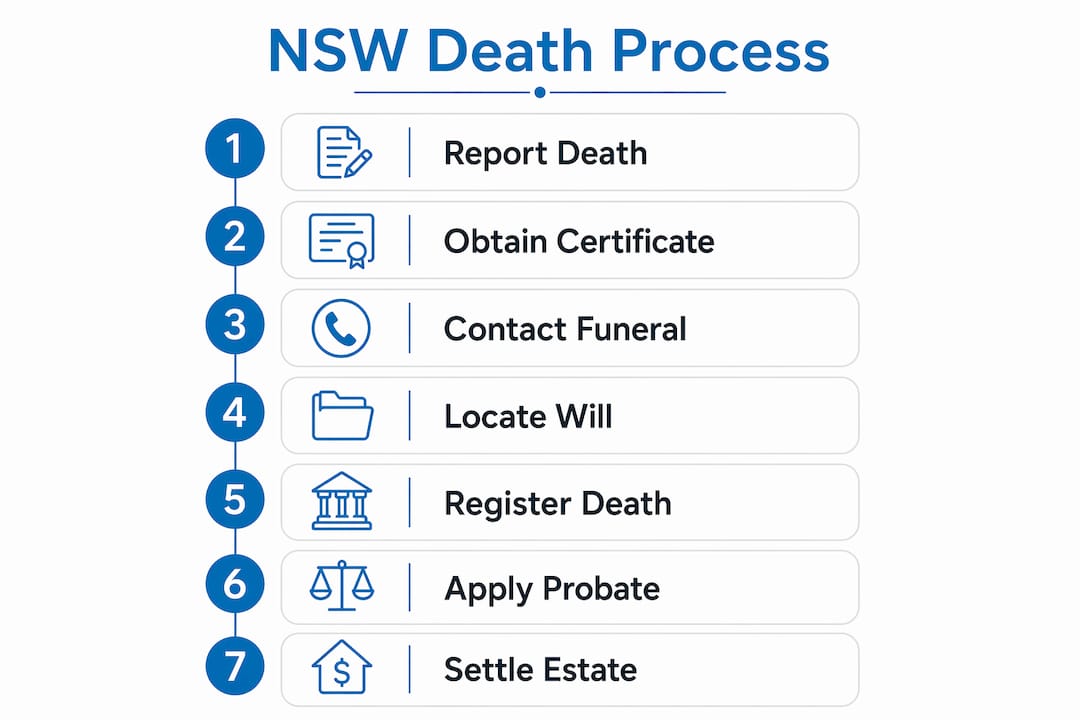
Once you have the certificate, contact a funeral director. Funeral directors in NSW act as a central hub in the days after a death, handling registration with the Registry of Births, Deaths and Marriages and helping families navigate the immediate steps. Most families do not need to register the death themselves because the funeral director manages this process on their behalf.
Locate the will as soon as possible. The will names the executor, the person legally responsible for administering the estate. If there is no will, NSW intestacy rules apply, and the Supreme Court of NSW appoints an administrator. Understanding whether a valid will exists shapes every decision that follows.

How to register a death and obtain the death certificate in NSW
Death registration in NSW is a legal requirement. The death must be registered with the NSW Registry of Births, Deaths and Marriages, and this typically happens within days of the death occurring.
Who registers the death?
Funeral directors usually register the death and apply for the death certificate on the family’s behalf. This is the standard process in NSW. If you need to register without a funeral director, you can do so directly through the NSW Registry of Births, Deaths and Marriages using the prescribed forms.
What documents do you need?
- The medical certificate of cause of death, signed by the treating doctor
- Personal details of the deceased, including full name, date of birth, and address
- Details of the deceased’s parents and spouse or partner
- Information about any children
What is the death certificate used for?
The death certificate is the official proof of death. You will need it to access bank accounts, apply for probate, notify superannuation funds, transfer property, and close accounts. Order multiple certified copies early. Most institutions require an original certified copy, not a photocopy.
Pro Tip: Order at least five certified copies of the death certificate at the time of registration. Running out of copies causes delays when dealing with banks, superannuation funds, and government agencies simultaneously.
What are the executor’s responsibilities in NSW?
The executor’s role is a significant legal responsibility, not a formality. Executors can be personally liable if they distribute assets before all estate debts are paid. That risk is real and applies even when the executor acts in good faith.
The probate application
Probate is the Supreme Court of NSW’s formal recognition that a will is valid and that the executor has authority to act. The probate application should be made within six months of the date of death. Applications made after six months require an affidavit of delay explaining the reason for the late filing. Staying organised from the start avoids this complication and the additional cost it brings.
Key steps for executors
- Locate and review the will to confirm your appointment as executor.
- Apply for probate through the NSW Supreme Court once you have gathered the required documents.
- Identify and value all estate assets, including property, bank accounts, superannuation, and investments.
- Pay all outstanding debts, taxes, and funeral expenses before distributing anything.
- Wait the mandatory six months before distributing assets to beneficiaries.
- Publish a Notice of Intention to Distribute and wait a further 30 days before making distributions.
- Prepare estate accounts and distribute assets to beneficiaries according to the will.
The executor role in complex estates, such as those involving multiple properties, business interests, or potential family disputes, requires professional legal advice early. Engaging an estate lawyer before problems arise is far less costly than resolving them after the fact.
Pro Tip: You have the right to decline the executor role before you begin any administration. Once you start acting as executor, renouncing the role becomes very difficult. If the estate is complex or contentious, seek legal advice before accepting.
Simons George Legal’s estate administration checklist gives executors a practical framework for managing each stage without missing critical deadlines.
How do you organise a funeral and notify relevant parties?
Funeral arrangements in NSW should reflect the deceased’s wishes wherever possible. Check the will first, as many people record their funeral preferences there. If no preferences exist, the executor or next of kin makes the decisions.
Arranging the funeral
Funeral directors in NSW handle the logistics of burial or cremation, including transport, venue, and documentation. Costs vary widely depending on the type of service. The estate generally covers funeral expenses as a priority debt, meaning they are paid before any distribution to beneficiaries.
Notifying government agencies and organisations
- Notify Services Australia within 28 days if the deceased was receiving Centrelink or other government payments. Missing this deadline can result in overpayments that the estate must repay.
- Contact the Australian Taxation Office to finalise the deceased’s tax affairs and lodge any outstanding returns.
- Notify superannuation funds, as super does not automatically form part of the estate and requires separate handling.
- Inform financial institutions, insurance companies, and utility providers.
- Contact the deceased’s employer if applicable.
The Australian Death Notification Service centralises notifications to multiple government agencies in a single process. This reduces the administrative load on grieving families considerably. Using it early saves hours of repeated phone calls and paperwork.
Caring for dependents
If the deceased had dependent children or adults in their care, arrange appropriate guardianship or support immediately. The will may nominate a guardian for minor children. If it does not, or if there is a dispute, the Family Court of Australia has jurisdiction to appoint one.
How do you look after yourself after a death?
The bereavement process in NSW is not only a legal and administrative challenge. It is an emotional one, and looking after your mental and physical health during this period is a genuine priority, not an afterthought.
Grief affects concentration, memory, and decision-making. Trying to manage complex legal and financial tasks while in acute grief increases the risk of errors. Breaking the process into small, manageable steps reduces that risk.
Support services available in NSW include Griefline, which provides telephone and online counselling for people experiencing loss. Your GP is also a practical first point of contact for mental health referrals under a Medicare Mental Health Care Plan.
Pro Tip: Delegate where you can. If you are the executor, you do not have to manage every task personally. Engaging a solicitor for probate and estate administration frees you to focus on your own wellbeing and your family.
Professional legal and financial advice does more than protect the estate. It reduces the cognitive load on the executor and family members, allowing them to process grief without the constant pressure of legal deadlines.
Key takeaways
Managing the steps after death in NSW correctly protects the estate, prevents personal liability for the executor, and gives the family the space to grieve without compounding legal stress.
| Point | Details |
|---|---|
| Register the death promptly | The funeral director usually registers the death with the NSW Registry of Births, Deaths and Marriages on the family’s behalf. |
| Apply for probate within six months | Late applications require an affidavit of delay; staying organised avoids this cost and complication. |
| Executors face personal liability | Distributing assets before paying all debts exposes the executor to personal financial risk under NSW law. |
| Notify Services Australia within 28 days | Missing this deadline on government payments can create overpayments the estate must repay. |
| Use the Australian Death Notification Service | This centralised service notifies multiple agencies at once, reducing the administrative burden on the family. |
What I have learned from helping families through this process
After working with families across Sydney through some of the hardest moments of their lives, the pattern I see most often is this: the legal mistakes happen not because people are careless, but because they are grieving and overwhelmed, and nobody told them the rules in plain language.
The six-month waiting period before distributing assets catches executors out regularly. They want to do the right thing by the beneficiaries and move quickly. The instinct is understandable. The legal consequence is not. An executor who distributes assets early, even with good intentions, can be held personally liable for any debts that later surface. That is a serious outcome that a short conversation with a lawyer at the start would have prevented.
The other thing I see is people accepting the executor role without understanding what it involves. The will names you, so you feel obligated. But you have the right to decline before you begin. In complex estates, particularly those with multiple properties, business interests, or family tension, that decision deserves careful thought. Once you start, stepping back becomes legally complicated.
My honest advice: get one hour of legal advice in the first two weeks. Not because the process is impossible to manage alone, but because knowing the deadlines, the risks, and the correct sequence from the start changes everything. It turns a chaotic situation into a manageable one.
— George
Estate legal support from Simons George Legal
Simons George Legal is a Bondi-based wills and estates practice serving families across Sydney. The firm handles probate and estate administration, contested wills, family provision claims, and complex estate litigation. Whether you are an executor managing a straightforward estate or a family member facing a disputed inheritance, the team provides clear advice tailored to your specific circumstances.

New clients receive a complimentary 30-minute consultation, giving the firm a chance to assess your situation and recommend practical next steps. For matters involving wills and estates across NSW, Simons George Legal offers the technical expertise and approachable manner that makes a difficult process manageable.
Funding your legal matter — No Win, No Fee
Simons George Legal offers No Win, No Fee arrangements for eligible matters, including contested wills and family provision claims. Eligibility is assessed during the free initial consultation, so you know where you stand before committing to anything.
This arrangement removes the upfront cost barrier for people with a legitimate claim. You do not need to have funds available to access quality legal representation. If your matter qualifies, the firm carries the financial risk alongside you.
Book a free case assessment with Simons George Legal to find out whether your matter is eligible and what your options are.
No Win, No Fee arrangements are subject to case eligibility and a written costs agreement. Liability limited by a scheme approved under Professional Standards Legislation.
FAQ
What is the first thing to do when someone dies in NSW?
Obtain a medical certificate of cause of death from the treating doctor or hospital. Then contact a funeral director, who will manage death registration with the NSW Registry of Births, Deaths and Marriages.
How long does an executor have to apply for probate in NSW?
Probate applications should be made within six months of death. Applications made after this period require an affidavit of delay explaining the reason.
Can an executor distribute assets immediately after death?
No. Executors must wait at least six months after the date of death and a further 30 days after publishing a Notice of Intention to Distribute before releasing assets to beneficiaries.
Who do I need to notify when someone dies in NSW?
Notify Services Australia within 28 days if the deceased received government payments. Also notify the ATO, superannuation funds, banks, insurers, and employers. The Australian Death Notification Service can centralise many of these notifications.
What happens if there is no will?
If there is no valid will, NSW intestacy rules apply and the Supreme Court appoints an administrator to manage the estate. The estate is then distributed according to a fixed legal formula rather than the deceased’s personal wishes.