Most people assume that if someone dies without a will, their assets automatically pass to whoever they were closest to. That assumption is wrong, and the gap between expectation and reality is where families get hurt. Intestacy is the legal condition of dying without a valid will, and it triggers a rigid, state-governed process that distributes your estate according to a statutory formula, not your personal wishes. Understanding what is intestacy, and how intestacy laws operate in Australia, is the first step toward protecting the people you care about.
Table of Contents
- Key takeaways
- What intestacy means under Australian law
- How intestate estates are actually divided
- The real risks of dying without a will
- Probate without a will: how intestate estates are administered
- My perspective: intestacy laws rarely reflect real life
- How Simons George Legal can help
- FAQ
Key takeaways
| Point | Details |
|---|---|
| Intestacy defined | Dying without a valid will means the law, not you, decides who receives your assets. |
| State laws govern distribution | Intestacy laws vary by Australian state, so where you live affects who inherits and how much. |
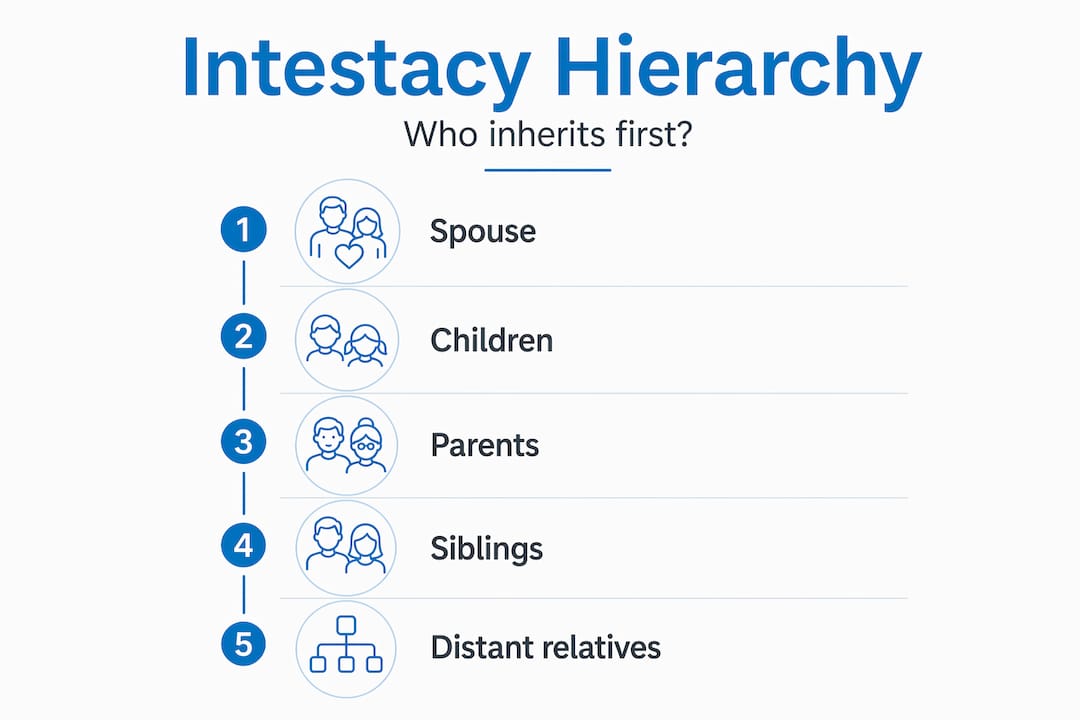
| Strict beneficiary hierarchy | Assets pass to spouse, then children, then parents and siblings in a fixed statutory order. |
| Chosen people may miss out | Friends, charities, and de facto partners of short duration may receive nothing under intestacy rules. |
| A will prevents most problems | A properly drafted and updated will removes almost all the uncertainty that intestacy creates. |
What intestacy means under Australian law
To define intestacy simply: a person dies intestate when they have no valid will at the time of death, or when their will only partially covers their estate. That second scenario, called partial intestacy, catches many people off guard. A will that fails to account for newly acquired assets or that contains a clause later struck down by a court can leave a portion of the estate governed by intestacy rules even when a will exists.
In Australia, intestacy laws vary significantly between states and territories. There is no single federal intestacy law. New South Wales, Victoria, Queensland, and Western Australia each have their own succession legislation, and the rules around who qualifies as a spouse, what constitutes a de facto relationship, and how assets are divided can differ in meaningful ways. This is why jurisdiction matters. Moving interstate without updating your estate planning documents can have real consequences.
The typical statutory order of beneficiaries under Australian intestacy laws runs as follows:
- Spouse or de facto partner (subject to relationship length and state-specific rules)
- Children of the deceased
- Parents of the deceased
- Siblings of the deceased
- Grandparents
- Aunts and uncles
- First cousins
One legal nuance worth knowing: beneficiaries must survive the deceased by a minimum period, typically 30 days, to be eligible to inherit. If a beneficiary dies within that window, they are treated as having predeceased the deceased for distribution purposes.
At the far end of the hierarchy, if no eligible relatives can be identified, the estate does not sit in limbo. It escheats to the government, meaning the state takes ownership of the assets under escheatment rules. This outcome is rare, but it does happen.
Pro Tip: If you have recently separated from a spouse but have not yet divorced, check your state’s intestacy rules carefully. Some jurisdictions are updating legislation to treat separated spouses as having predeceased the deceased, but this is not uniform across Australia.
How intestate estates are actually divided
The distribution formula under intestacy depends almost entirely on who survives the deceased. The following table illustrates how assets are typically divided across common scenarios under Australian intestacy laws. Note that specific shares and thresholds vary by state.
| Surviving relatives | Typical distribution outcome |
|---|---|
| Spouse only, no children | Entire estate to spouse |
| Spouse and children from that relationship | Entire estate to spouse in most Australian states |
| Spouse and children from a prior relationship | Spouse receives a statutory legacy plus a share of the remainder; children share the rest |
| Children only, no spouse | Estate divided equally among children |
| No spouse, no children | Estate passes to parents equally, or to surviving parent |
| No spouse, no children, no parents | Estate divided among siblings equally |
| No eligible relatives | Estate escheats to the state |
The scenario that creates the most conflict is when a deceased person leaves behind a spouse and children from a previous relationship. In that situation, the spouse does not automatically receive everything. The children from the prior relationship have a statutory entitlement, and the exact split depends on the state. For example, in Ontario, Canada, the surviving spouse receives a preferential share of $350,000 before any residue is divided with children. While Australian thresholds differ, the concept of a preferential share for spouses exists in several Australian jurisdictions and is worth understanding.
What the table above cannot capture is the emotional cost. When adult children from a first marriage discover that their parent’s second spouse will receive the bulk of the estate, disputes follow. Intestacy does not prevent family provision claims either. Eligible persons who feel inadequately provided for can still apply to the court for a greater share, adding time, cost, and stress to an already difficult period.

The real risks of dying without a will
Intestacy is effectively a one-size-fits-all legal default that ignores every personal relationship outside biological or legal family structures. Here is where that creates genuine harm.
- Chosen beneficiaries are excluded. Friends, stepchildren who were never formally adopted, charities, and mentors receive nothing under intestacy rules. The law does not recognise emotional bonds or informal commitments.
- De facto partners may miss out. Common law partners have no automatic inheritance rights in many jurisdictions, regardless of how long the relationship lasted. A partner of 10 years who is not legally married and does not meet the state’s de facto threshold could walk away with nothing.
- Unintended relatives may inherit. An estranged sibling or a parent with whom the deceased had no relationship may receive assets simply because they appear higher in the statutory hierarchy than the deceased’s actual support network.
- Disputes become more likely. Without a will to express clear intentions, family members are left to interpret the law rather than the deceased’s wishes. That gap is where inheritance disputes take root and legal costs escalate.
- Testamentary wishes for guardianship are lost. Parents of minor children cannot nominate a guardian through intestacy. The court decides, and it may not choose who the deceased would have wanted.
Legislative changes are also reshaping intestacy outcomes. Separated spouses are increasingly treated as having predeceased the deceased in modern intestacy reforms, which is a sensible update but also a reminder that the law changes and your estate planning documents need to keep pace.
Pro Tip: Review your will after every major life event: marriage, divorce, separation, the birth of a child, or a significant change in assets. Outdated wills are one of the most common causes of unintended partial intestacy. Simons George Legal’s guide on estate planning mistakes covers this in detail.
Probate without a will: how intestate estates are administered
When someone dies intestate, the estate still needs to be formally administered. The process is similar to probate with a will, but with one key difference: there is no executor. Instead, an interested party, usually the next of kin, applies to the Supreme Court for a grant of letters of administration.
Court-appointed administrators carry the same fiduciary duties as executors. They must collect all assets, pay outstanding debts and liabilities, and distribute the remainder according to the statutory formula. The role is demanding, and the administrator is personally liable if they get it wrong.
The practical steps in administering an intestate estate typically include:
- Applying to the Supreme Court for letters of administration
- Identifying, valuing, and securing all estate assets
- Notifying creditors and settling outstanding debts
- Lodging any required tax returns for the deceased
- Distributing the net estate to beneficiaries according to intestacy rules
One complication that arises specifically in intestate estates is that the administrator has discretion to sell or transfer assets to beneficiaries, but may delay asset sales where it is in the estate’s interest. That discretion, while legally sound, can create tension with beneficiaries who want a quick resolution.
It is also worth noting that a beneficiary can serve as the administrator. A beneficiary acting as estate trustee must still act impartially toward all other beneficiaries, which can be awkward when family dynamics are already strained. Intestate estates tend to take longer and cost more to administer than estates with a clear, valid will. The absence of instructions creates ambiguity at every step.
My perspective: intestacy laws rarely reflect real life
I have worked with enough families navigating intestacy to say this plainly: the law is not designed to honour your relationships. It is designed to create a predictable default. Those are very different things.
I have seen long-term de facto partners left with nothing because the relationship did not meet the technical threshold under state law. I have seen estranged adult children inherit assets that the deceased clearly never intended for them, simply because no will existed to say otherwise. And I have seen blended families torn apart by disputes that a single, well-drafted document could have prevented entirely.
The other thing I have noticed is that people consistently underestimate how quickly life changes create intestacy risk. A marriage, a divorce, a new child, or the acquisition of a significant asset can all affect whether an existing will adequately covers your estate. An outdated will can produce a partial intestacy just as damaging as having no will at all.
My honest advice: do not treat a will as something you do once and forget. Treat it as a living document that needs to reflect your current life. If you are unsure whether your existing will is still fit for purpose, a short conversation with a wills and estates lawyer will tell you quickly. The cost of that conversation is nothing compared to the cost of intestacy for the people you leave behind.
— George
How Simons George Legal can help

Intestacy is entirely avoidable with the right legal advice, and Simons George Legal makes that process straightforward. Based in Bondi and serving clients across Sydney, the firm specialises in wills and estates law, helping individuals and families create clear, legally sound documents that reflect their actual wishes rather than a statutory formula.
Whether you need to draft a will for the first time, update an existing one after a life change, or navigate probate and estate administration for a loved one who has died without a will, Simons George Legal provides honest, practical guidance at every step. The firm also handles contested estates and family provision claims when intestacy has already created a dispute. New clients receive a complimentary 30-minute consultation to assess their situation and identify the most practical next steps.
FAQ
What is intestacy in simple terms?
Intestacy occurs when a person dies without a valid will, meaning the law decides how their estate is distributed rather than their own documented wishes.
Who inherits under intestacy in Australia?
Assets pass first to a spouse or de facto partner, then to children, then to parents, siblings, and more distant relatives in a fixed statutory order that varies by state.
Can a de facto partner inherit under intestacy?
De facto partners may inherit under intestacy in some Australian states, but eligibility depends on the length and nature of the relationship. Short-term or unregistered de facto partners may receive nothing.
What is the difference between intestacy and probate?
Probate is the court process for validating a will and authorising an executor to administer the estate. Intestacy refers to dying without a valid will, which triggers a similar court process but requires letters of administration instead of a grant of probate.
How long does it take to administer an intestate estate?
Intestate estates generally take longer to administer than estates with a valid will because there is no executor named and the court must appoint an administrator. The process can take anywhere from several months to over a year depending on the complexity of the estate and any disputes that arise.