A family provision claim is a court application made by an eligible person who believes a deceased person’s estate failed to make adequate provision for their proper maintenance and support. Governed by state and territory succession laws across Australia, including the Succession Act 2006 (NSW) and the Succession Act 1981 (QLD), these claims do not invalidate a will. They ask the court to redistribute estate assets to correct an inadequate outcome. Eligibility, time limits, and court discretion are the three factors that determine whether a claim succeeds or fails.
What is a family provision claim and who does it apply to?
A family provision claim, sometimes called contesting a will, is a legal application asking the Supreme Court to adjust how a deceased person’s estate is distributed. The core legal test is whether the will or intestate distribution failed to make adequate provision for the applicant’s proper maintenance and support. Critically, the claim does not challenge the validity of the will itself. It accepts the will as legally valid but argues the outcome is financially unjust for the applicant.

Each Australian state and territory has its own legislation, which means the rules differ depending on where the deceased lived and held assets. NSW, Queensland, and Victoria are the three most commonly relevant jurisdictions for Sydney-based families. Courts in all jurisdictions hold broad discretion to grant or refuse additional provision, and no outcome is guaranteed regardless of how strong a claim appears on paper.
Who can make a family provision claim in Australia?
Eligibility is the first question to resolve, and the answer varies by jurisdiction. The category of “eligible persons” is defined by statute, and falling outside that category ends a claim before it begins.
In NSW under the Succession Act 2006, eligible persons include:
- A spouse or de facto partner of the deceased
- A child of the deceased, including adopted children
- A former spouse in certain circumstances
- A grandchild who was wholly or partly dependent on the deceased
- A member of the deceased’s household who was dependent on the deceased
- A person in a close personal relationship with the deceased at the time of death
Queensland and Victoria use similar but not identical categories. In Queensland, courts assess eligibility by examining the nature of the relationship and the degree of financial dependency. Adult children who are financially independent face a higher threshold in most jurisdictions, though they are not automatically excluded.
One concept unique to NSW is the “notional estate” rule. Courts can look beyond assets held at the time of death to property transferred by the deceased before death, including assets placed in trusts or transferred to a new partner. This prevents deliberate asset divestment from defeating a legitimate claim. Estranged family members are not automatically excluded either. Whether estrangement affects eligibility depends on the reasons for the breakdown and the length of the separation. You can read more about estranged family inheritance rights in NSW specifically.
What are the types and grounds of family provision claims?
Family provision claims arise in two distinct situations: where the deceased left a valid will, and where the deceased died intestate (without a will). Both scenarios can produce an inadequate outcome for an eligible person.
Where a will exists, the claim argues that the testator’s choices failed to provide adequately for the applicant. Where no will exists, the statutory intestacy rules distribute the estate automatically, and those rules may also leave an eligible person without sufficient support. The legal grounds for intervention are the same in both cases: the distribution fails the test of adequate provision for proper maintenance and support.
Courts consider a range of factors when assessing whether the grounds are made out:
- The applicant’s current financial position, assets, income, and future needs
- The size and nature of the estate, including any notional estate in NSW
- The nature and duration of the relationship between the applicant and the deceased
- Any contributions the applicant made to the deceased’s welfare, property, or business
- The competing claims of other beneficiaries and their own financial circumstances
- Any conduct by the applicant that the court considers relevant
Contributions carry particular weight. An adult child who provided years of unpaid care to an elderly parent, or a spouse who contributed financially to building a business, stands in a stronger position than a claimant whose connection to the deceased was distant or intermittent.
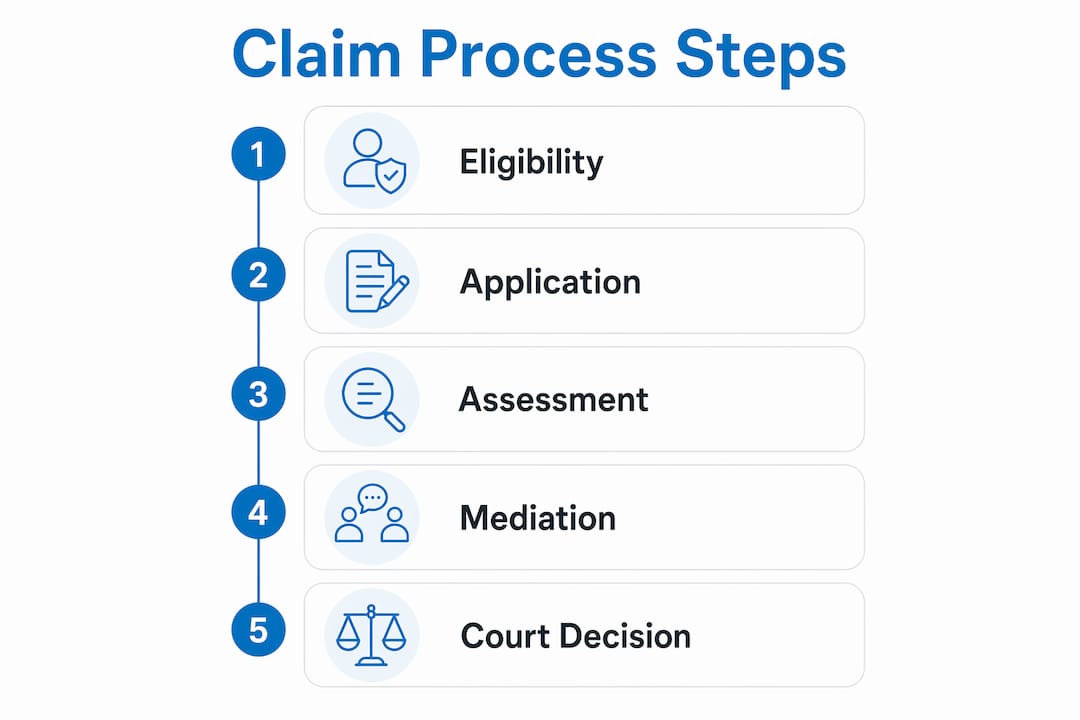
How does the family provision claim process work?
The process follows a defined sequence, and missing a deadline can permanently extinguish your right to claim.
- Obtain legal advice early. Before taking any formal step, get advice on eligibility, the strength of your claim, and the likely costs. Early advice shapes every decision that follows.
- Serve written notice on the executor. In Queensland, written notice to the executor must be given within 6 months of the date of death. In NSW, the filing deadline is generally 12 months from the date of death. Missing these deadlines is serious. Courts grant extensions only in rare circumstances.
- Gather evidence. You will need financial records, medical evidence if relevant, proof of your relationship with the deceased, and documentation of any contributions you made. The strength of your evidence directly affects your prospects.
- File the application. The claim is filed in the Supreme Court of the relevant state. In Queensland, formal filing must occur within 9 months of death.
- Attend mediation. Most claims settle through mediation before reaching a hearing. Mediation reduces costs and emotional strain for all parties, and courts actively encourage it.
- Proceed to hearing if unresolved. If mediation fails, the matter proceeds to a Supreme Court hearing where a judge determines the outcome.
Pro Tip: Do not wait until the estate is distributed before seeking advice. Once assets are transferred to beneficiaries, recovering them becomes significantly more complicated and costly.
Outcomes range from a lump sum payment to an adjusted share of the estate or, in some cases, a specific asset. The court tailors the remedy to the applicant’s actual needs rather than applying a fixed formula.
How do courts assess family provision claims?
Courts do not simply ask whether the applicant received less than they expected. The question is whether the deceased’s moral duty to provide for the applicant was left unfulfilled.
| Factor | What courts examine |
|---|---|
| Applicant’s financial need | Current assets, income, liabilities, and future earning capacity |
| Size of the estate | Total value of assets available for distribution, including notional estate in NSW |
| Relationship with deceased | Closeness, duration, and nature of the relationship |
| Applicant’s contributions | Financial, domestic, or caring contributions made to the deceased or estate |
| Competing beneficiaries | Financial circumstances and legitimate claims of other beneficiaries |
| Applicant’s conduct | Any behaviour the court considers relevant to the justice of the claim |
The notional estate concept in NSW adds a layer of complexity. If the deceased transferred significant assets to a new partner or placed property in a trust before death, those assets can be drawn back into the assessment pool. This prevents a testator from engineering a situation where the estate appears too small to support a claim.
“Courts are not rewriting the will to reflect what the applicant wanted. They are asking whether a wise and just testator, knowing all the circumstances, would have made greater provision.”
This framing matters. A claimant who received nothing but had a distant relationship and independent means faces a very different assessment than a dependent spouse who was left out of a will entirely.
Practical considerations for applicants and respondents
Whether you are considering making a claim or defending an estate against one, the practical realities deserve honest attention.
For applicants, the key risks are cost and time. Uncomplicated matters may cost up to $7,000, while contested claims can take 6 to 12 months or longer. That figure rises sharply if the matter proceeds to a Supreme Court hearing. Legal costs may be covered by the estate if your claim succeeds, but an unsuccessful or poorly prepared claim can result in a cost order against you personally.
For respondents and executors, the obligation is to administer the estate properly while the claim is on foot. Distributing the estate prematurely while a claim is pending creates personal liability for the executor.
Common pitfalls to avoid:
- Delaying legal advice until the deadline is close or passed
- Failing to document contributions made to the deceased during their lifetime
- Underestimating the emotional toll on family relationships
- Assuming a “no contest” clause in a will prevents a family provision claim. It does not. Such clauses are generally unenforceable against eligible persons in Australian jurisdictions.
- Overlooking the notional estate rules in NSW when assessing the true size of the estate
Pro Tip: Mediation is not a sign of weakness. Settling at mediation preserves family relationships, reduces legal fees, and produces a certain outcome. A court hearing produces certainty of a different kind: neither party controls the result.
Early legal advice consistently improves outcomes for both claimants and respondents by setting realistic expectations and identifying the strongest arguments before costs escalate.
Funding your legal matter — no win, no fee
Access to legal advice should not depend on whether you can afford to pay upfront. Simons George Legal offers No Win, No Fee arrangements for eligible family provision claims, meaning you do not pay legal fees unless your claim succeeds.
Eligibility for this arrangement is assessed during a free initial 30-minute consultation. Simons George Legal reviews the strength of your claim, your eligibility as an applicant, and the likely value of the estate before recommending a funding structure that suits your circumstances.
For many people, the upfront cost of legal fees is the single biggest barrier to pursuing a legitimate claim. No Win, No Fee removes that barrier and allows you to access specialist legal representation without financial risk at the outset.
Book a free case assessment with Simons George Legal to find out whether your matter qualifies.
No Win, No Fee arrangements are subject to case eligibility and a written costs agreement. Liability limited by a scheme approved under Professional Standards Legislation.
Key takeaways
A family provision claim succeeds or fails on three things: eligibility, evidence of inadequate provision, and compliance with strict procedural deadlines.
| Point | Details |
|---|---|
| Definition of the claim | A court application to redistribute an estate where adequate provision was not made for an eligible person. |
| Eligibility varies by jurisdiction | Spouses, children, de facto partners, and dependants qualify in most states, but definitions differ across NSW, QLD, and VIC. |
| Deadlines are critical | In NSW, claims must be filed within 12 months of death; in QLD, written notice is required within 6 months. |
| Most claims settle at mediation | Mediation resolves the majority of claims before a court hearing, reducing costs and preserving relationships. |
| Notional estate rules in NSW | Courts can include assets transferred before death when assessing what provision should be made. |
What I have learned from years of family provision work
George’s perspective on family provision claims and access to justice.
The cases that stay with me are rarely the ones with the largest estates. They are the ones where a person spent years caring for an ageing parent, contributed financially to a family business, or simply trusted that they would be looked after, only to find the will told a completely different story.
What surprises many clients is how much weight courts give to contributions. A written record of those contributions, kept contemporaneously, is worth more than any amount of retrospective evidence assembled after the fact. If you are in a situation where you are providing significant care or financial support to a family member, document it now.
The other observation I would offer is this: most disputes I see could have been avoided with a well-drafted, regularly updated will. Family provision claims are not a failure of the legal system. They are often the consequence of estate planning that did not keep pace with changing family circumstances. The inheritance disputes that reach litigation are almost always the ones where no one had an honest conversation about expectations while the deceased was still alive.
— George
How Simons George Legal can help with your claim

Simons George Legal is a dedicated wills and estates practice based in Bondi, serving individuals and families across Sydney. The firm acts in family provision claims and complex estate litigation, representing both applicants seeking greater provision and executors defending estates against claims.
Every client receives clear, honest advice tailored to their specific family and financial circumstances. Whether you are at the earliest stage of considering a claim or already facing a contested matter, Simons George Legal offers a complimentary 30-minute consultation to assess your situation and outline your options. Contact the team at Simons George Legal to book your free case assessment today.
FAQ
What is a family provision claim in simple terms?
A family provision claim is a legal application to the Supreme Court asking for a larger share of a deceased person’s estate because the will or intestacy rules failed to provide adequately for your proper maintenance and support. It does not challenge whether the will is valid.
Who is eligible to make a family provision claim in NSW?
Eligible persons in NSW include spouses, de facto partners, children, former spouses in certain circumstances, grandchildren who were dependent on the deceased, and persons in a close personal relationship with the deceased at the time of death.
How long do you have to make a family provision claim?
In NSW, the deadline to file is generally 12 months from the date of death. In Queensland, written notice to the executor must be given within 6 months and the formal application filed within 9 months. Courts rarely grant extensions, so acting promptly is critical.
What happens if a family provision claim is unsuccessful?
An unsuccessful claim may result in a cost order against the applicant, meaning you could be required to pay the other party’s legal costs. This risk underlines the importance of obtaining qualified legal advice before filing.
Can you make a claim even if you were left something in the will?
Yes. A family provision claim can succeed even where the applicant received a bequest, if the court finds that the amount provided was inadequate for their proper maintenance and support given all the circumstances.