A contested will is a formal legal challenge brought against a deceased person’s will, disputing either its fairness or its validity under New South Wales law. These disputes arise most commonly when an eligible person believes they received inadequate provision from the estate, or when there are serious questions about whether the will was properly made. The governing legislation in NSW is the Succession Act 2006 (NSW), which sets out who can challenge a will, on what grounds, and within what timeframes. Understanding your position early is the single most important step you can take.
What is a contested will under NSW law?
A contested will, more precisely called a will contest or will challenge in legal practice, covers two distinct types of proceedings in NSW. The first is a family provision claim, where an eligible person argues the deceased did not make adequate provision for their maintenance, education, or advancement in life. The second is a validity challenge, where the will itself is attacked on grounds such as lack of testamentary capacity, undue influence, fraud, or improper execution.
The distinction matters because the two pathways involve different courts, different evidence, and different timeframes. A family provision claim does not seek to invalidate the will. It asks the court to redistribute the estate more fairly. A validity challenge, if successful, can result in the will being declared void entirely, which may trigger intestacy rules if no earlier valid will exists.

Both types of dispute fall under the jurisdiction of the NSW Supreme Court, and both carry real financial and emotional costs. Knowing which type of claim applies to your situation shapes every decision that follows.
Who can contest a will in NSW?
Not everyone who feels aggrieved by a will has the legal right to challenge it. Eligibility under Section 57 of the Succession Act 2006 (NSW) is strictly defined, and courts apply that definition without exception.
Eligible persons include:
- Spouses and de facto partners of the deceased at the time of death
- Former spouses and former de facto partners in certain circumstances
- Children of the deceased, including adopted children
- Grandchildren who were wholly or partly dependent on the deceased
- Members of the deceased’s household who were dependent on them
- Persons in a close personal relationship with the deceased, where financial dependency can be demonstrated
The eligibility criteria under s.57 are deliberately broad to capture genuine dependency relationships, but they are not unlimited. A distant relative who simply expected to inherit, or a friend who feels overlooked, does not qualify. Courts focus on the nature and depth of the relationship, not on feelings of disappointment.
Pro Tip: If you are unsure whether you qualify as an eligible person, seek legal advice before the 12-month deadline passes. Eligibility is assessed on the specific facts of your relationship with the deceased, and an experienced solicitor can give you a clear answer quickly.
Proving eligibility is only the starting point. You must also demonstrate that the provision made for you (or the absence of any provision) was inadequate given your financial circumstances and needs. Eligibility alone does not guarantee a successful claim.
What are the legal grounds for contesting a will?
The legal grounds for contesting a will in NSW fall into two broad categories. Understanding the difference between them is critical because they lead to entirely different legal processes.
Family provision claims
Family provision claims are the most common type of will dispute in NSW. The court does not ask whether the will was properly made. It asks whether the deceased’s moral duty to provide for the claimant was fulfilled. Factors the court weighs include the claimant’s financial need, the size of the estate, the nature of the relationship, and the competing claims of other beneficiaries.
Validity challenges
Challenges to a will’s validity are based on different grounds entirely. Validity may be disputed on the following bases:
- Lack of testamentary capacity: The deceased did not understand the nature of making a will, the extent of their estate, or the claims of those who might benefit.
- Undue influence: Another person pressured or coerced the deceased into making or changing the will.
- Fraud or forgery: The will was fabricated or the deceased’s signature was forged.
- Improper execution: The will was not signed and witnessed in accordance with the formal requirements of the Succession Act 2006 (NSW).
These grounds require strong proof, often involving medical records, forensic handwriting analysis, and witness testimony. The evidentiary bar is high.
| Ground | Type of claim | Key requirement |
|---|---|---|
| Inadequate provision | Family provision | Financial need and eligible person status |
| Lack of testamentary capacity | Validity challenge | Medical or expert evidence of incapacity |
| Undue influence | Validity challenge | Proof of coercion or pressure |
| Fraud or forgery | Validity challenge | Forensic or documentary evidence |
| Improper execution | Validity challenge | Procedural defect in signing or witnessing |
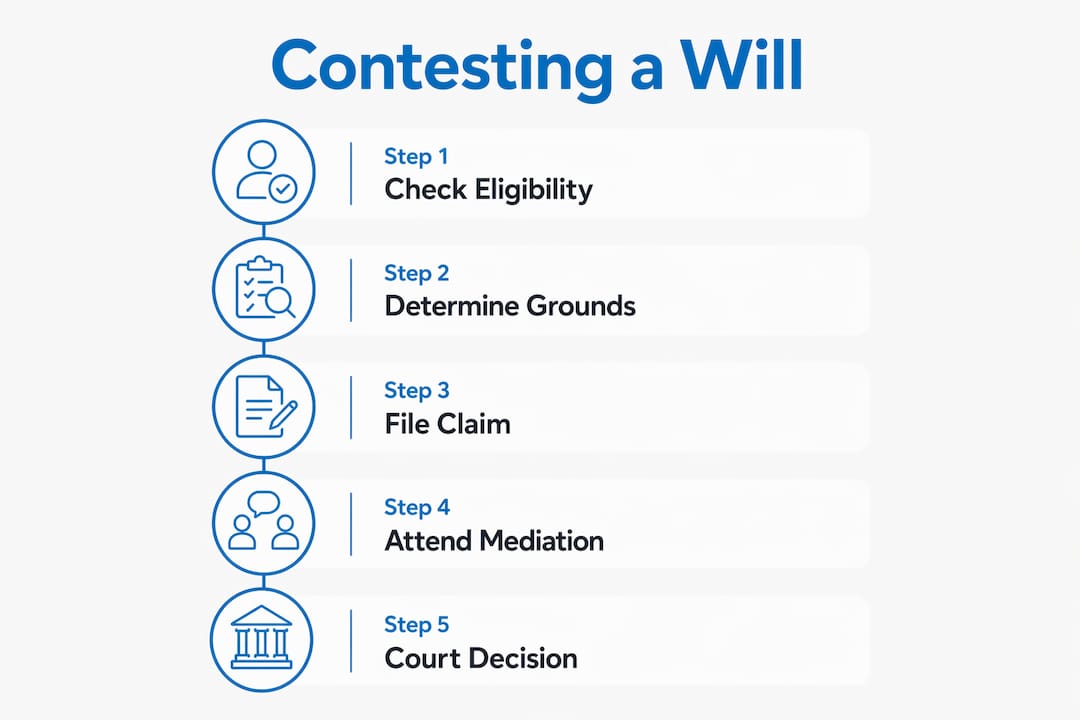
How to contest a will in NSW: step-by-step
The contesting a will process in NSW follows a defined sequence. Acting promptly at each stage protects your rights and improves your prospects.
- Seek legal advice immediately. The 12-month deadline from the date of death for family provision claims is strictly enforced by NSW courts. Extensions are rare and granted only in exceptional circumstances such as fraud or serious incapacity. Missing this deadline can permanently extinguish your right to claim.
- Gather your evidence. Comprehensive evidence is required from the outset. This includes the deceased’s will, financial documents showing your dependency, proof of your relationship, correspondence, and any witness statements that support your position.
- Send a formal letter of demand. Before filing in court, your solicitor will typically write to the executor outlining your claim and inviting negotiation. Many disputes are resolved at this stage without any court involvement.
- File your claim in the NSW Supreme Court. If negotiation fails, your solicitor files a summons and supporting affidavit in the Supreme Court of NSW. The claim is formally on foot from this point.
- Attend mediation. NSW courts require parties to attempt mediation before proceeding to a hearing. Legal experts confirm that mediation is a crucial stage for reducing family conflict and reaching settlement. The majority of family provision claims resolve at or before mediation.
- Proceed to hearing if necessary. If mediation fails, the matter proceeds to a contested hearing before a judge. The judge considers all evidence and makes orders about the distribution of the estate.
Pro Tip: Do not wait until the deadline is close before seeking advice. Early legal intervention gives your solicitor time to gather evidence, negotiate effectively, and explore settlement options before costs escalate.
What happens in a will contest: outcomes and pitfalls
Family provision claims typically resolve within 6 to 18 months, with many settling through mediation well before a court hearing. Validity challenges can take longer, particularly where forensic evidence is required.
Successful outcomes vary depending on the type of claim:
- A successful family provision claim results in the court ordering additional provision from the estate, either as a lump sum or specific asset.
- A successful validity challenge can result in the will being declared void, with the estate distributed under an earlier valid will or under intestacy rules.
- Partial success is also possible, where the court increases provision but not to the level sought.
The financial risks of contesting deserve serious attention. Claims based purely on emotional grievances or a sense of being left out are routinely dismissed. Courts apply statutory criteria, not moral sympathy. A claimant who fails may be ordered to pay the estate’s legal costs, which can reduce or eliminate any inheritance they might otherwise have received.
“The court’s role is not to rewrite a will because a family member feels it is unfair. The court asks whether the deceased failed in a legal duty to provide for someone with a genuine financial need.”
Mediation is not just a procedural step. It is often the most constructive pathway for families who want to preserve relationships while resolving a genuine dispute. Settlements reached in mediation are private, faster, and less costly than a court hearing.
Practical advice before you start contesting a will
Before committing to a will contest, consider the following:
- Assess your eligibility honestly. Not every grievance translates into a legal claim. A solicitor experienced in challenging a will can assess your position at an early consultation.
- Organise your financial records. Courts require clear evidence of your financial circumstances, your dependency on the deceased, and the adequacy of any provision made for you.
- Understand the costs involved. Even with a strong claim, litigation is expensive and emotionally draining. Weigh the likely outcome against the cost and time involved.
- Consider the family impact. Will disputes can permanently damage relationships. Mediation and negotiated settlements often produce better outcomes for everyone involved.
- Act within the time limit. Strict enforcement of time limits makes early legal advice the single most important step you can take to preserve your rights.
Pro Tip: Bring every document you can find to your first legal consultation: the will, any earlier wills, financial statements, correspondence with the deceased, and details of your relationship. The more your solicitor knows at the outset, the better they can assess your claim.
Funding your legal matter: No Win, No Fee
Simons George Legal offers No Win, No Fee arrangements for eligible will contest matters. This means you do not pay legal fees upfront if your case qualifies. Eligibility is assessed during a free 30-minute initial consultation, where the firm reviews your circumstances and advises whether your claim has merit.
For many families, the cost of litigation is the single biggest barrier to pursuing a legitimate claim. No Win, No Fee removes that barrier for eligible clients, allowing you to access experienced legal representation without financial risk at the outset.
Book your free case assessment with Simons George Legal today to find out whether your matter qualifies.
No Win, No Fee arrangements are subject to case eligibility and a written costs agreement. Liability limited by a scheme approved under Professional Standards Legislation.
Key takeaways
Contesting a will in NSW requires eligibility under the Succession Act 2006 (NSW), clear legal grounds, and prompt action within the 12-month deadline to protect your rights.
| Point | Details |
|---|---|
| Definition of a contested will | A formal legal challenge to a will’s fairness or validity under NSW succession law. |
| Eligibility is strictly defined | Only persons listed under Section 57 of the Succession Act 2006 (NSW) can bring a claim. |
| Two distinct grounds exist | Family provision claims address fairness; validity challenges address how the will was made. |
| The 12-month deadline is firm | Family provision claims must be filed within 12 months of death, with rare exceptions. |
| Costs risks are real | Failed claimants may be ordered to pay the estate’s legal costs, reducing any potential inheritance. |
What I’ve learned from years of contested will matters
After working through many contested estate matters, the pattern I see most often is this: families wait too long, and by the time they seek advice, the deadline is dangerously close or the evidence has become harder to gather.
The second pattern is equally common. People come in convinced they have a strong claim because they feel the will was unfair. Courts do not share that standard. NSW courts apply the Succession Act 2006 (NSW) with precision. Financial need, dependency, and the nature of the relationship are what matter. Hurt feelings, however understandable, do not move a judge.
What I find genuinely encouraging is how often mediation resolves these disputes in a way that preserves something of the family relationship. A negotiated settlement, reached privately and without a public court hearing, is almost always preferable to a contested judgment. It is faster, less costly, and leaves room for the family to move forward.
My honest advice: if you think you may have a claim, get advice now. Not next month. Now. The 12-month clock starts from the date of death, not from when you decided to act.
— George
Speak with Simons George Legal about your matter
If you are facing a will dispute in NSW, Simons George Legal provides experienced, practical support at every stage of the process.

The firm’s wills and estates lawyers in Bondi act in family provision claims, validity challenges, and complex estate litigation across Sydney. Every new client receives a complimentary 30-minute consultation to assess their situation and identify the most practical path forward. Whether you are considering a claim or defending one, Simons George Legal provides clear advice tailored to your family and financial circumstances. Contact the firm today to book your free consultation.
FAQ
What is the difference between contesting and challenging a will?
Contesting a will typically refers to a family provision claim, where an eligible person argues they received inadequate provision from the estate. Challenging a will refers to a validity dispute, where the will itself is attacked on grounds such as lack of testamentary capacity, undue influence, or improper execution.
How long do you have to contest a will in NSW?
Family provision claims must be filed in the NSW Supreme Court within 12 months of the date of death. Extensions are granted only in exceptional circumstances, making early legal advice critical.
Who pays legal costs in a will contest?
Costs orders vary depending on the outcome. A successful claimant may have costs paid from the estate, but a claimant who fails may be ordered to pay the estate’s legal costs, which can significantly reduce or eliminate any expected inheritance.
Can an estranged child contest a will in NSW?
Yes, an estranged child is still an eligible person under Section 57 of the Succession Act 2006 (NSW) and can bring a family provision claim. However, the nature and length of the estrangement is a factor the court will weigh when assessing the claim. Simons George Legal has specific experience with estranged family inheritance rights in NSW.
Does contesting a will delay the estate administration?
Yes. A contested will can delay the distribution of the estate for the duration of the proceedings, which typically range from 6 to 18 months. Executors are generally required to hold estate assets until the dispute is resolved or a court order is made.