If you’re facing an urgent probate situation in NSW, three things protect your position right now: preserve the original will and every related document, lodge a caveat if you have a legitimate interest, and contact the Supreme Court Probate Registry or a specialist lawyer immediately. Expedition requests exist but can’t be considered until 14 days after notice of intended application. Waiting risks assets being distributed before you can act.
TL;DR:
- Filing a caveat properly requires a genuine interest such as being a beneficiary or disputing the will’s validity; improper caveats risk costs orders.
- Urgent expedition requests to speed up probate processing must be supported by evidence of immediate, genuine need and filed at least 14 days after notice of application.
- Suspected probate fraud cases need quick action to preserve evidence, lodge caveats, and consider civil or criminal proceedings before assets are distributed.
- Contact the Supreme Court probate registry early to check application status and gather witnesses and documents within the first 72 hours to protect your legal position.
- No Win, No Fee arrangements are available for eligible urgent cases, helping reduce upfront costs for contested probate, fraud, or expedition proceedings.
Table of Contents
- First actions: what to do in the first 24 to 72 hours
- Stopping probate before a grant: caveat, appearance and contested proceedings
- How to request urgent expedition of a probate application from the Supreme Court
- Probate fraud and forged wills: urgent civil and criminal options
- What the Court does next: probate list days, timelines and likely orders
- How specialists triage urgent probate matters
- Funding your legal matter, No Win, No Fee
- Essential court pages, practice notes and forms for urgent probate matters
- Sources
- FAQ
First actions: what to do in the first 24 to 72 hours
The first three days after you learn about an urgent probate problem, whether it’s a suspected forged will, a missing document or a property sale about to fall through, decide whether you have any options left. Acting fast preserves evidence and keeps your legal choices open.
Start with the physical documents. Locate the original will, not a photocopy, and any earlier drafts, correspondence with the deceased’s solicitor, or notes about changes they intended to make. Photograph each page and record who has held the document and when. This chain of custody matters enormously if the will’s validity is challenged later.
Next, build a contact list. You’ll want names and details for anyone who witnessed the will, treating doctors or specialists who saw the deceased close to when it was signed, and any financial institutions or real estate agents currently handling the estate’s assets. If a property sale is underway, get the agent’s contact details and the contract of sale.
Avoid informal arrangements during this window. Do not agree to divide assets, sign anything releasing your claim, or let anyone move money or property “just to sort things out temporarily.” These steps are hard to undo and can weaken your legal position even when everyone involved has good intentions.
- Preserve the original will and log who has accessed it, with dates.
- Gather contact details for witnesses, doctors and financial institutions.
- Avoid informal negotiations, asset transfers or signing anything under pressure.
- Check the filing status of any probate application already lodged with the registry.
- Book a short consultation with an estates lawyer to triage your options.
Contact the Probate Registry to check whether an application has already been filed and what stage it’s at. If someone else is the applicant, this tells you how much time you realistically have. From there, a short initial consultation with a specialist can clarify whether you have standing to object, whether a caveat is appropriate or whether the situation calls for something more urgent, like an approach to the duty judge.
Pro Tip: Keep a single running document, even just notes on your phone, that records every date, conversation and document you encounter from day one. Courts and lawyers both move faster when the timeline is already assembled.
Stopping probate before a grant: caveat, appearance and contested proceedings
If you believe a grant of probate should not be issued, whether because you dispute the will’s validity, suspect undue influence, or believe a later will exists, a caveat is usually your fastest tool. Filing one with the Supreme Court stops the registry issuing a grant immediately, and it stays in effect for six months unless it’s withdrawn, lapses or the court orders it to cease.
A caveat matters because informal objections do nothing. A phone call to the registry, an email to the executor, or a verbal warning to family members has no legal effect on the grant process. Only a properly filed caveat, or a court order, actually halts things.
- Confirm you have a legitimate interest, such as being a beneficiary, next of kin, or a party disputing the will’s validity, before filing.
- Complete UCPR Form 141 and file it with the Supreme Court’s probate registry.
- Serve the caveat as required and monitor the six-month window, since it lapses automatically if not renewed or converted into contested proceedings.
- If the dispute is serious, file an appearance and prepare for contested proceedings, which may require the executor to prove the will in solemn form.
Filing a caveat without a genuine interest carries real risk. The Supreme Court’s guidance is explicit that an improper caveat can expose the person who lodged it to costs orders, so this isn’t a tool to use defensively “just in case.” If your concern is more serious than a temporary hold, such as clear evidence of forgery or a later will, contested proceedings and a solemn form grant may be necessary from the outset rather than starting with a caveat.
How to request urgent expedition of a probate application from the Supreme Court
Sometimes the problem isn’t stopping a grant, it’s getting one faster. The Supreme Court does allow requests for expedited processing, but the process is specific and the grounds are limited.
Requests go to [email protected], addressed to the Prothonotary. Your email needs the estate’s name, the filing date of the application, and a clear explanation of why urgency is warranted. The Supreme Court’s own guidance sets out acceptable grounds: a pending property settlement at risk of falling through, active litigation that depends on the grant, financial hardship for a sole beneficiary, or a need to preserve business continuity.
- Email the Prothonotary with the estate name, filing date and specific reasons for urgency.
- Attach evidence such as a signed settlement contract, a property listing, or documents showing financial hardship.
- Remember the mandatory 14-day rule: expedition cannot be considered until 14 days after the notice of intended application, under section 42(2)(b) of the Probate and Administration Act 1898.
- Do not expect expedition to be granted for delays caused by the executor or for property sales that proceeded without proper authority.
That last point trips people up often. The court will not fast-track an application simply because an executor has been slow, and it won’t retroactively bless a property sale that went ahead before probate was properly dealt with. Expedition is for genuine, evidenced urgency, not for fixing avoidable delay. Bring documentary proof, a settlement contract or listing notice carries far more weight than a description of the situation.
Probate fraud and forged wills: urgent civil and criminal options
Suspected probate fraud demands a different kind of speed. If you believe a will has been forged, that an earlier will was concealed, or that an affidavit supporting an application contains false information, every day matters more than usual because once assets are distributed, getting them back is difficult.
Watch for the common indicators: a “final” will that conveniently favours one party and appeared shortly before death, witnesses who can’t be located or whose signatures don’t match other documents, undervaluation of estate assets in the probate application, or an executor who resists sharing information with beneficiaries.
- Secure the original will and any prior versions, and don’t let anyone else handle them.
- Get written statements from witnesses as soon as possible, while memories are fresh.
- Lodge a caveat if you have standing, to prevent a grant while you investigate further.
- Consider whether the matter should proceed as contested probate, a claim for revocation of an existing grant, or a solemn form application.
- Report suspected forgery to police where the evidence supports a criminal element, alongside any civil action.
Civil and criminal tracks can run at the same time. A police referral doesn’t stop you from also filing a caveat or starting contested proceedings, and in serious cases both are appropriate. The civil process protects the estate’s assets while a criminal investigation, which moves on its own timeline, deals with the conduct itself.
Pro Tip: If you suspect fraud, resist the urge to confront the suspected wrongdoer directly before you’ve secured documents and witness statements. Early confrontation can prompt destruction of evidence.
What the Court does next: probate list days, timelines and likely orders
Once you’ve taken action, whether that’s a caveat, an expedition request or a fraud referral, it helps to know how the Supreme Court actually processes these matters.
Under Practice Note SC EQ 07, the Registrar in Probate manages the Probate List on Tuesdays and family provision matters are heard on Thursdays. Urgent applications go to the Registrar in Probate first, who can refer a matter to a judge when the situation demands it. If the Registrar isn’t available and the matter is genuinely an emergency, such as imminent distribution of assets or irreparable harm, the duty judge can be approached directly.
Processing times move week to week. The Supreme Court publishes current figures, and applications filed in late August 2026 were still under assessment into early September 2026, according to the latest Court figures.
| Stage | What happens | Who manages it |
|---|---|---|
| Standard filing | Application assessed in filing order | Registry staff, Registrar in Probate |
| Expedition request | Considered only after the 14-day notice period | Prothonotary, then Registrar in Probate |
| Caveat filed | Grant blocked for up to six months | Registrar in Probate |
| Genuine emergency | Ex parte relief where Registrar unavailable | Duty Judge |
For executors and beneficiaries, the practical consequence of doing nothing is straightforward: the standard queue keeps moving. If you have grounds to object or a genuine need for speed, silence doesn’t preserve your position, only a caveat, a properly evidenced expedition request or contested proceedings does.
How specialists triage urgent probate matters
When a specialist takes on an urgent probate matter, the first job is working out three things quickly: does this person have standing to act, how urgent is the situation really, and what’s the right document to file. Getting this sequence wrong, filing a caveat without standing, for instance, can create costs exposure that outweighs whatever the original problem was.
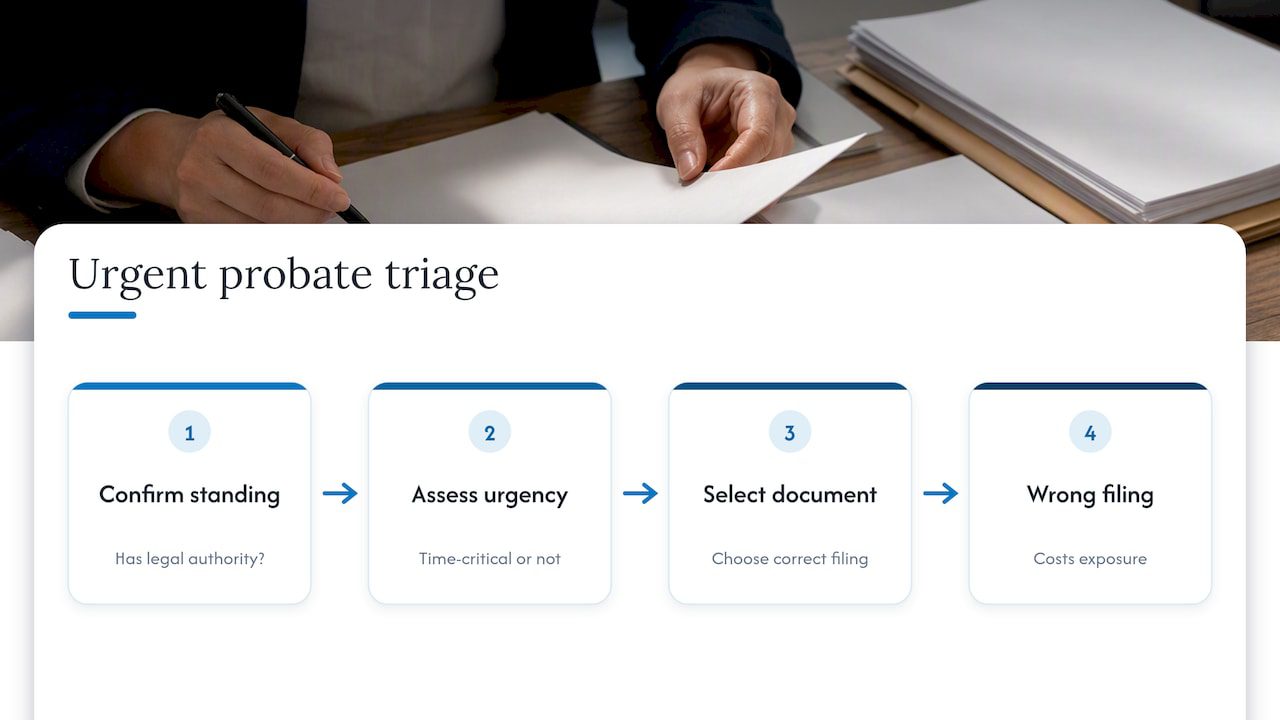
The practical triage that saves both time and money usually comes down to preparation. Having short minutes ready before approaching the Registrar in Probate, serving interested parties early rather than waiting for a directions hearing to force it, and assembling a documentary bundle before, not after, a hearing date is set all shorten the path to resolution.
The most common mistake is understandable but costly: people act on instinct, lodging a caveat because it feels protective, or transferring an asset informally because a family member asked. Neither move holds up well once the matter is examined properly.
— George
Funding your legal matter, No Win, No Fee
Cost is often the biggest reason people delay acting on an urgent probate problem, even when they have a legitimate claim. No Win, No Fee arrangements are available for eligible cases, with eligibility checked during a free initial consultation. This removes the upfront cost barrier that stops many people from pursuing a claim they’d otherwise be entitled to make.
If you’re dealing with a caveat decision, a suspected forged will, or an urgent expedition request, book a free case assessment with Simons George Legal to find out where you stand and what it would cost to act.

No Win, No Fee arrangements are subject to case eligibility and a written costs agreement. Liability limited by a scheme approved under Professional Standards Legislation.
Essential court pages, practice notes and forms for urgent probate matters
For direct reference, the Supreme Court’s probate pages cover applications and expedition requests, Practice Note SC EQ 07 sets out list procedures, and the Probate List Guidelines detail service requirements for contested matters. Caveats use UCPR Form 141, filed directly with the registry.
This article is general information, not a substitute for advice from a qualified lawyer. Consult a qualified legal professional about your own circumstances before acting on anything here.
FAQ
What is the typical waiting time for probate in NSW?
Processing times vary by filing volume and change regularly. The Supreme Court publishes current figures showing applications filed between 19 August 2026 and 27 August 2026 were still under assessment in early September 2026, so checking the current published times before assuming a timeframe is worthwhile.
What is the average cost of probate in NSW?
Simons George Legal doesn’t publish a fixed probate fee, since costs depend on the estate’s complexity and whether the matter is contested. A free initial consultation is the fastest way to get a clear estimate for your specific situation.
Can I do probate myself in NSW?
Yes, executors can file a probate application themselves through the Supreme Court’s own process, and many straightforward, uncontested estates are handled this way. Complications like disputed wills, suspected fraud, or urgent expedition requests generally call for specialist legal advice given the strict evidence and timing rules involved.
How soon can an estate be distributed after probate in NSW?
There’s no single fixed timeframe, as it depends on the estate’s assets, any outstanding claims and whether a caveat or contested proceedings are in play. Executors typically wait a period after the grant to allow potential family provision claims or objections to surface before distributing, since early distribution can leave them personally exposed if a valid claim later emerges.