A transmission application is the document that puts a deceased person’s land into the name of the person who now controls it. That person is the executor, the administrator, or in some cases the beneficiary. In NSW it is lodged electronically with NSW Land Registry Services after a grant of probate or letters of administration, and it is where many estates stall, because a mistake in the grant, the title or the entitlement stops registration. If the estate is contested, or you are unsure who is entitled to the property, get advice before lodging. At Simons George Legal we run probate and estate administration and contested estate matters from our Bondi base, so the application is lodged with the dispute in view.
TL;DR
- A transmission application under section 93 of the Real Property Act 1900 registers the executor, administrator, trustee, beneficiary or next of kin as the owner of land held by someone who has died.
- It follows a grant of probate or letters of administration. There are two forms: 03AE (to the executor, administrator or trustee) and 03AD (direct to a beneficiary or next of kin).
- It is lodged through PEXA, the electronic conveyancing network, by a practitioner who certifies that the grant and supporting evidence are held.
- A transfer by an executor to a beneficiary under the will usually attracts a fixed $100 duty rather than full transfer duty. Buyouts that depart from the will can cost far more.
- If anyone may challenge the will or the distribution, settle that before the land is registered in anyone’s name.
Table of Contents
- What a transmission application does
- The grant comes first
- Two types of application: 03AE and 03AD
- How to lodge a transmission application in NSW
- Transfer duty on deceased estate land
- Why a transmission application matters in a contested estate
- Common problems that hold up a transmission
- Perspective: why we treat this as a legal step, not an administrative one
- Getting help with your transmission application
- Funding Your Legal Matter — No Win, No Fee
- FAQ
- Sources
What a transmission application does
Land in NSW is registered on a title, and the registered proprietor is the person the register names. When that person dies, the register does not update itself. According to the Registrar General’s guidelines, where the deceased held the land solely or as a tenant in common, a Transmission Application under section 93 of the Real Property Act 1900 applies to register the executor, administrator or trustee, or the devisee, beneficiary or next of kin, as proprietor.
Some terms, in plain words:
- Executor: the person named in the will to administer the estate.
- Administrator: the person a court appoints when there is no will or no executor able to act.
- Devisee: a person who is left land under a will.
- Tenant in common: a co-owner who holds a separate share that passes under their will. Joint tenants are treated differently, because the surviving owner takes the whole property by survivorship, so no transmission is needed for the deceased’s share.
Until the application is registered, the executor generally cannot sell or transfer the land, because the title still shows the deceased. That is why the application sits in the middle of most estate administrations that involve a house, a farm or an investment property. Our step-by-step guide to the probate application covers the stage before it.
The grant comes first
A transmission application is not the first step. The Registrar General’s Circular 04 says the application follows a grant of probate or letters of administration. Probate is the Supreme Court’s confirmation that the will is valid and the executor may act. Letters of administration is the equivalent where there is no will, or no executor who can act. If you do not yet have either, the land cannot be transmitted.
If there is no will at all, the law decides who inherits, and that decides who can apply for the grant and who ends up with the land. Our guides to dying without a will in NSW and the intestate succession rules explain that order of entitlement.
Two types of application: 03AE and 03AD
The Registrar General’s Schedule of eDealings lists the two forms. Form 03AE is the transmission application by an executor, administrator or trustee. Form 03AD is the transmission application by a devisee, beneficiary or next of kin. Both are made under section 93 of the Real Property Act 1900.
| Executor, administrator or trustee (03AE) | Direct to beneficiary (03AD) | |
|---|---|---|
| Who becomes the registered proprietor | The personal representative | The beneficiary, devisee or next of kin |
| When it suits | The executor will sell the land, hold it on trust or transfer it later | The land is going to the beneficiary under the will or intestacy and no sale is needed |
| Extra step | A later transfer or sale is needed to move the land on | The executor, administrator or trustee must consent |
Registering the executor
This is the usual route when the executor needs to sell or deal with the property. Registering the executor puts the executor in a position to sell, and the proceeds then go back into the estate for distribution. It also keeps options open if the family has not agreed what to do with the property.
Going direct to a beneficiary
The NSW Land Registry Services form 03AD asks the applicant to state their entitlement, the date of death, and the probate or letters of administration number and grant date. It also asks for the Revenue NSW Duties Assessment Number, and the applicant signs before an eligible witness. The executor, administrator or trustee must consent, with that signature witnessed as well. Where a Notice of Sale is required, the form certifies that the relevant electronic notice data has been submitted and stored.
The direct route skips a step, but only when the entitlement is clear. If two beneficiaries disagree about who gets the house, a direct application naming one of them is the wrong tool.
How to lodge a transmission application in NSW
Both types have been available on PEXA since 16 July 2018, according to Circular 04. Since 1 July 2019, the Registrar General’s Rules of Conveyancing material requires mainstream dealings, including transmission applications, to be lodged electronically. Waivers exist for limited cases only. In practice, an individual executor does not lodge on PEXA alone: a lawyer or conveyancer does it.
The working sequence runs like this.
- Confirm the grant and the title. Check the grant names the right executor or administrator, and that the title search shows the deceased as proprietor in the capacity you expect (sole owner, or tenant in common). Errors here are the most common reason an application cannot proceed.
- Work out who should be registered. Decide between the executor route and the direct-to-beneficiary route. This depends on whether the land will be sold, kept in the estate, or handed over under the will.
- Deal with Revenue NSW. For a direct-to-beneficiary application, obtain the Duties Assessment Number before you lodge. The next section explains the duty position.
- Prepare the document in PEXA. PEXA’s help guide for NSW transmissions explains that you create the document from the Documents menu, confirm the titles and then check the applicant details. If several co-owners have died, each transmission goes in its own workspace, lodged one after another, and the first must be registered before the next workspace is created.
- Certify the evidence. For electronic lodgement, the grant need not be attached or uploaded. Instead, Circular 04 says the practitioner must certify that the supporting evidence is retained and that reasonable steps were taken to make sure the application is correct and compliant. A false certification risks suspension or termination of the practitioner’s PEXA subscription, which is why practitioners are careful about what they sign.
- Lodge, settle and register. Once registered, the title shows the new proprietor and the land can be dealt with.
The same circular says a Transmission Application and a Transfer must be lodged in separate electronic cases. PEXA’s own guide describes a transmission and a transfer sharing one workspace, so confirm the current rule with your practitioner before you plan the sequence.
In a straightforward estate, this is a few days of work after the grant. In an estate where the executor has a conflict with a beneficiary, the lodging itself is easy and the preparation is the hard part.
Transfer duty on deceased estate land
Beneficiaries often assume they pay full stamp duty to inherit a house. They generally do not, if the transfer follows the will.
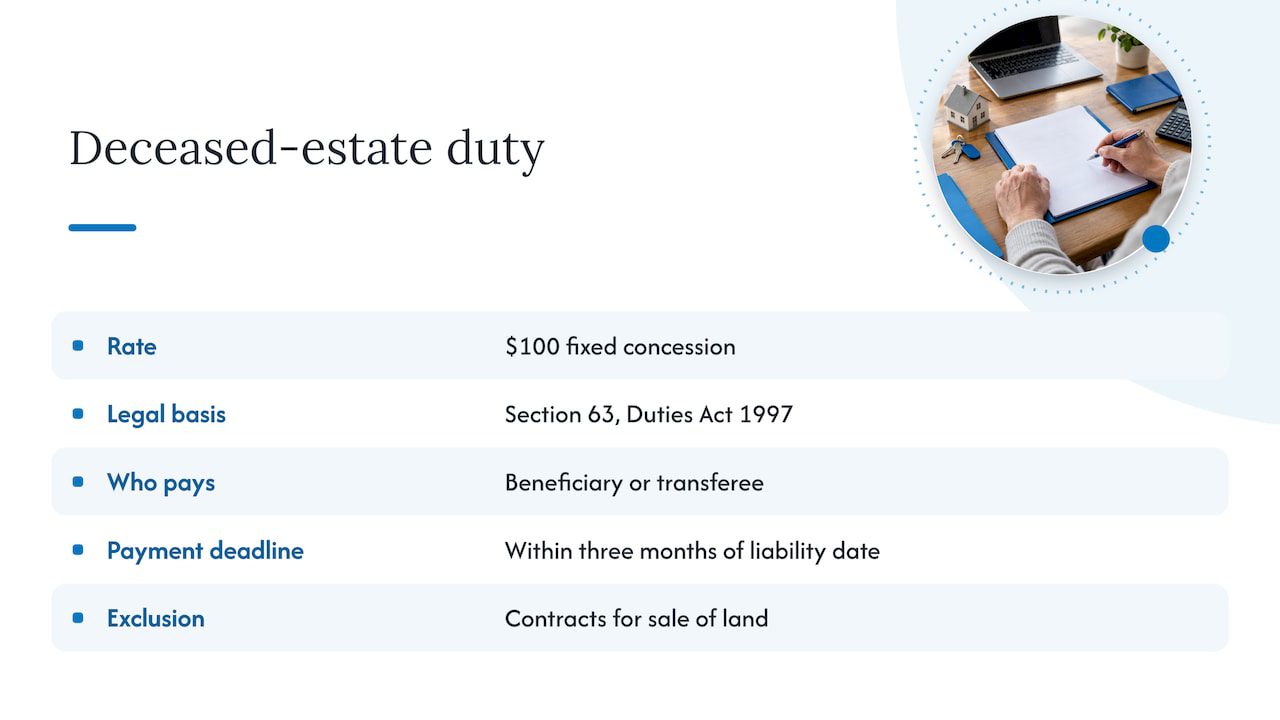
Revenue NSW (page updated 18 June 2026) grants the $100 concessional rate where the executor or administrator transfers property directly to a beneficiary under and in conformity with the will, the intestacy rules, a court order, a trust for sale, or an appropriation of the beneficiary’s entitlement. The legal basis is section 63 of the Duties Act 1997. Revenue NSW’s property professionals overview says the concession covers a transmission application to an executor, administrator or trustee, a transmission application to a beneficiary or devisee, and a transfer from executor to beneficiary. Duty is payable by the beneficiary or transferee, within three months of the liability date. It does not apply to a contract for sale of land.
The fixed amount is $100. Revenue NSW’s ruling DUT 046 records that the former $50 figure increased to $100 from 1 February 2024.
When a buyout changes the answer
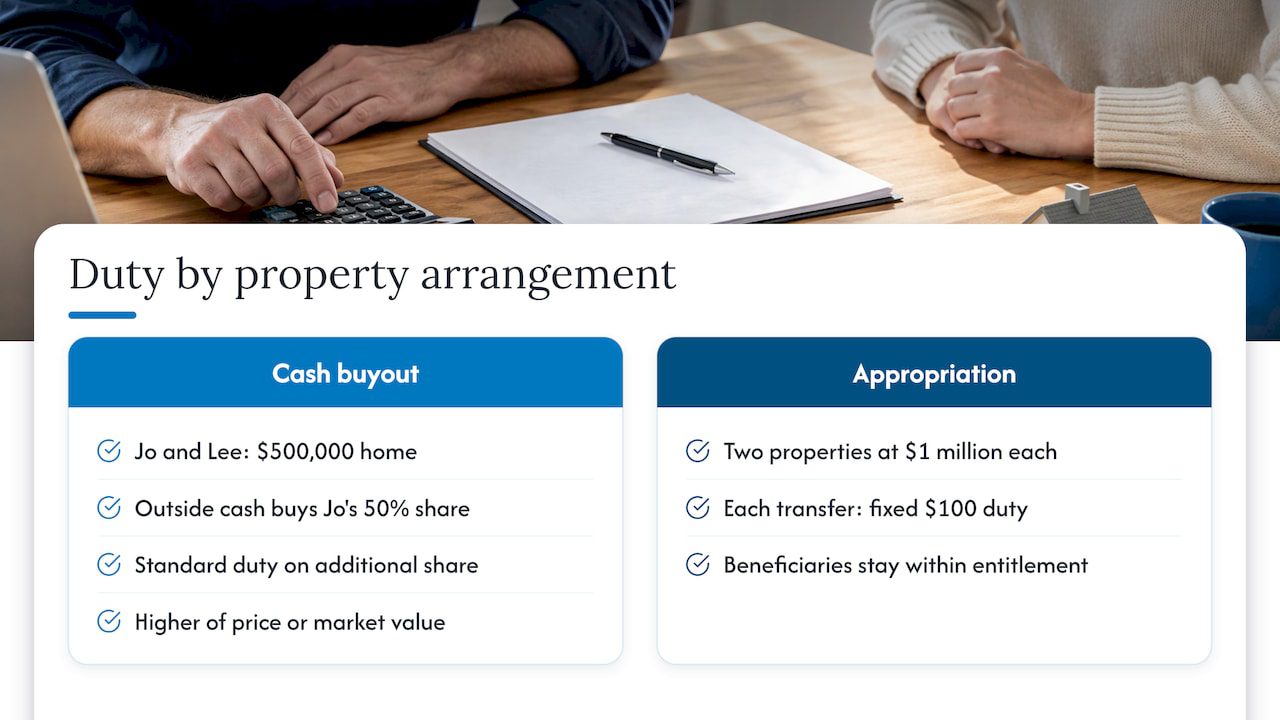
The concession follows the will, not the family’s preference. Revenue NSW gives an example of siblings Jo and Lee, each entitled to 50% of a $500,000 home. If Lee buys Jo out with cash from outside the estate, standard duty applies to the additional 50%, calculated on the higher of the amount paid or the market value. By contrast, where an appropriation keeps each beneficiary within their entitlement, Revenue NSW’s two-property example (two properties of $1 million each) keeps each transfer at the fixed duty.
The practical lesson is to settle how the property will be divided before the paperwork is prepared. A well-meant family arrangement made after the grant can turn a $100 transfer into a five-figure bill. Our guide to deceased estate tax obligations in NSW covers the wider tax picture.
Why a transmission application matters in a contested estate
Registering land is an act of administration, and it changes who holds legal title. In a harmonious estate that is routine. In a contested one it can be the moment the dispute becomes real.
If you are an executor, you owe duties to every beneficiary. Lodging a transmission direct to one beneficiary while another is preparing a claim can expose you to allegations that you favoured one person or dealt with an asset improperly. If someone is threatening a challenge, the sensible course is to take advice before the land moves.
If you are a beneficiary, you may be asked to sign a consent or a family arrangement so the property can be transferred quickly. Signing without understanding the duty and the effect on your entitlement is how people lose value. If you think you were left too little, that deserves attention before the land is registered, because time limits apply to claims on the estate. Our guide to contesting a will in NSW: eligibility, time limits and costs sets them out, and family provision claims are the usual route for an eligible person left without adequate provision.
If you are being challenged, an executor facing a claim needs a plan for the assets. Our page on how to defend an estate is the place to start.
It also helps to understand why estate disputes go to court, and to keep records from the start. Our inheritance dispute documentation checklist lists what to gather.
Common problems that hold up a transmission
Most delays come from a short list of causes. Our guide to estate administration delays goes deeper, but these are the ones that matter for land.
- Mismatch between the grant and the title. A name spelled differently, or a title held in a different capacity, has to be explained before registration.
- Several deceased owners. Where multiple tenants in common have died, PEXA requires a separate transmission for each, one registered before the next begins.
- Missing consent. A direct-to-beneficiary application needs the executor’s witnessed consent.
- No duties assessment. The Revenue NSW assessment number is part of form 03AD, so the duty question has to be answered first.
- Unresolved family disagreement. A transmission that a beneficiary later says was premature becomes evidence in the dispute.
Perspective: why we treat this as a legal step, not an administrative one
Executors often tell us they were handed a title search and a form and assumed the rest was clerical. For a simple estate it can be. For an estate where a relative is unhappy, it is a decision with consequences.
Our matters are partner-led by a specialist with extensive Supreme and High Court experience, so the person who advises you on the transmission is the same person who understands how it would look in court. That matters when we are asked to register land in one name while a family provision claim is still possible.
We would rather talk through the order of steps with you at the start than repair a registration later. Our approach is clear, honest advice about who should be registered, when, and what it means for the other beneficiaries.
George
Getting help with your transmission application
If you are an executor, our probate and estate administration service takes you from the grant to the registered title, including the duty position and any dispute risk along the way. If the estate is already in dispute, our estate litigation team acts for executors and beneficiaries across Sydney, the Eastern Suburbs, the Northern Rivers and regional NSW, in person or virtually. New clients receive a complimentary 30-minute consultation, where we assess your situation and recommend practical next steps.

If you have not yet made your own will, the same lesson applies in reverse: clear instructions now save your family from this process later. See making and amending a will.
Funding Your Legal Matter — No Win, No Fee
Simons George Legal offers No Win, No Fee arrangements for eligible cases. We check eligibility during a free initial consultation, so you know where you stand before committing to anything. For people with a legitimate claim, this removes the upfront cost barrier that can otherwise stop a valid inheritance dispute before it starts. You can read how it works on our No Win, No Fee page. To find out whether your matter qualifies, book a free case assessment with us today.
No Win, No Fee arrangements are subject to case eligibility and a written costs agreement. Liability limited by a scheme approved under Professional Standards Legislation.
FAQ
What is a transmission application in NSW?
It is the application, made under section 93 of the Real Property Act 1900, that registers an executor, administrator, trustee, beneficiary or next of kin as the proprietor of land held by someone who has died. It follows a grant of probate or letters of administration.
Can you do a transmission application on PEXA?
Yes. Both types have been available on PEXA since 16 July 2018, and mainstream dealings including transmissions have been lodged electronically since 1 July 2019. A practitioner lodges it and certifies that the supporting evidence is retained.
What is a transmission direct to beneficiary?
It is form 03AD, used where the land passes straight to a beneficiary or next of kin. The applicant states their entitlement and the grant details, quotes the Revenue NSW Duties Assessment Number and signs before an eligible witness. The executor, administrator or trustee must also consent.
How much duty is payable when land passes under a will?
Where the transfer is under and in conformity with the will or intestacy, Revenue NSW applies a fixed duty of $100, in place of the former $50 figure from 1 February 2024. A buyout that departs from the will can attract standard duty on the extra portion.
Should I lodge a transmission if someone may contest the will?
Talk to an estates lawyer first. Registering land changes legal title, and an executor who acts before a possible challenge is resolved can create avoidable risk. Contact us for an initial consultation.
Sources
- Transmission Application (electronic), Registrar General’s Guidelines
- Circular 04: Transmission Applications, Registrar General
- Schedule of eDealings, Registrar General
- Form 03AD Transmission Application, NSW Land Registry Services
- Rules of Conveyancing after 1 July 2019, Registrar General
- Transmission (NSW), PEXA help guide
- Transfer duty concession for deceased estate transfers, Revenue NSW
- Transfer duty concessions for deceased estates overview, Revenue NSW
- Ruling DUT 046 Deceased estates, Revenue NSW