Testamentary capacity in NSW is defined as the legal ability to make a valid will, assessed at the exact moment the will is signed. The standard comes from the English case Banks v Goodfellow (1870), which Australian courts, including the NSW Supreme Court, continue to apply today. Capacity is not the same as general health or intelligence. A person can have a serious illness and still meet the legal test. Equally, a person who appears well may fail it. Understanding where the line sits matters enormously, whether you are making a will, updating one, or questioning the validity of a deceased person’s estate.
What is the legal test for testamentary capacity in NSW?
The Banks v Goodfellow test sets four criteria that must all be satisfied at the time the will is made and signed. NSW courts apply each criterion carefully, and failing even one can render a will invalid.
The four elements are:
- Understanding the nature and effect of making a will. The testator must grasp that they are creating a document that distributes their assets after death.
- Understanding the extent of their property. They do not need to know every dollar figure, but they must have a general awareness of what they own.
- Awareness of those who have a natural claim on their estate. This means recognising close family members or dependants, even if the testator chooses to exclude them.
- Freedom from delusions or mental disorders affecting the will. Any false belief that directly influences how assets are distributed can invalidate the will.
These criteria are narrow and specific. They do not require the testator to be in perfect mental health. The NSW Supreme Court confirmed this in Knox v Peacock 2024] NSWSC 976, where a testator with [cognitive impairment still had capacity because she retained sufficient understanding of her assets and the significance of making a will. Expert evidence showed that retained semantic and long-term knowledge can satisfy the test even when other cognitive functions have declined.
Pro Tip: If you are assisting an elderly relative with their will, ask their solicitor to document the capacity assessment in writing at the time of signing. That record can be decisive if the will is challenged later.

How is capacity assessed and what evidence counts?
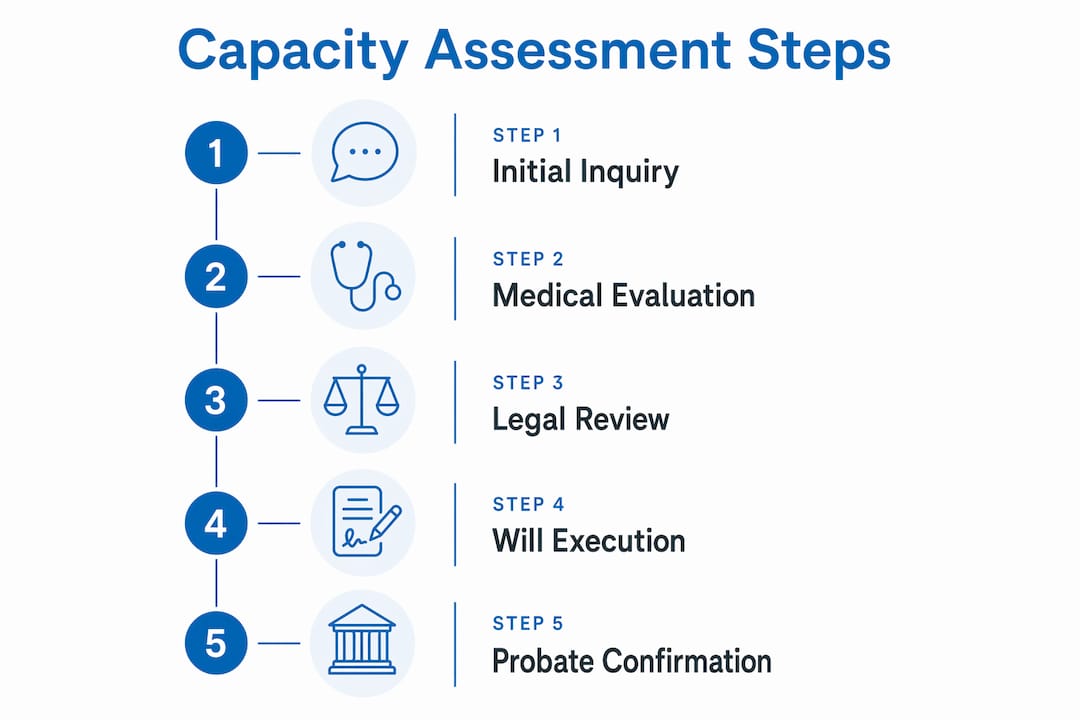
Capacity is assessed at the time the will is executed, not before or after. This timing rule creates a practical challenge: by the time a dispute arises, the testator has died and cannot be examined.
NSW courts consider the following types of evidence when capacity is contested:
- Medical records. Diagnoses, medication history, and clinical notes from around the time of signing are highly relevant.
- Solicitor’s file notes. A careful solicitor will record their observations of the testator’s behaviour and responses during the will-making appointment.
- Witness statements. The two witnesses who signed the will can give evidence about the testator’s apparent state of mind.
- Expert opinion. Geriatricians, neuropsychologists, and psychiatrists are regularly called to interpret medical records and give opinions on likely capacity at the relevant date.
- Video or audio recordings. Some solicitors now record will-signing appointments, particularly where capacity may be questioned.
Capacity must be proved on the balance of probabilities in NSW disputes. That standard means the court must be satisfied it is more likely than not that the testator had, or lacked, capacity. Cognitive disorders such as dementia do not automatically mean a person lacked capacity. The question is always whether the disorder affected the specific understanding required by the Banks v Goodfellow test at the moment of signing.
Pro Tip: Where there is any doubt about a testator’s capacity, ask their GP to complete a capacity assessment on the same day the will is signed. A contemporaneous medical opinion is far stronger evidence than a retrospective one.
What common issues lead to will disputes in NSW?
Family conflict alone does not prove a lack of testamentary capacity. This is the most common misconception in contested estate matters. Courts apply the Banks v Goodfellow criteria strictly. A disappointed beneficiary cannot succeed simply by showing the testator made an unexpected or unfair decision.
Common triggers for capacity-based will disputes in NSW include:
- Late-life wills made after a dementia diagnosis. These attract scrutiny, but a diagnosis alone is not conclusive.
- Wills that dramatically change prior instructions. A sudden shift in beneficiaries, especially close to death, raises questions courts will examine carefully.
- Wills made under the influence of a carer or new partner. These cases often involve both capacity and undue influence arguments running together.
- Estrangement and exclusion of adult children. Families sometimes conflate a parent’s deliberate choice to exclude a child with incapacity. The two are legally distinct. A testator can exclude estranged family members and still have full capacity.
- Wills made using a will kit without legal advice. Errors in execution can raise questions about whether the testator understood what they were signing.
Contentious probate proceedings are increasing in NSW. The rise reflects an ageing population, greater wealth held in estates, and more blended families with competing interests. Understanding the difference between a capacity challenge and a family provision claim matters. A family provision claim does not require proof of incapacity. It asks whether the testator made adequate provision for an eligible person, regardless of their mental state.
What practical steps protect will validity in NSW?
Taking deliberate steps when making or updating a will reduces the risk of a successful challenge later.
| Step | Why it matters |
|---|---|
| Use a qualified NSW wills and estates solicitor | A solicitor can assess capacity, document observations, and ensure correct execution |
| Obtain a GP capacity assessment on signing day | Contemporaneous medical evidence is the strongest defence against later challenges |
| Follow all execution formalities exactly | The will must be signed by the testator and witnessed by two people present at the same time |
| Keep a record of your reasoning | A letter or statutory declaration explaining why you made certain choices can counter undue influence claims |
| Store the will securely | The NSW Trustee and Guardian offers a safe storage service for wills and related documents |
| Review and update carefully | Only update a will when capacity is clear and documented, not during a health crisis |
Avoid will kits if there is any complexity in your estate or family situation. Will kits require following instructions exactly, and errors in execution can render the entire document invalid. A solicitor costs more upfront but far less than contested probate proceedings.
How does NSW law handle capacity challenges in court?
When a will is challenged on capacity grounds, the party relying on the will bears the initial burden of proving it was properly executed. Once that is established, the burden shifts to the person challenging the will to prove lack of capacity on the balance of probabilities.
Key features of NSW capacity litigation include:
- Expert evidence is central. Courts routinely appoint independent medical experts or accept competing expert reports from each party.
- The court examines the testator’s state at the specific moment of signing. Evidence about behaviour weeks before or after is relevant but not determinative.
- A successful challenge voids the will. The estate then passes under an earlier valid will, or under the rules of intestacy if no valid will exists.
- An unsuccessful challenge can result in a costs order. Bringing a weak capacity claim carries real financial risk.
Challenging a will on capacity grounds is not a quick or inexpensive process. Anyone considering this path should get advice from a specialist in estate litigation before committing to proceedings. The strength of the medical and legal evidence available will largely determine the outcome.
What are the formal requirements for a valid will in NSW?
A valid will in NSW must meet both capacity and formal requirements. Meeting one without the other is not enough.
The formal requirements are:
- The will must be in writing.
- The testator must sign the will, or direct another person to sign it in their presence.
- The signature must be made or acknowledged in the presence of at least two witnesses present at the same time.
- The testator must be over 18, unless the NSW Supreme Court has authorised a will for a person under that age.
- Capacity must exist at the exact time of execution, not at some earlier or later point.
Witnesses cannot be beneficiaries under the will. A witness who is also a beneficiary does not invalidate the will itself, but they forfeit their gift. Capacity assessed at the time of signing is the governing standard. A testator who had capacity when they gave instructions but lost it before signing has not made a valid will.
Funding your legal matter — no win, no fee
Simons George Legal offers No Win, No Fee arrangements for eligible testamentary capacity and will dispute matters. Cost should not stop you from getting proper legal advice when a legitimate claim exists.
Eligibility is assessed during a free 30-minute initial consultation. Simons George Legal will review the facts of your matter, advise on the strength of your position, and explain what a No Win, No Fee arrangement would cover. This removes the upfront cost barrier for people who have a genuine case but are uncertain about the financial commitment of litigation.
Book a free case assessment with Simons George Legal to find out whether your matter qualifies.
No Win, No Fee arrangements are subject to case eligibility and a written costs agreement. Liability limited by a scheme approved under Professional Standards Legislation.
Key takeaways
Testamentary capacity in NSW requires satisfying all four Banks v Goodfellow criteria at the exact moment a will is signed, and failing even one element can void the entire document.
| Point | Details |
|---|---|
| Capacity is time-specific | The legal test applies at the moment of signing, not before or after. |
| Four criteria must all be met | Understanding the will, property extent, beneficiaries, and absence of relevant delusions are all required. |
| Family conflict is not proof of incapacity | Courts apply a strict cognitive test, not a fairness test. |
| Documentation is your best protection | Solicitor file notes and a same-day GP assessment are the strongest evidence in any dispute. |
| Formal requirements also apply | A will must be in writing, signed, and witnessed by two people simultaneously to be valid in NSW. |
What I have learned from testamentary capacity disputes in NSW
The cases that concern me most are not the obvious ones. When a testator has advanced dementia and signs a will the day before they die, the challenge is usually straightforward. The harder cases are the ones where capacity sat right on the borderline, and nobody thought to document anything at the time.
Clients often come to me after a parent has died and left a will that feels wrong. Sometimes it is wrong, legally speaking. More often, the parent made a deliberate choice that the family finds painful. Courts do not rewrite wills because a decision seems unfair. They only intervene when the cognitive test is not met. That distinction is one I have to explain carefully, because grief and legal merit are not the same thing.
The most effective thing any person can do when making a will is treat the signing appointment as a legal event, not an administrative one. Bring your GP’s written assessment. Ask your solicitor to take detailed file notes. If your family situation is complicated, consider a statutory declaration explaining your reasoning. These steps cost very little. Undoing a contested estate costs a great deal more.
The law in this area is also evolving. Knox v Peacock [2024] NSWSC 976 is a good example of courts applying the Banks v Goodfellow test with nuance, recognising that cognitive impairment is not binary. That is the right approach. Capacity is a spectrum, and the legal test reflects that. What matters is whether the specific understanding required by the test was present at the specific moment it needed to be.
— George
Simons George Legal: wills, estates, and capacity disputes in NSW
Simons George Legal is a specialist wills and estates practice based in Bondi, serving clients across Sydney. The firm handles everything from straightforward will drafting and updates to complex capacity disputes and contested probate proceedings.

If you are concerned about the validity of a will, need to update your own estate planning, or are involved in an inheritance dispute, Simons George Legal offers a complimentary 30-minute consultation. The firm’s wills and estates lawyers provide clear, direct advice on where you stand and what your options are. Capacity issues are handled with the seriousness and sensitivity they deserve.
FAQ
What is testamentary capacity in NSW?
Testamentary capacity in NSW is the legal ability to make a valid will, assessed using the Banks v Goodfellow test. The testator must understand the nature of making a will, the extent of their property, who has a natural claim on their estate, and be free from delusions affecting their decisions.
Who has the burden of proof in a capacity dispute?
The party relying on the will must first prove it was properly executed. The burden then shifts to the person challenging the will to prove lack of capacity on the balance of probabilities.
Does dementia automatically mean a person lacked testamentary capacity?
No. A dementia diagnosis does not automatically void a will. The court asks whether the disorder affected the specific understanding required by the Banks v Goodfellow test at the moment of signing, as confirmed in Knox v Peacock [2024] NSWSC 976.
Can a will be challenged simply because the family disagrees with it?
No. Family conflict and disappointment do not establish lack of capacity. Courts apply a strict cognitive test focused on the testator’s mental state, not the fairness of the outcome.
What are the formal requirements for a valid will in NSW?
A valid will must be in writing, signed by the testator or a person directed by them, and witnessed by at least two people present at the same time. The testator must also be over 18 and have legal capacity at the exact moment of signing.