An executor can renounce their role before a grant of probate issues, but once probate has been granted, renunciation is no longer available. Revocation after a grant requires a Supreme Court order and is reserved for limited, exceptional grounds. The main statute governing both is the Probate and Administration Act 1898, and a common practical alternative is appointing NSW Trustee and Guardian by deed.
TL;DR:
- Renunciation by an executor is only possible before probate is granted; after issuance, only the Court can revoke a grant on limited, exceptional grounds.
- Revocation is usually based on specific statutory conditions such as discovering the deceased was alive at the time of grant or proof of fraud, and must be sought promptly.
- Applying for revocation requires evidence like affidavits, discovery of a later will, or proof of forgery, with delays weakening the application’s strength.
- Alternatives like executing a deed under section 75A or filing a caveat often provide faster, less costly solutions than revocation for dealing with executor issues.
- Court-ordered revocation involves returning estate assets, pausing distributions, and issuing a new grant to the correct party, while good faith transactions generally remain protected.
Table of Contents
- Renunciation vs revocation: the legal difference and when each applies
- Statutory grounds and common reasons the court will revoke a grant
- Who can apply, timing and how delay affects the court’s view
- How to apply to revoke a grant in NSW: documents, procedure and checklist
- Effects of revocation and what the court can order
- Practical alternatives when revocation is unlikely or impractical
- Practical next steps: what executors and interested parties should do now
- Funding your legal matter — no win, no fee
- What the conventional advice gets wrong about revocation
- How Simons George Legal can help with your probate matter
- Primary sources and further reading
- Sources
- FAQ
Renunciation vs revocation: the legal difference and when each applies
These two words get mixed up constantly, but they describe entirely different moments in an estate’s life.

Renunciation happens before a grant issues. An executor named in a will who does not want the role can formally give it up, and the Supreme Court of NSW’s guidance on renunciation and reserving leave sets out how that step is recorded. Revocation happens after a grant has already been made, and it is an order the Court issues, not a choice the executor can make unilaterally.
The practical consequences differ sharply:
- An executor who renounces before grant walks away cleanly and someone else (often the next entitled person or NSW Trustee and Guardian) steps in.
- An executor who wants out after a grant has issued cannot simply resign; they need either a court order or, more commonly, a deed arrangement.
- Beneficiaries waiting on distributions should know that a revocation application, once filed, can pause administration until the Court resolves the issue.
Knowing which category your situation falls into shapes everything that follows, from paperwork to timing.
Statutory grounds and common reasons the court will revoke a grant
Revocation is not something the Supreme Court grants lightly. It sits at the intersection of protecting beneficiaries and respecting the finality of a grant already issued.
Section 40C of the Probate and Administration Act 1898 (NSW) requires the Supreme Court to revoke a grant of probate if it later appears the person was living at the date of the grant. This is one of the only truly mandatory grounds, and the Court can also make ancillary orders to protect the estate while the matter is sorted out.
Beyond that core scenario, the Court has recognised several other circumstances that commonly lead to a revocation application:
- Fraud or misrepresentation in the original probate application.
- Discovery of a later will or codicil that supersedes the one already proved.
- A grant made to someone who turns out to have no real interest in the estate.
- A forged will, or a material error identifying the deceased’s next of kin.
Judicial guidance from the Supreme Court consistently frames revocation as a curative remedy rather than a punitive one. The Court’s focus, as reflected in the Estate Kouvakis principle, is the due administration of the estate rather than protecting any individual’s right to hold the office of executor.
Who can apply, timing and how delay affects the court’s view
Standing to apply under s40C extends to the person found to be alive, anyone entitled to apply for a grant, and any person with a genuine interest in the estate, such as a beneficiary or creditor.
Timing matters more than most applicants expect. The Court looks closely at whether an applicant had an earlier opportunity to raise concerns and did not. Someone who was notified of the original probate application, had time to object, and stayed silent will generally face a harder road than someone who only learned of the problem after the grant issued.
Certain discoveries should prompt action within days, not months:
- Finding a later will or codicil after probate has already been granted.
- Uncovering evidence that the deceased’s signature, or the will itself, was forged.
- Learning that the person named as deceased in the grant is, in fact, alive.
Delay does not automatically defeat an application, but it weakens it, and it gives the current executor more time to deal with estate assets in ways that become harder to unwind.
How to apply to revoke a grant in NSW: documents, procedure and checklist
A revocation application is typically framed as part of a summons for probate or administration (Form 111), with a recital seeking revocation alongside the fresh grant being sought. The Supreme Court’s probate checklist sets out the affidavits and evidence required, including what is needed when proving a copy or lost will.
Expect to prepare and file affidavits from attesting witnesses, any later will or codicil (original or copy), and evidence of fraud, mistake or the relevant statutory ground. Service and publication obligations also apply: UCPR forms such as Forms 41 and 140 may be relevant depending on the application, and the NSW Online Registry governs publication of notices such as the Notice of Intended Distribution.
Uncontested revocation matters can often be dealt with by a Registrar in chambers, keeping costs and timeframes manageable. Opposed matters go to open court, which usually means significantly more time and expense.
A practical starting checklist:
- Identify and preserve the original will or later testamentary document.
- Notify affected beneficiaries and the current executor or administrator in writing.
- Secure estate assets and pause any pending distributions where possible.
- Gather attesting witness affidavits and any evidence of fraud or mistake.
- Prepare the summons and supporting affidavits, framing the relief sought clearly.
Pro Tip: Pleading the revocation request within a single summons for a fresh grant, rather than as a separate application, often saves both filing steps and legal fees.
Effects of revocation and what the court can order
Once a grant is revoked, s40D of the Probate and Administration Act sets out what happens next. The former grantee must account for, and hand over, any estate money or property still in their hands, and anyone who paid death duty under the revoked grant may be entitled to reimbursement once a new grant issues.
The Court’s orders typically address several practical needs at once:
- Delivery up of the original grant document.
- A restraint on the former executor acting further as legal personal representative.
- Appointment of a new grantee or, in urgent cases, a receiver to protect the estate.
- Issue of a fresh grant to the properly entitled party.
Importantly, people who dealt with the estate in good faith before revocation, such as purchasers of estate property, generally retain protection for those transactions. Affected parties who suffer loss because of a later-revoked grant may still have remedies against the former executor personally.
Practical alternatives when revocation is unlikely or impractical
Revocation is not always the right tool, and it is rarely the fastest one. Several alternatives achieve similar outcomes with less cost and delay.
The most common is a deed under s75A, which lets an executor who no longer wants the role appoint NSW Trustee and Guardian or a trustee company to take over, provided the deed is filed with the Court. This avoids contested proceedings entirely when the problem is willingness rather than wrongdoing.
Where the concern is executor misconduct rather than a desire to step back, other tools fit better:
- A caveat can temporarily halt a grant from issuing or further dealings while concerns are investigated, and a caveat on property can similarly protect specific estate assets.
- Contested probate in solemn form forces the propounder of a will to prove it formally before the Court.
- A removal application targets the executor’s conduct without necessarily unwinding the grant itself.
Pro Tip: Match the remedy to the real problem: an unwilling executor rarely needs a court order, but a dishonest one usually does.
Practical next steps: what executors and interested parties should do now
If you suspect grounds for revocation or you are an executor wanting to step back, the first priority is preservation: lock down the original will, secure bank accounts and property, and pause any planned distributions until you have advice. Acting within days rather than weeks protects your position and the estate’s.
Before any legal appointment, gather what you can: attesting witness affidavits, bank statements and estate records, relevant correspondence, and any later testamentary document you believe exists. This evidence shapes what remedy makes sense.
A complimentary 30-minute consultation is offered for exactly this kind of triage. In that first conversation, we assess the facts, identify the likely remedy (revocation, a s75A deed, a caveat or a removal application), and give you a realistic estimate of time and cost before you commit to anything further.
Funding your legal matter — no win, no fee
Court proceedings over a grant of probate can be daunting, particularly when the estate’s assets are tied up and cash is tight. Conditional fee arrangements are available for eligible cases, so cost does not have to be the reason a legitimate claim goes unpursued.
Eligibility is assessed during a free initial consultation, where the strength of the claim, the likely remedy, and whether a conditional fee structure is appropriate for the matter are considered. This removes the upfront cost barrier for people with a legitimate claim who might otherwise hesitate to act.
If you believe you have grounds to challenge or revoke a grant, you can book a free case assessment.
No Win, No Fee arrangements are subject to case eligibility and a written costs agreement. Liability limited by a scheme approved under Professional Standards Legislation.
What the conventional advice gets wrong about revocation
Most guidance on this topic treats revocation as the headline remedy, as though it is the natural next step whenever something goes wrong with a grant. In practice, it is the remedy of last resort. The Court’s own framing, focused on due administration rather than punishing an executor, means that revocation applications succeed when they fix a genuine problem, not when they simply express frustration with how an estate is being handled.
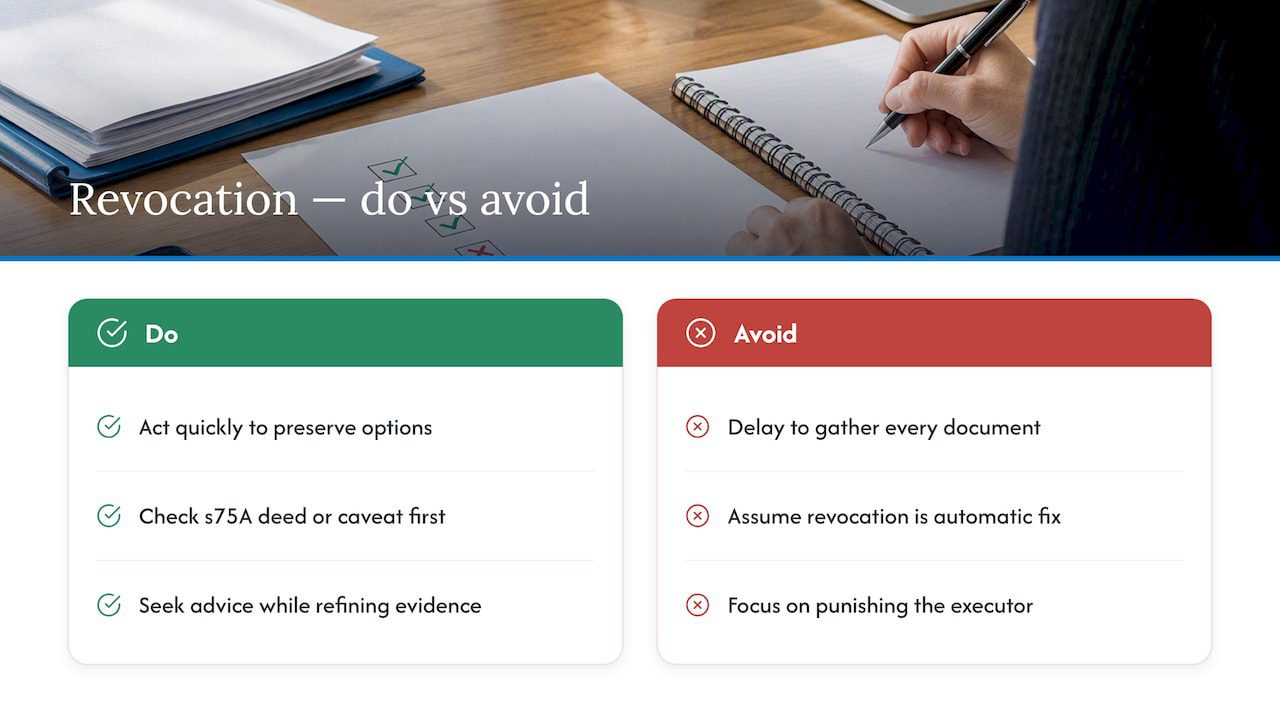
The bigger miss in most executor-focused content is timing. People spend weeks gathering every possible piece of evidence before acting, not realising that delay itself can undercut their position if they had an earlier chance to object and stayed quiet. The priority is not building the perfect case; it is acting fast enough to preserve your options, then refining the evidence with proper advice.
If there is one thing worth doing differently, it is checking whether a s75A deed or a caveat solves the actual problem before assuming a revocation application is necessary. Court orders take time; deeds and caveats often do not.
— George
How Simons George Legal can help with your probate matter
Whether you are facing a contested grant, considering removing an executor, or simply unsure whether revocation applies to your situation, our probate and estate administration and estate litigation teams can assess your options directly.

Book your free 30-minute consultation, bring the will, any later testamentary documents, and relevant correspondence, and we will set out the likely remedy, timeframe and cost before any further step is taken.
Primary sources and further reading
For the statutory text itself, see the Probate and Administration Act 1898. The Supreme Court’s complex probate proceedings guidance explains renunciation, revocation and the s75A deed route, while its probate checklist sets out forms, affidavits and filing steps.
This article is general information, not a substitute for advice from a qualified lawyer. Consult a qualified legal professional about your own circumstances before acting on anything here.
Sources
FAQ
How do I renounce probate in NSW?
Renunciation is only available before a grant of probate issues: an executor named in the will formally declines the role, following the process set out in the Supreme Court’s guidance. Once a grant has already been made, renunciation is no longer possible, and the executor must instead consider a s75A deed or a court application.
How much does it cost to remove an executor?
Costs vary depending on whether the matter is contested, with uncontested applications generally dealt with more quickly and cheaply by a Registrar in chambers, while opposed matters listed in open court take longer and cost more. Likely costs are assessed during a free initial consultation, and no win, no fee arrangements are available for eligible disputes.
How long does probate last in NSW?
A standard, uncontested grant of probate does not expire, but the administration process it authorises typically takes several weeks to a few months to complete. Contested matters, including those involving a revocation application, extend well beyond that timeframe because opposed proceedings require court listing and additional evidence.
Can you stop someone from contesting a will?
You cannot prevent someone with proper legal standing from bringing a genuine challenge, but procedural tools like a caveat can pause a grant while concerns are resolved. The Supreme Court’s focus throughout is the due administration of the estate, so legitimate challenges based on fraud, a later will or similar grounds will be heard on their merits.