Yes, the Supreme Court of NSW can remove an executor, but only where the due and proper administration of the estate is genuinely at risk through misconduct, incapacity, persistent delay, or a conflict of interest. If probate hasn’t been granted yet, a renunciation or caveat can often fix the problem without a courtroom. Once probate is granted, you’re generally looking at a formal application, real evidence, and a cost and timing risk you need to weigh before you start.
TL;DR:
- Executors can be removed only if their misconduct, incapacity, persistent delay, or conflict of interest genuinely threaten estate administration.
- Evidence needed includes bank records, correspondence, valuations, affidavits, and medical proof, with court costs potentially rising significantly if contested.
- Removal before probate is simpler and faster through renunciation or caveats, while post-probate removal requires formal court applications with supporting evidence.
- Courts focus on whether the estate is being properly managed rather than personal grievances, often preferring tailored or interim solutions over full litigation.
- Legal firms may offer conditional, no-win, no-fee arrangements for eligible cases to reduce upfront costs and facilitate early assessment and evidence gathering.
Table of Contents
- What does an executor actually have to do in NSW?
- What grounds justify removing an executor in NSW?
- How do you actually remove an executor in NSW?
- What evidence do you need, and what will it cost?
- Are there alternatives to a contested court fight?
- How Simons George Legal approaches executor removal cases
- Funding Your Legal Matter — No Win, No Fee
- What the research actually tells us about this fight
- How Simons George Legal can help with your executor dispute
- Sources
- FAQ
What does an executor actually have to do in NSW?
An executor isn’t just a name on a will. Once the Supreme Court grants probate, that person takes on a formal legal office with binding obligations to the estate and everyone who stands to inherit from it.
Under NSW law, an executor must realise the estate’s assets, pay off debts and taxes, keep proper accounts, and distribute what’s left according to the will. The oath or undertaking they give isn’t to the family. It’s to the court itself, which is why the Supreme Court treats the role so seriously when something goes wrong.
That formality matters because it changes the legal question you’re asking. You’re not really asking “should this person keep being executor?” You’re asking whether the court’s own appointee is still capable of doing what the court authorised them to do. The Supreme Court’s guidance on complex probate proceedings makes clear that the court’s central concern is always the due and proper administration of the estate, not personal grievances between family members.
An executor’s day-to-day responsibilities typically include:
- Locating and securing estate assets, from bank accounts to property and personal effects
- Notifying beneficiaries and creditors, and advertising for claims where required
- Lodging tax returns and meeting obligations the Australian Taxation Office sets for deceased estates
- Keeping clear financial records of every transaction made on the estate’s behalf
- Distributing assets to beneficiaries only once debts, taxes, and expenses are settled
If you’re an executor yourself and want a clearer sense of what’s expected at each stage, our probate application guide for executors walks through the process in order. Miss enough of these steps, or do them badly enough, and you start building a case for removal, whether you’re the one accused of it or the one bringing the application.
What grounds justify removing an executor in NSW?
The Supreme Court doesn’t remove executors for being unpleasant, slow to answer emails, or disliked by the family. It removes them when their conduct or condition genuinely threatens the estate’s proper administration, and NSW case law draws a fairly consistent line around four categories.
Misconduct is the most obvious ground. This covers misappropriating estate funds, profiting personally from estate dealings, or acting against the interests of beneficiaries. Courts treat any hint of self-dealing harshly, because an executor who benefits from mismanagement has an incentive structure that runs directly against their duty.
Incapacity covers executors who can no longer physically or mentally perform the role, whether through illness, cognitive decline, or a serious health event. Medical evidence carries real weight here, but the court doesn’t require proof of fault. It just needs to see that the estate isn’t being administered.
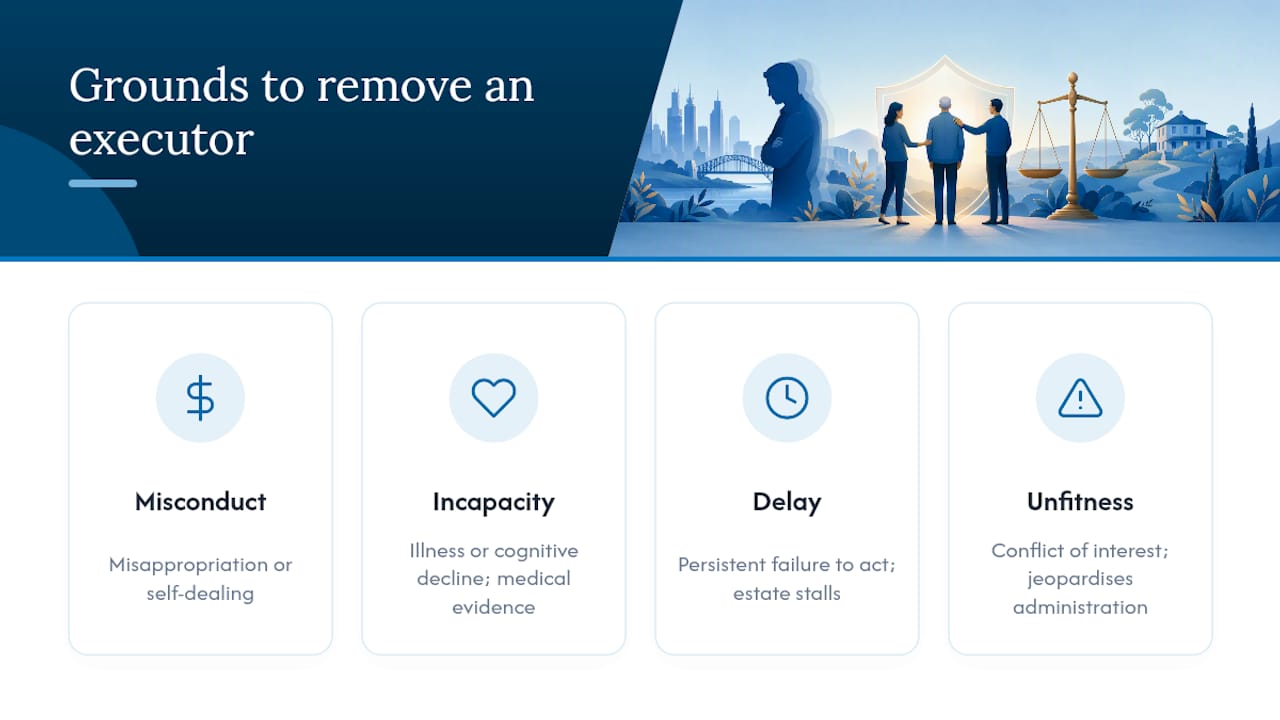
Persistent delay is one of the most common triggers for removal applications, and it doesn’t require dishonesty at all. An executor who simply fails to act, ignores beneficiaries, and lets an estate stall for years is frustrating the very purpose of their appointment.
Conflict of interest or unfitness is the broadest category, and it’s where much of the case law sits. The legal test asks whether the executor remains a fit and proper person to continue, judged against whether their continuance would jeopardise proper administration.
Three NSW Supreme Court decisions shape how this test is applied in practice. In McKerracher v McKerracher [2011] NSWSC 1288, the court confirmed removal is appropriate where an executor’s acts or omissions prevent due and proper administration, and noted the court can vest estate property in a remaining executor rather than revoking the entire grant. In Profilio v Profilio [1999] NSWSC 657, the court removed one executor from several while leaving the others to continue administration, showing the court’s preference for tailored orders over blunt ones. In Lawless v Donaldson [2012] NSWSC 570, the court removed an executor whose omissions stalled administration, and made clear that sympathy for an executor’s personal circumstances, in that case depression, doesn’t outweigh the estate’s need for functioning administration.
The common thread across all three judgments is that the court asks a practical question, not a moral one: is this estate actually being administered? If our guide to disputing executor misconduct is useful for anything, it’s working out early whether your concerns fit one of these categories or whether they’re really a dispute about the will’s terms, which is a different legal fight entirely.
How do you actually remove an executor in NSW?
The pathway you take depends entirely on one fact: has probate already been granted? That single detail changes everything about speed, cost, and formality.
If probate hasn’t been granted yet, you have faster and cheaper options. An executor can voluntarily renounce their role under section 69 of the Probate and Administration Act 1898 (NSW), which simply removes them from the running before they ever take on the office. If they won’t renounce voluntarily, you can lodge a caveat with the Supreme Court, which stops probate being granted until the dispute is resolved. Acting at this stage is almost always cheaper than waiting.
If probate has already been granted, the process becomes a formal court application. Here’s the general sequence:
- Gather your evidence first. Bank statements, estate accounts, correspondence, and any medical records need to be assembled before you file anything.
- File a summons or statement of claim in the Supreme Court of NSW, setting out the grounds for removal and the orders you’re seeking.
- Support the application with affidavits from yourself and any other witnesses who can speak to the misconduct, delay, or incapacity.
- Propose specific orders. This usually means asking the court to revoke the existing grant, issue a fresh grant to a new executor or administrator, and vest estate property accordingly, following the pattern set in Profilio and McKerracher.
- Attend directions hearings and, if the matter isn’t resolved, a final hearing where the judge decides based on the evidence filed.
Solicitors typically prepare these applications by building a clear chronology first, then matching each allegation to a document or witness that supports it. The Supreme Court’s own guidance on complex probate proceedings notes that procedural steps like reserving leave to a substitute executor can sometimes avoid a full removal application altogether.
Pro Tip: Don’t wait for the “perfect” piece of evidence before you act. If an executor is stalling and the estate is losing value through delay, a caveat or an early letter proposing renunciation often resolves things faster than building the ultimate case file.
Procedural hurdles commonly arise around notifying all interested parties correctly and serving beneficiaries who may not have engaged with the estate at all. Get that service wrong and you can lose months.
What evidence do you need, and what will it cost?
Courts don’t remove executors on the strength of frustration. They remove them on the strength of documents, so the quality of your evidence largely determines whether an application succeeds.
A solid removal application is usually built around:
- Bank and estate account records showing where money has gone and when
- Correspondence with the executor, especially anything showing requests ignored or promises broken
- Independent valuation reports where asset value or mismanagement is in dispute
- Medical evidence where incapacity is the ground being argued
- Witness statements or affidavits from people who can speak directly to the conduct in question
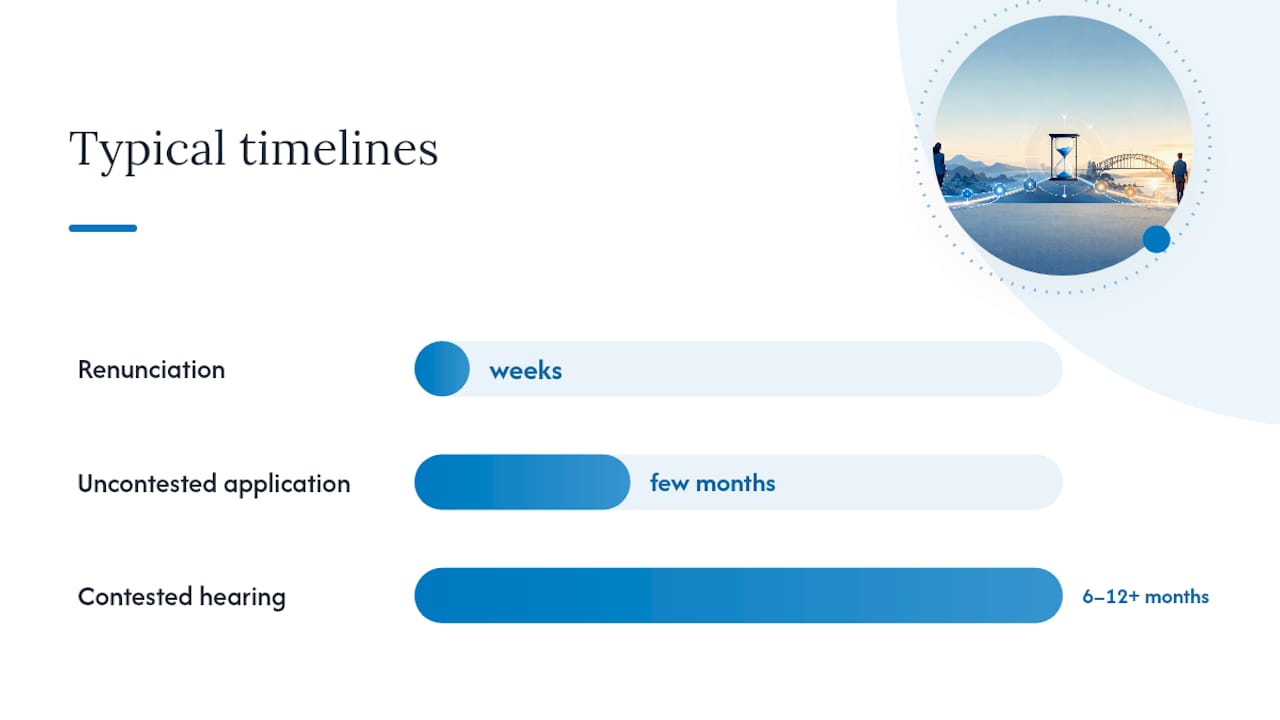
Timelines vary enormously depending on the pathway. A straightforward renunciation before probate can be sorted in a matter of weeks. An uncontested court application, where the executor doesn’t fight the removal, often takes a few months from filing to final orders. A genuinely contested hearing, with competing affidavits and cross-examination, can run well beyond six to twelve months once you account for directions hearings and court listing delays. Our estate administration delays guide breaks down why these stalls happen and what tends to fix them faster.
Cost is the sharpest edge of this process. The Supreme Court’s own contested proceedings guidance warns plainly that revoking probate or removing an executor can be complex and costly, and that an unsuccessful applicant may be ordered to pay the other side’s costs on top of their own. Costs are sometimes met by the estate itself, but whether this happens is at the court’s discretion and not guaranteed.
That risk is exactly why targeted interim orders, rather than a full contested trial, are worth exploring where the estate is losing value through delay but the underlying dispute isn’t yet resolved. A closer look at likely legal costs for inheritance disputes is worth reading before you commit to a contested pathway.
Are there alternatives to a contested court fight?
Court is not always the first move, and it shouldn’t be. The College of Law’s guidance on executor removal treats removal as a remedy of last resort, and the Supreme Court’s own approach to complex probate matters reflects the same preference for resolving disputes before they reach a judge.
Three alternatives are worth trying first in most cases:
- Ask for voluntary resignation or renunciation. A direct, well-documented request to an executor to step aside, backed by a written agreement, resolves more disputes than people expect, especially before probate is granted.
- Try mediation. The Supreme Court actively encourages it in probate disputes, and a mediated outcome usually costs a fraction of a contested hearing while preserving family relationships that litigation tends to wreck.
- Propose a neutral professional administrator. Where family members can’t agree on anyone in the family, appointing an independent professional by consent avoids both the cost of litigation and the appearance of favouritism.
These options work when the executor (or the family) is willing to engage. They stop being realistic once an executor has actively misappropriated funds, disappeared, or shown they’ll ignore any agreement that isn’t backed by a court order. At that point, litigation is the only practical route left, and the sooner you get advice on your evidence, the better positioned you’ll be.
How Simons George Legal approaches executor removal cases
In executor removal matters, a legal firm may start with an assessment of whether the evidence supports the legal test, before any documents are filed. Litigation against an executor can be expensive and slow if the underlying case is weak, and is often faster when the paper trail is solid.
Initial case assessments can provide clear answers on whether a situation fits recognised grounds for removal, misconduct, incapacity, delay, or conflict of interest, and what evidence may strengthen it. Where renunciation or mediation seems more realistic than a court fight, that is usually raised early.
The practical work often involves drafting affidavits, compiling bank and estate records into a chronology, and negotiating with the executor or their solicitor before any contested hearing. A proportionate strategy, rather than blanket litigation, is commonly adopted.
Funding Your Legal Matter — No Win, No Fee
Cost is often the biggest reason people delay acting on a legitimate executor removal claim. Some legal firms offer conditional fee arrangements for eligible cases, checked during a free initial consultation, so you’re not paying upfront just to find out where you stand. That eligibility check removes the biggest barrier for people with a genuine claim but limited cash to fund a court application.
If you think you have grounds to remove an executor, book a free case assessment and get a straight answer on your options before committing to anything. Full terms are set out in a written costs agreement once eligibility is confirmed, detailed on our No Win, No Fee eligibility page.
No Win, No Fee arrangements are subject to case eligibility and a written costs agreement. Liability limited by a scheme approved under Professional Standards Legislation.
What the research actually tells us about this fight
The case law is consistent on one point that gets lost in most online advice: the Supreme Court doesn’t care about family conflict, it cares about administration outcomes. McKerracher, Profilio, and Lawless all turn on the same question, whether the estate is actually being managed, not on who’s more sympathetic.
Where conventional advice falls short is in treating removal as a binary, fight or don’t fight. The court’s own guidance shows a strong preference for tailored solutions: vesting orders that keep one executor while removing another, renunciation before things escalate, mediation before pleadings are filed. Readers who jump straight to “I need to sue the executor” often skip cheaper, faster options that would have solved the actual problem.
If there’s one priority for anyone reading this with a genuine grievance, it’s evidence first, filing second. A chronology with documents attached beats an emotional account of frustration every time a judge reads a file. Build that before you decide anything else.
— George
How Simons George Legal can help with your executor dispute
If you’re weighing up whether to push for an executor’s removal, Simons George Legal is the direct alternative to muddling through court forms alone or gambling on a DIY caveat that gets rejected on a technicality. The firm handles probate and estate administration, contested wills, and estate litigation as a core practice, not a side service, which means the merits check you get at the first meeting is grounded in genuine Supreme Court experience rather than a general practice guess.

On instruction, Simons George Legal checks the merits of your case, prepares the affidavits and court documents a removal application needs, gathers the evidence that actually moves a judge, and represents you in negotiations or at hearing if the matter doesn’t settle. If eligibility for a conditional fee arrangement applies to your case, that gets confirmed before you pay anything beyond the free assessment.
The first step is a free case assessment through our probate and estate administration service, where you’ll get a clear view of whether your situation meets the legal test for removal and what it would realistically cost to pursue. If litigation does turn out to be necessary, our estate litigation team takes it from there.
Sources
The legal framework and case examples in this guide draw on primary NSW sources, useful if you want to read the underlying material yourself before instructing a solicitor.
- Complex probate proceedings — Supreme Court of NSW
- Grounds for executor removal — College of Law (COLLAW)
This article is general information, not a substitute for advice from a qualified lawyer. Consult a qualified legal professional about your own circumstances before acting on anything here.
FAQ
How difficult is it to remove an executor in NSW?
It depends entirely on your evidence and whether probate has already been granted. Renunciation before probate can be straightforward, but a contested removal after probate requires solid documentary proof of misconduct, incapacity, delay, or conflict of interest, and the Supreme Court warns these applications can be complex.
How much does it cost to have an executor removed in NSW?
Costs vary widely depending on whether the matter is contested, and current pricing for a case assessment is best confirmed directly with the firm rather than estimated in advance. Simons George Legal offers a free initial consultation and, for eligible cases, conditional fee arrangements that reduce the upfront cost barrier.
What are the grounds for removing an executor in NSW?
The recognised grounds are misconduct, incapacity, persistent delay in administering the estate, and conflict of interest or unfitness to hold the office. NSW case law including McKerracher v McKerracher confirms the court’s test is whether the executor’s continuance jeopardises the due and proper administration of the estate.
How long does an executor have to settle an estate in NSW?
There’s no fixed statutory deadline, but executors are expected to administer estates without unreasonable delay, and courts treat persistent tardiness as grounds for removal in its own right. If administration has stalled for years without explanation, that pattern itself can support a removal application.