A trustee in New South Wales can be removed through three routes: using removal powers written into the trust deed, relying on the statutory appointment mechanism in the Trustee Act 1925, or applying to the Supreme Court of New South Wales. Deed-based removal is usually the fastest and cheapest option when the deed allows it. Court applications are the last resort, reserved for cases with strong evidence of misconduct or incapacity, and early legal advice makes a real difference to which path suits your situation.
TL;DR:
- Trustee removal is most straightforward when the trust deed explicitly grants a clear and properly exercised power of removal, avoiding the need for court action.
- If the deed’s removal clause is silent or ambiguous, the statutory powers under the Trustee Act 1925 offer a formal process for trustee appointment and discharge, requiring correct deed execution and compliance.
- Court-ordered removal demands strong objective evidence of misconduct, incapacity, or breach, with the Supreme Court only acting when continued trusteeship risks harm to beneficiaries or proper trust administration.
- Litigation carries significant risks including high legal costs, delays, and potential erosion of the trust fund, especially if costs are recoverable under the “loser pays” principle.
- Alternative resolutions such as mediation or negotiated deed changes are preferred first options, as they are less costly, faster, and preserve confidentiality unless evidence of dishonesty or incapacity is substantial.
Table of Contents
- Types of trusts and why the trust deed matters for removal
- Statutory powers under the Trustee Act 1925 (NSW)
- Grounds for court-ordered removal and the evidentiary threshold
- Supreme Court process for removal in NSW: steps, timing and procedural rules
- Alternatives to court: mediation, negotiated deed changes and consent orders
- Practical checklist: what to do if you want to remove a trustee in NSW
- Costs, risks and likely outcomes: what applicants should expect
- Practical tips from a wills and estates specialist
- Funding your legal matter: No Win, No Fee
- Sources
- FAQ
Types of trusts and why the trust deed matters for removal
Before you can work out how to remove a trustee, you need to know what kind of trust you are dealing with. Testamentary trusts (created by a will), discretionary family trusts, unit trusts and bare trusts are all common structures in NSW, and each behaves differently when a trustee dispute arises. A discretionary family trust dispute often involves control of a family business, while a testamentary trust dispute usually surfaces during estate administration when beneficiaries question how the trustee is managing assets left to them.
The trust deed is the first document any solicitor will ask for, because most deeds contain their own machinery for appointing and removing trustees. These clauses typically cover:
- Who holds the power to remove or appoint a trustee, often the settlor, a nominated appointor, or a majority of beneficiaries.
- Whether removal requires unanimous agreement or just a majority decision among appointors or beneficiaries.
- Whether a corporate trustee can be substituted for an individual trustee, and what formalities that substitution requires.
- Any notice periods or procedural steps the deed demands before a removal takes effect.
Practitioners always start by reading the deed from cover to cover, because a well-drafted removal clause can resolve a dispute in weeks rather than the months or years a court case can take. When the deed gives someone the clear power to remove a trustee, exercising that power correctly, and documenting it properly, generally avoids the need for court involvement altogether. Problems arise when the deed is silent, ambiguous, or when the person with the removal power is themselves part of the dispute. That is when statutory or court-based options come into play.
Statutory powers under the Trustee Act 1925 (NSW)
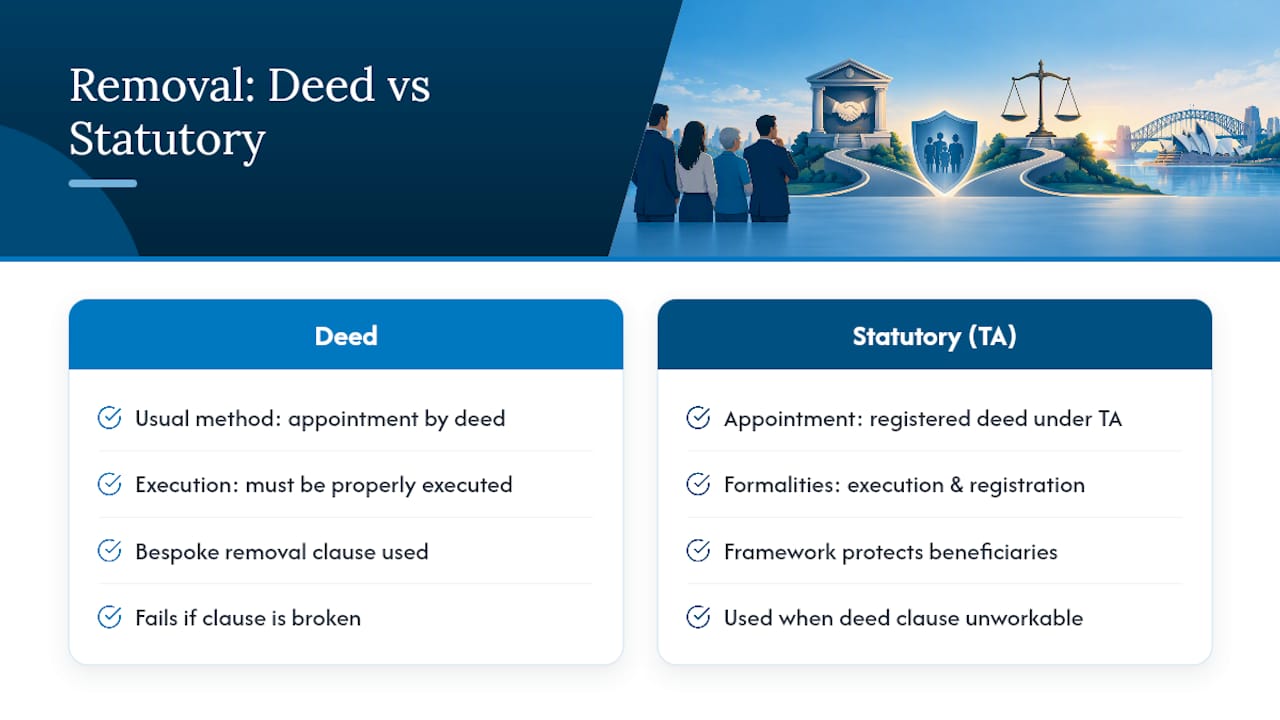
When a deed does not adequately address removal, or where the deed’s mechanism has broken down, the Trustee Act 1925 provides a statutory fallback. Sections 6 to 9 and related provisions permit the appointment of a new trustee by registered deed, and set out formalities for replacing an outgoing trustee, including who may exercise the power and how the discharge of the old trustee is documented.
Sections 6–9 and related provisions permit appointment of new trustees by registered deed and set formalities for trustee replacement.
The Trustee Act 1925 sets the formal framework that governs trustee appointment and discharge across NSW, and any deed-based or statutory removal ultimately has to comply with its requirements to be effective.
The Act’s formalities exist to protect the trust and its beneficiaries, not just the parties negotiating a removal. A new trustee is usually appointed by deed, and that deed has to be executed correctly to have legal effect. There are also practical constraints: a trust generally needs a minimum number of trustees, and where NSW Trustee & Guardian or a trustee company is not remaining as a trustee, at least two trustees typically need to stay in place for the discharge of an outgoing trustee to be valid. The outgoing trustee is discharged from the trust once these conditions are satisfied, provided the deed of appointment is properly drafted and registered where required, as outlined in the Trustee Act’s consolidated provisions.
Parties tend to rely on the statutory mechanism instead of a purely deed-based power in two scenarios: where the deed’s own removal clause is unworkable (for example, because the person meant to exercise it has died or lost capacity), or where all parties agree a change is needed but want the certainty of a process backed by legislation rather than a bespoke deed clause that might later be challenged. Using the statutory route does not require court involvement when everyone cooperates, which keeps costs down and the trust’s assets intact.
Grounds for court-ordered removal and the evidentiary threshold
When deed powers and statutory appointment are not available, cooperation has broken down, the Supreme Court of New South Wales can step in and order a trustee’s removal. The Supreme Court’s guidance on contested proceedings makes clear that the Court will only remove a trustee where the trustee’s continued presence is detrimental to the beneficiaries or to the sound administration of the trust. A personality clash or a simple loss of confidence is usually not enough on its own.
The grounds that typically persuade a court to intervene include:
- Serious breach of trust, such as misapplying trust funds or failing to keep proper accounts.
- Dishonesty or fraud in the trustee’s dealings with trust property.
- Loss of mental capacity that leaves the trustee unable to perform their duties.
- A conflict of interest so significant it compromises the trustee’s ability to act impartially.
- General unfitness to administer the trust, including persistent neglect of trustee obligations.
The Court’s focus stays firmly on the welfare of the beneficiaries and the proper administration of the trust fund, not on resolving a family argument or vindicating one side’s grievance. That means allegations need to be backed by objective, contemporaneous evidence rather than assertions about a trustee’s character or past behaviour. Trust accounts and financial statements, bank records showing the movement of trust funds, forensic accounting reports where mismanagement is alleged, and medical evidence where incapacity is in issue are the kinds of material that actually move a court. Correspondence showing a pattern of non-disclosure or refusal to account to beneficiaries also carries weight, because it goes directly to whether the trustee is fit to continue in the role.
Supreme Court process for removal in NSW: steps, timing and procedural rules
Applying to the Supreme Court to remove a trustee is a structured process, and the Court expects strict compliance with its own rules along the way. The matter usually proceeds through the Equity Division, and contested estate and trust matters follow the framework set out in the Court’s guidance on contested proceedings.
A typical application moves through these stages:
- Pre-filing preparation. Gather the trust deed, trustee accounts, correspondence and any evidence of the alleged breach or incapacity before drafting the statement of claim.
- Commencing proceedings. File a statement of claim (or summons, depending on the relief sought) naming the trustee as defendant and joining beneficiaries or other interested parties who may be affected by the outcome.
- Service. Serve all parties with a proper interest in the trust, since the Court expects everyone materially affected to have notice and an opportunity to respond.
- Directions and disclosure. Comply with the Court’s directions on disclosure of documents, which in the Probate and Family Provision List are shaped by Practice Note SC EQ 07.
- Affidavit evidence. Prepare affidavits addressing the grounds for removal, generally structured around the annexures and content the Practice Note requires.
- Interlocutory steps. Seek interim relief where needed, such as injunctions freezing trust dealings or orders compelling disclosure of trust records pending the final hearing.
- Hearing and judgment. Attend the hearing where the Court weighs the evidence against the legal grounds for removal before making orders.
Practice Note SC EQ 07 sets detailed disclosure and affidavit requirements and list deadlines that apply to contested probate and family provision matters in the Equity Division, and trustee removal applications running alongside estate disputes are expected to follow the same discipline.
| Stage | What happens | Key requirement |
|---|---|---|
| Filing | Statement of claim or summons lodged | Proper parties identified and joined |
| Service | All affected parties notified | Beneficiaries and co-trustees served |
| Disclosure | Documents exchanged under directions | Compliance with Practice Note SC EQ 07 |
| Affidavits | Evidence formally set out | Structured content, including required annexures |
| Interlocutory relief | Urgent orders sought if needed | Injunctions or disclosure orders |
| Hearing | Court determines the application | Evidence tested against legal grounds |
Pro Tip: Treat every Practice Note deadline as fixed, missing one can cost you far more time than it saves.
Failure to comply with the Court’s procedural directions, including the disclosure rules under Practice Note SC EQ 07, can lead to delay, adverse costs orders, or the application being struck out altogether. The Court runs a busy list, and it has little patience for parties who treat its timetables as optional.
Alternatives to court: mediation, negotiated deed changes and consent orders
Litigation is not the only way to resolve a trustee dispute, and it is rarely the first choice of an experienced solicitor. The Supreme Court actively encourages parties to attempt mediation before a contested hearing, and many trustee disputes settle once both sides see the cost and delay a full hearing would involve.
Negotiated solutions generally take one of a few forms:
- A deed variation that amends the trust’s terms, including its removal and appointment provisions, by agreement between the relevant parties.
- A deed of appointment that formally installs a new trustee once the outgoing trustee agrees to step aside.
- Consent orders filed with the Court that record an agreed outcome, giving it the same enforceability as a judgment without a contested hearing.
Pro Tip: Propose mediation early, before positions harden and legal costs start eating into the trust fund itself.
Settling a dispute this way keeps the details private, tends to cost a fraction of a full hearing, and gets the trust running normally again far sooner. The trade-off is that a negotiated outcome depends on both sides genuinely wanting to resolve things, and it works best when there is no serious allegation of dishonesty that a beneficiary needs a court to formally establish. Simons George Legal generally recommends exploring mediation and deed-based solutions first, reserving court applications for cases where the evidence of misconduct is strong and negotiation has genuinely failed. Our guide to inheritance dispute resolution options in NSW covers these pathways in more depth, and our estate dispute negotiation strategies guide sets out practical tactics for approaching a trustee directly.
Practical checklist: what to do if you want to remove a trustee in NSW
Whichever route ends up being right for your situation, the groundwork is the same. Getting organised early saves time and money later, whether the matter settles by agreement or ends up before the Court.
- Locate the trust deed and read its removal and appointment clauses carefully, since this determines whether you can act without the Court at all.
- Gather recent trust accounts, bank statements, and any financial records showing how trust assets have been managed.
- Collect correspondence and meeting minutes that show the trustee’s conduct, decisions, and any refusal to provide information to beneficiaries.
- Request formal accounts from the trustee in writing if you have not already received regular reporting, and keep a record of the request and any response.
- Obtain medical evidence promptly if the trustee’s capacity is in question, since capacity assessments are far more persuasive when made close to the events in dispute.
- Preserve everything, do not delete emails or dispose of records, even ones that seem unhelpful to your position.
- Book a legal consultation and bring a written timeline of events along with copies of the deed, accounts, and key correspondence, so your solicitor can assess the strongest route quickly.
Turning up to that first meeting with organised documents rather than a verbal account of what happened often shaves weeks off the early advice stage, because your solicitor can assess the deed’s removal clause and the strength of your evidence in one sitting.
Costs, risks and likely outcomes: what applicants should expect
Court proceedings to remove a trustee carry real financial risk, and anyone considering this route needs a clear picture of what is at stake before filing anything. The Supreme Court generally applies a “loser pays” principle in contested civil litigation, meaning an unsuccessful applicant can be ordered to pay a significant portion of the other side’s legal costs on top of their own.
Litigation can quietly erode the very trust fund it is meant to protect, since legal costs are sometimes drawn from trust capital, particularly where a trustee is defending the claim in their capacity as trustee rather than personally, as reflected in the Supreme Court’s contested proceedings guidance.
Applicants should weigh up:
- The prospect of an adverse costs order if the claim is found to be unreasonable or poorly evidenced.
- The risk that prolonged litigation reduces the value of the trust fund that beneficiaries ultimately stand to receive.
- The time cost of a contested hearing, which can run well beyond the timeline of a negotiated deed variation.
- The availability of conditional fee arrangements for eligible claims, which can shift some of the financial risk away from the applicant.
Cost-management strategies matter as much as the legal argument itself. Getting early advice on the merits, being realistic about the evidence you actually have rather than what you believe happened, and being open to mediation all reduce the risk of an expensive, drawn-out dispute. Where a claim is genuinely strong, a solicitor can also advise on whether a conditional or no-win, no-fee arrangement is available, which changes the cost calculation considerably for the person bringing the application.
Practical tips from a wills and estates specialist
Most trustee disputes we see do not need a courtroom, they need someone to read the deed properly and have a firm conversation early. We generally steer clients toward mediation unless the evidence points to genuine dishonesty or incapacity, because that is where a court is actually likely to act.
The most common mistake self-represented parties make is ignoring Practice Note SC EQ 07 or filing affidavits that read like a diary rather than structured evidence. At a first appointment, we ask for the deed, accounts and a plain timeline, then build an evidence bundle around whichever route the facts actually support.
— George
Funding your legal matter: No Win, No Fee
Trustee disputes can be expensive to run, and that cost puts many people off pursuing a legitimate claim before they have even spoken to a solicitor. Some legal firms offer conditional arrangements for eligible cases, so the financial risk of pursuing a genuine claim does not fall entirely on you upfront.

Eligibility is assessed during a free initial consultation, where the strength of your evidence and the likely path your matter will take are evaluated, whether that is a deed-based solution, a statutory appointment, or Supreme Court proceedings. This assessment removes the upfront cost barrier for people with a legitimate claim who might otherwise never get advice. Book a free case assessment with Simons George Legal to find out where you stand.
No Win, No Fee arrangements are subject to case eligibility and a written costs agreement. Liability limited by a scheme approved under Professional Standards Legislation.
This article is general information, not a substitute for advice from a qualified lawyer. Consult a qualified legal professional about your own circumstances before acting on anything here.
Sources
FAQ
What are the grounds for removing a trustee from a trust?
The main grounds are serious breach of trust, dishonesty, loss of capacity, a significant conflict of interest, or general unfitness to administer the trust. Courts focus on whether the trustee’s continued presence harms beneficiaries or the trust’s proper administration, as set out in the Supreme Court’s contested proceedings guidance, rather than on personal disagreements alone.
How difficult is it to remove a trustee?
Removal is usually straightforward when the trust deed gives someone a clear power to appoint or remove trustees, or when the statutory process under the Trustee Act 1925 applies and everyone cooperates. It becomes far more difficult, and slower, once the matter needs a contested Supreme Court application, because the Court expects strong objective evidence rather than a simple loss of confidence.
What is required to remove a trustee?
You generally need either a deed provision that lets someone remove and replace the trustee, or grounds recognised by the Court such as breach of trust, dishonesty or incapacity, backed by proper evidence. That evidence typically includes trust accounts, bank records, and in capacity cases, medical reports, structured in line with the Court’s disclosure requirements under Practice Note SC EQ 07.
Can a trustee be removed without their knowledge?
No, a trustee is entitled to notice of any proceedings or formal steps taken to remove them, since they are a necessary party to both deed-based and court processes. In a Supreme Court application, the trustee must be served and given the opportunity to respond before any removal order is made.