You can remove a probate caveat in NSW by waiting for it to lapse after six months, negotiating a withdrawal, applying for an order that the caveat cease to be in force, or commencing contested proceedings. Each path carries different costs and evidence requirements, and adverse costs orders are a real risk, so check the filed caveat, confirm service, and get legal advice before choosing a route.
TL;DR:
- A probate caveat remains in force for six months and can be removed by lapse, withdrawal, court order, or contested proceedings, each with different costs and evidence standards.
- Only individuals with a genuine, identifiable interest, such as beneficiaries, executors, or creditors, can lodge a valid caveat; suspicious or unfounded claims face likely removal and costs penalties.
- The most common defenses against removal include demonstrating a reasonably arguable interest or procedural faults, with evidence like capacity or forgery reports often tipping the court’s decision.
- Filing a caveat improperly or without supporting evidence can lead to adverse costs and the caveat’s quick removal, increasing the risks for tactical or unsubstantiated claims.
- Executors and applicants should assess costs and timing carefully, as contested proceedings can extend delays and escalate expenses, especially once a matter is set for trial or formal dispute.
Table of Contents
- What is a probate caveat and what effect does it have in NSW
- Who can lodge a probate caveat and what counts as a legitimate interest
- How to lodge a probate caveat step by step
- Options to remove or resolve a caveat: comparing the four routes
- What happens after you apply to remove a caveat
- Practical timeline and cost checklist for executors and applicants
- How the Supreme Court treats caveats: practice notes, forms and guidelines
- Common defences and strategies caveators use to resist removal
- How a caveat affects the estate administration timeline
- Outcomes when caveat removal succeeds or fails
- NSW case law shaping how caveat removal is decided
- Funding Your Legal Matter — No Win, No Fee
- Author perspective: advising executors and beneficiaries on caveats
- Sources
- FAQ
What is a probate caveat and what effect does it have in NSW
A probate caveat is a formal notice filed with the Supreme Court of NSW that stops a grant of probate or letters of administration from issuing without notice to the person who lodged it, known as the caveator. Once filed, the Registrar cannot process a grant while the caveat remains in force, which effectively freezes the estate administration until it is resolved.
A caveat lasts for six months from the date it is filed, under Supreme Court Rules Part 78, and a caveator can file a fresh caveat if the underlying dispute is unresolved when the first one expires. The filing formalities are straightforward but strict.
- The caveator must use the approved form, UCPR form 141, when lodging the document.
- Filing happens through the Supreme Court registry or its online system, with a fee payable at the time.
- The caveat must be served on the applicant or known potential applicants for the grant, with proof of that service kept on file.
Executors dealing with a filed caveat should read the probate application process alongside this guide, since a caveat directly interrupts that timeline.
Who can lodge a probate caveat and what counts as a legitimate interest
Not everyone who dislikes a will can stop probate with a caveat. The Court expects the caveator to have a genuine, identifiable interest in the outcome of the grant, not simply a grievance or a family disagreement.
- Beneficiaries named under the will being propounded, or under an earlier will that would apply if this one fails.
- People who believe they have a valid family provision claim and want time to assess their position.
- A named executor under a competing or later will who disputes the document being put forward.
- An administrator or creditor with a genuine financial interest in how the estate is distributed.
The Probate List Guidelines set the test the Court applies: an order removing a caveat will not ordinarily be made if the caveator can point to a reasonably arguable interest, such as suspected forgery, lack of testamentary capacity, undue influence, or a genuinely competing will.
A caveat lodged without a reasonably arguable interest is unlikely to survive a motion to remove it, according to the same guidelines, and the caveator risks personal exposure to costs. A phone call to the registry or an informal letter expressing concern does not amount to a caveat and does not stop a grant, a point confirmed on the Court’s page on applying for a grant of administration with a will annexed.
How to lodge a probate caveat step by step
If you believe you have proper grounds to hold up a grant, the process is procedural but needs care at every step.
- Complete UCPR form 141, the approved caveat form, and pay the registry filing fee set out in the Supreme Court fees schedule.
- File the form through the Online Registry or the relevant Supreme Court registry.
- Serve the caveat on the applicant for the grant, or on any other known potential applicant, and retain evidence of that service.
- Keep the caveat’s particulars limited to what you can support: state your interest and the basis for it without overreaching into allegations you cannot yet prove.
Pro Tip: Draft the caveat around the narrowest defensible ground rather than every suspicion you have, since an overreaching caveat is easier to challenge and harder to defend on costs.
The most common mistakes are failing to serve the document properly, using a caveat purely to buy time without an arguable interest, and neglecting to update or withdraw the caveat when circumstances change. Our page on caveats explained covers these pitfalls and the adverse costs risk in more depth.
Options to remove or resolve a caveat: comparing the four routes
Once a caveat is in force, the applicant for probate has four realistic ways to move the estate forward, and the right choice depends on cost tolerance, the strength of the caveator’s position, and how much delay the family can absorb.
- Waiting for lapse: the caveat expires automatically six months after filing under Supreme Court Rules Part 78, costs nothing extra, but leaves the estate stalled for that period and the caveator can simply file again.
- Negotiation and withdrawal: often the fastest and cheapest outcome when both sides are willing to talk, typically involving an exchange of information, a compromise on distribution, or an agreement to proceed once specific concerns are addressed.
- Notice of motion to have the caveat cease: suited to cases where the applicant believes the caveator has no real standing; this goes to the Registrar first, requires supporting affidavit evidence, and is quicker and cheaper than a full trial.
- Commencing contested proceedings: appropriate where there is a genuine dispute over the will’s validity or competing claims to the grant, usually by statement of claim or an application for probate in solemn form, and it brings full case management, disclosure obligations and higher cost exposure.
The Probate List Guidelines make clear that if the caveator establishes a reasonably arguable interest, the matter will not be resolved quickly at the Registrar stage. It becomes contested proceedings with directions, affidavits and a timetable set by the Court. Executors who want to understand what a full contest looks like should read our guide on contesting a will in NSW, since the procedural path overlaps closely with removing a caveat that turns out to be well founded.
What happens after you apply to remove a caveat
Filing a notice of motion to have a caveat cease does not guarantee a quick resolution. The Court’s response depends heavily on whether the caveator can show a genuine basis for their position.
- A Registrar typically hears the initial motion and can dispose of it where the caveator’s interest is plainly weak or unsupported.
- Where the caveator produces evidence of a reasonably arguable interest, the matter is escalated toward a Judge and treated as contested proceedings, potentially heading to a determination in solemn form.
- Both sides are usually expected to file affidavits identifying the relief sought and the factual basis for their position, including documents supporting or undermining the caveator’s claimed interest.
The Supreme Court’s costs protocol requires parties in probate disputes to file Costs Disclosure Statements and contemplates costs capping orders. Estates under the $1.5 million net value reference in the protocol are flagged for early consideration of a costs cap, which limits how much can be recovered even if the matter runs to a hearing.
If the matter does proceed toward trial, the Court can make interlocutory orders and set a directions timetable, and daily hearing fees start to apply once listed for a contested hearing. This is the point where costs escalate fastest, and it is worth revisiting the contested proceedings pathway before committing further resources.
Practical timeline and cost checklist for executors and applicants
Understanding the sequence of dates and cost triggers helps you decide whether to wait, negotiate or push for a hearing.
- Filing a caveat has immediate effect: the Registrar cannot issue a grant from that point.
- The caveat lapses automatically after six months unless withdrawn earlier or replaced by a fresh one.
- An uncontested motion to remove a weak caveat can often be listed and resolved well inside that six month window.
- A genuinely contested matter moves onto a directions timetable and can run considerably longer, with costs building at each stage.
Typical cost items include the modest statutory filing fee under the fees schedule, solicitor fees for preparing the motion or defending it, affidavit preparation, and daily hearing fees if the matter proceeds to a contested hearing. Adverse costs orders remain the biggest financial risk for a caveator who cannot make out an arguable interest.
Pro Tip: Before committing to litigation, ask your solicitor whether the estate qualifies for a costs capping order under the protocol, since this can materially change the economics of pursuing or defending a caveat.
A short decision checklist helps: consider the estate’s value, the strength of the evidence on either side, the state of relationships between the parties, and how much delay and cost everyone involved can genuinely tolerate.
How the Supreme Court treats caveats: practice notes, forms and guidelines
The Court’s approach to caveats is not discretionary guesswork. It follows published rules and guidelines that set out exactly what will and will not succeed.
- The Probate List Guidelines state that an order to remove a caveat will not ordinarily be made if the caveator identifies a reasonably arguable interest, and if that interest exists the matter proceeds as contested.
- The approved caveat form is UCPR form 141, and the six month duration is set out under Supreme Court Rules Part 78.
- The probate costs protocol requires disclosure of estate net value and flags matters under $1.5 million for early costs capping consideration.
| Source document | What it governs |
|---|---|
| Probate List Guidelines | Test for removing a caveat and case management approach |
| Supreme Court Rules Part 78 | Six month caveat duration and procedural rules |
| Costs and cost capping protocol | Disclosure statements and costs capping thresholds |
| UCPR form 141 | Approved form for lodging a caveat |
In practice, this means an executor’s affidavit needs to do more than assert the caveator is wrong. It needs to identify the relief sought, attach the relevant will and estate documents, and directly address why the caveator’s claimed interest does not meet the arguable threshold, which is exactly what the guidelines expect at the Registrar stage.
Common defences and strategies caveators use to resist removal
A caveator facing a motion to remove their caveat typically leans on one of a few recognised strategies rather than simply refusing to engage.
The most common defence is producing evidence of a reasonably arguable interest, such as medical records suggesting impaired capacity at the time the will was signed, correspondence suggesting undue influence, or a signed document that appears to be a later, competing will. Under the Probate List Guidelines, this kind of evidence is usually enough to push the matter out of a quick Registrar disposal and into contested proceedings.
Caveators also sometimes argue procedural defects, pointing to inadequate service of the probate application or missing documents in the executor’s affidavit, to buy time rather than to resolve the substantive dispute. Others use the caveat period strategically to gather further evidence, commission a handwriting or capacity assessment, or negotiate a settlement from a stronger procedural position.
Where a caveator cannot point to anything beyond a general suspicion or family friction, that absence of evidence is itself often decisive against them at the Registrar stage. Executors facing a caveat they suspect is tactical rather than substantive should focus their affidavit on exposing exactly that gap, since the guidelines place the burden on the caveator to show their interest is genuinely arguable.

How a caveat affects the estate administration timeline
A caveat’s most immediate practical effect is delay. No grant can issue while the caveat is in force, which means the executor cannot access estate assets, pay debts, or begin distributing to beneficiaries through the formal grant process.
For executors, this creates a genuine tension between duty and patience. Beneficiaries often want updates, creditors may press for payment, and property may need maintenance or insurance renewal, all while the estate technically cannot be administered through probate. Executors should keep clear records of estate assets and liabilities during this period, since a well documented position strengthens any later application to remove the caveat and speeds up administration once it is resolved.
Where the caveat resolves quickly, whether by lapse, withdrawal or a successful motion, the estate administration typically resumes close to where it left off. Where it escalates into contested proceedings, the delay can extend the overall administration by many months, and executors should factor this into communications with beneficiaries and any third parties relying on the estate’s assets. Our estate administration steps checklist sets out what else executors should be managing in parallel while a caveat dispute plays out.
Outcomes when caveat removal succeeds or fails
The result of a caveat removal application has direct consequences for both sides, and understanding them helps set realistic expectations before you start.
If the motion to remove the caveat succeeds, because the caveator cannot show a reasonably arguable interest, the caveat ceases to be in force and the original probate application can proceed. The caveator may face an adverse costs order for having lodged a caveat without proper grounds, which is a meaningful deterrent against speculative caveats.
If the caveator successfully demonstrates a reasonably arguable interest, the matter does not simply end there. It moves into contested proceedings, often heading toward a determination in solemn form, with both sides facing the cost and time burden of a fuller dispute. The applicant for probate does not lose outright at this stage, but the path to a grant becomes longer and more expensive.
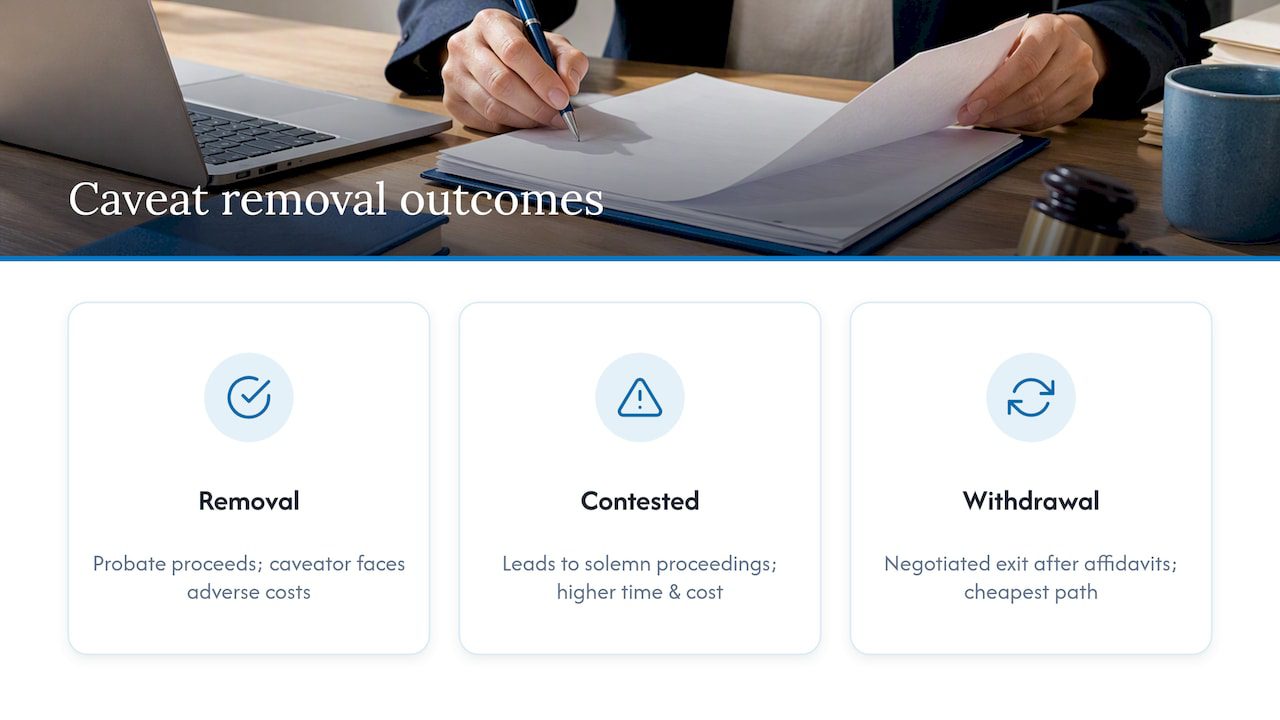
There is a middle outcome that occurs often in practice: negotiated withdrawal once one side sees the strength, or weakness, of the other’s position after initial affidavits are exchanged. This avoids a formal ruling altogether and is usually the cheapest path once the parties have tested their evidence, which is why early legal advice on the merits matters so much before committing to a hearing.
NSW case law shaping how caveat removal is decided
NSW courts have consistently applied the reasonably arguable interest test rather than requiring a caveator to prove their case in full at the removal stage. This reflects the Court’s recognition that a caveat is meant to preserve a genuine dispute for proper determination, not to force a caveator to litigate their whole case just to keep the caveat alive.
Decisions in this area typically turn on whether the caveator has produced credible, specific evidence, medical opinion on capacity, handwriting analysis suggesting forgery, or documentary support for a competing will, rather than general assertions of unfairness or disappointment with the will’s terms. Where caveators fail to produce anything beyond suspicion, courts have been willing to remove the caveat and, in some cases, order costs against the caveator personally.
The practical effect of this consistent approach is that the threshold is not especially high, a caveator does not need to win the underlying dispute to survive a removal motion, but it is not nominal either. Vague dissatisfaction or a desire to delay administration will not meet it. This is why the affidavit evidence on both sides, not just the strength of the underlying family dispute, tends to determine how quickly a caveat resolves.
Funding Your Legal Matter — No Win, No Fee
Cost is often the biggest barrier to getting a caveat resolved properly, whether you are lodging one or trying to remove one. No Win, No Fee arrangements are available for eligible cases, so a legitimate claim does not have to sit on the shelf because of upfront legal costs.
Eligibility is checked during a free initial consultation, where the strength of your position, the estate’s circumstances and the likely cost path are considered before any commitment. This removes the upfront cost barrier for people with a genuine claim and lets you make an informed decision rather than a rushed one.

Book a free case assessment to find out where you stand and whether a No Win, No Fee arrangement suits your matter.
No Win, No Fee arrangements are subject to case eligibility and a written costs agreement. Liability limited by a scheme approved under Professional Standards Legislation.
Author perspective: advising executors and beneficiaries on caveats
Most caveat matters we see fall into a handful of patterns: a suspected forgery, a competing will that surfaces late, or a beneficiary who was simply never told about a death. Early advice changes outcomes more than people expect, because the strength of your affidavit evidence, not the strength of your grievance, decides how quickly a caveat resolves.
We tell clients to preserve documents immediately, keep clear proof of service if they lodge a caveat, and get a realistic costs assessment before choosing between negotiation and a formal motion. Too many caveats are fought on principle rather than evidence, which is expensive for everyone.
If you are facing a caveat or considering lodging one, take the complimentary 30 minute consult first. It usually clarifies, within that half hour, whether you have a genuinely arguable position or a costly distraction.
— George
Sources
For readers who want to check the rules directly, the Probate List Guidelines set out the removal test, the contested proceedings page covers the six month duration and UCPR form 141, and the costs and cost capping protocol explains disclosure obligations. Filing fees sit in the Supreme Court fees schedule, and general grant procedure is on the applying for probate page. Readers dealing with estate property should also see this conveyancing guide for deceased estates.
This article is general information, not a substitute for advice from a qualified lawyer. Consult a qualified legal professional about your own circumstances before acting on anything here.
FAQ
How easy is it to remove a caveat?
It depends entirely on whether the caveator can show a reasonably arguable interest under the Probate List Guidelines. A caveat with no real evidence behind it can often be removed relatively quickly at the Registrar stage, while one supported by genuine evidence of forgery, incapacity or a competing will typically moves into contested proceedings.
How long does a caveat stay on a property or estate?
A probate caveat remains in force for six months from the date it is filed under Supreme Court Rules Part 78. It can lapse naturally at that point, be withdrawn earlier by agreement, or be replaced with a fresh caveat if the dispute is still unresolved.
How much does it cost to remove an executor?
Removing an executor is a separate process from removing a probate caveat and depends on the specific grounds and evidence involved, so there is no fixed figure that applies to every case. Because costs vary significantly with the complexity of the dispute, it is best assessed during a consultation with a solicitor experienced in estate litigation.
Can you stop someone from contesting a will?
You cannot prevent an eligible person from bringing a genuine claim, but you can require them to demonstrate a real basis for it before the Court will let a caveat or dispute hold up the estate. If someone lodges a caveat without a reasonably arguable interest, the Probate List Guidelines support an application to have it removed, and the caveator risks an adverse costs order.