Per stirpes splits an estate by family branch, so if your child dies before you, their children step into that share. Per capita splits equally between every surviving beneficiary, full stop, with no branch loyalty involved. In Australia, if you die without a will, the statutory rules generally behave like per stirpes, so understanding both terms matters even if you never plan to write either one into a clause, as NSW Government guidance and firms like Simons George Legal both point out.
TL;DR:
- Per stirpes ensures a deceased child’s share passes directly to their own children, maintaining the original family branch regardless of the number of descendants.
- Per capita divides the estate equally among all surviving beneficiaries at the same generational level, regardless of family branch size, which can dilute individual shares in larger branches.
- Both methods require identifying all eligible beneficiaries, but per capita often demands a broader search due to its headcount-based distribution.
- In NSW, dying without a will leads to statutory distribution that closely mirrors per stirpes, with children of deceased beneficiaries stepping into their parent’s place.
- Using explicit drafting language and reviewing existing wills after family changes are crucial to minimize disputes and ensure the distribution reflects your intentions.
Table of Contents
- Per stirpes explained: how a branch keeps its share
- Per capita explained: equal shares, no branch loyalty
- Per stirpes vs per capita: side-by-side outcomes
- What happens if you die without a will in NSW
- Choosing between per stirpes and per capita: a practical checklist
- Estate tax implications of per stirpes vs per capita
- Per capita with representation: the middle ground
- How to write per stirpes or per capita clauses correctly
- When these clauses end up in court
- Getting the drafting right the first time
- Funding Your Legal Matter — No Win, No Fee
- Sources
- FAQ
Per stirpes explained: how a branch keeps its share
Per stirpes means “by the branch.” If a named beneficiary dies before the will maker, their share doesn’t get reabsorbed into the pool. It passes straight down to their own children, keeping that branch of the family whole.
Picture an estate left to two children, Child A and Child B, split evenly. Child A dies before the will maker, leaving two children of their own. Under per stirpes, Child B still takes their half share. Child A’s half share doesn’t get redistributed among everyone else; it splits equally between Child A’s two children.
That structure has real consequences for how an estate gets administered:
- Each branch’s total share stays fixed regardless of how many descendants sit underneath it.
- Executors need to locate every living descendant in the affected branch, which can add weeks to administration if family members have lost touch.
- Perceived unfairness can surface when one branch has five grandchildren and another has one. Each grandchild in the larger branch ends up with a smaller individual amount than their cousin in the smaller branch, even though the branches themselves are treated equally.
Per stirpes suits families who want a deceased child’s line protected rather than diluted, which is one reason Lawpath’s estate planning content flags it as the more commonly recommended default for average families.
Per capita explained: equal shares, no branch loyalty
Per capita means “by the head.” Every surviving beneficiary at the relevant generational level gets an identical slice, and the size of any one branch has no bearing on it, according to WillsHub’s explanation of deceased estate distribution.
Take that same estate, left to Child A and Child B. Say both children die before the will maker. Child A leaves two children; Child B leaves one. Under per capita, all three grandchildren are treated as equal individual beneficiaries, each receiving an equal share. Compare that to per stirpes, where Child A’s branch would keep their original half share (split two ways) and Child B’s sole child would take the other half share.
Implications worth weighing:
- Per capita can dilute a branch’s total holding once several descendants exist within it, since the estate is sliced by headcount, not by lineage.
- It can create friction between cousins who feel their parent’s branch has effectively been penalised for having more children.
- Executors still need a full list of every eligible living beneficiary before a single dollar moves, which is its own administrative task.
Some will makers choose per capita deliberately: they want strict equality between living beneficiaries, irrespective of which parent they descended from, and they’re comfortable with the branch-size trade-off that comes with it.
Per stirpes vs per capita: side-by-side outcomes
The clearest way to see the difference is to run the identical family tree through both methods.
- How shares pass when a beneficiary predeceases the will maker. Per stirpes locks the deceased beneficiary’s share to their own children. Per capita pools it back in and redistributes across everyone at that generational level.
- Who typically benefits. Per stirpes tends to favour grandchildren in larger branches, protecting their parent’s original entitlement. Per capita favours grandchildren in smaller branches, since headcount, not lineage, sets the amount.
- Administration complexity. Both methods require executors to locate living descendants, but per capita usually demands a wider search because every beneficiary at the relevant level must be identified before shares can be calculated, a point Cockatoo’s estate planning explainer also raises.
- Typical use case. A blended family with stepchildren and children from different relationships often needs custom drafting rather than either default term alone. A single-child family rarely sees any practical difference between the two. A large extended family with uneven branch sizes is where the choice matters most, and where disputes are most likely if the will is silent.
Using generic labels: an estate with several children, including one predeceased with four kids of their own. Per stirpes gives that predeceased child’s branch their fixed share to split equally among their children. Per capita treats all the surviving grandchildren and children as equals, dividing the estate by the total number of surviving beneficiaries, resulting in a very different allocation for the surviving children.
What happens if you die without a will in NSW
Dying intestate hands the decision to the state, not to you. NSW succession law sets a fixed order of distribution: a surviving spouse generally takes the estate outright if there are no children from another relationship, then children, then more distant relatives in a set hierarchy, as outlined in the NSW Government’s guidance on dying without a will.
Where a child has already died, that child’s own children usually step into their parent’s place under the statutory formula, an outcome that closely mirrors per stirpes even though the legislation never uses that Latin term.
Other states run comparable rules with their own thresholds. The Law Handbook SA sets out how a spouse’s statutory legacy interacts with children’s entitlements, and the figures differ from NSW’s own thresholds, so the exact split depends on which state governs the estate.
Family agreements can’t override any of this once someone has died without a will. If the statutory outcome feels unfair, the only real remedy is a family provision claim, and that requires court involvement, time, and legal costs that a clear will would have avoided entirely.
Choosing between per stirpes and per capita: a practical checklist
Bring this to your first meeting with a solicitor rather than trying to resolve it yourself in the will template—using a practical selling inherited property checklist can help you understand estate administration and asset realisation steps clearly.
Favour per stirpes when:
- You have grandchildren and want a deceased child’s branch protected at its original size.
- Your family includes stepchildren you want treated differently from biological descendants, which needs explicit drafting either way.
- You want to avoid the “smaller branch gets bigger individual shares” dynamic that per capita produces.
Favour per capita when:
- Strict equality between living beneficiaries matters more to you than preserving branch shares.
- You have no strong attachment to lineage-based fairness and want a simple, headcount-based split.
Drafting tips that avoid most disputes: name your intended beneficiaries explicitly rather than relying on class descriptions like “my issue,” specify what happens if a named beneficiary predeceases you, and consider a substitution or anti-lapse clause rather than leaving it to the Latin term alone, advice echoed in the Barnes Walker legal glossary.
Pro Tip: Never mix generations in the same clause without clarifying intent. “To my children and grandchildren equally” reads simple but creates exactly the kind of ambiguity that ends up in court.
Estate tax implications of per stirpes vs per capita
Australia doesn’t impose a federal estate tax or inheritance tax, so neither method changes the tax bill on the estate itself. That’s a genuine point of difference from jurisdictions like the United States, where estate tax thresholds can interact with how shares are calculated across generations.
Where tax does bite in Australia is capital gains tax on inherited assets, and here the distinction between per stirpes and per capita rarely changes the outcome directly. What matters more is who ends up holding which asset, since CGT cost bases and main residence exemptions follow the individual beneficiary, not the method used to get them there. A per stirpes distribution that hands a rental property to two grandchildren jointly can create a more complicated CGT position on eventual sale than a per capita distribution that hands each grandchild a separate, simpler asset.
Superannuation death benefits sit outside the will entirely in most cases, governed by binding nomination rules rather than per stirpes or per capita language, which is worth checking separately if super forms a large part of the estate. The practical tax question isn’t which Latin term you use. It’s what assets end up where, and whether the resulting CGT exposure was actually intended.
Per capita with representation: the middle ground
Per capita with representation is a hybrid that most people have never heard of, and it solves a specific problem neither pure method handles well. It works like per stirpes at the first generational break, then applies per capita among the survivors from that point down.
Here’s the mechanism: shares are divided at the generation closest to the will maker where at least one beneficiary is still alive. If a beneficiary at that level has died, their share drops down and gets split equally among their own descendants, rather than being further subdivided branch by branch at every subsequent generation.

The practical difference from pure per stirpes shows up when a family has three generations of predeceased beneficiaries. Pure per stirpes keeps subdividing branch by branch all the way down, which can leave a great-grandchild with a tiny fraction of the original share. Per capita with representation flattens that out once it reaches the first surviving generation, treating everyone at that level equally regardless of how many predeceased ancestors sit above them.
Some jurisdictions, including several US states, have adopted this as their default statutory model precisely because it avoids the extreme fractional outcomes pure per stirpes can produce in large, multi-generation families. Australian succession law doesn’t use this as a default, but nothing stops a will maker from drafting it explicitly, and it’s worth raising with your solicitor if your family tree has more than two generations of potential predecease to plan around.
How to write per stirpes or per capita clauses correctly
The Latin term alone is rarely enough. Courts have had to interpret ambiguous per stirpes and per capita clauses for decades, and the safest approach treats the term as a starting point, not the finished clause.
A workable clause names the primary beneficiaries first, then states the fallback explicitly: “To my children, A and B, in equal shares, and if either predeceases me leaving children of their own, that deceased child’s share to pass to their children in equal shares per stirpes.” That sentence does the work the single Latin word alone can’t guarantee, because it removes any argument about which generational level the term was meant to apply to.
Avoid listing broad, undefined classes such as “my grandchildren” without saying what happens if one of them also predeceases you before the estate is distributed. Avoid combining per stirpes and per capita language in the same clause without a court-tested precedent behind the wording, since inconsistent phrasing is exactly what invites a challenge. If your will already contains one of these clauses from years ago, a review of your existing will after any birth, death, marriage, or separation in the family is worth doing before it becomes a problem rather than after.
For blended families specifically, don’t assume “per stirpes” automatically includes or excludes stepchildren. It doesn’t, by default, and the anti-lapse provisions that apply when a child dies before the will maker won’t rescue an ambiguous clause; they only fill gaps the legislation is designed to fill, not the ones your specific family situation creates.
When these clauses end up in court
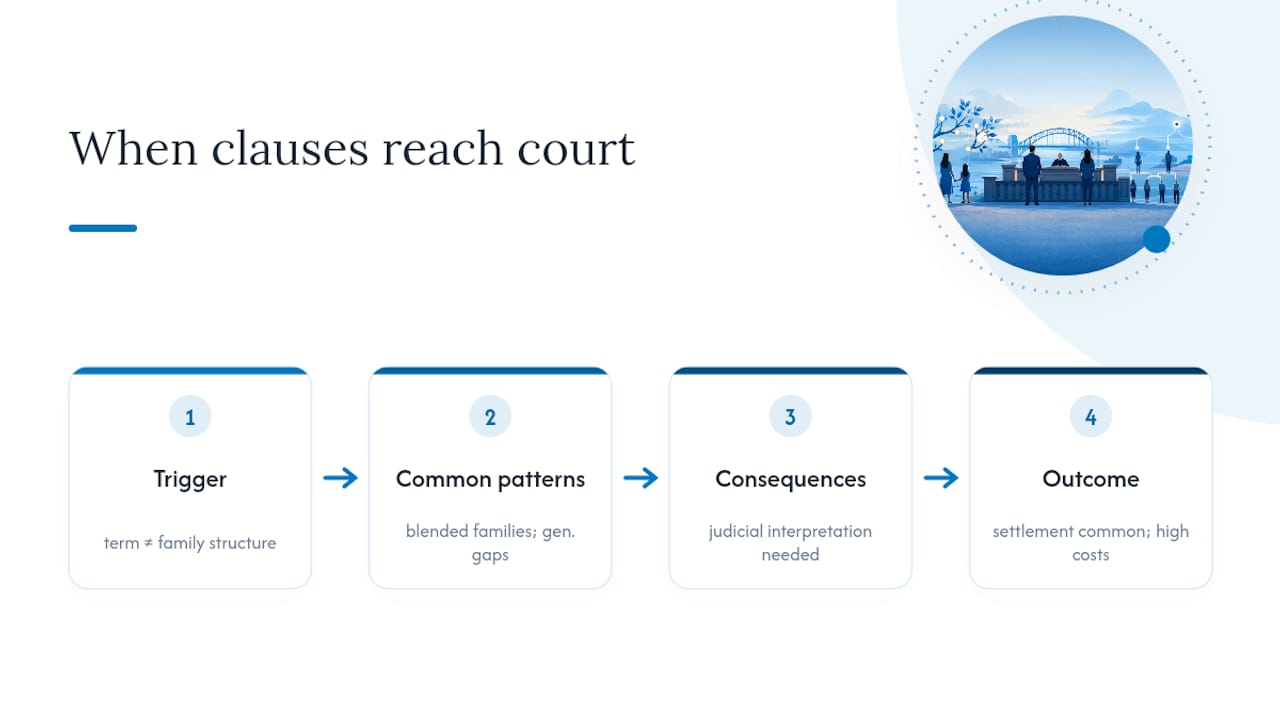
Disputes over per stirpes and per capita language tend to follow a predictable pattern: a will uses one term, a family’s actual structure doesn’t map cleanly onto it, and someone argues the drafter meant the other method. Courts then have to reconstruct intention from whatever evidence exists outside the four corners of the clause itself, which is expensive and slow for everyone involved.
The most common trigger is a blended family where “children” was never defined to include or exclude stepchildren, combined with a per stirpes clause that assumes a single bloodline running cleanly through each branch. Add a predeceased child with children from two different relationships, and a term that looked simple on paper suddenly needs judicial interpretation to apply at all.
A second recurring pattern involves per capita clauses drafted without specifying which generational level the equal split applies to. If a will says “to my grandchildren per capita” but some grandchildren were alive when the will was signed and others were born after, or some predeceased the will maker themselves, the class of “grandchildren” itself becomes contestable before any dollar amount can even be calculated.
These disputes usually resolve through negotiated settlement rather than a full trial, because litigation costs eat into the estate for everyone. That’s precisely why clear, explicit drafting at the outset, rather than reliance on a bare Latin term, remains the cheapest form of dispute prevention available. If you’re already facing a distribution dispute over ambiguous language in an existing will, inheritance dispute resolution options in NSW are worth exploring before costs escalate further.
Getting the drafting right the first time
Latin terms feel precise, but they carry centuries of case law baggage that doesn’t always match what a client actually wants for their own family. That gap between the word and the intention is where most disputes start.
A useful pattern: a will maker with two children and a blended family assumed “per stirpes to my children” would automatically cover a stepchild raised as their own. It wouldn’t have, without explicit naming, and catching that gap during drafting rather than after death avoided what could have become a drawn-out family provision claim. The lesson generalises well beyond that one family: whenever a will’s structure doesn’t map neatly onto a standard biological family tree, the Latin term needs a plain-English sentence sitting right next to it.
If your circumstances have changed since your will was last reviewed, a fresh look now costs far less than a dispute later.
— George
Funding Your Legal Matter — No Win, No Fee
If you believe you have a legitimate claim over how an estate has been, or will be, distributed, cost shouldn’t be the reason you don’t pursue it. Simons George Legal offers No Win, No Fee arrangements for eligible cases, including many contested estate and family provision matters.
Eligibility is checked during a free initial consultation, so you’ll know where you stand before committing to anything. That structure removes the upfront cost barrier that stops many people with a genuinely strong claim from ever raising it.
If you think your situation might qualify, book a free case assessment and find out where you stand.
No Win, No Fee arrangements are subject to case eligibility and a written costs agreement. Liability limited by a scheme approved under Professional Standards Legislation.
Sources
For statutory detail beyond what’s covered here, the NSW Government’s guidance on dying without a will sets out the default distribution order for NSW estates. The Law Handbook SA covers statutory thresholds under South Australian succession law for comparison. For firm-specific advice on drafting or reviewing your will, visit Simons George Legal’s wills and estates page.
This article is general information, not a substitute for advice from a qualified lawyer. Consult a qualified legal professional about your own circumstances before acting on anything here.
- Per stirpes meaning & per capita in deceased estates — WillsHub
- Dying without a Will | NSW Government
- Distribution of an intestate estate — Law Handbook SA
- Per stirpes & per capita in a will — Lawpath
FAQ
What’s the difference between per stirpes and per capita?
Per stirpes distributes by family branch, so a deceased beneficiary’s share passes to their own children. Per capita divides equally among every surviving beneficiary at the same level, regardless of which branch they belong to.
What does a per stirpes vs per capita chart actually show?
A comparison chart typically maps the same family tree twice: once showing branch shares staying intact under per stirpes, and once showing equal individual shares under per capita, so you can see how the dollar amounts diverge for the same family.
Who is first in line to inherit under Australian law?
Under NSW intestacy rules, a surviving spouse generally inherits first, followed by children, and where a child has died, that child’s own children typically step into their place, similar to how per stirpes operates.
Does a spouse automatically inherit everything in Australia?
Not always. A surviving spouse usually takes the whole estate if there are no children from a different relationship, but if there are children from another relationship, the spouse’s share is capped by a statutory legacy amount before the remainder splits with the children, as set out in state succession legislation.