Severing a joint tenancy in NSW converts ownership from joint tenants to tenants in common in equal shares, and it ends the right of survivorship immediately on registration. If you are facing a joint tenancy severed estate dispute, three things matter right now: check the current title through NSW Land Registry Services, preserve every document and communication related to the property, and get urgent legal advice before the 30-day notice window closes.
The statutory basis is section 97 of the Real Property Act 1900, which provides that registration of a transfer by a joint tenant of their own interest to themselves severs the joint tenancy. The process runs through NSW Land Registry Services (NSW LRS) and is lodged electronically via PEXA.
Immediate steps to take:
- Obtain a current title search from NSW LRS to confirm whether a transfer has been lodged or registered
- Gather all documents: title deeds, correspondence, any notices received, wills, family law orders, and mortgage documents
- Contact a wills and estates lawyer immediately, particularly if the notice period is still running
Key takeaways
Severing a joint tenancy in NSW is a statutory process under s97 of the Real Property Act 1900, and a dispute must be addressed within the 30-day notice period to have any real chance of stopping registration.
Table of Contents
- What does severing a joint tenancy actually do?
- How severance works in NSW: the step-by-step process
- Why do people sever a joint tenancy?
- What to do if a severance is disputed
- How severance affects estates, wills and tax
- How a wills and estates lawyer can help
- Funding your legal matter — No Win, No Fee
- What these disputes look like in practice
- Simons George Legal can help you resolve this
- Sources
- FAQ
What does severing a joint tenancy actually do?
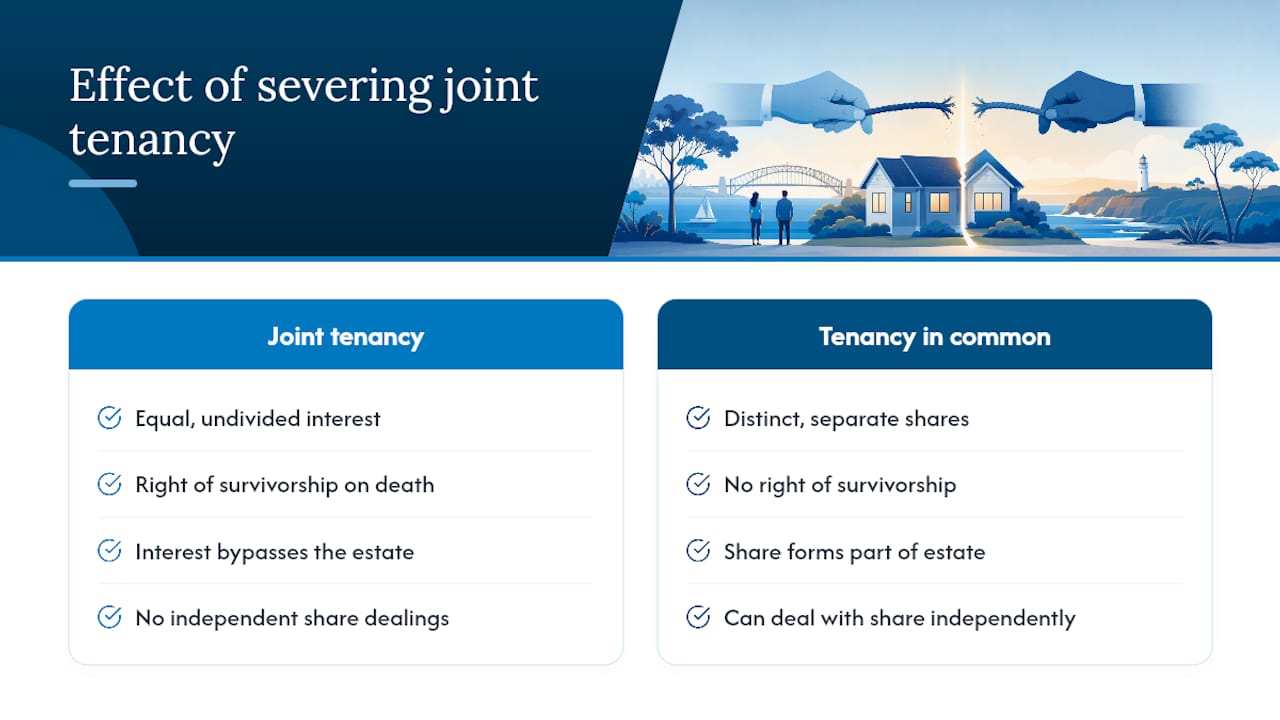
Joint tenancy is a form of co-ownership where each owner holds an equal, undivided interest in the whole property. The defining feature is the right of survivorship: when one joint tenant dies, their interest passes automatically to the surviving joint tenant or tenants, regardless of what a will says.
Severance ends that arrangement. Once a joint tenancy is severed, the co-owners become tenants in common, each holding a distinct share that they can deal with independently. That share becomes part of their estate on death and passes under their will or, if there is no will, under the intestacy rules in NSW.
A short example makes the difference concrete. Two siblings own a property as joint tenants. One severs the joint tenancy and then dies. Under the old arrangement, the survivor would have taken the whole property. After severance, the deceased’s half-share forms part of their estate and passes to whoever is named in their will, or to their next of kin if they died intestate. The survivor keeps only their own half.
Courts also recognise severance by mutual agreement or by a course of dealings, including will-making as part of a pattern of conduct, though the unilateral transfer under s97 is the most common and most certain method in NSW.
How severance works in NSW: the step-by-step process
The Real Property Act 1900 is the governing statute. Under s97, a joint tenant lodges a transfer of their own interest to themselves, and registration of that transfer severs the joint tenancy. Here is how the process unfolds in practice.
The procedural steps
- Prepare the Transfer Severing Joint Tenancy form. The transferor completes the standard transfer form, describing the dealing as a transfer severing joint tenancy. The form must accurately identify all joint tenants.
- Prepare a statutory declaration. The NSW LRS guidance requires a statutory declaration that includes the name and address of every other joint tenant and specific prescribed statements that must not be altered.
- Notify registered mortgagees, chargees and covenant chargees. The transferor must notify any lender or chargee recorded on title before or at the time of lodgment.
- Lodge electronically via PEXA. All NSW severance transfers must be lodged through an Electronic Lodgment Network. In practice, that means PEXA, where the dealing is created as a Residual Document in a Workspace and the statutory declaration is attached. Lodgment does not mean immediate registration.
- Registrar-General gives notice. On lodgment, the Registrar-General gives notice to the other joint tenants. The Registrar-General may also request further evidence, including verification of names and addresses.
- 30-calendar-day notice period runs. Registration proceeds on expiry of the notice period, unless the other joint tenants consent to earlier registration or a dispute arises.
- Registration. If no objection is lodged and no court order intervenes, the Registrar-General registers the transfer and the joint tenancy is severed.
Key timeline
| Stage | Who acts | Typical timeframe |
|---|---|---|
| Prepare transfer form and statutory declaration | Transferor’s lawyer | Several business days |
| Notify mortgagees and chargees | Transferor’s lawyer | At lodgment |
| Lodge via PEXA | Transferor’s lawyer | On lodgment day |
| Registrar-General issues notice to co-owners | NSW LRS | Shortly after lodgment |
| Notice period | All parties | Until the notice period expires |
| Registration (if no dispute) | NSW LRS | After the notice period expires |
Pro Tip: The most common causes of delay are an incomplete statutory declaration, incorrect addresses for co-owners, and failure to notify mortgagees. Get the addresses right before lodgment and engage the lender early. Errors at this stage routinely trigger Registrar-General queries that extend the timeline and give a disputing co-owner more time to act.
Why do people sever a joint tenancy?
Understanding the reason behind a severance matters because different triggers create different dispute risks, and the legal strategy that follows depends heavily on context.
- Separation or family law proceedings. When a relationship breaks down, one or both parties may sever the joint tenancy to prevent the other from inheriting the property automatically. If family law property proceedings are already on foot, a court order may already restrict dealings with the property, and a unilateral severance could breach that order.
- Estate planning. A co-owner who wants to leave their share to children from a previous relationship, or to someone other than the surviving co-owner, must sever the joint tenancy first. Without severance, a will that purports to deal with jointly held property has no effect on that interest.
- Creditor or bankruptcy risk. A co-owner facing financial difficulty may sever to crystallise their share and make it available to creditors, or conversely to protect it through other arrangements. Trustees in bankruptcy have their own powers to deal with jointly held interests, so this area requires careful legal advice.
- Sale or refinance involving unequal contributions. Where co-owners want to restructure their interests to reflect unequal financial contributions, severance into tenants in common is the first step, often followed by a deed of trust or co-ownership agreement recording the agreed proportions.
Each of these scenarios carries its own dispute risk. A severance during family law proceedings can trigger urgent court applications. An estate-planning severance can provoke a family provision claim from a surviving partner who expected to inherit. Tailored joint tenancy legal advice before lodgment is far cheaper than litigation after.
What to do if a severance is disputed
A joint tenancy severed estate dispute can move quickly. The 30-day notice period is the critical window, and an interlocutory injunction or emergency court application during that window is often the only way to stop registration where urgent facts arise, such as fraud, incapacity, or a breach of a family law order.
Immediate checklist if you are disputing a severance:
- Obtain a current title search from NSW LRS to confirm what has been lodged and whether the 30-day period is still running
- Request copies of the lodged dealing and the statutory declaration from NSW LRS
- Preserve all evidence: correspondence, text messages, emails, any notices received, wills, family law orders, and bankruptcy notices
- Notify your mortgagee and insurer of the dispute
- Get urgent legal advice, particularly if the 30-day window is still open
Legal remedies available in NSW courts include:
- An interlocutory injunction to prevent registration while the dispute is heard
- A declaration as to the true ownership or the validity of the dealing
- An order setting aside the transfer where there was fraud, undue influence, or incapacity at the time of lodgment
- Family law property orders that override or restrict the effect of a severance
The inheritance dispute documentation checklist published by Simons George Legal sets out the evidence you should gather: title documents, statutory declarations, notices served, bank records, communications, wills, and any family law or bankruptcy orders. Courts examining a disputed severance will look closely at the precise wording of the dealing lodged, the statutory declaration, and any contemporaneous acknowledgements by the parties.
Because severance by unilateral transfer is not a secret, the Registrar-General’s notice obligation under s97 means the other joint tenants will usually find out quickly. That transparency cuts both ways: it gives a disputing co-owner the chance to act, but it also means a lodging party cannot later claim the severance was unknown to others.
How severance affects estates, wills and tax
Once a joint tenancy is severed, the departing co-owner’s share is an asset of their estate. It passes under their will if they have one, or under the NSW intestacy rules if they do not. This is a significant change from the joint tenancy position, where the will was simply irrelevant to that interest.

Capital gains tax is the main tax consideration. The ATO’s guidance on co-ownership and right of survivorship explains that for CGT purposes, a deceased joint tenant’s interest is treated as passing in equal shares to the surviving joint tenants. After severance, that treatment no longer applies. The share instead passes as part of the estate, and the CGT cost base and main residence exemption treatment can differ significantly depending on when the interest was acquired, how it has been used, and whether the property was the deceased’s main residence.
The interaction between severance, the main residence exemption, and the timing of any subsequent sale is genuinely complex. A deceased estate tax obligations guide can give you a starting framework, but specialist tax advice from an accountant or tax lawyer is necessary before making decisions that affect the estate’s CGT position.
Registered mortgagees are also affected. A mortgagee’s security interest attaches to the whole property, and a severance does not extinguish that security. Where a mortgagee’s consent or a payout arrangement is required before the transfer can be registered, failing to engage the lender before lodgment increases the risk of registry referral or delay. Practitioners coordinate with mortgagees early for exactly this reason.
How a wills and estates lawyer can help
A lawyer experienced in NSW estate disputes does more than draft documents. In a severance-related matter, the practical tasks include:
- Conducting title searches and reviewing lodged dealings to confirm the current state of the title
- Drafting or reviewing the Transfer Severing Joint Tenancy form and statutory declaration to minimise Registrar-General queries
- Advising on the 30-day notice period and whether urgent court action is warranted
- Preparing and filing injunctions or court proceedings where a dispute arises during the notice window
- Negotiating with mortgagees and co-owners to resolve consent or payout issues before lodgment
- Advising on the tax consequences of severance, including CGT and main residence exemption issues
- Assessing family provision risk where a severance changes the estate distribution in a way that may disadvantage a dependent or eligible claimant
- Advising on inheritance dispute resolution options where litigation can be avoided through negotiation or mediation
Early legal advice shapes outcomes. Evidence gathered in the first days after a dispute arises is often the most valuable, and a lawyer who understands the registry process can identify procedural errors in a lodged dealing that might otherwise go unnoticed until it is too late to act.
Simons George Legal offers a complimentary initial consultation and can assess eligibility for funded arrangements, discussed in the section below.
Funding your legal matter — No Win, No Fee
Cost is a real barrier when a joint tenancy severance has already disrupted your estate plans or inheritance. Simons George Legal offers No Win, No Fee arrangements for eligible contested estate matters and inheritance disputes, including severance-related litigation.
Eligibility is assessed during a free initial consultation, where the firm reviews the facts, identifies the legal issues, and advises on the realistic prospects of the matter. If your case qualifies, the arrangement removes the upfront cost barrier entirely, so a legitimate claim is not abandoned simply because legal fees feel out of reach.
To find out whether your matter is eligible, book a free case assessment with Simons George Legal. The consultation takes around 30 minutes and gives you a clear picture of your options and next steps before you commit to anything.
No Win, No Fee arrangements are subject to case eligibility and a written costs agreement. Liability limited by a scheme approved under Professional Standards Legislation.
What these disputes look like in practice
The pattern in severance-linked estate disputes is consistent: one party acts unilaterally, often without warning, and the other party finds out through a registry notice or a solicitor’s letter. By then, the 30-day clock is already running.
What I see most often is a co-owner who has been advised to sever as part of separation or estate planning, but who has not considered the downstream consequences for the other party’s estate, their mortgage, or any existing family law orders. The severance itself may be technically valid, yet the surrounding circumstances, an incomplete statutory declaration, a missed mortgagee notification, or a breach of a court order, can give the other party real grounds to challenge it.
The practical advice I give consistently is this: act within the 30-day window, gather your evidence immediately, and do not assume the process will resolve itself. A well-prepared interlocutory application filed promptly is far more effective than a damages claim filed after registration.
Simons George Legal can help you resolve this

A joint tenancy severed estate dispute is time-sensitive, and the difference between a good outcome and a missed opportunity is often measured in days. Simons George Legal is a Sydney-based wills and estates practice that handles estate litigation, contested wills, probate, and inheritance disputes for clients across Sydney, the Eastern Suburbs, Northern Rivers, and regional NSW.
The firm’s free 30-minute initial consultation gives you a direct assessment of your matter: what the title shows, whether the 30-day window is still open, and what legal steps are available to you. There is no obligation, and the consultation is the fastest way to understand whether you have grounds to act and what acting will involve.
Book your free consultation at Simons George Legal and get a clear answer on where you stand.
Sources
The following primary sources contain the official procedural detail, forms, and legislative text for NSW severance matters.
- REAL PROPERTY ACT 1900 – SECT 97
- Transfer severing a joint tenancy
- Transfer Severing Joint Tenancy | NSW | PEXA Help Centre
- Real Property Act 1900 No 25
- Co-ownership and right of survivorship — ATO
- Severing joint tenancy — Willshub
This article is general information, not a substitute for advice from a qualified lawyer. Consult a qualified legal professional about your own circumstances before acting on anything here.
FAQ
What happens when a joint tenancy is severed?
Severance converts the ownership from joint tenants to tenants in common in equal shares, ending the right of survivorship. The severing co-owner’s share becomes an asset of their estate and passes under their will or intestacy rules rather than automatically to the surviving co-owner.
Can one joint tenant sever the tenancy without the other’s agreement?
Yes. Under s97 of the Real Property Act 1900, a joint tenant can sever unilaterally by lodging a transfer of their own interest to themselves via PEXA, without the consent of the other joint tenants.
What is a Transfer Severing Joint Tenancy form?
It is the dealing form used in NSW to effect a unilateral severance under s97. The form must be accompanied by a statutory declaration naming the other joint tenants and their addresses, and the dealing is lodged electronically through PEXA.
How long does the severance process take in NSW?
Registration proceeds after 30 calendar days from the date the Registrar-General’s notice is issued to the other joint tenants, provided no objection or court order intervenes. Delays can occur if the statutory declaration is incomplete or if mortgagee notifications are missing.
What can I do if I want to dispute a severance?
Act immediately within the 30-day notice period. Obtain a current title search, gather your evidence, and seek urgent legal advice about applying for an interlocutory injunction or other court relief to prevent registration while the dispute is resolved.