If you need money from a deceased estate in NSW before a dispute is finished, there are two different routes. One is an interim family provision order, which the Supreme Court can make under section 62 of the Succession Act 2006. The other is an interim distribution, a part-payment an executor makes from the estate. They are often confused, and mixing them up can cost an applicant time or expose an executor to personal liability.
This guide explains both, who can use them, what the court must be satisfied of, and the traps on each side of the table.
TL;DR
- An interim family provision order is a court order, made while a family provision claim is still being decided, that releases money to an eligible person.
- The court must be of the opinion that no less provision than the interim amount would be made in the final order. That is a real hurdle, so ask for a figure you can justify.
- An interim distribution is a voluntary part-payment by an executor. It is not a court order and does not need a claim to be on foot.
- Executors who distribute too early, or without paying debts and allowing for claims, can be personally liable.
- The court can also restrain distribution of an estate while a family provision claim is pending.
Table of Contents
- Interim provision and interim distribution: the difference
- Who can apply for interim provision
- What the court must be satisfied about
- What happens once an interim order is made
- Restraining distribution while a claim is pending
- How an executor makes an interim distribution safely
- The risks of paying out too soon
- How long it takes and what to expect
- Our perspective
- Getting help with an interim application
- Funding Your Legal Matter — No Win, No Fee
- FAQ
- Sources
Interim provision and interim distribution: the difference
The two terms sound alike, but they sit in different places in the process.
Interim provision belongs to a family provision claim. Someone who is an eligible person, and who says the will (or the intestacy rules) left them without adequate provision, asks the court for a first payment while the full claim is worked out. The power comes from section 62 of the Succession Act 2006, which lets the court make an interim order before it has fully considered the application.
An interim distribution is an executor’s decision. It is a provisional payment, usually to meet an urgent need, that is taken into account in the final accounts and should not exceed the person’s final entitlement. The executor should keep enough in the estate to cover outstanding liabilities.
| Interim family provision order | Interim distribution | |
|---|---|---|
| Who decides | The Supreme Court of NSW | The executor or administrator |
| Who can receive it | An eligible person with a family provision claim | A beneficiary under the will or intestacy |
| Legal basis | Section 62, Succession Act 2006 | The executor’s powers and duty to administer the estate |
| Main test | No less provision would be made in the final order | Estate can still meet debts, costs and any claims |
| Risk if wrong | Order is later confirmed, varied or revoked | Executor personally liable for any shortfall |
Sometimes the two meet. A beneficiary who also wants to challenge the will may ask the executor for an interim distribution and, if the executor refuses, turn to the court.
Who can apply for interim provision
Only an eligible person can. The Act defines that group in section 57. It includes a spouse, a de facto partner, a child, and certain people who were dependent on the deceased or lived in the same household. The Succession Act 2006 sets out the full list.
Being eligible is only the first gate. An interim order sits on top of a family provision claim, so you also need a claim to make. Family provision claims must generally be filed within 12 months of the date of death, unless the court grants leave to file late. If you are close to that deadline or past it, get advice quickly. Our guide to the family provision claim process in NSW walks through the stages, and eligibility and outcomes covers who succeeds.
Adult children often ask whether they qualify. They can, but the court looks closely at the circumstances. See adult child claims against a parent’s estate for the detail.
What the court must be satisfied about
The test is in section 62(1). The court may make an interim order if it is of the opinion that no less provision than that proposed in the interim order would be made for the eligible person in the final order.
In plain terms, you are asking the judge to predict the outcome. If the final result is likely to be at least the amount you want now, the interim order can be made. If the judge cannot be confident about that, the application fails or the amount is cut back.
This is why interim applications are harder than they look. A Supreme Court judgment, Byrd v Margiotta [2023] NSWSC 1556, has been summarised as noting that applicants may be reluctant to apply because of the practical difficulty of persuading a judge the amount would be no more than the final provision. That reluctance is understandable, but the power exists for a reason. The NSW Law Reform Commission, in Report 110, treated the interim order power as essential because pressing financial needs cannot be ignored while the long process of final determination continues.
What evidence helps
The Act sets the test, but in practice applications are won on evidence. Expect to need:
- an affidavit setting out your relationship with the deceased and your current financial position;
- proof of urgent need, such as rent or mortgage arrears, medical costs, or the loss of income caused by the death;
- information about the size and nature of the estate, so the court can see the money is there and that other beneficiaries are not unfairly exposed;
- a modest, well-reasoned figure, with a clear reason why the final order would be at least that much.
A realistic request tends to fare better than an ambitious one. If you ask for less than you expect to receive at the end, you stay comfortably inside the section 62 test.
What happens once an interim order is made
An interim order is not the end of the claim. Under section 62(2), after making one the court must go on to finally determine the application by confirming, revoking or varying the interim order.
That means the interim payment is treated as part of the eventual outcome. If the final provision is larger, you receive the balance. If the court decides on a lower figure or none, the interim order can be varied or revoked. This is the main reason judges are careful about the amount.
If the claim ends in a negotiated settlement, the interim amount is normally taken into account in the terms. Our overview of estate litigation settlement options explains how that works. Many claims resolve at mediation before a hearing.
Restraining distribution while a claim is pending
An interim order puts money in your hands. A different power protects the estate so there is something left to award. Section 62(3) allows the court to make an order restraining the final or partial distribution of an estate while it decides a family provision application, with limited exceptions.
For a claimant, this matters when you fear the executor is about to pay out the estate. For an executor, it is a reminder that a pending claim can lock the estate until the court has ruled.
In some cases the court goes further and appoints a special administrator, or a receiver and manager, to hold estate property as a protective measure. Justice Lindsay’s survey of the field describes these tools. They are used where there is a real risk to the assets or a conflict that cannot be managed any other way.
How an executor makes an interim distribution safely
Executors sometimes face a beneficiary in real hardship while probate or a dispute drags on. Paying something early can be sensible, but the process matters.
- Check the source of your power. Look at the will and the legislation to confirm you can make a part-payment and on what conditions.
- Pay or provide for debts first. The deceased’s debts must be paid before anything goes to beneficiaries.
- Allow time for claims. Executors should generally avoid distributing within six months of the date of death, so family provision claims can be filed.
- Consider a Notice of Intended Distribution. Publishing one on the NSW Online Registry gives creditors a 30-day window to claim and can offer an executor some protection from personal liability.
- Communicate with interested parties. Tell the other beneficiaries and anyone who might claim what you intend to do and why.
- Keep funds back and record everything. Hold enough to meet outstanding liabilities, and document the payment as an advance to be brought into the final accounts.
If the beneficiaries cannot agree, relief may be sought from the court under Part 54 of the Uniform Civil Procedure Rules, as this overview of interim distributions explains. For the wider picture of an executor’s duties, see our estate administration steps checklist for executors and the guide on probate vs administration.
The risks of paying out too soon
The danger for executors is simple. An executor or administrator who fails to administer the estate properly may be personally liable to repay or compensate the estate.
If you distribute early and a successful family provision claim later arrives, the money may be gone. Recovering it from a beneficiary who has spent it is difficult, and the shortfall can fall on you. Three situations call for particular caution:
- a known estranged child or former partner who has not been told about the estate (see estranged family member inheritance rights);
- an estate with a single large asset, such as a home or farm, where cash is thin;
- a partial intestacy, where part of the estate is not covered by the will (see our guide to partial intestacy in NSW).
If a claim has been threatened or filed, the safest course is usually to hold off until you have advice, or to agree terms in writing with everyone affected. Our guide to defending a family provision claim covers the executor’s position in detail.
One more point. Where an executor also makes a claim in a personal capacity, the court ordinarily gives directions so a contradictor represents the estate. An executor who is also a claimant needs separate, careful advice.
How long it takes and what to expect
There is no fixed timetable. An interim application is a step inside a larger proceeding, and it is usually heard on affidavit evidence well before the final hearing. How quickly it moves depends on the court’s list, how contested the facts are and whether the estate’s value is agreed.
Practical points for applicants:
- Speed comes from preparation. A complete affidavit with documents attached avoids adjournments.
- Expect opposition. The executor or other beneficiaries may argue the amount is too high or the estate too uncertain.
- Costs are part of the picture. An interim application adds work and cost to the claim, so it needs to be worth it. A modest, genuinely urgent request is easier to justify than a tactical one.
- Try agreement first. An executor with a sound reason to pay something early may agree, which avoids the application altogether.
If delays on the executor’s side are the problem, our article on estate administration delays explains the usual causes.
Our perspective
In our experience, interim relief is under-used and over-feared. Clients who are cut out of a will, or left with too little, often have immediate bills and no access to the estate. They assume they must wait for the final result. Sometimes that is right. Sometimes a carefully framed request, or a sensible conversation with the executor, gets them through the gap.
The discipline is in the amount. Because the court looks to the likely final outcome, we advise clients to ask for what they can defend, not what they would like. A smaller order that is made is worth more than a larger one that is refused and has cost you a hearing.
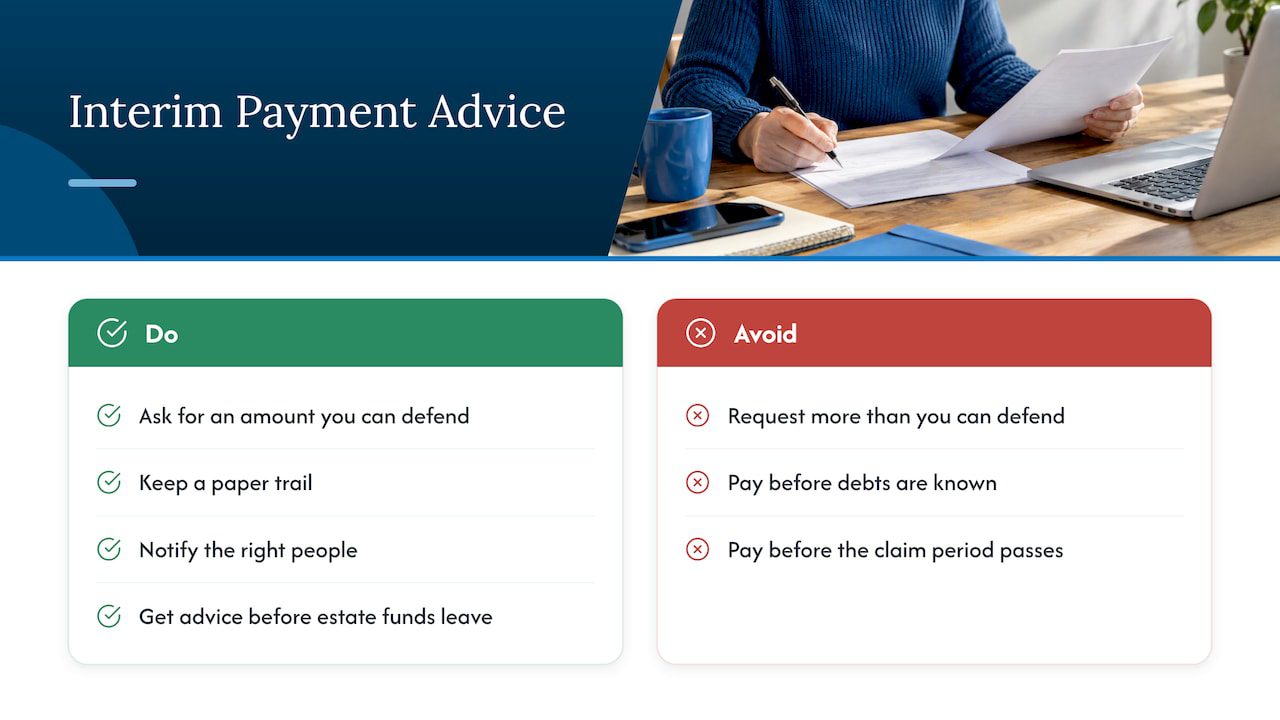
For executors, we see the opposite mistake: paying a beneficiary early out of kindness, before debts are known and before the claim period has passed. Compassion is fine, but it needs a paper trail, notice to the right people and funds held back. When there is any hint of a family provision claim, we recommend getting advice before a cent leaves the estate.
Every matter at our firm is partner-led, and we would rather tell you early that an interim application is not worth pursuing than let costs build.
— George
Getting help with an interim application
Whether you are an eligible person who needs funds now or an executor who is being pressed for a part-payment, the first step is the same: a clear view of the claim, the estate and the risks. We act for claimants and for executors, and our team handles family provision claims and estate litigation across Sydney and regional NSW, in person or by video. New clients receive a complimentary 30-minute consultation.

If you are an executor facing a claim, our page on how we defend an estate explains what we do.
Funding Your Legal Matter — No Win, No Fee
Simons George Legal offers No Win, No Fee arrangements for eligible cases. We check eligibility during a free initial consultation, so you know where you stand before committing to anything. For people with a legitimate claim, this removes the upfront cost barrier that can stop them from pursuing it. You can read more on our No Win, No Fee page. To find out whether your matter qualifies, book a free case assessment with us today.
No Win, No Fee arrangements are subject to case eligibility and a written costs agreement. Liability limited by a scheme approved under Professional Standards Legislation.
FAQ
Can I get an interim payment from an estate without going to court?
Yes, if the executor agrees. An executor can make an interim distribution to a beneficiary, provided debts are covered and enough is kept back for liabilities and possible claims. The payment is taken into account in the final accounts. If the executor refuses, the options are negotiation or an application to the court.
Is an interim family provision order guaranteed if I am an eligible person?
No. Eligibility only lets you apply. The court must be of the opinion that no less provision than the interim amount would be made in the final order. If it is not satisfied of that, it can refuse or reduce the amount.
Can an interim order be taken back?
The court must finally determine the claim by confirming, revoking or varying the interim order. So the interim payment is not a final entitlement. Judges are cautious about the amount for exactly that reason.
How long do I have to make a family provision claim in NSW?
Generally 12 months from the date of death, unless the court grants leave to file late. An interim order depends on a claim being made, so the deadline matters. Get advice as early as you can.
Should an executor distribute within six months of death?
Generally not. That period allows time for family provision claims to be filed, and distributing earlier risks personal liability if a claim succeeds. If a beneficiary is in hardship, get advice on a safe, documented part-payment.
Sources
- Succession Act 2006 No 80, NSW Legislation
- Succession Act 2006, section 62, AustLII
- Distributing the estate, Legal Aid NSW
- How Interim Distributions in Estates Work in Australia
- NSW Law Reform Commission, Report 110
- Byrd v Margiotta [2023] NSWSC 1556, case summary
- Wills and Estates: A Survey of the Field, Supreme Court of NSW (2018)
- The Family Provision Jurisdiction, Supreme Court of NSW (2021)