An inter vivos trust is created while you are alive and holds assets you hand over now. A testamentary trust is written into your will and only starts when you die. For most families planning what happens after death, and for executors and beneficiaries dealing with an estate that is already in dispute, the testamentary trust is the structure that matters, because it is built to carry assets to the next generation with control and protection. This guide explains the difference in plain terms, what each means for tax and control, and what happens when the will that creates a trust is challenged in NSW.
TL;DR
- An inter vivos trust (“between the living”) is set up during your lifetime. A testamentary trust is created by your will and begins on death.
- Assets you place in an inter vivos trust generally stop being part of your personal estate. A testamentary trust is funded from the estate, so the will must be valid and properly drafted.
- A testamentary trust can protect beneficiaries who are young, vulnerable, going through a relationship breakdown or in financial difficulty, and can help with business and farm succession.
- If the will creating the trust is challenged, the trust can be delayed or reshaped. Executors and beneficiaries should get advice early.
- Simons George Legal offers a free 30-minute consultation to assess your position.
Table of Contents
- What each type of trust is
- Inter vivos vs testamentary trust: the key differences
- Why a will trust is often the better fit for families
- Tax: where testamentary trusts stand out
- What is a bloodline trust?
- Testamentary trusts for business owners and farming families
- When the trust begins: what happens after death
- When the will or the trust is challenged
- How to choose between the two
- Our perspective
- Getting your trust drafted or defended
- Funding Your Legal Matter — No Win, No Fee
- FAQ
- Sources
What each type of trust is
A trust is an arrangement in which a trustee holds and manages property for the benefit of one or more beneficiaries, following the terms set out in a trust deed or a will. The Queensland Public Trustee describes it this way: the trustee manages the assets under the trust’s terms, whether those terms sit in a deed or in a will.
The two types differ in one thing first: timing.
Inter vivos trust
The Latin phrase means “between the living”. The Public Trustee of South Australia explains that property settled on an inter vivos trust ceases to belong to the person who settled it and to their personal estate. Academic commentary in Equity and Trusts in Australia adds that it can be created by declaring yourself trustee of your own property, or by transferring property to someone else as trustee.
People use it to make regular or discretionary payments to someone, including as a protective trust for a vulnerable person, as the South Australian Public Trustee notes. It is also the structure behind most family trusts that run investments or a business during the owner’s life.
Testamentary trust
A testamentary trust is created by a will and operates on death. The Queensland Public Trustee says it is written into the will and distributes property after death. The Australian Taxation Office (ATO) explains that it is established under a valid will and is a separate trust from the deceased estate. It functions like a discretionary family trust, with the will’s provisions operating like a trust deed.
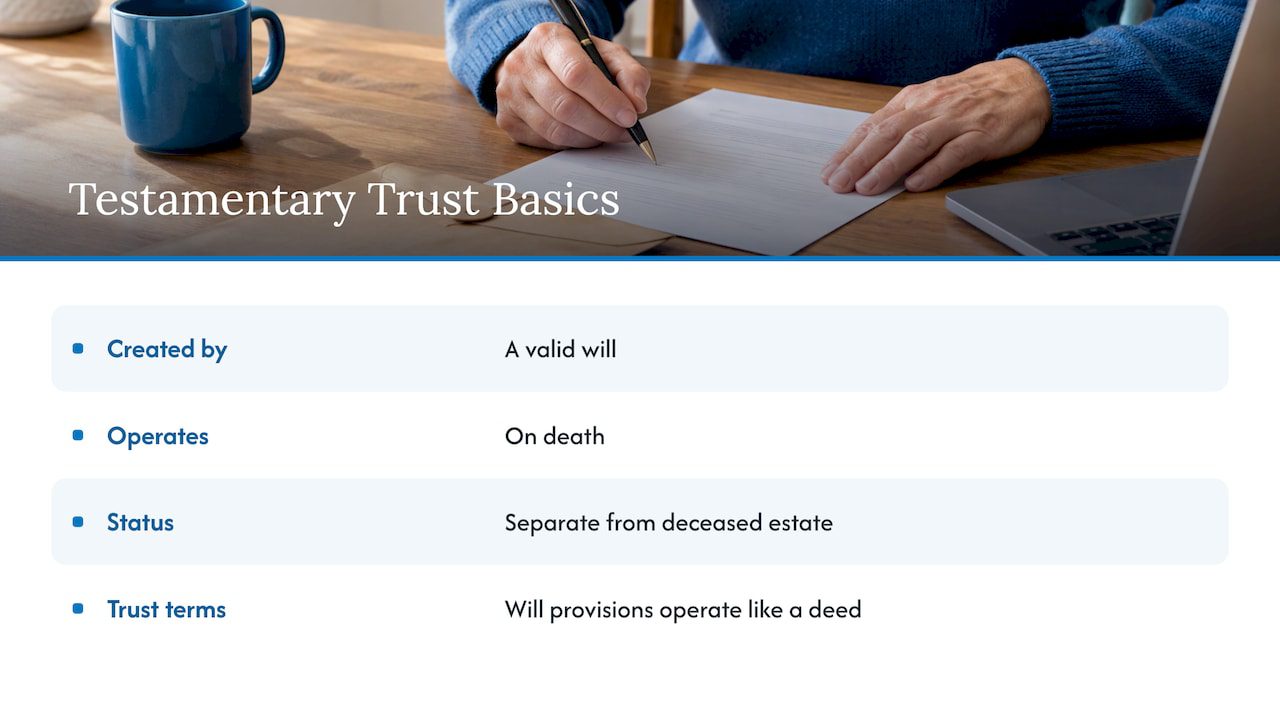
That last point matters for you. The trust is only as sound as the will that creates it.
Inter vivos vs testamentary trust: the key differences
| Feature | Inter vivos trust | Testamentary trust |
|---|---|---|
| When it starts | During your lifetime | When you die, under your will |
| Where it is created | A trust deed, or a declaration over your own property | Your will |
| What it holds | Assets you transfer or declare while alive | Assets passing from your estate |
| Your own control | You can build in a role for yourself, but assets generally leave your personal estate | You keep full control of your assets until death, and can change the will |
| Who sets it up | You, with a deed | The executor puts the will’s terms into effect |
| Reporting | Trust tax return and records | The trustee lodges a tax return every financial year and keeps proper records, per the ATO |
| Main use | Asset holding, running a business, early protection of a vulnerable person | Protecting and managing an inheritance for beneficiaries after death |
The practical reading of this table is simple. An inter vivos trust is a decision you act on now and live with. A testamentary trust is a decision you record now and can still change until death.
Why a will trust is often the better fit for families
When readers ask about a “lifetime trust vs will trust”, the real question is whether they want to give up assets today. Many people do not. They want to keep their home, savings and business in their own name while they are alive, and decide how those assets are held afterwards.
A testamentary trust does this. Because you create it in your will, you can alter the terms whenever your family circumstances change. Our guide on simple will vs trust shows when a basic will is enough and when a trust adds value.
A testamentary trust is typically considered where:
- a beneficiary is a child, or is vulnerable or has special needs
- a beneficiary has a high-risk profession, debts or a history of poor money management
- a beneficiary is in a marriage or relationship that may end
- the family is blended, and you want to provide for a current partner and also keep assets for children from an earlier relationship
- you own a business or farm that should stay in the family
Our article on testamentary trusts and divorce protection explains the relationship breakdown situation in detail, and what a will trust beneficiary is covers the beneficiary’s side.
Tax: where testamentary trusts stand out
Tax is the reason testamentary trusts are widely discussed in Australia. Because the trust works like a discretionary trust, the trustee may be able to direct income to beneficiaries who pay less tax on it. The ATO treats minors (people under 18 at 30 June) differently from adults: those who are not “excepted persons” generally face higher rates on non-excepted income, as set out on the ATO’s page for people under 18. Australian-resident minors who are excepted persons, or who receive only excepted income, have the ordinary $18,200 tax-free threshold. This is a rule for qualifying income and not an automatic concession for every distribution.
So the tax outcome depends on the type of income, the beneficiary and the trustee’s decisions each year. It is a good reason to have the trust drafted carefully and administered with advice, and it is not a reason to set one up without checking how it fits your assets. Whether the benefit justifies the work is usually a question of how much will sit in the trust and how long it will run.
An inter vivos trust has its own tax profile, and transferring assets into one while you are alive can have tax and duty consequences that do not arise when assets pass under a will. That is one more reason many people prefer to keep their assets in their own name until death and structure the inheritance by will.
What is a bloodline trust?
“Bloodline trust” is a popular label rather than a separate legal category. It describes a testamentary trust drafted so that assets stay within the family line. The will can name descendants as beneficiaries and direct what happens to the trust’s capital if a beneficiary dies, separates or becomes bankrupt, so that the inheritance is not simply absorbed into a former partner’s property settlement or a creditor’s claim.
The outcome is never guaranteed. A court dealing with a property settlement or a family provision claim can look at the resources available to a person, and the way the trust is drafted and who controls it affect how it is treated. Careful drafting of who the trustee is, who can benefit and what discretion the trustee holds is where this protection is built.
Testamentary trusts for business owners and farming families
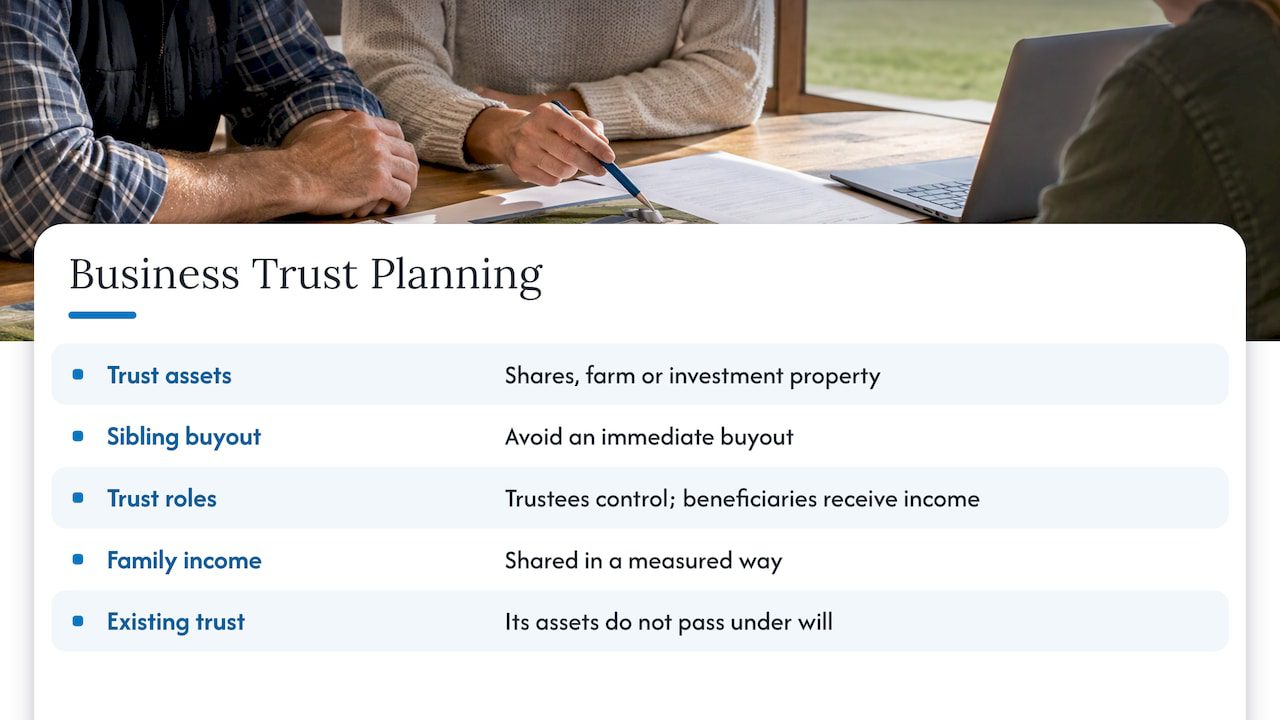
For a business owner, the will can place business shares, a farm or an investment property into a trust, so that the people who run the business are not forced to buy out siblings straight away, and income can be shared across the family in a measured way. A testamentary trust can also separate the people who control the business (the trustees) from those who enjoy its income (the beneficiaries). That is useful where one child works on the farm and others do not.
It works best when planned with the rest of your arrangements: company constitutions, partnership or shareholder agreements, existing family trusts and superannuation. A will trust that sits alone and conflicts with those documents causes the disputes it was meant to avoid. If you have an existing inter vivos family trust, your will should be written with that trust in mind, because assets already held by it do not pass under your will.
When the trust begins: what happens after death
A testamentary trust does not exist until the will takes effect. The executor first obtains probate, the Supreme Court’s confirmation that the will is valid, then gathers the assets, pays debts and funds the trust according to the will. Property such as real estate has to be transferred by the proper registry process, and the deceased estate transmission process in NSW explains how title is dealt with when the owner has died. Our guide on distributing estate assets sets out the executor’s steps in order, and our page on probate and estate administration describes how we support executors through the process.
Delays at this stage directly affect the trust. Beneficiaries wait for income, and the trustee cannot act until the trust is funded. Our article on estate administration delays covers the common causes.
When the will or the trust is challenged
Because the trust is created by the will, a successful challenge to the will can affect the trust. This is the situation executors and beneficiaries in NSW most often meet.
There are two broad routes:
- Challenging the will itself. The usual grounds are that the will-maker lacked capacity, did not know and approve the contents, was under undue influence, or the will was not properly signed and witnessed. Our guides on contesting a will and the grounds for contesting a will explain each ground.
- A family provision claim. An eligible person who believes they were left without adequate provision can ask the court to order more from the estate, even where the will is valid. This can reshape the assets available to the trust. See family provision claims in NSW and the claim process. Strict time limits apply, so do not wait to seek advice.
A third issue sometimes arises: someone says they hold a share of a property by way of a constructive trust, which sits outside the will. Our article on constructive trust claims against an estate explains how these work.
If you are the executor
The executor’s duty is to the estate and to the terms of the will, including the trust. When a claim is made, the executor generally defends the will and the estate’s assets, rather than taking sides among family members. Our guide to defending a family provision claim in NSW sets out the executor’s role, and our Defend An Estate service is built for it.
If you are a beneficiary
A beneficiary named as a trust beneficiary may fear that a challenge will freeze or cut their inheritance. Early advice helps you understand the strength of the claim against you, the likely timetable and whether mediation can resolve things before a hearing. Our Estate Litigation and mediation and disputes services cover both contested hearings and negotiated settlements.
How to choose between the two
Work through these questions in order:
- Do you want to hand over assets now? If not, a testamentary trust in your will is the natural route.
- Who needs protection after you die? Young children, vulnerable adults, beneficiaries with creditors or relationship risk are the classic cases.
- Is there a business or farm? Decide who will control it and who will only receive income.
- How large is the estate? The larger the assets going into the trust, the more a trust is likely to be worth the drafting and annual administration.
- Could the will be challenged? If a family member could say they were left out, the will and its trust should be drafted with that risk in mind from the start, with clear records of why you made your decisions.
An inter vivos trust makes sense in a narrower set of cases: where you want assets held outside your estate now, for example to support a vulnerable person during your lifetime or to run a business through a trust.
Our perspective
Most disputes we see over trusts in wills start from the same place: a will that was made without thinking about who might challenge it, or who would be left holding the trust.
Every matter at our firm is partner-led by a specialist with extensive Supreme and High Court experience. That means the person who advises on the trust structure understands how a court will read it when a family member contests it. We think good drafting and good litigation knowledge belong together, and that is how we approach testamentary trusts, whether we are writing one or defending one.
If you are an executor or beneficiary already in a dispute, we give clear, honest advice about where you stand and what the next step should be, with costs kept proportionate to what is at stake.
George
Getting your trust drafted or defended
If you are planning an estate, we draft and update wills, including testamentary trusts, and we cover farm and business succession and blended family structures. If a will or trust is already under challenge, we act for executors and beneficiaries across Sydney, the Eastern Suburbs, the Northern Rivers and regional NSW, in person or virtually.
New clients receive a complimentary 30-minute consultation, where we assess your situation and recommend practical next steps.

Start with our will making and amending service if you are planning, or our estate litigation team if a dispute has begun.
Funding Your Legal Matter — No Win, No Fee
Simons George Legal offers No Win, No Fee for eligible cases. We check eligibility during a free initial consultation, so you know where you stand before committing to anything. This removes the upfront cost barrier for people with a legitimate claim, who might otherwise be unable to pursue or defend a matter involving a trust or a contested will. Read more on our No Win, No Fee page, then book your free case assessment today.
No Win, No Fee arrangements are subject to case eligibility and a written costs agreement. Liability limited by a scheme approved under Professional Standards Legislation.
FAQ
What does inter vivos mean in trusts?
It means “between the living”. An inter vivos trust is created during the settlor’s lifetime, and the property placed in it generally no longer forms part of their personal estate, as the Public Trustee of South Australia explains. It contrasts with a testamentary trust, which starts under a will after death.
Does a trustee have more power than a beneficiary?
The trustee manages the trust assets and makes decisions within the terms of the deed or will. Beneficiaries hold the right to benefit and to see that the trustee follows those terms. In a testamentary trust the will sets out how much discretion the trustee has, so the drafting decides the balance.
Can a testamentary trust be challenged?
Yes, indirectly. Because the trust is created by the will, a challenge to the will’s validity, or a family provision claim against the estate, can change what the trust receives. Time limits apply to these claims, so executors and beneficiaries should seek advice as soon as a claim is raised.
Do testamentary trusts have ongoing obligations?
Yes. According to the ATO, the trustee must lodge a tax return every financial year and maintain proper records. Choosing a trustee who can manage this, or who has professional support, is part of the planning.
Sources
- Inter vivos trusts, Public Trustee of South Australia
- About trusts, Queensland Public Trustee
- Creating an Express Trust, Equity and Trusts in Australia, Cambridge University Press
- Estate planning, Australian Taxation Office
- Your income if you are under 18 years old, Australian Taxation Office
- Deceased estate transmission application, NSW