A hidden assets estate dispute arises when one or more parties to an inheritance fail to disclose assets that rightfully form part of a deceased estate, preventing fair distribution to beneficiaries. In Australian estate law, this is formally addressed through the principles of full and frank disclosure, executor duties under state legislation, and court-enforced investigative powers. Whether you are a beneficiary who suspects concealment or an executor unsure of your obligations, the legal tools available are more powerful than most people realise. Acting early is the single most important thing you can do.
What legal duties apply in a hidden assets estate dispute?
Executors carry the heaviest obligations when it comes to asset disclosure. Under NSW law, executors must secure all assets, pay debts, and obtain proper valuations before any distribution occurs. Failure to do so creates personal liability. That means an executor who overlooks, conceals, or misvalues assets can be sued by beneficiaries for the resulting loss.
The timing rules are strict. NSW executors cannot distribute an estate until at least 6 months after the date of death and 30 days after publishing a Notice of Intention to Distribute. This window exists specifically to give claimants time to come forward. Distributing early, or without proper notice, exposes the executor to personal liability.
Beneficiaries hold corresponding rights. Full and frank disclosure is an ongoing legal obligation in estate and family law, enforceable by courts. A beneficiary is entitled to a complete picture of the estate’s assets and liabilities, not just what the executor chooses to share.
Key executor obligations under NSW law include:
- Completing a Deceased Estate Information form and maintaining an exhaustive asset identification checklist
- Obtaining independent valuations for real property, business interests, and significant personal assets
- Notifying the Australian Taxation Office and meeting all tax compliance requirements
- Publishing the Notice of Intention to Distribute before any payments to beneficiaries
Pro Tip: If you are a beneficiary and the executor refuses to provide a full asset inventory, you can apply to the Supreme Court for an order compelling disclosure. You do not need to wait until distribution.
What tools can uncover concealed estate assets?
Forensic accountants are the most effective first line of investigation in disputes over hidden wealth. They trace financial inconsistencies across bank statements, tax returns, business records, and trust accounts. Forensic accounting costs range from $7,500 to over $50,000 depending on complexity. That cost is recoverable from the estate if concealment is proven.
Courts have significant powers to compel disclosure. The key legal tools are:
- Subpoenas. Courts issue subpoenas to banks, the ATO, employers, and financial institutions, bypassing any attempt by a party to conceal records. The documents go directly to the court.
- Search orders. Search orders allow courts to enter premises and seize hidden documents or assets when there is a real risk of evidence destruction. These are serious mechanisms reserved for complex disputes.
- Freezing orders. Courts can freeze assets to prevent dissipation or transfer offshore while proceedings are on foot. This is critical when assets are at risk of moving beyond Australian jurisdiction.
- Court-ordered disclosure. A party can be ordered to file a sworn statement of assets and liabilities. Lying in that statement is contempt of court.
Two asset classes deserve special attention. Discretionary trusts are a common vehicle for concealing wealth because the deceased may have held control without formal legal ownership. Cryptocurrency portfolios are harder to trace but leave transactional trails through bank accounts and exchanges. Forensic accountants now routinely examine crypto holdings as part of any thorough asset trace.
Pro Tip: Ask the executor for copies of the deceased’s last three tax returns. Discrepancies between declared income and lifestyle expenses are one of the clearest early signals of concealed assets.
The consequences of concealment are severe. Courts draw adverse inferences when assets are hidden and can adjust settlements heavily in favour of the honest party. In extreme cases, courts have awarded 100% of disputed assets to the non-concealing party, plus additional cash payments.
How to investigate suspected hidden assets: a step-by-step process
A structured approach protects your position and maximises the chance of recovery. Rushing in without legal guidance often destroys evidence or alerts the other party to move assets.
Step 1: Gather and document what you already know.
Collect bank statements, tax returns, property records, business documents, and any correspondence that references assets. Note any lifestyle indicators that seem inconsistent with the declared estate value. This forms the foundation of your case.
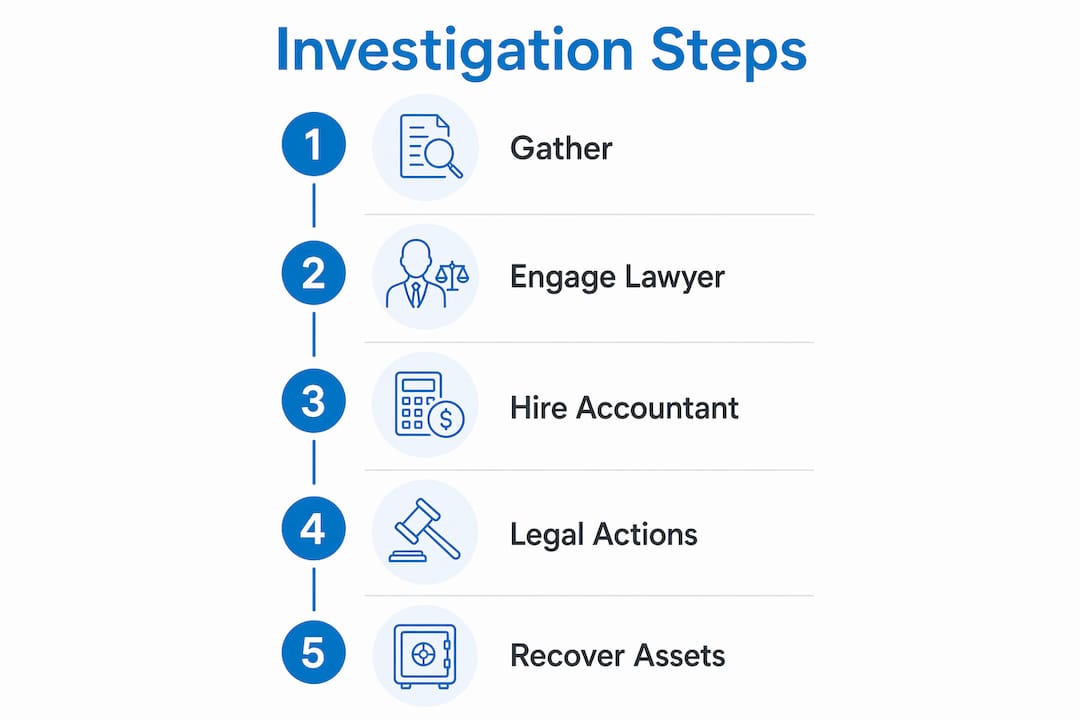
Step 2: Engage a wills and estates lawyer immediately.
Early legal intervention is critical. Once assets leave Australian jurisdiction, cross-border recovery becomes extremely difficult. A lawyer can apply for freezing orders before the other party realises proceedings have begun.

Step 3: Retain a forensic accountant.
Brief the forensic accountant with every document you have gathered. They will identify gaps, inconsistencies, and patterns that point to undisclosed assets. Their report becomes evidence in court proceedings.
Step 4: Use formal legal procedures.
Your lawyer can issue subpoenas to third parties, apply for search orders, and compel sworn asset disclosure. These tools work because they operate independently of the other party’s cooperation.
Step 5: Respond to non-cooperation strategically.
If the executor or another party refuses to cooperate, document every refusal in writing. Non-cooperation is itself evidence. Courts treat it seriously when drawing inferences about what is being hidden.
What to avoid during this process:
- Confronting the other party directly before legal advice. This alerts them and may trigger asset transfers.
- Accepting verbal assurances about the estate’s completeness without written confirmation.
- Delaying action. Beneficiaries who delay reduce their chances of recovery significantly, especially if assets move offshore or are spent.
- Conducting your own searches of the deceased’s property without legal authority. Evidence obtained improperly can be excluded.
Common mistakes when dealing with hidden property disputes
The biggest mistake beneficiaries make is assuming that inactivity is safe. Unresolved estates compound in complexity and tax liability over time. Delaying estate administration creates costly complications including the loss of capital gains tax concessions, a risk sometimes called the “double death tax trap” when a surviving spouse dies before the estate is finalised.
Executors frequently underestimate their personal exposure. Executors are personally liable for undisclosed assets and tax compliance failures. An executor who relies on incomplete information provided by family members, without independently verifying it, does not escape liability by claiming ignorance.
Subtler forms of concealment are often overlooked. Deliberate undervaluation of real property, gifting assets to third parties shortly before death, and placing assets inside family trusts are all methods used to reduce the apparent size of an estate. These require a forensic eye, not just a review of the will.
Non-disclosure in an estate dispute is not just a moral failure. It is a legal one. Courts treat concealment as a serious breach, and the consequences, including cost orders, adverse inferences, and redistributed assets, can far outweigh whatever was gained by hiding the asset in the first place.
The inheritance dispute documentation you gather from the outset shapes every step that follows. Thorough, continuous disclosure is not optional. It is the legal standard courts enforce.
Key takeaways
Uncovering hidden assets in an estate dispute requires early legal action, forensic expertise, and court-enforced disclosure tools working together.
| Point | Details |
|---|---|
| Act immediately | Delays reduce asset recovery chances and increase tax exposure for the estate. |
| Executor liability is personal | Executors face personal liability for undisclosed assets and tax compliance failures. |
| Forensic accountants are essential | They trace hidden funds across trusts, crypto, and offshore accounts using subpoenas and financial analysis. |
| Courts have strong powers | Subpoenas, search orders, and freezing orders compel disclosure and preserve assets before they disappear. |
| Concealment carries severe penalties | Courts can award 100% of disputed assets to the honest party and impose additional cost orders. |
What I have learned from estate disputes involving hidden assets
The cases that concern me most are not the ones where someone has obviously hidden a bank account. Those are usually found. The cases that cause real harm are the ones where concealment is subtle: a property transferred to a child two years before death, a business interest held through a trust that nobody thought to question, a cryptocurrency wallet that the deceased never mentioned.
Families often come to me months or even years after the estate should have been finalised. By that point, assets have sometimes moved, tax concessions have been lost, and the cost of recovery has multiplied. The estate litigation process becomes far more expensive than it needed to be, simply because nobody acted when the signals were first visible.
My advice is consistent: if something feels wrong about the estate, get legal advice before you say anything to the other parties. The moment you raise your suspicions informally, you give the other side time to prepare. A lawyer can move quickly and quietly, using court tools that operate without warning.
Selecting the right forensic accountant matters as much as selecting the right lawyer. Look for someone with specific experience in estate and trust structures, not just general accounting. The intersection of trust law and tax is where most concealment happens, and that requires a specialist.
Inaction is never neutral in these matters. Every week that passes without formal steps is a week in which assets can move, records can be lost, and your legal position can weaken.
— George
Simons George Legal can help you recover what is rightfully yours
If you suspect that assets are being concealed in an estate you are involved in, the right time to act is now. Simons George Legal is a Bondi-based wills and estates practice with deep experience in contested estates, inheritance disputes, and complex asset recovery litigation across Sydney.

The firm’s estate litigation team works with forensic accountants, applies for court orders, and pursues full disclosure on behalf of beneficiaries and executors who need to protect their position. New clients receive a complimentary 30-minute consultation to assess their situation and identify the most practical next steps. Contact Simons George Legal today to book your free case assessment.
Funding your legal matter — no win, no fee
Cost should not prevent you from pursuing a legitimate claim. Simons George Legal offers No Win, No Fee arrangements for eligible estate dispute matters. Eligibility is assessed during a free initial consultation, so you know exactly where you stand before committing to anything.
This arrangement removes the upfront cost barrier for people with a genuine claim to hidden or undisclosed estate assets. If your case qualifies, you pay legal fees only if the matter resolves in your favour. Book a free case assessment with Simons George Legal to find out whether your matter is eligible and what your options are.
No Win, No Fee arrangements are subject to case eligibility and a written costs agreement. Liability limited by a scheme approved under Professional Standards Legislation.
FAQ
What counts as a hidden asset in an estate dispute?
A hidden asset is any property, account, investment, or financial interest that should form part of a deceased estate but has not been disclosed by the executor or another party. Common examples include undisclosed bank accounts, property transferred before death, trust interests, and cryptocurrency holdings.
Can a beneficiary force an executor to disclose all assets?
Yes. Beneficiaries can apply to the Supreme Court for an order compelling full asset disclosure. Full and frank disclosure is an ongoing legal obligation, and courts enforce it with cost orders and adverse inferences against non-compliant parties.
How do courts find hidden assets in estate litigation?
Courts use subpoenas to obtain financial records directly from banks, the ATO, and employers. Forensic accountants analyse those records to identify concealed funds, undervalued assets, and suspicious transfers that occurred before or after the date of death.
What happens if an executor conceals assets in NSW?
An executor who conceals or fails to disclose assets faces personal liability for any resulting loss to the estate. Courts can remove the executor, order repayment of concealed assets, and impose cost orders. In serious cases, the conduct may also attract criminal liability.
How long do I have to act if I suspect hidden assets?
Act as soon as possible. Delays reduce the chance of recovery because assets can be transferred offshore or dissipated. Freezing orders and subpoenas are most effective when applied for early, before the other party has time to move funds or destroy records.