Gathering evidence in an inheritance dispute means collecting specific financial records, medical reports, property valuations, and relationship documentation that Australian courts recognise as proof of your claim. The Supreme Court of NSW requires you to file a family provision claim within 12 months of the date of death, so starting your evidence collection early is not optional. Courts apply a “wise and just” standard, asking whether the deceased failed a moral duty to provide for you, not simply whether you need money. That distinction shapes everything you collect.
Start gathering these immediately:
- Tax returns, bank statements, and asset schedules for the past two to three years
- Medical reports documenting disabilities, chronic illness, or care needs
- Emails, texts, letters, and photos showing your relationship with the deceased
- Professional property valuations for all real estate in the estate
- Witness statements from people who observed your contributions to the deceased’s care or household
- Records of any unpaid work, caregiving, or financial support you provided
How to gather evidence in an inheritance dispute: the essential types
Courts and legal practitioners recognise several distinct categories of evidence, each serving a different purpose in your claim. The Supreme Court Practice Note SC EQ 07 sets out what administrators must disclose, and your own evidence should mirror that level of detail.
- Financial records: Income from all sources, including wages, Centrelink payments, and investment returns. Expenses, debts, liabilities, and personal assets such as property, superannuation, and vehicles. The court needs a complete picture of your financial position, present and future.
- Medical evidence: Reports from treating doctors, specialists, or allied health professionals that explain your condition, how it affects your capacity to work, and what ongoing care costs you face. Age-related limitations count here too.
- Relationship evidence: A chronological history of your connection with the deceased. Emails, text messages, birthday cards, photographs, and travel records all help. Courts look at the nature, duration, and quality of the relationship.
- Property valuations: Kerbside appraisals or formal valuations for every property in the estate. These establish the estate’s true value and affect what provision is reasonable.
- Contribution evidence: Records of unpaid caregiving, home maintenance, or financial assistance you provided to the deceased. Third-party witness statements corroborating these contributions carry real weight with courts.
- Authenticity checks: Affidavits, certified copies of original documents, and corroborative testimony from independent witnesses. Courts scrutinise whether documents are genuine, so chain of custody matters from the moment you collect anything.
The Succession Act 2006 (NSW) lists the factors a court weighs when deciding whether adequate provision was made. Your evidence should speak directly to those factors: your age, health, financial circumstances, the size of the estate, and any contributions you made to the deceased’s welfare.
What are the key legal deadlines and procedures you need to know?
Timing is the single biggest trap in inheritance disputes. Miss the deadline and you need court permission to proceed, which adds cost and uncertainty.
| Stage | Timeframe | Key action |
|---|---|---|
| File family provision claim | Within 12 months of death | Lodge summons and affidavit in the Equity Division |
| Lodge a caveat | — | Prevents probate grant while dispute is active |
| Mediation | Before final hearing | Mandatory for all family provision applications |
| Final hearing | If mediation fails | Judge reviews all affidavit evidence and decides |
All family provision applications in NSW are referred to mediation before any final hearing. Mediation resolves most disputes without a trial, saving months of cost and stress. If it fails, the matter proceeds to a judge who weighs the affidavit evidence from both sides.
Executors play a dual role that can create complications. An executor named in the will administers the estate, but if that executor also wants to make a claim, they cannot do both simultaneously. The court appoints an independent administrator to manage the estate while the executor pursues their claim. You have a legal right to request full estate accounts from the executor, and undisclosed assets can challenge any distributions already made. If an executor refuses to provide proper disclosure, that refusal itself becomes relevant in proceedings.
Practical steps for collecting and preserving your evidence
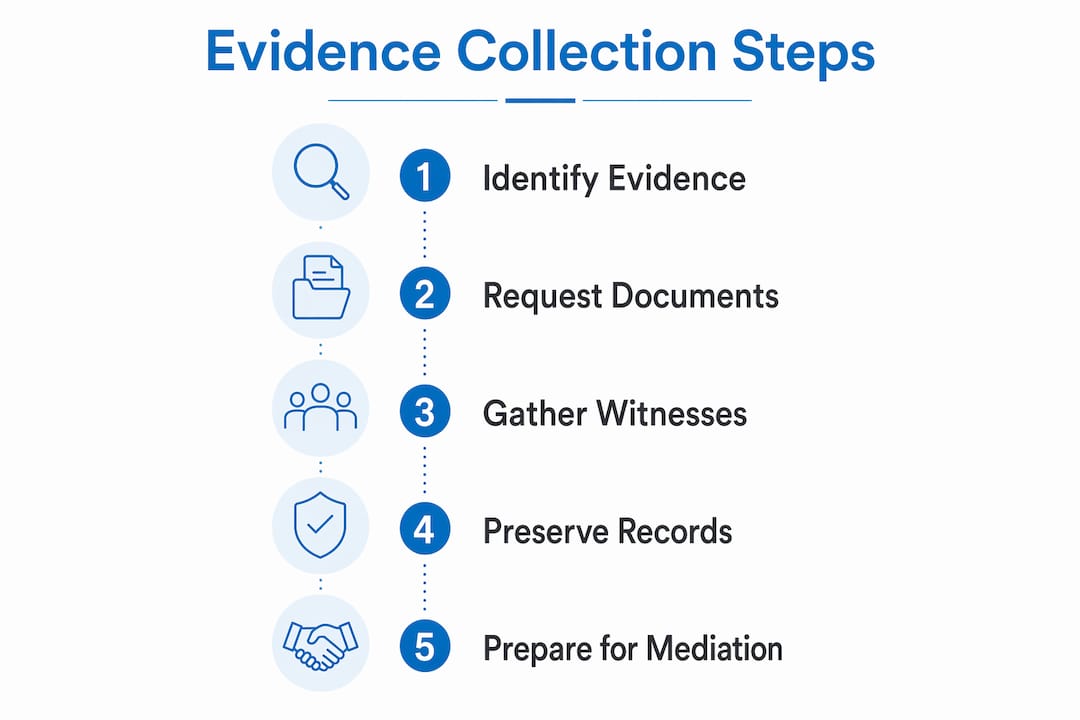
The process of collecting evidence for an inheritance dispute works best when you treat it like building a file for court from day one, because that is exactly what you are doing.
- Contact financial institutions in writing. Request statements, loan records, and account histories for the deceased and for yourself. Banks respond to formal written requests; verbal requests rarely produce usable records.
- Obtain medical records promptly. Ask your treating doctors for a letter or report that addresses your specific circumstances: your diagnosis, prognosis, work capacity, and care costs. GPs can usually provide this within a few weeks.
- Prepare witness statements carefully. Identify people who observed your relationship with the deceased or your contributions to their care. Each statement should be specific: dates, locations, and what the witness personally saw or heard. Vague statements add little.
- Request estate disclosure formally. Write to the executor requesting a full inventory of assets and liabilities, copies of the will, and details of any transactions since death. Keep copies of every letter and response.
- Preserve digital evidence. Screenshot text messages and emails before they disappear. Save them to a secure location and note the date and device. Courts accept digital records when they are properly authenticated.
- Use certified copies. For original documents like birth certificates or property titles, obtain certified copies from a Justice of the Peace or solicitor. Never submit originals to court without keeping a certified copy.
Common obstacles include uncooperative executors, missing records, and witnesses who are reluctant to give statements. An executor who delays disclosure can be compelled by court order. Missing bank records can often be reconstructed through tax returns or ATO records. For reluctant witnesses, a solicitor’s letter explaining the formal process sometimes prompts cooperation.
Pro Tip: Legal costs in family provision matters are scrutinised against the size of the estate. Spending a large sum in legal fees on a modest estate rarely makes sense. Discuss proportionality with your lawyer at the outset and revisit it at each stage.

Simons George Legal advises clients to start the evidence collection process as soon as a dispute becomes likely, well before any formal claim is filed. Early preparation gives you time to track down records that take weeks to obtain and to identify gaps before they become problems. You can also explore your dispute resolution options at the same time, since many claims settle before reaching court.
Understanding how mediation works in legal disputes can help you prepare for that stage too, since the strength of your evidence directly shapes your negotiating position.
Funding your legal matter — No Win, No Fee
Cost is a real barrier for many people with legitimate inheritance claims. Simons George Legal offers a No Win, No Fee arrangement for eligible cases, which means you pay no upfront legal fees to pursue your claim.
Eligibility is assessed during a free initial consultation. Simons George Legal reviews the merits of your case, the size of the estate, and your circumstances before confirming whether the arrangement applies. For people with a strong claim but limited funds, this removes the financial risk that otherwise stops them from acting.

If you are facing an inheritance dispute and want to understand your options, book a free case assessment with Simons George Legal today.
No Win, No Fee arrangements are subject to case eligibility and a written costs agreement. Liability limited by a scheme approved under Professional Standards Legislation.
Key takeaways
Gathering evidence early and systematically is the single most important step you can take to protect your inheritance claim in Australia.
| Point | Details |
|---|---|
| File within 12 months | Family provision claims must be lodged with the Supreme Court of NSW within 12 months of the date of death. |
| Cover all evidence categories | Financial records, medical reports, relationship evidence, property valuations, and contribution evidence each serve a distinct purpose. |
| Request executor disclosure | You have a legal right to full estate accounts; undisclosed assets can affect any distributions already made. |
| Mediation comes first | All NSW family provision applications go to mediation before a final hearing, making strong evidence critical for negotiation. |
| Match costs to estate size | Legal spending is scrutinised against estate value, so discuss proportionality with your lawyer from the start. |
FAQ
How long do I have to file an inheritance dispute claim in NSW?
A family provision claim must be filed within 12 months of the date of death. After that deadline, you need court permission to proceed, which is harder to obtain and adds cost.
What evidence does a court consider in a family provision claim?
Courts weigh your financial circumstances, health, age, the nature of your relationship with the deceased, any contributions you have made to the estate, and the size of the estate. Evidence must address the factors listed in the Succession Act 2006 (NSW).
Can I get documents from the executor if they are uncooperative?
Yes. You have a legal right to request full estate accounts and asset disclosure from the executor. If they refuse, a court order can compel production of the relevant records.
Does every inheritance dispute go to court?
No. All NSW family provision applications are referred to mediation first. Most disputes settle at that stage, which is faster and less costly than a trial.
What if I cannot afford a lawyer for my inheritance claim?
Simons George Legal offers No Win, No Fee arrangements for eligible cases, assessed during a free initial consultation. This removes the upfront cost barrier for people with a legitimate claim.