Yes, a forged will can be challenged in NSW through the Supreme Court, and in serious cases through a criminal referral to police under the Crimes Act 1900. The single most important thing you can do first is preserve the original document untouched and get legal advice before probate is granted or assets are distributed. Acting early is what keeps your options open.
TL;DR:
- Challenging a forged will in NSW is most effective when started before probate is granted, as evidence can weaken the document’s credibility early on.
- Evidence such as handwriting analysis, chain of custody records, and inconsistent versions of the will are crucial to prove or disprove forgery in court.
- Immediate steps include photographing the original, recording access, gathering earlier wills and documents, and seeking urgent legal advice to prevent asset distribution.
- Forensic experts’ reports are persuasive but not definitive; a combination of medical, financial, and witness evidence strengthens a forgery case.
- Early, well-evidenced legal action reduces costs and increases chances of recovering assets or preventing wrongful distribution, especially with No Win, No Fee options.
Table of Contents
- What counts as a forged will in NSW?
- Criminal offences and penalties for forging a will
- How does the Supreme Court decide if a will is genuine?
- What evidence proves or disproves a forged will?
- What should you do immediately if you suspect a forged will?
- What happens if a forged will is proven or disproven?
- How Simons George Legal supports clients with suspected forged wills
- Funding your legal matter — No Win, No Fee
- Statutory time limits for challenging a will on grounds of forgery in NSW
- Impact of a forged will on rightful beneficiaries and estate distribution
- Preventative measures to reduce the risk of will forgery
- Practical perspective: when to litigate and when to negotiate
- Book a case assessment and next practical steps
- Sources
- FAQ
What counts as a forged will in NSW?
A will is forged when the signature, the document, or both are not genuine, meaning the deceased never actually made or approved it. NSW law requires a will to be signed by the testator and witnessed by two people present at the same time, though courts can admit informal documents in limited circumstances if satisfied they reflect genuine testamentary intention.
Forgery is a distinct problem from a lack of testamentary capacity, undue influence, or a later valid revocation, each of which raises different evidence and different arguments. The practical test courts apply is ‘knowledge and approval’: did the deceased actually know and approve the contents of the document being propounded as their will?
Criminal offences and penalties for forging a will
Section 253 of the Crimes Act 1900 (NSW) makes it an offence to create a false document, forgery carries a maximum penalty that can include imprisonment. Separately, section 135 criminalises fraudulently destroying or concealing a will, covering people who hide or tamper with a genuine document rather than fabricate one.
Civil proceedings and criminal prosecution run on separate tracks with different standards of proof. Police involvement typically follows once a civil finding of forgery has been made, or where the evidence of deliberate fabrication is already strong.
How does the Supreme Court decide if a will is genuine?
A grant of probate rests on the assumption the will is genuine, and the Supreme Court of NSW treats forgery allegations seriously, requiring solid evidence before disturbing that presumption. Once you raise a credible challenge, the burden shifts to whoever is propounding the disputed document to satisfy the Court it is authentic.
Contested proceedings are the correct route, and the Court strongly prefers these challenges start before probate is granted and assets are dealt with. Waiting until after distribution turns a straightforward dispute into a far messier recovery exercise.
Two NSW cases show how this plays out. In Pozniak Estate: Morgan v Reuben, the Court leaned on handwriting expert evidence and doubts about witness credibility to find signatures had been forged and set the disputed instrument aside. In McGettigan v Coulter, the Court found a purported later will was forged, with multiple inconsistent versions and a suspicious paper trail undermining its credibility. Both cases turn on the same theme: authenticity is decided on evidence, not assertion.
What evidence proves or disproves a forged will?
Building a forgery case, or defending one, depends on assembling the right documentary and expert evidence quickly.
- Forensic document examiners compare letter forms, pressure patterns, ligatures, and ink ageing, and their reports are persuasive but not determinative on their own.
- Earlier wills, medical records, and financial documents help show whether the disputed document fits or breaks a long established pattern of testamentary intention.
- Witness affidavits and a clear chain of custody matter enormously, particularly when only photocopies surface late in proceedings rather than an original.
- Multiple conflicting ‘original’ documents are a serious red flag, one the Court in McGettigan treated as fatal to the propounded instrument’s credibility.
Pro Tip: Photograph every page of the will immediately, including the back and any staple holes, and note exactly who has handled it and when. That record can matter as much as the document itself once a dispute reaches court.
What should you do immediately if you suspect a forged will?
Move fast, but move carefully. The steps below are roughly the order most lawyers would recommend.
- Leave the original untouched, photograph it in full, and record everyone who has had access to it.
- Get urgent legal advice and consider lodging a caveat or urgent application to stop probate being granted or assets being distributed.
- Collect earlier wills, correspondence, and financial or medical records, and identify witnesses while their memories are fresh.
- Report clear evidence of deliberate fabrication to police, alongside pursuing the civil challenge.
Practitioners consistently see the same pattern: it is far cheaper and far more effective to stop a grant of probate before it issues than to try to unwind distributions afterwards.
What happens if a forged will is proven or disproven?
A successful challenge can see probate set aside and an earlier valid will admitted instead, or a grant of administration issued if no valid will exists. The Court can also order recovery of assets already distributed under the forged document, though this becomes harder the longer assets have been dispersed.
Costs risk cuts both ways. An unsuccessful challenger can be ordered to pay costs, and courts weigh whether the challenge was reasonably arguable, how the evidence held up, and whether the estate’s funds were used responsibly along the way. This is exactly why early, well-evidenced action matters: it protects both your legal position and your exposure to an adverse costs order.
How Simons George Legal supports clients with suspected forged wills
Partner-led advice is offered on contested wills, probate, and forged document disputes, shaped around each family’s specific circumstances rather than a one-size approach. New clients can receive an initial consultation covering standing to challenge the will, protective steps to take, an evidence checklist, and a realistic view of likely costs.
Costs are kept proportionate to what is at stake in the estate, and conditional fee arrangements may be discussed where a matter is eligible. You leave that first conversation knowing where you stand and what happens next.
Funding your legal matter — No Win, No Fee
Suspecting a forged will is stressful enough without worrying about legal bills before you know if you have a case. Simons George Legal offers No Win, No Fee for eligible cases, so eligible clients with a legitimate claim aren’t forced to pay upfront just to find out where they stand.
Eligibility is checked during your free initial consultation, where the firm reviews the strength of your evidence and the likely path forward before any costs commitment is discussed. This removes the upfront cost barrier for people with a legitimate claim who might otherwise walk away simply because they can’t afford to test it. Book a free case assessment to find out if your matter qualifies.
No Win, No Fee arrangements are subject to case eligibility and a written costs agreement. Liability limited by a scheme approved under Professional Standards Legislation.
Statutory time limits for challenging a will on grounds of forgery in NSW
There is no single fixed limitation period written specifically for forgery challenges the way there is for family provision claims, but timing still drives everything. The Supreme Court of NSW is explicit that contested proceedings work best when raised before probate is granted, and once assets are distributed, recovery becomes dramatically harder regardless of how strong your evidence is.
Practically, this means the real deadline is the date of the grant, not some statutory cutoff months later. If you suspect forgery before probate has issued, a caveat can halt the process almost immediately, buying time to gather evidence properly. If probate has already been granted, you can still apply to have it revoked, but you are now fighting against a presumption of validity the Court has already accepted once.
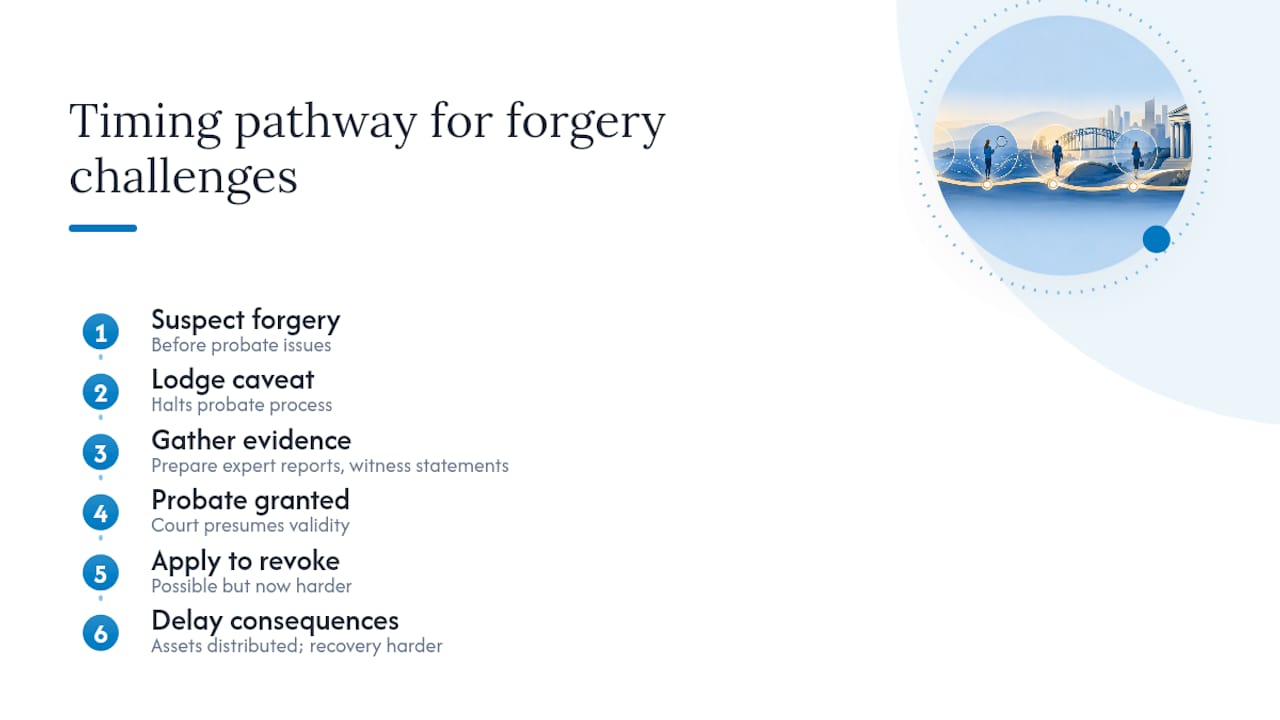
This differs sharply from family provision claims, which carry a strict 12 month limitation period from the date of death under NSW succession law, extendable only with the Court’s permission and good reason. A forgery challenge isn’t bound by that same clock, but delay still erodes your position because evidence goes stale, witnesses’ memories fade, and assets get spent or transferred to third parties who may have acted in good faith. If you have any suspicion at all, treat it as urgent, not as something to research over a few weeks.
Impact of a forged will on rightful beneficiaries and estate distribution
A forged will doesn’t just cheat one person out of an inheritance. It rewrites who gets what across an entire estate, often diverting assets away from spouses, children, or long-term partners toward someone with no legitimate claim, or a reduced claim, under the deceased’s actual wishes.
The practical damage compounds the longer it goes unchallenged. Once an executor starts distributing assets under a forged document, property gets sold, superannuation gets paid out, and cash gets spent. Even a later successful court challenge may only recover part of what was lost, because third parties who received money or assets in good faith are sometimes protected from having to hand it back.
Rightful beneficiaries also carry an emotional cost that rarely gets discussed. Contesting a will you suspect is forged often means accusing a family member, a carer, or someone close to the deceased of fabricating a legal document, and that reshapes family relationships permanently, win or lose. This is part of why the Court’s preference for early action matters so much: it protects not just the assets, but the chance to resolve the dispute before it hardens into years of litigation. Genuine beneficiaries who move quickly, lodge a caveat, and gather evidence early give themselves the best realistic shot at recovering what they were actually entitled to receive.
Preventative measures to reduce the risk of will forgery
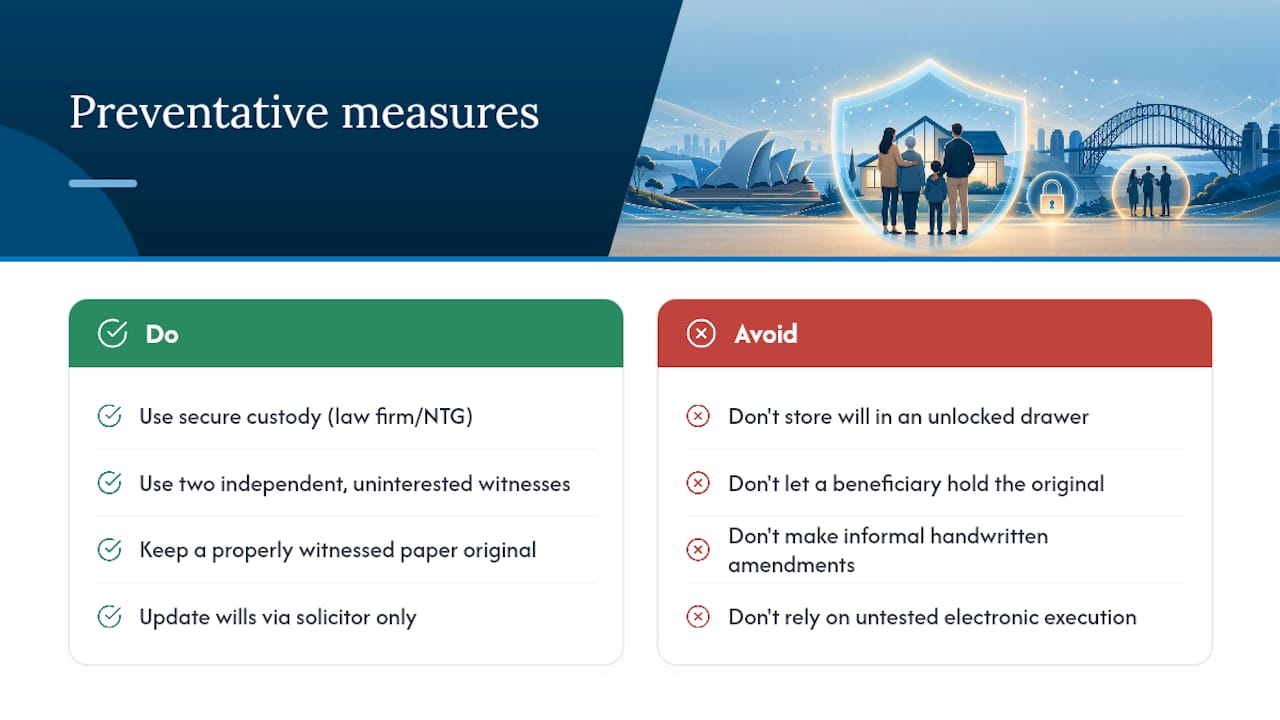
The best forgery defence is one built before anyone dies, not after. Several practical habits meaningfully cut the risk.
Secure storage is the obvious starting point. A will sitting in an unlocked drawer, or worse, held by the exact person who stands to benefit from a fraudulent version, creates the opportunity forgery thrives on. Storing the original with a law firm, the NSW Trustee and Guardian, or in a secure safe custody facility removes easy access and creates a clear record of who holds the genuine document.
Proper execution matters just as much as storage. Using two independent witnesses who have no personal or financial interest in the estate, and who can be located years later if needed, gives any future challenge a much stronger evidentiary foundation than witnesses who are also beneficiaries.
Electronic wills are an emerging area in NSW, and while the formal legal framework around them is still developing, some jurisdictions are moving toward recognising properly authenticated digital execution with audit trails. Until that framework matures locally, a properly witnessed paper original, stored securely and updated through a solicitor rather than informal handwritten amendments, remains the safer approach. Regular reviews with your lawyer, particularly after major life changes, also reduce the temptation or opportunity for someone else to slip in an unauthorised version.
Practical perspective: when to litigate and when to negotiate
Clear, well-evidenced forgery usually calls for litigation, not a negotiated compromise. Borderline cases, where the handwriting evidence is inconclusive or witness recollections conflict, often settle better through mediation, which preserves estate value that litigation quietly erodes through legal costs. Either way, lodge protective court steps first. A caveat costs little and keeps every option, including a negotiated settlement, genuinely open.
— George
Book a case assessment and next practical steps
If you suspect a will has been tampered with, the smartest move is a straight conversation with someone who deals with this constantly, not another week of googling case law. Simons George Legal is the practical alternative to guessing your way through a forgery dispute alone: instead of trying to interpret Supreme Court judgments yourself, you get partner-led advice on your actual documents, in a free 30-minute assessment, before you spend a dollar on formal proceedings.

That first conversation covers whether you have standing to challenge the will, what protective steps to take immediately, and a realistic read on cost and likely timeframes. The firm also handles probate and estate administration and estate litigation where a matter escalates beyond an initial dispute. Bring whatever you have: the will itself if you hold it, earlier versions, correspondence, and a rough timeline of who said what and when. Book your free assessment and find out where you actually stand before the clock runs any further against you.
Sources
This article is general information, not a substitute for advice from a qualified lawyer. Consult a qualified legal professional about your own circumstances before acting on anything here.
FAQ
How much does it cost to contest a will in NSW?
Costs vary widely depending on how contested the matter becomes and whether it settles early or goes to a full hearing. Simons George Legal offers a free 30-minute consultation to assess your position and discuss fee options, including No Win, No Fee arrangements for eligible disputes, before you commit to anything.
What is the penalty for forgery in Australia?
Under section 253 of the Crimes Act 1900 (NSW), forgery by making a false document carries a maximum penalty that can include imprisonment. Related conduct, such as fraudulently destroying or concealing a will, is a separate offence under section 135.
On what grounds can you contest a will in NSW?
You can challenge a will for forgery, lack of testamentary capacity, undue influence, improper execution, or a later valid revocation, and each ground relies on different evidence. Eligible family members can separately bring a family provision claim if they were left out or under-provided for, regardless of whether the will itself is genuine.
How successful are will challenges?
Success depends heavily on the strength of the evidence, particularly handwriting analysis, witness credibility, and whether earlier wills or documents support the claim of forgery, as seen in Pozniak Estate and McGettigan v Coulter. Acting before probate is granted, rather than after assets are distributed, meaningfully improves the odds of a favourable outcome.