An executor can sell NSW property, but settlement almost always waits for a Grant of Probate or Letters of Administration first. Marketing and even exchange can often happen earlier. Before doing anything, pay estate debts from the eventual sale proceeds, keep every valuation and invoice on file, and lodge the probate application promptly. Get advice early if there’s any doubt about title, disputes, or timing.
TL;DR:
- Executors can sell estate property without beneficiary approval under NSW law, but settlement must wait for a probate or Letters of Administration to avoid legal issues.
- Procuring a grant of probate typically takes six to twelve weeks, with contested applications or overseas property prolonging the process.
- Preparing the property for sale—such as obtaining valuations, securing insurance, and arranging repairs—can begin before probate is issued to reduce delays.
- Sale proceeds are used first to pay debts, taxes, and estate costs; missing deadlines, like the two-year CGT exemption window, can cause significant tax liabilities.
- Contracts can include conditions tying settlement to probate issuance, with deposits kept in trust to avoid disputes or premature access.
Table of Contents
- Can an executor sell property in NSW? The legal authority explained
- How do you get a grant of probate in NSW?
- Preparing the property for sale without a completed grant
- What can an executor do before probate is granted?
- Money and tax: what happens to the sale proceeds?
- How do you handle beneficiaries who disagree with the sale?
- Executor checklist: from appointment to distribution
- Practitioner notes from Simons George Legal
- How Simons George Legal helps executors sell estate property
- Funding Your Legal Matter — No Win No Fee
- Sources
- FAQ
Can an executor sell property in NSW? The legal authority explained
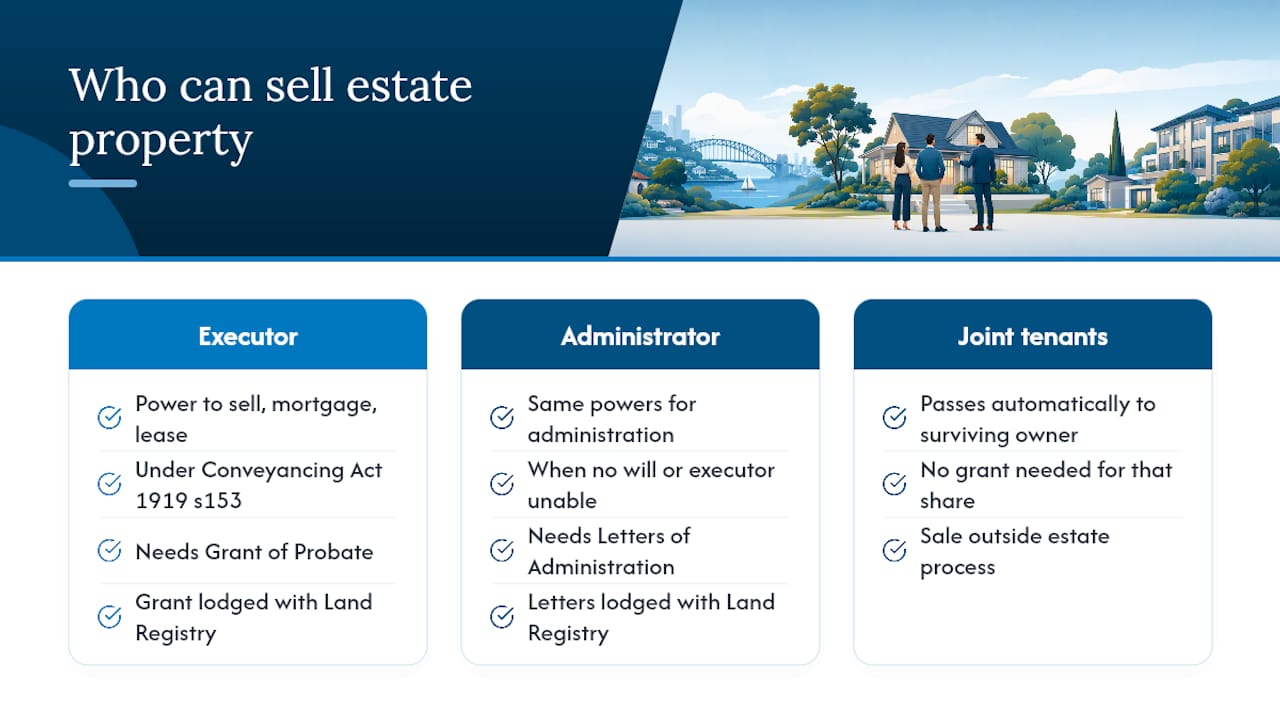
Yes, under the Conveyancing Act 1919 s153, an executor or administrator has the power to sell, mortgage, or lease estate real estate for administration purposes, and doesn’t need every beneficiary’s sign off to do it. That power exists to let executors settle debts, cover administration costs, and eventually distribute the estate without needing unanimous agreement from everyone named in the will.
The catch is proving you’re actually the executor. A Grant of Probate confirms the will is valid and names you as the person with authority to act. If there’s no will, or the named executor can’t act, the court issues Letters of Administration instead, which gives an administrator equivalent powers. Both documents get lodged with Land Registry Services before title can transfer.
There are exceptions worth knowing. Property held as joint tenants passes automatically to the surviving owner outside the estate, so no grant is needed for that share. Some very low-value or straightforward matters move faster through the registry, but real property sales almost never skip the grant requirement.
Buyers’ solicitors won’t proceed to settlement without sighting a grant, and neither will Land Registry Services. That’s not bureaucratic caution. It’s the mechanism that stops someone falsely claiming authority over a deceased person’s assets, which is precisely why the system insists on it before money changes hands.
How do you get a grant of probate in NSW?
You’ll need the original will, the death certificate, an executor’s affidavit, and an inventory of the estate’s assets and liabilities. The Supreme Court of NSW processes applications through its online registry, and missing documents or an incomplete affidavit are the most common reasons applications stall.
Start by publishing a probate notice online, which gives anyone with an interest in the estate 14 days to raise an objection before you can lodge the actual application. Once lodged, court processing typically takes four to eight weeks, so a realistic total timeline from death to grant is six to twelve weeks when documents are gathered without delay.

Contested applications can extend that timeline considerably, sometimes by an uncertain additional period, particularly if someone lodges a caveat disputing the will’s validity or your appointment. If that happens, get legal advice immediately rather than trying to push through the standard process. Our guide to probate timelines breaks down what causes the most common holdups.
One detail catches out plenty of executors: if the deceased owned property in another state, a NSW grant doesn’t automatically apply there. You’ll need to reseal the grant in that jurisdiction before dealing with assets held outside NSW, which adds its own processing time on top of the local wait.
Preparing the property for sale without a completed grant
You can prepare and market the property while probate is still moving through the court, and most executors should. Waiting for the grant before lifting a finger just burns weeks you don’t need to lose.
- Get at least two independent valuations, three if the estate is contentious or beneficiaries disagree about value, and keep every written appraisal on file.
- Confirm building and contents insurance stays current in the estate’s name; a vacant property with lapsed cover is a real liability exposure if something goes wrong.
- Secure the premises, arrange minor repairs that lift presentation without blowing the estate’s budget, and photograph the property’s condition before and after any work.
- Decide between auction, private treaty, or an off-market sale based on the property type and local market. Auction suits properties with clear buyer demand; private treaty often works better for estates that need flexibility on settlement timing.
- Brief your real estate agent properly. An agent who’s handled deceased estate sales before will understand why settlement can’t rush ahead of probate and won’t push you into a contract that ignores that reality.
Choosing the right agent matters more than most executors expect. Someone unfamiliar with estate sales might promise a settlement date that simply can’t happen if the grant hasn’t come through, which creates friction with the buyer and their solicitor later.
What can an executor do before probate is granted?
Marketing, open homes, and even signing a contract of sale can often happen before the grant arrives, but settlement itself ordinarily waits. This is the point where a lot of executors get nervous, understandably, because a buyer wants certainty and you can’t fully give it until the court has acted.
The fix is in the contract terms. A well-drafted special condition ties settlement to the grant being issued, with a sunset clause protecting both sides if probate is unusually delayed. Deposits should sit in the estate account or your solicitor’s trust account, not anywhere they could be disputed or accessed prematurely.
Once the grant issues, your solicitor lodges a transmission application with Land Registry Services, which formally records your authority to deal with the title. That’s a separate step from settlement itself, and skipping it is one of the more common administrative errors executors make when they try to manage conveyancing without a solicitor’s involvement.
A solicitor or licensed conveyancer coordinates this whole sequence: managing the special conditions, tracking probate progress, and communicating with the buyer’s solicitor so nobody is left guessing why settlement hasn’t happened yet. That communication alone prevents most of the friction that turns a routine sale into a dispute.
Money and tax: what happens to the sale proceeds?
Sale proceeds don’t go straight to beneficiaries. Mortgages, council rates, strata levies, and the costs of administering the estate all get paid first, and skipping that order is one of the fastest ways an executor exposes themselves to personal liability.
Tax is the other piece executors underestimate. The Australian Taxation Office treats a deceased person’s main residence as exempt from Capital Gains Tax if the estate sells it within two years of the date of death. Miss that window and the estate may face a CGT bill calculated against the property’s value at death, which can be a significant and unexpected cost if nobody flagged it early. Understanding how capital gains tax works more broadly helps make sense of why that date matters so much.
Get a formal valuation as close to the date of death as practical. It becomes the baseline for any future CGT calculation and it’s far easier to obtain now than to reconstruct years later. Keep every receipt, invoice, and bank statement tied to the estate account. Complex estates, especially those with multiple properties or overseas assets, warrant specialist tax advice rather than guesswork. Our deceased estate tax guide covers reporting obligations in more depth.
How do you handle beneficiaries who disagree with the sale?
Communicate early and often. Share valuations, marketing plans, and agent recommendations with beneficiaries before decisions get locked in, not after. An executor’s duty runs to the estate and its creditors, not to whichever beneficiary is pushing hardest for a quick sale or a higher price, and that distinction is worth stating plainly if tension builds.
Keep a written file of every valuation, appraisal, and marketing decision. If a beneficiary later argues the property sold for less than it should have, that documentation is what shows you acted reasonably rather than carelessly. Selling well below a credible valuation without a clear explanation is the scenario most likely to draw a legal challenge, and personal liability can follow if a court finds you breached your duty.
Mediation is often faster and cheaper than litigation when disagreement escalates. Getting legal advice before you distribute funds, not after, gives you room to resolve disputes without the estate footing a large legal bill later.
Executor checklist: from appointment to distribution
- Secure the property, locate the original will, and obtain the death certificate.
- Lodge the probate notice, then the probate application, with the required affidavit and asset inventory.
- Arrange valuations, confirm insurance, and instruct your agent and solicitor once the grant is close.
- Add contract protections tying settlement to the grant, with deposits held in trust.
- Settle debts from sale proceeds, lodge required tax returns, then distribute according to the will.
Our estate administration checklist walks through each of these steps with more detail on timing and documentation.
Practitioner notes from Simons George Legal
The most expensive mistake we see is executors acting before the grant arrives, or keeping loose records of valuations and decisions. Get at least two independent valuations, tell beneficiaries what you’re doing before you do it, and treat paper trails as non negotiable. Early legal advice almost always costs less than fixing a dispute after distribution.
— George
How Simons George Legal helps executors sell estate property
Selling a deceased estate property in NSW means juggling probate timing, contract conditions, and tax deadlines all at once, and getting any one of them wrong creates delay or dispute. Simons George Legal works with executors across Sydney and the Eastern Suburbs on exactly this: coordinating probate applications, briefing conveyancers on protective contract terms, and flagging beneficiary disputes before they become litigation.

New clients are offered an initial consultation to assess the estate’s status and outline practical next steps for managing probate and protecting executors. If beneficiaries are already at odds, or the estate includes property in more than one state, that conversation is where we map out the safest path forward. Book a consultation through our wills and estates services page and get clarity before you sign anything.
Funding Your Legal Matter — No Win No Fee
Estate disputes can stall a property sale for months, and legal costs shouldn’t be the reason a legitimate claim goes unpursued. Simons George Legal offers No Win, No Fee arrangements for eligible cases so executors and beneficiaries facing a genuine dispute aren’t forced to weigh their rights against an upfront legal bill they can’t afford.
Eligibility gets assessed during a free initial consultation where we look at the facts of your matter and give you an honest view on whether a conditional arrangement fits. That removes the cost barrier for people with a real claim, who might otherwise walk away from it. Book a free case assessment with Simons George Legal to find out where you stand
No Win, No Fee arrangements are subject to case eligibility and a written costs agreement. Liability limited by a scheme approved under Professional Standards Legislation.
This article is general information, not a substitute for advice from a qualified lawyer. Consult a qualified legal professional about your own circumstances before acting on anything here.
Sources
- Guide for executors
- ATO guidance — inherited property and capital gains tax
- Conveyancing Act 1919 — s153
- Applying for probate — Supreme Court of NSW
FAQ
Can an executor sell a house without beneficiaries approving in NSW?
Yes. Under Conveyancing Act 1919 s153, executors can sell estate property without unanimous beneficiary consent, provided they act reasonably and in the estate’s best interests.
How long does an executor have to settle an estate in NSW?
There’s no fixed deadline, but probate typically takes six to twelve weeks to obtain, and most straightforward estates settle within twelve months of death.
How much do solicitors charge to be executors of an estate?
Fees vary by estate complexity and the firm’s billing structure, ranging from fixed fees for simple matters to hourly rates for contested or complex administration; ask for a clear cost estimate at the first consultation.
What happens if the deceased’s home isn’t sold within two years?
The estate may lose the main residence Capital Gains Tax exemption, and the ATO may assess CGT based on the property’s value at the date of death.
Can I sign a contract of sale before probate is granted?
Often yes, with a special condition making settlement conditional on the grant issuing; this lets you secure a buyer without breaching your obligations as executor.