Blended families in Australia face a challenge most couples don’t anticipate until it’s too late: the law doesn’t see your family the way you do. Protecting children and stepchildren through estate planning for blended families is not a box-ticking exercise. It’s the difference between your wishes being honoured and your estate becoming a source of grief, confusion, and costly legal disputes. If you have children from a previous relationship, stepchildren you’ve raised as your own, or a partner with kids of their own, the standard approach to wills and inheritance simply won’t protect everyone the way you intend.
Table of Contents
- Key takeaways
- Protecting children and stepchildren in blended family estates
- Estate planning strategies to protect all children
- Sources of conflict in blended family estates
- Practical steps to get your estate plan right
- My perspective on blended family estate planning
- How Simons George Legal can help your blended family
- FAQ
Key takeaways
| Point | Details |
|---|---|
| Stepchildren don’t inherit automatically | Without being named in a will, stepchildren are typically excluded under Australian intestacy laws. |
| Wills must be updated after family changes | Remarriage, new children, or separation can invalidate or significantly alter your existing will. |
| Testamentary trusts offer strong protection | They allow you to direct assets to specific children or stepchildren and add conditions that prevent unintended outcomes. |
| Conflict is common but avoidable | Most disputes in blended families stem from poor communication and misaligned legal documents, not genuine malice. |
| Professional advice is not optional | A specialist wills and estates lawyer familiar with blended families can identify risks a generic will simply won’t address. |
Protecting children and stepchildren in blended family estates
The starting point for any blended family is understanding where Australian law actually stands. The gap between what you assume the law does and what it actually does can be significant, and for stepchildren, that gap has real consequences.
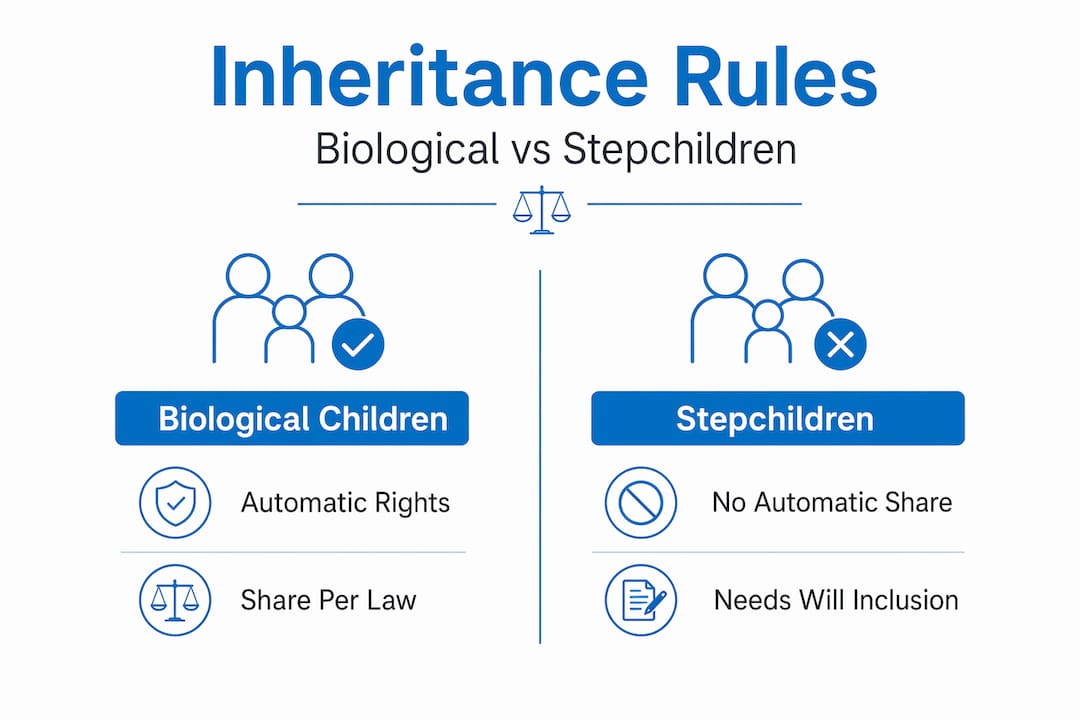
Under Australian intestacy laws, if you die without a valid will, your estate is distributed according to a strict statutory formula that prioritises blood relatives and legal spouses. Stepchildren not legally adopted typically receive nothing. No matter how long you raised them, how much you loved them, or how dependent they were on you financially, they are invisible under the intestacy rules unless they bring a family provision claim and successfully prove their case.
The situation doesn’t automatically improve with a will, either. Stepchildren generally have no automatic inheritance rights without being expressly named. If your will leaves everything to your spouse and you die first, nothing legally compels your surviving spouse to pass anything to your biological children from a prior relationship. They could remarry. They could write a new will. They could leave your estate entirely to their own biological children.
| Scenario | Biological children | Stepchildren (not adopted) |
|---|---|---|
| Die without a will | Inherit per intestacy formula | Generally receive nothing |
| Will leaves all to spouse | Inherit only if spouse’s will includes them | No guaranteed entitlement |
| Will names stepchildren expressly | Entitled to their share | Protected as nominated beneficiaries |
| Stepparent adoption completed | Standard inheritance rights apply | Inherit as biological children do |
There are jurisdictional nuances worth knowing. In Victoria, intestacy directs the estate to the nearest blood relatives with stepchildren typically excluded unless adopted. In NSW, a stepchild can potentially bring a family provision claim, but eligibility is not straightforward. Courts assess the reality of the domestic relationship, the financial dependency involved, and the nature of ongoing support. Stepchild eligibility in NSW depends on proving a domestic bond and financial dependency, not merely affection or years of informal parenting.
Estate planning strategies to protect all children
Once you understand the legal reality, the question becomes: what tools can you use to protect everyone fairly? Blended family estate planning offers several options, and most situations benefit from combining more than one.
The starting point is your will. A well-drafted will should name every intended beneficiary explicitly, including stepchildren. It should also account for what happens if your spouse predeceases you, or if circumstances change. Leaving “everything to my spouse” without conditions can inadvertently cut your biological children out of the picture entirely. Reviewing and updating your will after family changes is one of the most practical steps you can take, yet it’s consistently overlooked.
Testamentary trusts are one of the most powerful tools available for blended families. Rather than leaving assets outright to a beneficiary, a testamentary trust holds assets under specific conditions that you define in your will. You can direct income or capital to your children or stepchildren in ways that protect them even if your spouse remarries or makes different choices after your death. You can also set up separate trusts for biological and stepchildren, each with its own terms. A step-by-step guide to trusts can help you understand how these structures work in practice before you speak with a lawyer.
Other tools worth considering include:
- Step-parent adoption. Step-parent adoption in Australia gives a stepchild full inheritance rights equivalent to a biological child. It requires Family Court approval and an assessment that adoption serves the child’s best interests. This is not a quick process, but for families with a genuine and permanent parental bond, it provides the clearest legal protection.
- Parenting orders. Where adoption isn’t appropriate or wanted, parenting orders can establish legal responsibility and help document the nature of the relationship, which matters in any future family provision claim.
- Beneficiary nominations. Superannuation, life insurance, and jointly held assets often pass outside your will entirely. If you haven’t updated beneficiary nominations to include stepchildren, these significant assets may never reach them regardless of what your will says.
Pro Tip: After any major family change, treat your estate plan as a complete system. Review your will, all trusts, your superannuation binding nominations, and life insurance beneficiaries together. A mismatch between any of these can defeat your intentions.
Sources of conflict in blended family estates
Rising disputes in blended families are a documented trend. Research shows 41% of practitioners have reported more disputes in blended and step-families, with 68% identifying conflicts between children, stepchildren, and surviving parents as the leading source of friction. Understanding why these disputes happen is the first step to preventing them.
The most common triggers follow a recognisable pattern:
- Assumptions without documentation. One partner assures their children verbally that they’ll be looked after. Those assurances are not legally enforceable without a properly drafted will or trust. Courts do not uphold informal promises.
- Inconsistent documents. A will names stepchildren as beneficiaries, but superannuation nominations haven’t been updated and direct the entire balance to the surviving spouse. Assets passing outside the will can undermine even the most carefully written estate plan.
- The surviving spouse problem. When one partner dies and leaves everything to the surviving spouse, there is no legal obligation for that spouse to honour promises made to the deceased’s biological children.
- Exclusions without explanation. When a beneficiary is excluded from a will without any documented reason, the likelihood of a family provision claim increases significantly.
“Most disputes in blended families could be prevented with careful legal planning and honest conversations, reducing misunderstandings from informal assurances.”
Clear communication within your family is not a substitute for legal documentation, but it reduces the shock that typically drives people to contest estates. Family members who don’t know your wishes are far more likely to challenge them. An open conversation about your intentions, backed by a legally sound plan, is far more effective than secrecy combined with the hope that everyone will understand.
Pro Tip: No-contest clauses in Australian wills have limited enforceability compared to some other jurisdictions. Don’t rely on them as your primary conflict-prevention strategy. Proper drafting and documentation of your reasons is more effective.
Practical steps to get your estate plan right
If you’re in a blended family and you haven’t reviewed your estate plan recently, this is the place to start. The process doesn’t need to be overwhelming, but it does need to be thorough.
- List every person who matters. Write down your biological children, your partner’s biological children, any children you’ve raised together, and any former spouses or partners with ongoing financial claims. This is your starting point for understanding who has rights and who needs to be explicitly included.
- Audit every asset. Property, superannuation, investments, life insurance, business interests. Identify which assets pass through your will and which pass via beneficiary nomination or joint ownership. Inheriting property in Australia involves more complexity than most families expect.
- Update your will with specific nominations. Don’t rely on generic language. Name each intended beneficiary and specify what you want them to receive. If you’re excluding someone, document your reasons clearly.
- Consider a testamentary trust. If your estate is substantial, or if you want to protect children from a previous relationship, speak with a specialist lawyer about whether a testamentary trust suits your situation.
- Align all beneficiary nominations. Update superannuation binding death benefit nominations, life insurance beneficiaries, and any jointly held accounts to reflect your current intentions.
- Plan for contingencies. Consider what happens if your partner remarries, if you have more children, or if a beneficiary predeceases you. Your plan should hold up under changing circumstances, not just present ones.
- Review every three to five years. Family dynamics change. Laws change. What protected your family adequately five years ago may not be adequate today.
If disputes do arise despite careful planning, understanding your options around dividing inherited property between siblings and step-siblings can help manage those conversations constructively.
My perspective on blended family estate planning
In my experience, blended families are where the gap between people’s intentions and the legal reality is widest. I see it repeatedly. A parent genuinely believes their stepchildren are protected because they’ve been raising them for a decade. The reality is that without an explicit legal structure, that protection doesn’t exist.
What I’ve also learned is that the emotional complexity of these situations often delays action. Couples avoid the conversation because discussing what happens after death feels like it introduces doubt or conflict into the relationship. That hesitation is understandable. But it is also exactly how well-intentioned families end up in costly, distressing disputes years later.
The families I’ve seen handle this best don’t just get the legal documents right. They have the honest conversations. They tell their children and stepchildren what the plan is, why decisions were made, and what to expect. That transparency doesn’t guarantee everyone will be happy, but it removes the surprise that typically fuels formal challenges. Specialist legal advice combined with genuine family dialogue is the combination that works. The legal framework for wills and inheritance is there to serve your intentions, but only if you use it deliberately and early enough to matter.
— George
How Simons George Legal can help your blended family
Blended family estate planning requires more than a standard will kit or a template downloaded online. The stakes are too high and the variables too complex.

Simons George Legal works with blended families across Sydney to create estate plans that genuinely protect every person you care about, whether they are biological children, stepchildren, or a combination of both. From drafting and updating wills with precise beneficiary nominations, to establishing testamentary trusts and advising on superannuation nominations, the firm handles the full picture. When disputes do arise, Simons George Legal also acts in inheritance disputes and family provision claims to protect clients’ interests. New clients are welcome to book a complimentary 30-minute consultation to discuss their situation and understand what practical steps make sense for their family. Reach out through simonsgeorgelegal.com.au/wills-and-estates-lawyers to get started.
FAQ
Do stepchildren automatically inherit in Australia?
No. Stepchildren have no automatic inheritance rights under Australian intestacy laws unless they are expressly named in a will or have been formally adopted by the step-parent.
What is a testamentary trust and why does it matter for blended families?
A testamentary trust is a trust created within your will that holds and distributes assets according to conditions you set. It is particularly useful in blended families because it allows you to protect assets for specific children, including stepchildren, even if your surviving spouse remarries.
Can a stepchild contest a will in NSW?
Yes, but eligibility is not guaranteed. A stepchild’s family provision claim in NSW requires demonstrating a genuine domestic bond and financial dependency, not simply a close emotional relationship. Courts examine the facts carefully.
What happens if I die without a will in a blended family?
Your estate will be distributed under the intestacy rules of your state, which allocate assets to blood relatives and legal spouses. Stepchildren who have not been legally adopted typically receive nothing, regardless of how long you raised them.
How often should a blended family review their estate plan?
Review your estate plan every three to five years, and immediately after any significant change such as remarriage, the birth of a child, separation, or a significant shift in your financial position.