Estate grant legal aid in NSW is defined as government-funded or subsidised legal assistance available to eligible individuals who need help applying for a grant of representation, such as probate or letters of administration. Legal Aid NSW provides this support for straightforward grant applications but does not typically fund contested estate proceedings or family provision claims. For those matters, the Law Society of NSW Pro Bono Scheme and the NSW Bar Association’s Legal Assistance Referral Scheme (LARS) are the primary alternatives. Understanding what is estate grant legal aid NSW, and where it stops, is the first step to getting the right help.
What is an estate grant and why does legal aid matter?
An estate grant is a formal court order that authorises someone to deal with a deceased person’s assets. There are two main types. Probate is granted when the deceased left a valid will, confirming the executor’s authority to act. A grant of letters of administration applies when there is no valid will, appointing an administrator to manage the estate instead.
Without a grant, banks, share registries, and property titles offices will not release assets to anyone. This is why the grant application process matters so much. Executors and administrators carry personal legal responsibility for the estate, and errors in the application can cause significant delays or personal liability.

Legal Aid NSW assists with the process of applying for probate or letters of administration but does not fund contested proceedings. This distinction is critical. Many people assume legal aid covers the full scope of estate disputes, but the funding is focused on the administrative grant process only.
Key terms to understand before applying:
- Probate: A Supreme Court order confirming a will is valid and the executor has authority to act.
- Letters of administration: A Supreme Court order appointing an administrator when there is no valid will.
- Executor: The person named in a will to carry out its instructions.
- Administrator: A person appointed by the court to manage an intestate estate.
- Grant of representation: The umbrella term covering both probate and letters of administration.
Who is eligible for estate grant legal aid in NSW?
Eligibility for legal aid estate grants in NSW depends primarily on financial means. Legal Aid NSW applies a means test that assesses your income, assets, and expenses. You must fall below set thresholds to qualify for funded assistance.
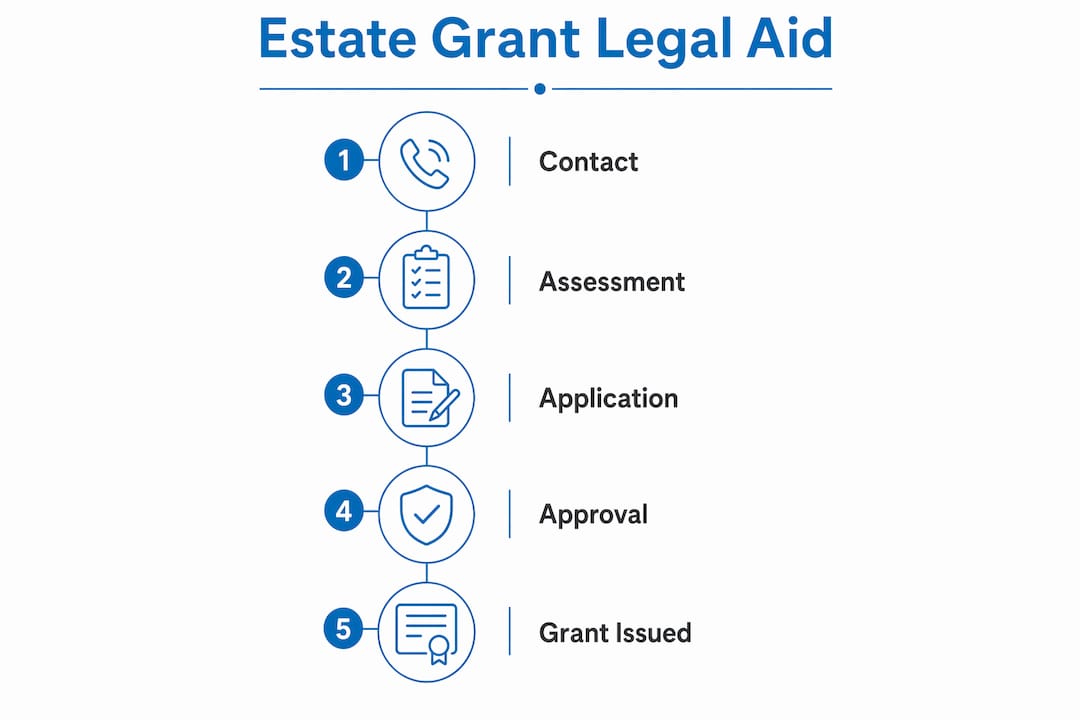
The application process follows these steps:
- Contact LawAccess NSW on 1300 888 529 for an initial assessment. This free telephone service determines whether you qualify for legal aid or need a referral elsewhere.
- Complete an online application through the Legal Aid NSW Grants Online portal, providing details of your financial situation and the estate matter.
- Submit supporting documents, including proof of income, a copy of the will (if one exists), and details of the estate assets.
- Await assessment. Legal Aid NSW reviews your application and determines whether the matter falls within its funded categories.
- Receive a decision. If approved, Legal Aid NSW assigns a solicitor or authorises a private solicitor to act on a legal aid certificate.
People who get help from a lawyer to complete their application are the most successful at being approved for a grant of legal aid. This means the application itself benefits from legal guidance, creating a practical challenge for those who cannot yet afford a solicitor.
Pro Tip: Contact LawAccess NSW before attempting to complete the Grants Online application yourself. The telephone assessment takes around 20 minutes and can save you weeks of back-and-forth with incorrect paperwork.
If you do not meet the financial threshold for Legal Aid NSW, the Law Society of NSW Solicitor Referral Service can connect you with affordable or pro bono legal advice, including dedicated support for eligible Aboriginal and Torres Strait Islander clients.
Why contested estate claims are usually not covered by legal aid
Legal Aid NSW does not typically provide grants for contested estate or family provision claims. This surprises many people who assume that legal aid covers any estate-related legal matter. The policy reflects resource constraints and the complexity of contested proceedings.
Family provision claims under the Succession Act 2006 (NSW) are civil disputes that can run for months or years. Legal Aid NSW reserves its estate funding for grant applications, which are procedural rather than adversarial.
For contested matters, the following alternatives exist:
- Law Society of NSW Pro Bono Scheme: Connects eligible applicants with solicitors who agree to act without charge. Applicants must demonstrate financial hardship and show they have already tried to access other services.
- NSW Bar Association LARS: The Legal Assistance Referral Scheme matches eligible people with barristers willing to provide pro bono advice or representation.
- Community legal centres: Organisations such as the Redfern Legal Centre provide free advice on some estate matters, subject to capacity.
- Self-representation: Technically possible but carries significant risk. The Supreme Court of NSW has strict procedural rules, and errors in contested proceedings can result in cost orders against you.
The risks of self-representation in contested estate matters are real. Executors’ delays or withholding of information are a common source of disputes, and beneficiaries without legal support often struggle to enforce their rights effectively. Early independent legal advice is the most reliable way to resolve these concerns.
What practical steps can you take if you need legal help for estate matters?
The starting point for anyone seeking free legal help in NSW is LawAccess NSW. This government service provides telephone advice and referrals, and it is the gateway to Legal Aid NSW, pro bono schemes, and community legal centres. You do not need to know which service you need before you call.
Pro Tip: Keep a written record of every conversation with LawAccess NSW, including the date, the name of the person you spoke with, and any reference number given. This record supports your application if you are referred to the Pro Bono Scheme or LARS, both of which require evidence of prior attempts to access legal services.
Common pitfalls to avoid when seeking estate grant assistance:
- Missing time limits. Family provision claims in NSW must generally be filed within 12 months of the date of death. Missing this deadline can extinguish your right to claim entirely.
- Assuming legal aid covers everything. As noted, legal aid estate grants cover the grant application process, not litigation.
- Delaying action on executor misconduct. If an executor is not communicating or is mismanaging assets, early legal advice protects your position. You can read more about contesting a will in NSW to understand your options.
- Distributing assets too early. Executors who wait six months from the grant of probate before distributing assets are generally protected from personal liability if a later family provision claim is made.
- Ignoring probate timelines. Understanding NSW probate timelines helps you plan and avoid unnecessary delays.
When legal aid and pro bono options are exhausted or unavailable, engaging a private wills and estates solicitor is the most reliable path. Many firms, including Simons George Legal, offer a free initial consultation to assess your matter before any costs are incurred.
What rights do beneficiaries have to estate information in NSW?
Beneficiaries have a right to certain estate documents, but the scope of that right depends on their position in the estate. The Supreme Court probate registry only provides the inventory of property to residuary beneficiaries. Other parties, such as creditors or specific gift recipients, typically must commence court proceedings to obtain specific records.
This information gap can leave beneficiaries feeling powerless, particularly when an executor is unresponsive. Knowing your rights in advance reduces that disadvantage.
| Document | Who can access it | How to obtain it |
|---|---|---|
| Copy of the will | Any person named in the will or with a legitimate interest | Request from the executor or Supreme Court probate registry |
| Inventory of property | Residuary beneficiaries | Request from the Supreme Court probate registry after grant |
| Full probate file | Generally restricted; court order may be required | Application to the Supreme Court |
| Estate accounts | Beneficiaries entitled to a share of residue | Request from the executor; court order if refused |
Access to probate registry files is strictly controlled. Residuary beneficiaries have wider rights than general claimants or creditors, which makes understanding your legal position before making requests genuinely important. If you are involved in an inheritance dispute, knowing what documents you are entitled to can shape your entire strategy.
Key takeaways
Estate grant legal aid in NSW covers the grant application process only. Contested estate matters and family provision claims require pro bono schemes, private legal advice, or specialist firms such as Simons George Legal.
| Point | Details |
|---|---|
| Legal aid scope is narrow | Legal Aid NSW funds grant applications, not contested estate or family provision proceedings. |
| Start with LawAccess NSW | Call 1300 888 529 first to be assessed and referred to the right service. |
| Pro bono schemes require preparation | The Law Society Pro Bono Scheme and LARS require proof of financial hardship and prior service attempts. |
| Beneficiary rights vary | Residuary beneficiaries have broader document access rights than other claimants under Supreme Court rules. |
| Time limits are strict | Family provision claims must generally be filed within 12 months of the date of death in NSW. |
George’s take on legal aid and estate grants in NSW
The most common misconception I see is that legal aid will cover a family member through an entire estate dispute, from the grant application all the way through to a contested hearing. It does not. Legal Aid NSW is a triage service for grant applications, and the funding stops well before the courtroom.
What I have found in practice is that people who contact LawAccess NSW early, before they have already made procedural errors, get far better outcomes. The referral to a pro bono scheme or community legal centre is much easier when you have not already filed incorrect documents or missed a deadline.
The other thing worth saying plainly: pro bono is not automatic. The Law Society Pro Bono Scheme and LARS both require applicants to show genuine financial hardship and evidence that they have already tried other avenues. Turning up without that documentation wastes everyone’s time, including yours.
My honest advice is this. If you have a legitimate estate matter and cannot afford private legal fees, do the groundwork first. Gather your financial documents, call LawAccess NSW, and keep records of every step. If you are a beneficiary dealing with an uncooperative executor, get independent legal advice as early as possible. Waiting rarely improves the situation and often makes it worse.
— George
Funding your legal matter. No Win, No Fee
Simons George Legal offers No Win, No Fee arrangements for eligible estate and inheritance dispute matters. This removes the upfront cost barrier for people who have a legitimate claim but cannot fund litigation out of pocket.

Eligibility for No Win, No Fee is assessed during a free 30-minute initial consultation. Simons George Legal reviews the merits of your matter, your financial position, and the likely costs before recommending a funding arrangement. There is no obligation to proceed after the consultation.
If you are dealing with a contested will, a family provision claim, or an executor who is not acting properly, book a free case assessment with Simons George Legal’s wills and estates team today.
No Win, No Fee arrangements are subject to case eligibility and a written costs agreement. Liability limited by a scheme approved under Professional Standards Legislation.
FAQ
What does estate grant legal aid NSW actually cover?
Legal Aid NSW covers the cost of applying for probate or letters of administration for eligible applicants. It does not cover contested estate proceedings or family provision claims.
How do I apply for legal aid for an estate grant in NSW?
Contact LawAccess NSW on 1300 888 529 for an initial assessment, then complete an application through the Legal Aid NSW Grants Online portal with supporting financial documents.
What if I don’t qualify for legal aid in NSW?
The Law Society of NSW Pro Bono Scheme and the NSW Bar Association’s LARS provide free legal assistance for eligible applicants who demonstrate financial hardship and prior attempts to access other services.
Can beneficiaries access estate documents without going to court?
Residuary beneficiaries can request the inventory of property from the Supreme Court probate registry. Other parties generally need a court order to access the full probate file.
Is there a time limit for contesting a will in NSW?
Family provision claims must generally be filed within 12 months of the date of death. Missing this deadline can permanently extinguish the right to make a claim.