Elder financial abuse in NSW is the illegal or improper use of an older person’s money, property or assets by someone in a position of trust. If you suspect it, the immediate step is to preserve any evidence you can and call the Ageing & Disability Abuse Helpline on 1800 628 221. If there’s an immediate risk to someone’s safety, call 000 first.
TL;DR:
- Most elder financial abuse in NSW is committed by trusted family members, especially adult children, around the time when control shifts through an Enduring Power of Attorney.
- Signs of abuse include unpaid bills despite available assets, unexplained large withdrawals, missing valuables, and reluctance to discuss financial changes.
- Immediate actions include ensuring safety, preserving evidence discreetly, contacting the helpline, and requesting the bank to monitor or restrict accounts.
- Legal remedies range from civil recovery and criminal charges to tribunal reviews, with early intervention significantly increasing the chance of recouping stolen funds.
- Working with experienced legal professionals allows for urgent injunctions, asset freezes, and estate disputes, with No Win, No Fee options easing access to legal help.
Table of Contents
- What counts as financial abuse and what does it look like in NSW?
- What should you do the moment you suspect abuse?
- What legal options exist to recover money or stop abuse?
- How are EPOAs and Wills misused, and how do you fight back?
- What everyday safeguards reduce the risk of abuse?
- How can an NSW wills and estates lawyer actually help?
- Funding your legal matter — No Win, No Fee
- What should you do next?
- How common is elder financial abuse in NSW?
- Which NSW agencies handle prevention and response?
- Is financial abuse legally different from other elder abuse in NSW?
- How long do legal remedies and investigations take in NSW?
- Where can you find official NSW help?
- What the toolkit doesn’t tell you
- Why work with Simons George Legal on an elder abuse matter?
- Sources
- FAQ
What counts as financial abuse and what does it look like in NSW?
Elder financial abuse covers a wide range of conduct, but the common thread is someone exploiting a relationship of trust to take control of an older person’s money or property. NSW’s Ageing & Disability Commission defines it as the illegal or improper use or management of an older person’s finances, and its examples read like a checklist of everyday betrayals: coercing someone into changing their Will, misusing an Enduring Power of Attorney (EPOA), stealing cash, jewellery or credit cards, skimming pension payments, or running up debt in the older person’s name.
The perpetrator is very often someone the family trusts completely. NSW government commentary points to adult children as frequent offenders, particularly around the point where an EPOA is activated and control shifts from the older person to their attorney. There’s a name for the underlying dynamic: “inheritance impatience,” where an adult child convinces themselves they’re only taking what they’ll eventually inherit anyway.
Watch for these signs:
- Bills going unpaid despite the person having enough money to cover them
- Large or frequent bank withdrawals that don’t match spending habits
- New signatories or names added to bank accounts without a clear reason
- A noticeable drop in living standards despite stable or growing assets
- Personal items, jewellery or documents that go missing
- Services like cleaners, home care or subscriptions being cancelled abruptly
- Reluctance or refusal to discuss money, banking, or a recent Will change
Pro Tip: If a family member suddenly becomes the only person who “handles everything” for an older relative and gets defensive when asked questions, treat that as a signal worth investigating, not just a personality quirk.
What should you do the moment you suspect abuse?
Act in this order:
- Assess safety first. If the older person is at risk of physical harm, call 000 immediately. Financial abuse can escalate alongside other forms of mistreatment.
- Preserve evidence without confronting the suspect. Gather bank statements, receipts, correspondence, and photos of relevant documents. Keep a dated log of unusual events, conversations or observations.
- Call the Ageing & Disability Abuse Helpline on 1800 628 221 for guidance, support and referral to the right agency.
- Report through Service NSW if you need a formal referral pathway, and involve police where you suspect theft, fraud or forgery.
- Contact the older person’s bank directly. Ask for a transaction history and request the bank monitor or temporarily restrict the account while the matter is investigated.
Banks can act quickly once alerted. Getting in early matters because funds can disappear fast once someone has gained control of an account, so the sooner you request a transaction history and flag concerns, the more evidence and money you may be able to protect.
Pro Tip: Ring the bank’s fraud or elder financial abuse line, not the general call centre. Most major banks have a dedicated team trained to handle exactly this situation.
What legal options exist to recover money or stop abuse?
Legal remedies in NSW sit across three lanes, and which one applies depends on what’s happened and how urgent it is.
- Civil recovery. If money or property has been misappropriated, a civil claim can seek repayment, an account of dealings, or an injunction to freeze assets before they’re moved further. This route often overlaps with estate litigation where a Will has already been changed or an estate is in dispute.
- Criminal reporting. Theft, fraud and forgery are criminal offences. Where there’s evidence of deliberate deception, forged signatures, or clear theft, police involvement can lead to charges separate from any civil claim.
- Tribunal and court options. The NSW Civil and Administrative Tribunal (NCAT) can review and revoke Guardianship or Financial Management orders, while the Supreme Court of NSW deals with more complex estate and trust disputes, including challenges to a Will’s validity.
Reporting obligations differ depending on the setting. Mandatory reporting to the Ageing & Disability Commission doesn’t apply across every community situation, but agencies and residential aged care providers face specific mandatory reporting duties to police or the Commonwealth Department of Health.
Early legal advice matters because civil and criminal processes run on different evidence standards and timeframes, and acting before assets are dissipated is far more effective than trying to claw money back later.
How are EPOAs and Wills misused, and how do you fight back?
An Enduring Power of Attorney gives someone legal authority to manage another person’s financial affairs, even after they lose capacity. It’s a powerful document, and that’s exactly why it gets abused. Common misuse includes withdrawing funds for the attorney’s own benefit, transferring property below market value, or refusing the principal access to their own money.
Signs an attorney is breaching their duty:
- Spending that doesn’t match the principal’s usual pattern or documented wishes
- Refusal to provide account records when a family member or co-attorney asks
- Property or assets transferred to the attorney or their associates
- A sudden Will change favouring the attorney shortly after they gain control
Steps to respond:
- Document every irregularity with dates, amounts and copies of statements.
- Notify the bank in writing that you have concerns about the attorney’s conduct.
- Consider revoking the power of attorney if the principal still has capacity, or apply to NCAT for review if they don’t.
- Seek urgent legal advice on injunctions or civil claims to recover misused funds.
What everyday safeguards reduce the risk of abuse?
Prevention beats recovery every time, and most of the effective safeguards are simple to put in place.
- Ask the bank to set transaction alerts, daily withdrawal limits, or require joint sign-off on large transfers.
- Reduce isolation. Regular visits and phone calls from people outside the immediate carer make exploitation harder to hide.
- Insist on independent legal advice before anyone signs a new EPOA or Will, separate from whoever benefits.
- Draft EPOAs narrowly rather than granting blanket authority, and consider a professional trustee for complex estates.
- Involve a financial counsellor or elder-rights advocate early if something feels off, even before you’re certain.
Pro Tip: A property transfer during someone’s lifetime can carry different risks depending on how ownership is structured; understanding common property ownership structures helps families spot red flags before signing anything.
How can an NSW wills and estates lawyer actually help?
Simons George Legal starts with evidence triage during a complimentary 30-minute consultation, reviewing what you’ve gathered and identifying immediate protective steps, including liaising with banks or advising on police reports where appropriate. From there, early solicitor-led action might mean preparing an urgent injunction to freeze assets, lodging an NCAT application to review a Guardianship or Financial Management order, or revoking a misused Power of Attorney. For matters heading toward recovery or estate litigation, the firm’s contested estates experience means the paperwork and strategy are ready before assets move further out of reach.
Funding your legal matter — No Win, No Fee
Legal costs shouldn’t stop someone from pursuing a legitimate claim to recover money or property taken through elder financial abuse. Simons George Legal offers No Win, No Fee arrangements for eligible cases, with eligibility assessed during your free initial consultation. This removes the upfront cost barrier that stops many families from acting even when they have a strong case. If you believe an older relative has been financially exploited, book a free case assessment with Simons George Legal to find out where you stand and what your options are.
No Win, No Fee arrangements are subject to case eligibility and a written costs agreement. Liability limited by a scheme approved under Professional Standards Legislation.
What should you do next?
The priority order doesn’t change: check safety, preserve evidence, call the helpline on 1800 628 221, then get legal advice before assets move any further. NSW has the services and legal pathways to respond, and Simons George Legal offers a free consultation to help you understand where your case stands.
How common is elder financial abuse in NSW?
Elder financial abuse is widely considered under-reported, because victims are frequently related to or dependent on the person exploiting them and feel shame, fear of retaliation, or reluctance to involve police against their own child or grandchild. The NSW Government has flagged the period around EPOA activation as particularly high-risk, precisely because that’s when control formally passes from one person to another and oversight often drops away. Rather than being a rare event, financial abuse tends to be ongoing and gradual rather than a single incident, which is part of why it goes unnoticed for so long. Families often only spot it once a pattern of withdrawals, missed bills or a suspicious Will change becomes impossible to ignore.
Which NSW agencies handle prevention and response?
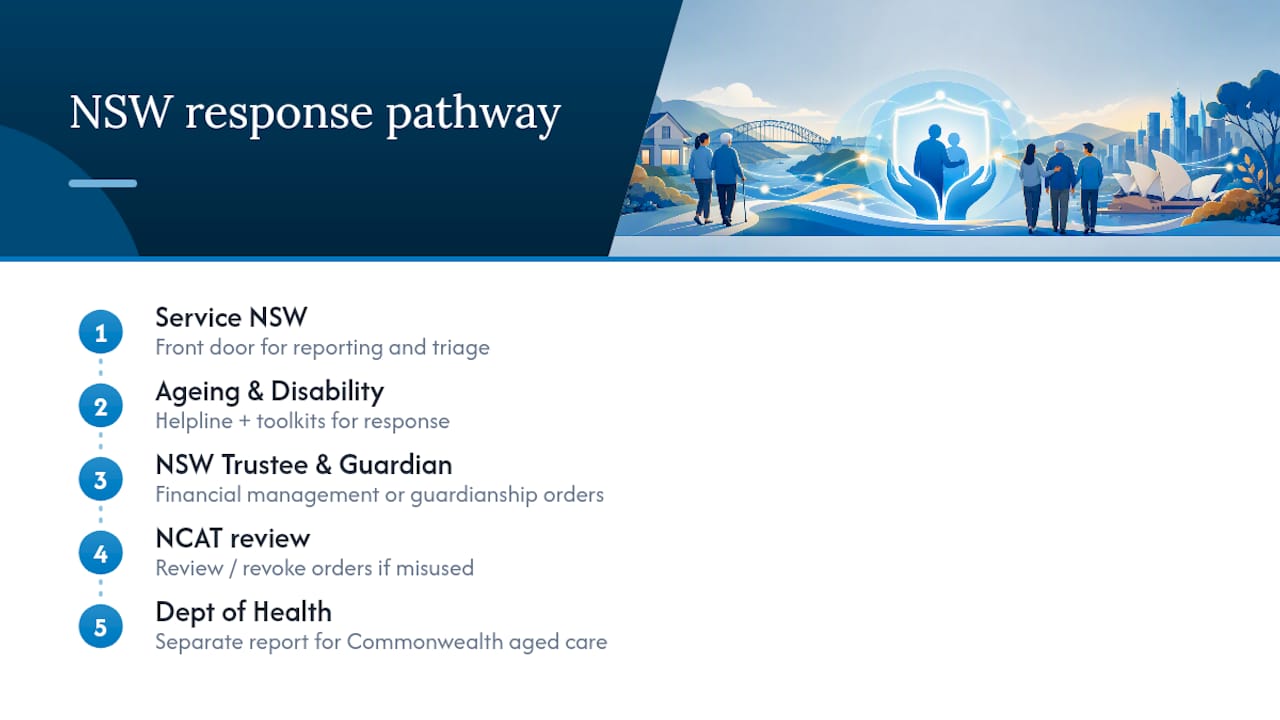
Several NSW bodies share responsibility, and knowing which one to call saves time. The Ageing & Disability Commission runs the Ageing & Disability Abuse Helpline and produces the practical toolkits frontline workers and families use to identify and respond to abuse. Service NSW acts as the front door for reporting, directing people to the right agency or helpline. NSW Trustee and Guardian steps in where formal financial management or guardianship orders are needed, particularly once someone has lost capacity to manage their own affairs. NCAT reviews and can revoke Guardianship or Financial Management orders where an appointed manager or guardian isn’t acting properly. For Commonwealth-funded residential aged care, incidents must be reported to the Department of Health on a separate line, since state and Commonwealth reporting duties don’t overlap neatly.
Is financial abuse legally different from other elder abuse in NSW?
NSW law doesn’t treat all elder abuse the same way, and the distinction matters for which remedy applies. Financial abuse involves money, property or assets, and it can trigger civil claims, criminal charges (theft, fraud, forgery) or NCAT review of financial management arrangements. Physical, psychological and neglect-based abuse are assessed differently, often involving different agencies, different evidence, and in serious cases, different criminal offences altogether. The overlap comes in mixed cases, where financial exploitation runs alongside coercive control or neglect, and a coordinated response across legal, banking and social-support channels tends to work better than treating financial recovery as a standalone issue.
How long do legal remedies and investigations take in NSW?
Timeframes vary enormously depending on the pathway. Urgent injunctions to freeze assets can, in genuinely urgent cases, be sought within days, since courts recognise that delay lets funds disappear. NCAT applications to review a Financial Management or Guardianship order typically take longer, often stretching to several weeks or months depending on the tribunal’s caseload and whether the matter is contested. Police investigations into fraud or theft move at their own pace and can take months, particularly where forensic accounting or bank records need to be subpoenaed. Civil recovery claims and estate litigation matters can run from several months to over a year if they proceed to a contested hearing, though many resolve earlier through negotiation once evidence is on the table. Acting early, before evidence is lost and assets are moved, consistently shortens every one of these timelines.
Where can you find official NSW help?
For direct support, use the Ageing & Disability Commission resources and helpline, Service NSW’s reporting page, and the Australian Government’s rights and protections guidance for national-level support options.
What the toolkit doesn’t tell you
The NSW Elder Abuse Toolkit is genuinely useful, but it’s written for frontline professionals working through structured cases, not for a daughter who’s just noticed her father’s savings account is $40,000 lighter than it should be. That gap between institutional guidance and the panic of a real family situation is where most people get stuck.
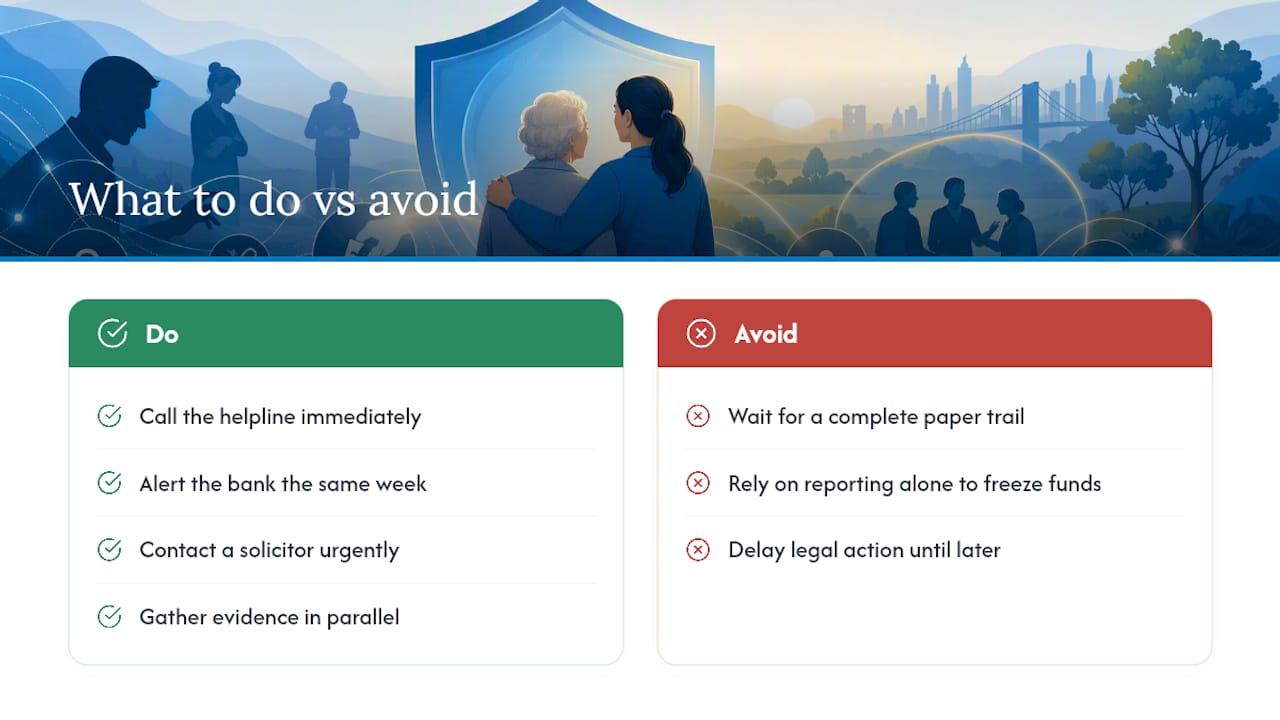
Here’s the judgement I’d make plainly: the conventional advice to “gather evidence first, then decide what to do” is right in principle but too slow in practice when an EPOA has just been activated or a bank account is actively being drained. Evidence collection and urgent legal action need to happen in parallel, not in sequence. Waiting until you have a complete paper trail before calling a solicitor or the bank is how thousands of dollars go missing in the time it takes to organise a filing cabinet.
What’s overrated is the idea that reporting alone solves anything. A helpline call is essential, but it triggers a referral, not a freeze on funds. What actually stops the bleeding is a bank alert and, where warranted, an urgent legal step, both happening in the same week you first suspect something’s wrong.
— George
Why work with Simons George Legal on an elder abuse matter?
Simons George Legal is the option for NSW families who need someone who already knows contested estates and financial abuse cases, not a general practice learning the ropes as your case unfolds. The firm handles evidence triage, urgent legal steps like injunctions and NCAT applications, and the recovery documentation needed once a case moves toward estate litigation or a formal claim under wills and inheritance law. New clients get a complimentary 30-minute consultation, so you can find out where you stand before committing to anything. If you suspect an older relative is being financially exploited, book that free consult now and get a clear read on your options before more money moves.
This article is general information, not a substitute for advice from a qualified lawyer. Consult a qualified legal professional about your own circumstances before acting on anything here.
Sources
- Financial abuse | Ageing & Disability Commission
- Report elder abuse | Service NSW
- NSW ministerial release — World Elder Abuse Awareness Day
- Protecting the rights of older people | Australian Government Attorney-General’s Department
FAQ
What is financial elder abuse in Australia?
It’s the illegal or improper use of an older person’s money, property or financial resources by someone they trust, including misuse of a Power of Attorney, coerced Will changes, or unauthorised withdrawals.
What are two indicators of financial abuse?
Sudden unpaid bills despite adequate assets and large or unexplained bank withdrawals are two of the clearest warning signs, alongside changes to a Will made shortly after someone gains financial control.
Is there mandatory reporting for elder abuse in Australia?
Mandatory reporting doesn’t apply universally in community settings in NSW, but it does apply in Commonwealth-funded residential aged care, where incidents must be reported to the Department of Health.
Is financial abuse a crime in Australia?
Yes, when it involves theft, fraud or forgery, financial abuse can be prosecuted as a criminal offence, separate from any civil claim to recover misused funds or property.
Can a lawyer help stop elder financial abuse in NSW?
Yes. A solicitor can pursue urgent injunctions to freeze assets, apply to NCAT to review a Financial Management or Guardianship order, and prepare civil claims for recovery, and Simons George Legal offers a free consultation to assess your options.