Executor misconduct in NSW is grounds for court-ordered removal, and beneficiaries have a clear legal right to challenge it. When an executor breaches their fiduciary duties — by stealing estate assets, self-dealing, or simply refusing to account for funds — the Supreme Court of NSW has the power to revoke their grant of probate and appoint a replacement. The process requires solid evidence and legal guidance, but it is well-established under NSW law.
Executor misconduct falls into three broad categories: incompetence, negligence, and intentional wrongdoing. All three can justify challenging executor actions through the courts, though the strength of your case depends heavily on the evidence you can produce.
Common forms of executor misconduct in NSW include:
- Misappropriating or stealing estate assets
- Failing to keep accurate, transparent accounts
- Self-dealing, including purchasing estate property without beneficiary consent
- Mixing personal funds with estate funds
- Negligent administration causing financial loss to the estate
- Failing to distribute the estate in accordance with the will
- Concealing information from beneficiaries
How do you dispute executor misconduct in NSW?
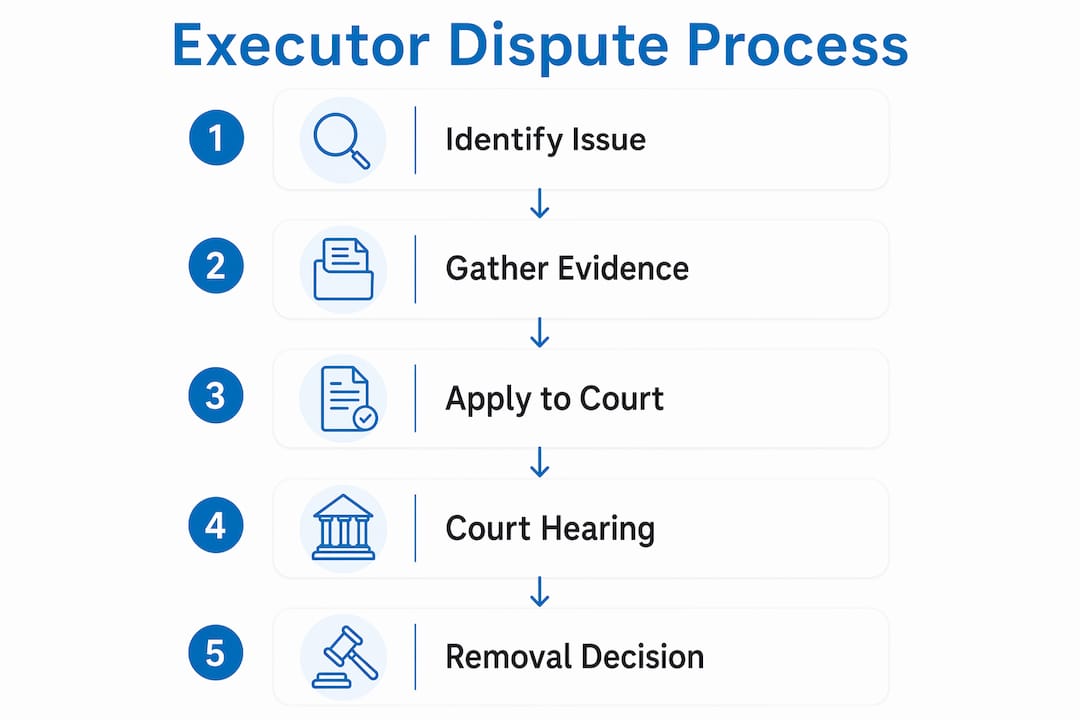
Disputing executor misconduct in NSW follows a structured legal process, and the Supreme Court of NSW is the body that hears removal applications. The court prefers minimal interference in estate administration, but it will act decisively when fiduciary duties are breached and the estate is put at risk.
The steps involved are:
- Gather evidence. Collect financial records, bank statements, correspondence, and any documents showing misconduct or concealment.
- Consult a wills and estates solicitor. Executor disputes are procedurally complex; specialist legal advice is critical before filing anything.
- Attempt resolution first. Mediation or direct negotiation can resolve some disputes without litigation, saving time and cost for all parties.
- File an application in the Supreme Court. Under section 75 of the Probate and Administration Act 1898 (NSW), beneficiaries can apply to have a grant revoked. The court will assess whether misconduct has put the estate in jeopardy.
- Serve notice on all interested parties. All beneficiaries and the executor must be notified of the application.
- Attend court hearings. The court will hear evidence from both sides before making any order.
Timeline varies considerably. A straightforward, unopposed application can be resolved in a matter of months. Contested matters involving complex family dynamics or significant assets can take one to two years or longer. The court’s approach is to make a removal order only where the evidence clearly justifies it.
What counts as executor misconduct? Real NSW case examples
NSW courts have dealt with executor misconduct across a wide spectrum, and the case law is instructive. Understanding what courts have actually found helps you assess whether your situation meets the threshold for removal.

Mixing personal and estate funds is one of the clearest breaches. In Chick v Grosfeld [2012] NSWSC 1166, the executor transferred a significant sum from the estate account into his own working account, then concealed the withdrawals by mislabelling them in the estate accounts as legal costs. The court found this a serious breach and revoked the grant of probate.
Self-dealing is equally serious. In Bruce v Bruce [2025] NSWSC 1466, executors sold estate property to a co-executor without the informed consent of all nine beneficiaries. The court found this breached the self-dealing rule, which voids any sale by a trustee to themselves regardless of whether the price was fair.
Misappropriating estate cash was the central issue in Stubberfield v Brown [2010] NSWSC 536. The executor had retained $100,000 in cash belonging to the deceased and then gave inconsistent, implausible explanations to the court. The grant of probate was revoked and the estate redistributed accordingly.
“The due and proper administration of the estate has either been put in jeopardy or has been prevented either by reasons of acts or omissions on the part of the executor, or by virtue of matters personal to them, for example, mental infirmity, ill health, or by virtue of the proof of other matters which established that the executor is not a fit and proper person to carry out the duties they have sworn to perform.” — Mavrideros v Mack (1998) 45 NSWLR 80, cited in Stubberfield v Brown
Unauthorised remuneration is a less obvious but common trigger. Executors cannot pay themselves from estate funds without explicit will authorisation or court approval. In Saffron v Cowley [2012] NSWSC 1108, executors paid themselves substantial commission advances without any court order, which the court found was a clear conflict of interest.
Negligent property management can also ground a claim. In Richardson v Richardson [2021] NSWSC 353, an executor allowed estate property to sit vacant and unrented, causing financial loss to the estate that the court ordered the executor to compensate.
Failing to account is a breach in its own right. Executors have a duty to render accounts when asked and to keep vouchers and receipts for every transaction. Concealing or falsifying those accounts, as occurred in Chick v Grosfeld, compounds the original breach and significantly damages the executor’s credibility before the court.
What evidence do you need to prove executor misconduct?
Courts are reluctant to remove an executor without clear, credible documentation. Gathering the right evidence early is the single most important thing you can do to strengthen your position.
The evidence that carries the most weight includes:
- Estate accounts and bank statements showing unexplained withdrawals, transfers to the executor’s personal accounts, or payments without receipts
- Correspondence and emails that reveal concealment, conflicts of interest, or the executor refusing to provide information
- The will itself and any relevant contracts, to establish what the executor was authorised to do
- Expert valuation reports where estate property has been sold at an undervalue or mismanaged
- Witness statements from other beneficiaries, professionals, or anyone with direct knowledge of the misconduct
- Receipts and invoices the executor has submitted, which can be cross-checked against actual payments
Pro Tip: Start documenting everything the moment you suspect a problem. Courts treat timely, organised records as far more credible than evidence assembled after the fact.
One practical step that beneficiaries often overlook: you have a legal right to inspect estate accounts. If the executor refuses, that refusal is itself evidence of a breach. An inheritance dispute documentation checklist can help you track what to request and when.
How long does an executor dispute take, and what happens after removal?
Executor disputes rarely resolve quickly. From the point of gathering evidence to a final court order, a contested removal application typically takes anywhere from several months to well over a year, depending on the complexity of the estate and how vigorously the executor contests the claim.
Common obstacles include:
- The executor refusing to cooperate or produce documents
- Complex family dynamics where beneficiaries disagree about whether to proceed
- Estates with multiple properties or business interests requiring expert valuation
- Delays caused by the executor’s own conduct, which ironically can extend the very administration they are supposed to be completing
Once an executor is removed, the estate still needs to be administered. The Supreme Court of NSW has several options for appointing a replacement. If the will names a substituted executor, that person can apply. If not, beneficiaries can apply for letters of administration, or the court may appoint the NSW Trustee and Guardian as an independent administrator. The choice depends on the will’s terms and whether the beneficiaries can agree.
Removal does not automatically undo what the executor has already done. Where misconduct has caused financial loss, a separate claim for compensation or damages may be necessary. In Richardson v Richardson, the court ordered the executor to compensate the estate for rental income lost through negligent property management. In Chick v Grosfeld, the court ordered the executor to repay funds misappropriated from the estate account.

The impact on estate administration can be significant. Delays in distribution, additional legal costs, and the need to reconstruct accounts all flow from executor misconduct. Beneficiaries should factor these realities into their decision to proceed.
What fiduciary duties does an executor owe under NSW law?
An executor’s fiduciary duties are among the most demanding in Australian law. They are not simply administrative obligations; they are duties of loyalty, honesty, and impartiality owed directly to the beneficiaries.
Under NSW law, as confirmed in Turch v Tripolone [2025] NSWSC 86, an executor must:
- Act honestly and in good faith at all times
- Act within the powers granted by the will and the law
- Preserve estate assets for the benefit of beneficiaries
- Act impartially between beneficiaries
- Keep proper accounts, including vouchers and receipts for every transaction
- Permit beneficiaries to inspect accounts on request
- Provide beneficiaries with information about the estate’s management
- Abide by the “no conflict” and “no profit” rules
The “no conflict” rule means an executor cannot place themselves in a position where their personal interests conflict with their duties to beneficiaries. The “no profit” rule means they cannot profit from their position without court approval or explicit will authorisation. Both rules are strict fiduciary constraints that courts enforce without sympathy for ignorance.
Breach of any of these duties can expose an executor to personal liability, court removal, and an order to compensate the estate. In Chick v Grosfeld, the court found that mixing estate funds with personal funds was a serious breach even though the money was ultimately repaid, because the breach itself demonstrated the executor was not a fit and proper person to continue.
Pro Tip: If you are a beneficiary and the executor has refused to show you the estate accounts, that refusal is a breach of fiduciary duty. You do not need to wait for further misconduct before seeking legal advice.
An executor who has already intermeddled in the estate cannot simply walk away. Once a grant of probate has been made, the executor cannot renounce their duties without court consent. This matters for disputes: an executor who realises they are under scrutiny cannot escape accountability by stepping aside unilaterally.
For a detailed look at what proper estate accounting requires, see Simons George Legal’s guide on estate accounting obligations.
Funding your legal matter — no win, no fee
Cost is the most common reason beneficiaries hesitate to pursue a legitimate executor misconduct claim. Simons George Legal offers no win, no fee arrangements for eligible executor misconduct cases, removing the upfront financial barrier that stops many people from acting.
Eligibility is assessed during a free initial consultation. The firm reviews the facts, identifies the strength of your claim, and explains what a no win, no fee arrangement would cover in your specific circumstances. You get honest advice about your prospects before committing to anything.
If your case qualifies, you can pursue your claim without paying legal fees unless the matter resolves in your favour. For beneficiaries facing a well-resourced executor, that matters.

Book a free case assessment with Simons George Legal’s wills and estates lawyers to find out whether your matter is eligible.
No Win, No Fee arrangements are subject to case eligibility and a written costs agreement. Liability limited by a scheme approved under Professional Standards Legislation.
Key takeaways
Disputing executor misconduct in NSW requires clear evidence of fiduciary breach and an application to the Supreme Court, which will remove an executor only where misconduct has put the estate at genuine risk.
| Point | Details |
|---|---|
| Misconduct threshold | Courts require evidence that misconduct has put the estate in jeopardy, not merely that the executor is difficult or slow. |
| Supreme Court jurisdiction | Only the Supreme Court of NSW can revoke a grant of probate and order an executor’s removal. |
| Evidence is decisive | Financial records, correspondence, and expert reports are the foundation of any successful removal application. |
| Replacement options | A removed executor can be replaced by a substituted executor named in the will, a beneficiary, or the NSW Trustee and Guardian. |
| Personal liability | A removed executor may be ordered to compensate the estate for losses caused by their misconduct. |
FAQ
What are examples of executor misconduct in NSW?
Common examples include misappropriating estate funds, mixing personal and estate accounts, self-dealing by purchasing estate property, paying unauthorised commissions, and failing to keep or produce estate accounts.
Can you sue an executor for breach of fiduciary duty?
Yes. An executor who breaches fiduciary duties can be ordered to compensate the estate for any loss caused, in addition to being removed from their role.
Can you dispute an executor in NSW?
Beneficiaries can apply to the Supreme Court of NSW to have an executor removed where misconduct or breach of duty has put the estate at risk. Legal advice from a wills and estates solicitor is strongly recommended before filing.
Can an executor be removed in NSW?
Yes. The Supreme Court can revoke a grant of probate and appoint a replacement if satisfied the executor has breached their duties or is not a fit and proper person to continue. The replacement may be a substituted executor, a beneficiary, or the NSW Trustee and Guardian.