You can refuse an inheritance in NSW, but only after the person has died, and you must take a clear, positive step to do it. The refusal is called a disclaimer. It is generally treated as permanent, and it can change who receives the gift, how an estate is distributed and what Centrelink thinks of your assets. Get advice on those effects before you sign anything. If you are weighing up a disclaimer in a contested estate, our estate planning and disputes team can work through it with you in a free 30-minute consultation.
TL;DR
- A beneficiary under a will or an intestacy can refuse a gift. No one can be forced to accept property against their will (Law Society Journal, May 2022).
- A disclaimer made before the person dies is ineffective. Doing nothing is not a disclaimer: you are presumed to accept unless you act.
- Where the gift goes next depends on the will, and a refused residuary gift can pass under the intestacy rules instead.
- Disclaiming to benefit someone else can trigger Centrelink deprivation rules, and there can be tax and duty consequences.
- Disclaiming does not end a dispute. If you are an executor or a family member who might claim, the timing matters.
Table of Contents
- What disclaiming an inheritance actually means
- When you can disclaim, and when you can’t
- How to make a valid disclaimer in NSW
- What happens to the gift you refuse
- Centrelink, tax and duty: the consequences people miss
- Disclaiming when the estate is in dispute
- Common mistakes
- How we help
- Our view on disclaimers
- Funding Your Legal Matter — No Win, No Fee
- FAQ
- Sources
What disclaiming an inheritance actually means
A disclaimer is a beneficiary’s formal refusal to take a gift left to them. It can apply to a gift in a will, such as a house, a sum of money or a share of the residue (what is left after specific gifts, debts and expenses). It can also apply to an entitlement under the intestacy rules, which decide who inherits when someone dies without a valid will. The Law Society Journal’s guide for beneficiaries explains that the law has long held that a person cannot be compelled to accept a gift of property against their will.
People disclaim for many reasons. The gift may carry costs, such as a property needing major repairs or a share in a business with liabilities. The beneficiary may be financially comfortable and want the gift to go to a sibling or the next generation. Or they may want to protect their pension, a bankruptcy position or a relationship. Each reason leads to a different result, which is why the reason matters as much as the paperwork.
Two terms are worth separating:
- Disclaiming is refusing a gift you are entitled to receive.
- Renouncing as executor is stepping aside from the job of administering the estate. It is a different decision with different consequences. Our guide to executor renunciation in NSW covers it.
A person can be both executor and beneficiary and do one without the other.
When you can disclaim, and when you can’t
Not before the death
A beneficiary cannot disclaim a gift while the will-maker is alive. A will can be changed or revoked until death, so there is nothing yet to refuse. The Law Society Journal notes that a disclaimer before the testator’s death is ineffective. If a parent asks you now whether you would want a particular asset, the answer has no legal effect.
Before you have accepted the gift
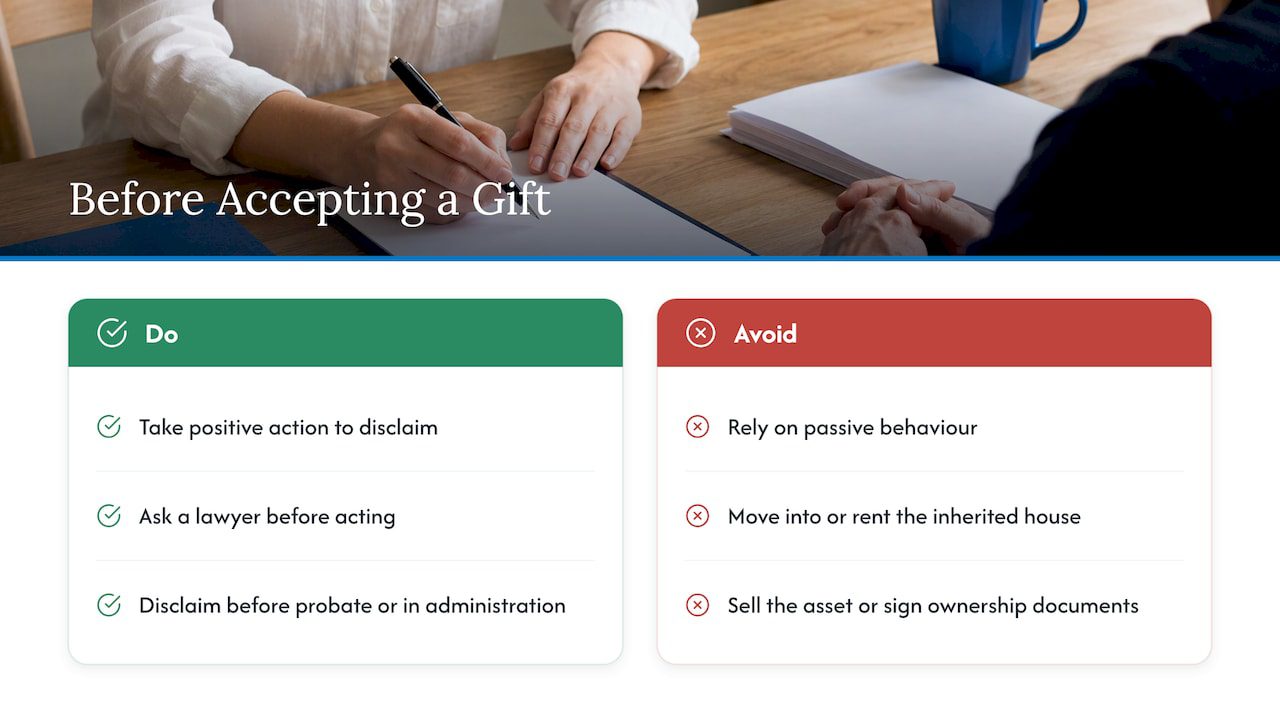
The law presumes a beneficiary accepts a gift unless they indicate otherwise, a principle taken from an English case, In re Stratton’s Disclaimer. The practical result, set out in the same article, is that someone who wants to reject an inheritance must take positive action. Passive behaviour will not do.
That is also the main trap. If you have taken the benefit of the gift, for example by moving into a house left to you, collecting rent from it, selling the item or signing documents that treat the asset as yours, you may be seen as having accepted it. At that point refusing it becomes much harder, and a question you should put to a lawyer before acting is whether you can still disclaim at all.
The research on this point is clear about the starting position: a residuary beneficiary may disclaim before probate is granted and during the administration of the estate. Probate is the Supreme Court’s grant confirming that the executor has authority to deal with the estate. Do not wait for the end of the administration, and do not do anything with the asset in the meantime that looks like ownership.
The 12-month clock on other claims
If you might want to make a family provision claim, you should know that the Succession Act 2006 (NSW) requires an application for a family provision order to be made within 12 months of the date of death, unless the Court allows otherwise on sufficient cause or the parties consent. Beneficiaries sometimes disclaim a small gift while believing they were left too little. Doing that without thinking about the claim you may still have is a costly mistake. See our guide to family provision claims in NSW before you decide.
How to make a valid disclaimer in NSW
NSW has no prescribed form, and no court approval is needed. According to the Law Society Journal, a disclaimer can be made by deed, in another written form, orally, or even inferred from conduct. It must be total, so you cannot keep part of a gift and refuse the rest, and it must be communicated to the people who need to know, in practice the executor.
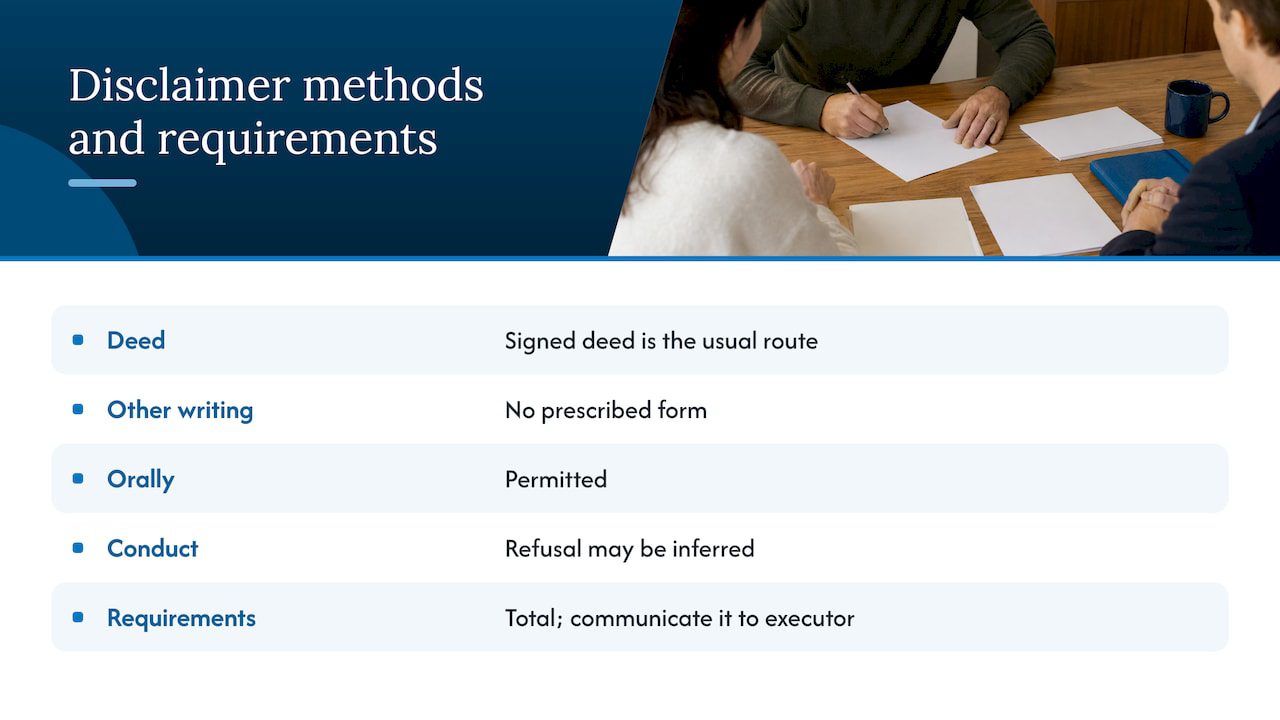
Just because the law allows an informal refusal does not mean you should use one. Executors and the people who deal with the estate need certainty. The Legal Practitioners’ Liability Committee’s guide for beneficiaries says that the executor will usually require written confirmation of the refusal. That is why a signed deed of disclaimer is the usual route.
A practical sequence
- Stop and hold still. Do not occupy, sell, rent out, mortgage or otherwise deal with the asset. Do not sign anything the executor sends that treats you as accepting.
- Identify exactly what you are refusing. A specific gift, a share of residue, or an entitlement on intestacy each leads to a different outcome. Check the will’s wording and any alternative gift it names.
- Work out who benefits. Find out who takes the gift in your place. If it will go to your own children, a sibling or a person you are close to, that can matter for your own finances.
- Check the financial consequences first. Tax, duty and Centrelink treatment all depend on the facts, and are covered below.
- Put it in writing, by deed. The document should clearly identify the deceased, the will, the gift and your total refusal, and be properly signed and witnessed.
- Give it to the executor. Keep proof that it was delivered. Until the executor knows, the estate cannot be administered on the footing that you refused.
- Do not change your mind casually. A disclaimer is generally treated as a permanent and irrevocable rejection, with only rare exceptions where fraud or undue influence is shown.
A deed drafted by a wills and estates lawyer is more than a formality. It is how you avoid unintended gifts, disputes with the executor and tax surprises. If you are in the middle of a contested matter, it is also how you avoid undermining your own position.
What happens to the gift you refuse
This is the question most beneficiaries ask second, and it is the one that most often surprises them. You do not choose who receives the gift. The will, or the intestacy rules, decides.
As a general guide:
- The will names an alternative. Many wills provide for a gift to pass to someone else, such as the beneficiary’s children, if the first beneficiary cannot or does not take it. Where there is such a clause, it is likely to apply.
- The gift falls into the residue. A refused specific gift often ends up in the residuary estate, shared among the residuary beneficiaries.
- There is no one left to take it. The Law Society Journal flags the trap that a disclaimer by a residuary beneficiary may cause a gift to lapse or to be distributed under the intestacy rules in Chapter 4 of the Succession Act 2006. In other words, refusing can send assets to relatives you never intended to benefit, or in a very different pattern from what the will-maker wanted.
If the whole estate is passing on intestacy, see our guides to dying without a will in NSW and intestate succession rules in NSW to see who would take if you stepped aside.
A worked example
Imagine a mother leaves her house to her son Daniel, and the rest of her estate to Daniel and his sister Priya equally. Daniel is financially secure and wants Priya to have the house. If Daniel disclaims the house, he cannot direct it to Priya. If the will has no alternative gift, the house is likely to fall into the residue, and Daniel, as a residuary beneficiary, would take half of it anyway. His refusal does not achieve what he wanted.
The cleaner path may be for Daniel to accept and then agree with Priya how the assets are divided, or to document a family arrangement. Which is right depends on tax, duty and, importantly, Centrelink, so this is exactly the sort of decision to take advice on before acting.
Centrelink, tax and duty: the consequences people miss
Centrelink and the Age Pension
If you receive a pension or other income support, disclaiming is not a way to keep your payments safe. Services Australia’s Social Security Guide, last reviewed 9 May 2022, states that deprivation provisions apply to a person’s interest in a deceased estate if they waive their right to it, or direct the executor to distribute it to a third party for no or inadequate consideration. A disclaimer that gives the gift away for nothing can therefore be treated as if you still held the asset. See our guide to inheritance and Centrelink for what has to be reported and when.
Income tax
According to the Law Society Journal, a person will not ordinarily be taxed on a disclaimer of a testamentary gift if they have not accepted the gift. Trust interests are different. If a beneficiary disclaims an interest in a family discretionary trust after year end, they may still be presently entitled to trust income under section 97 of the Income Tax Assessment Act 1936. The timing of a disclaimer can change the tax result.
Transfer duty
Whether duty applies to the transfer of property can depend on the terms of the disclaimer and on any agreement between beneficiaries. Informal arrangements, like those in the Daniel and Priya example, are where duty questions arise. The LPLC guide advises beneficiaries to get legal advice before rejecting a gift because of possible taxation, duty and other implications.
Disclaiming when the estate is in dispute
Our readers are usually not in a calm estate. They are executors dealing with a challenge, or beneficiaries unhappy with a will. In that setting, a disclaimer interacts with everything else:
- If you are an executor and beneficiary, refusing the gift does not end your duties as executor, and renouncing as executor does not cancel your gift. Keep the two decisions separate, and see our guide to defending a family provision claim as an executor.
- If you are contesting a will, disclaiming a gift under that will can send mixed signals about whether you accept it. Speak to a lawyer first about challenging a will.
- If you are being pressured to disclaim, by a relative, by another beneficiary or by an executor, do not sign. A disclaimer obtained through fraud or undue influence may be challenged, but proving that later is far harder than not signing in the first place.
- If you are estranged from the deceased, you may have rights you did not know about. Read about estranged family member inheritance rights in NSW before giving any of them away.
An executor who receives a disclaimer should also keep the documents tidy. Records matter if anyone later queries the distribution. Our inheritance dispute documentation checklist lists what to hold on to, and the executor’s notice of intended distribution process is the point at which the estate’s final shape is usually set out to those with an interest.
Common mistakes
- Treating silence as refusal. Not collecting a gift is not a disclaimer, because the law presumes acceptance.
- Acting like an owner first. Moving in, renting out or selling can amount to acceptance.
- Trying to “gift” through a disclaimer. You cannot name the recipient, and any attempt to steer the gift can attract deprivation, tax or duty consequences.
- Partial refusals. The disclaimer must be total.
- Ignoring the 12-month window. A beneficiary who might have a claim for more provision should decide that first.
- Signing the executor’s draft without advice. A document prepared for the estate’s convenience is not necessarily drafted for your protection.
How we help
We are a wills and estates practice based in Bondi, acting for individuals, families, executors and beneficiaries across Sydney, the Eastern Suburbs, the Northern Rivers and regional NSW, in person or virtually. Every matter is partner-led by a specialist with extensive Supreme and High Court experience.
For a beneficiary considering a disclaimer, that means looking at the whole picture: the will, who takes your place, whether you have a family provision claim to protect, and how the disclaimer sits alongside any estate litigation. For executors, it means advice on probate and estate administration when a beneficiary steps aside. New clients are offered a complimentary 30-minute consultation so we can assess the situation and recommend practical next steps.

If you want to plan your own estate so your beneficiaries never face this decision unprepared, see our will-making and amendment service.
Our view on disclaimers
A disclaimer looks simple: one signature and the gift is gone. In our experience of contested estates, the signature is the easy part. The hard part is understanding what happens next, because the gift moves under the will or the intestacy rules, not to the person you had in mind.
We approach every disclaimer as part of a larger question. What does this person want to achieve, who is affected, and what else do they hold that they might give up without meaning to? Often the best answer is a refusal by deed. Sometimes it is accepting the gift and agreeing a different arrangement with family. Sometimes it is not disclaiming at all, and using the gift as part of a negotiated settlement.
Because each matter is led by a partner with extensive Supreme and High Court experience, you get a clear and honest view early, before a document is signed that cannot be undone.
George
Funding Your Legal Matter — No Win, No Fee
Simons George Legal offers No Win, No Fee arrangements for eligible cases. We check eligibility during a free initial consultation, so you know where you stand before committing to anything. For people with a legitimate claim, this removes the upfront cost barrier that so often keeps them from pursuing it. If you think you may have a claim, or need to defend one, book a free case assessment with us today.
No Win, No Fee arrangements are subject to case eligibility and a written costs agreement. Liability limited by a scheme approved under Professional Standards Legislation.
FAQ
Can I refuse an inheritance in NSW?
Yes. A beneficiary under a will or an intestacy can refuse a gift, because nobody can be compelled to accept property against their will. You can only do so after the death, and you must act positively rather than simply doing nothing. Written confirmation to the executor is usually required.
Do I need a lawyer or a court order to disclaim?
NSW law has no prescribed form and no court approval is needed. A deed is still the safest way to disclaim, since executors usually want written confirmation. Get legal advice first, because the tax, duty and Centrelink consequences depend on your circumstances.
Can I choose who gets the gift I disclaim?
No. The will or the intestacy rules decide. A refused gift may pass to an alternative beneficiary, fall into the residue, or be distributed on intestacy. Trying to direct it to a particular person can attract Centrelink deprivation, tax or duty consequences.
Can I change my mind after disclaiming?
A disclaimer is generally treated as a permanent and irrevocable rejection. In rare cases, if fraud or undue influence can be proved, it may be challenged. Treat the decision as final and get advice before signing.
Will disclaiming affect my Centrelink payments?
It can. The Social Security Guide says deprivation provisions apply where a person waives an interest in a deceased estate, or directs it to someone else, for no or inadequate consideration. See our guide on inheritance and Centrelink, and take advice before you sign.
Sources
- Ready, steady, NO: tips and traps for beneficiaries wanting to reject an inheritance, Law Society Journal
- Succession Act 2006 (NSW) s 58, When an application may be made
- 4.1.5 Deprivation related to deceased estates, Social Security Guide
- A Guide for Beneficiaries, Legal Practitioners’ Liability Committee