Most people assume they have unlimited time to contest a will after a loved one dies. That assumption is wrong, and it costs people their rights every year. Contesting a will in NSW involves strict time limits, specific eligibility rules, and a procedural process that moves faster than most grieving families expect. Whether you believe you were unfairly left out of a will, suspect the deceased lacked mental capacity, or think undue influence was at play, understanding your rights and the time limits for contesting a will in NSW is the first step toward protecting your interests.
Table of Contents
- Key takeaways
- Contesting a will in NSW: understanding your rights
- Time limits for contesting a will in NSW
- Step-by-step process for contesting a will
- What happens after contesting a will
- My honest perspective on contesting wills
- How Simonsgeorgelegal can help you
- FAQ
Key takeaways
| Point | Details |
|---|---|
| 12-month deadline applies | Family provision claims must be filed within 12 months of the date of death under NSW law. |
| Eligibility is defined by law | Only spouses, de facto partners, children, grandchildren, and certain dependents can make a family provision claim. |
| Two types of challenge exist | Contesting a will and challenging its validity are legally distinct processes with different grounds and timeframes. |
| Courts can alter will provisions | A successful claim does not automatically void the will. Courts have power to redirect assets to make just provision. |
| Act quickly to protect evidence | Delay weakens your position regardless of claim type, as evidence deteriorates and assets may be distributed. |
Contesting a will in NSW: understanding your rights
The phrase “contesting a will” covers two legally distinct types of action, and confusing them is one of the most common mistakes people make at the outset.
The first is a family provision claim. This does not challenge whether the will is legally valid. Instead, it argues that the deceased failed to make adequate provision for your proper maintenance, education, or advancement in life. Under the Succession Act 2006 (NSW), eligible persons can seek adequate maintenance if the will leaves them without proper financial support. Eligible persons include a spouse or de facto partner, children (including adult children), grandchildren who were dependent on the deceased, and certain other household members who were financially dependent.
The second is a validity challenge. This attacks the legal foundation of the will itself. Common grounds include lack of testamentary capacity (the deceased did not understand what they were signing), undue influence (someone pressured the deceased into making certain provisions), and improper execution (the will was not signed or witnessed correctly). A successful validity challenge can result in the will being declared void, meaning an earlier will or the rules of intestacy would apply instead.
Your rights in will disputes NSW depend entirely on which type of claim you are pursuing. For a family provision claim, standing is determined by your relationship to the deceased. For a validity challenge, virtually any interested party, including a beneficiary under a prior will, may have standing. Knowing which path applies to your situation shapes every decision that follows, from evidence gathering to deadlines.
Time limits for contesting a will in NSW
This is where most people get caught off guard.
For family provision claims, the 12-month statutory deadline runs from the date of death, not from the date probate is granted. That distinction matters enormously. You could be waiting on probate and inadvertently let the clock run down. This deadline was recently reduced from 18 months under the Succession Act 2006 (NSW), making prompt action even more critical.
| Claim type | Time limit | Risk of delay |
|---|---|---|
| Family provision claim | 12 months from date of death | Claim may be barred without court leave |
| Validity challenge (capacity, undue influence) | No fixed statutory limit | Evidence deterioration, witness memory loss |
| Improper execution challenge | No fixed statutory limit | Distribution of estate before claim resolved |
For validity challenges, there is no fixed statutory time limit, but this does not mean you can wait indefinitely. Medical records, witness testimony, and financial documents all deteriorate over time. The longer you wait, the harder it becomes to reconstruct what was happening in the months before the will was signed.
Courts do have discretion to extend the 12-month deadline for family provision claims, but only in limited circumstances. You would need to satisfy the court that the delay was not your fault, that the estate has not already been fully distributed, and that extending time would not cause undue prejudice to other beneficiaries. The 2026 NSWCA case Di Giannantonio v Di Giannantonio illustrates the complexities that can arise when procedural history is contested, reinforcing that time-related issues rarely have simple answers.
Probate also matters here. Once probate is granted, the executor has authority to administer the estate. If assets are distributed to beneficiaries before your claim is resolved, recovering them becomes significantly harder. Lodging a caveat against probate is one tool available to preserve your position early in the process.

Pro Tip: If you are even considering contesting a will, contact a solicitor before the six-month mark from the date of death. This gives you time to gather evidence, explore options, and file well before the deadline.
Step-by-step process for contesting a will
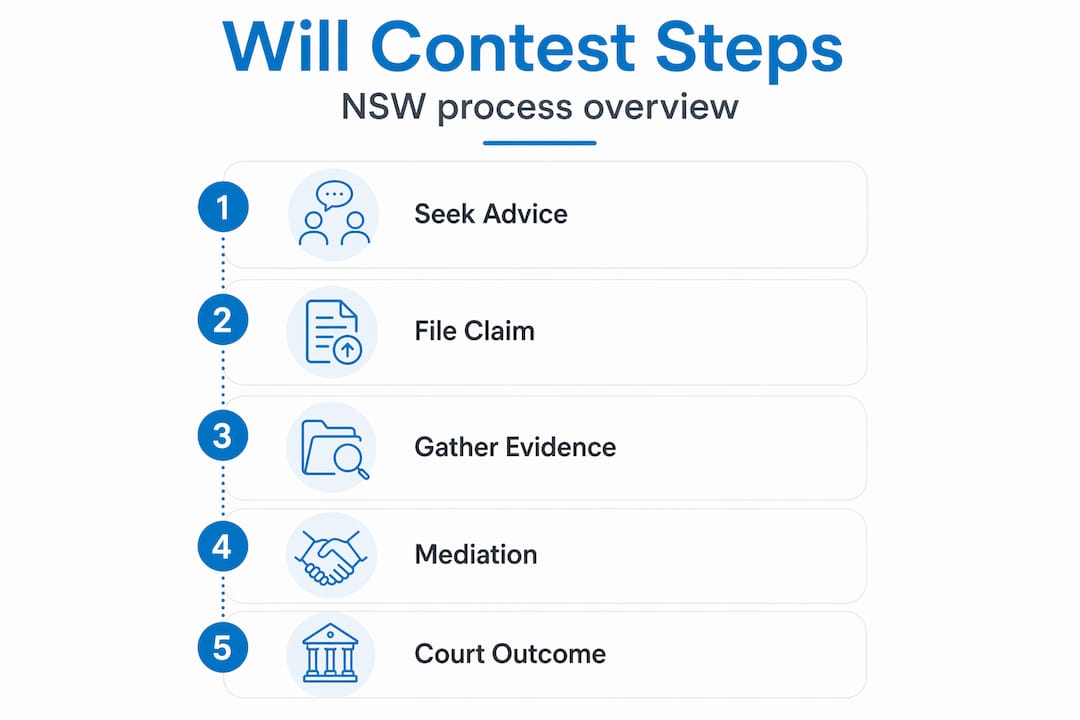
Understanding what actually happens procedurally removes a lot of anxiety. The NSW inheritance dispute process follows a fairly consistent path, even if individual cases vary.
- Obtain legal advice. Before doing anything else, get a clear assessment of your eligibility, the strength of your claim, and which type of action applies. Legal costs and case strategy should be discussed at this stage.
- Gather evidence. For a family provision claim, this means financial records, evidence of your relationship with the deceased, and any correspondence that speaks to the deceased’s intentions. For a validity challenge, medical records, file notes from the solicitor who drafted the will, and witness statements become central.
- File the claim. For family provision claims, proceedings are issued in the NSW Supreme Court and then served on the executor. Filing stops the clock on the 12-month deadline.
- Attempt negotiation and mediation. The court expects parties to try to resolve the dispute before a hearing. Most contested matters settle at this stage. Mediation is typically ordered by the court and can resolve claims significantly faster than a trial.
- Attend court if needed. If mediation fails, the matter proceeds to a hearing. Hearings typically occur one to two years after filing if the case goes to trial. At the hearing, the judge considers all circumstances and has broad powers to alter the will’s provisions.
- Receive the court’s decision. The court can make orders varying the will to provide for you out of the estate. This might take the form of a lump sum, an interest in property, or periodic payments depending on the circumstances.
Throughout this process, legal costs can be substantial. In most successful family provision claims, legal costs are paid from the estate. However, if your claim is unsuccessful, you may be ordered to pay the estate’s costs. That risk is real and should factor into your decision-making from the start.
Pro Tip: Ask your solicitor early about the realistic range of outcomes and costs. A frank conversation about the cost-benefit position at the outset will help you make a clear-headed decision rather than one driven purely by emotion.
What happens after contesting a will
The outcome of a contested will matter does not always look like what people imagine.
A successful family provision claim does not void the will. The court makes orders that sit alongside the will, carving out a provision for you from the estate. Courts aim to make provision that is just and equitable under Part IV of the Succession Act, weighing factors like your relationship with the deceased, your financial needs, your contributions to the estate, and the needs of other beneficiaries.
What this means in practice:
- Other beneficiaries will receive reduced shares if the court awards you a provision from the estate
- The executor remains responsible for administering the estate during and after the litigation
- Parties can appeal court decisions, extending the dispute timeline further
- Settlement agreements reached during mediation are binding and may include confidentiality terms
- Family relationships are often permanently affected by contested matters, regardless of outcome
The financial and emotional costs of a prolonged dispute should not be underestimated. Many families find that even when they “win,” the legal costs and the fractured relationships represent a significant loss in their own right. This does not mean you should avoid pursuing a legitimate claim. It means you should go in with clear expectations about what success actually looks like, including estranged family member rights which are often more limited than people assume.
My honest perspective on contesting wills
I have worked with many clients who came to me months after a loved one died, having convinced themselves they had plenty of time to act. Some of them were right. Some of them had already lost their window.
What I have learned is that the people who navigate this process best are the ones who seek advice early and keep their expectations grounded. Contesting a will is not a way to punish a family member who you feel treated you unfairly. The law is not a mechanism for settling old scores. It is a framework for correcting genuine failures to provide adequately for people who were financially dependent on, or closely connected to, the deceased.
The cases that break my heart are the adult children who genuinely needed financial support from a parent’s estate and who missed the 12-month deadline because they did not know it existed. Or the spouse who waited for the executor to “do the right thing” and distributed the estate before any claim was filed. Acting promptly to preserve rights is not just legal advice. It is the single most important thing you can do after a death where you believe something has gone wrong.
My advice is this: if you have a genuine question about whether you were properly provided for, get proper advice within the first few months. You may decide not to proceed. But that should be an informed decision, not a forced one.
— George
How Simonsgeorgelegal can help you
If you are considering challenging a will in New South Wales, you do not have to figure out this process alone. Simonsgeorgelegal is a Bondi-based wills and estates practice with deep experience in family provision claims and complex estate litigation across Sydney.

Whether you are still weighing your options or ready to act, the team at Simonsgeorgelegal can provide clear, honest guidance on your rights, your realistic prospects, and your timeline. New clients are offered a complimentary 30-minute consultation, which means you can get a frank assessment of your situation without any upfront cost. From family provision claims through to full estate litigation, Simonsgeorgelegal acts to protect clients’ rights while keeping costs proportionate to the outcome. If deadlines are approaching, do not wait. Contact the team today through simonsgeorgelegal.com.au/wills-and-estates-lawyers.
FAQ
Who can contest a will in NSW?
Eligible persons under NSW law include spouses, de facto partners, children, grandchildren who were dependent on the deceased, and certain household members who were financially dependent on the deceased at the time of death.
What is the time limit for contesting a will in NSW?
Family provision claims must be filed within 12 months of the date of death under the Succession Act 2006 (NSW). Courts can grant extensions in limited circumstances, but relying on this is risky.
What evidence do I need to contest a will?
For a family provision claim, you need financial records, evidence of your relationship with the deceased, and documentation of your needs. For a validity challenge, medical records and witness statements about the deceased’s state of mind are central.
How long does a will contest take in NSW?
Most matters resolve through mediation within the first 12 to 18 months of filing. If the dispute proceeds to a court hearing, the process typically takes one to two years from filing to resolution.
Can a will be changed after a successful contest?
A successful family provision claim does not void the will. Instead, the court makes orders that provide for you out of the estate, effectively varying the distribution while leaving the remainder of the will intact.