Challenging a will in NSW is the formal legal process of disputing how a deceased person’s estate has been distributed, either because the provision made was inadequate or because the will itself is invalid. The governing legislation is the Succession Act 2006 (NSW), which sets out who can bring a claim, on what grounds, and within what timeframe. Not everyone who feels aggrieved has legal standing to proceed, and missing the strict deadlines can permanently bar a claim. This guide explains exactly what you need to know before taking action.
Who can legally challenge a will in NSW?
Eligibility to challenge a will in NSW is restricted to specific categories of people defined under the Succession Act 2006 (NSW). The Act does not give every disappointed relative or friend the right to bring a claim. Understanding where you sit within those categories is the first question any solicitor will ask.
For a family provision claim, which is the most common type of challenge, eligible persons include:
- Spouses and de facto partners of the deceased
- Former spouses and former de facto partners
- Children of the deceased, including adopted children
- Grandchildren who were wholly or partly dependent on the deceased
- Members of the deceased’s household who were wholly or partly dependent
- Persons in a close personal relationship with the deceased at the time of death
Those outside these categories generally cannot bring a family provision claim, though challenges to the validity of a will itself may carry different standing requirements. A niece who received nothing, for example, has no automatic right to claim unless she can demonstrate dependency or a qualifying personal relationship.
Pro Tip: If you are unsure whether you qualify as an eligible person, do not assume you do not. Estranged children, de facto partners of short duration, and dependent household members are frequently surprised to learn they have standing.
What are the valid grounds for challenging a will in NSW?
The grounds for disputing a will in NSW fall into two broad categories: challenging the adequacy of provision and challenging the validity of the will itself.
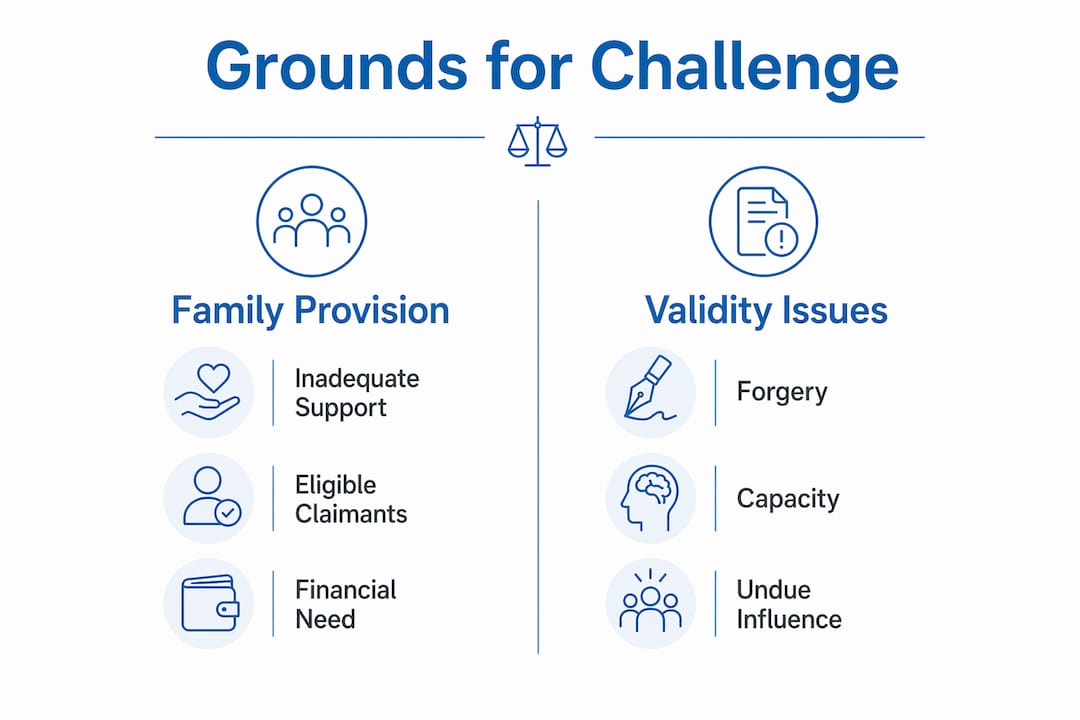
A family provision claim does not require you to prove the will was unfair in a moral sense. The court assesses adequacy of provision by weighing a range of factors under Section 60 of the Succession Act 2006, including the nature of the relationship, the claimant’s financial needs, the size of the estate, contributions made to the estate, and the deceased’s stated intentions. This means a child who received something may still succeed if what they received falls short of what the court considers adequate given their circumstances.
Validity challenges are a separate pathway entirely. Common grounds to challenge validity include:
- Lack of testamentary capacity: The deceased did not understand the nature of making a will, the extent of their estate, or the claims of those who might expect to benefit.
- Undue influence: A third party pressured or coerced the deceased into making or altering the will in a way that did not reflect their true wishes.
- Improper execution: The will was not signed or witnessed in accordance with the formal requirements under NSW law.
- Forgery or fraud: The document itself, or the signature on it, is not genuine.
Courts focus on adequacy of provision given each claimant’s individual circumstances rather than equality or fairness among beneficiaries. A sibling receiving twice as much as another does not, by itself, constitute grounds for a successful claim.
Validity challenges tend to be more complex and expensive to run than family provision claims. They require documentary evidence, often including medical records, witness statements, and expert opinion.
How to challenge a will in NSW: the step-by-step process
Knowing the process before you begin prevents costly procedural errors. The steps below reflect how most contested will matters progress through the NSW legal system.
- Seek legal advice immediately. Time limits are strict. A family provision claim must be filed within 12 months of the date of death. Extensions can be granted, but courts do not grant them readily, and delay weakens your position.
- Obtain a copy of the will and any grants of probate. You are entitled to request a copy of the will from the executor. If probate has been granted, the will becomes a public document filed with the Supreme Court of NSW.
- Assess your eligibility and prospects. A solicitor experienced in estate litigation will assess whether you are an eligible person, identify the most appropriate grounds, and give you a realistic view of your prospects before you commit to proceedings.
- Attempt negotiation or mediation. Mediation and negotiation resolve many contested will matters without court proceedings, saving both time and cost. Most matters settle at this stage when both parties have competent legal representation.
- File a summons in the Supreme Court of NSW. If negotiation fails, your solicitor files a summons and supporting affidavit in the Supreme Court of NSW. The estate is notified and has the opportunity to respond.
- Exchange evidence and attend hearings. Both parties exchange affidavits and documents. The court may order a mediation before any final hearing. If the matter proceeds to a hearing, a judge will consider all evidence and make final orders.
- Receive final orders. Successful family provision claims can result in court orders altering estate distributions, providing additional assets or lump sums to eligible claimants. The court balances the deceased’s intentions against the claimant’s demonstrated needs.
Pro Tip: Do not wait until probate is granted to seek advice. The 12-month clock starts from the date of death, not the date probate is finalised.
| Stage | Typical timeframe |
|---|---|
| Initial advice and eligibility assessment | Within days of death |
| Negotiation and mediation | 1 to 6 months |
| Filing in Supreme Court of NSW | Before 12-month deadline |
| Evidence exchange and hearings | 6 to 18 months from filing |
| Final orders | Varies by complexity |

How to dispute an executor of a will in NSW
Executor disputes are a distinct but related issue that frequently arises alongside will challenges. An executor holds significant legal powers over estate administration, but those powers are not unlimited.
Disputes involving executors typically arise in the following circumstances:
- Conflicts of interest: The executor is also a major beneficiary and is making decisions that favour their own position.
- Unreasonable delays: The executor is failing to administer the estate within a reasonable time, leaving beneficiaries without access to their entitlements.
- Mismanagement: Assets are being sold at undervalue, estate funds are being misused, or proper accounts are not being kept.
- Refusal to act: The executor is not taking steps to collect estate assets or pay debts.
Beneficiaries and eligible persons have the right to seek court intervention if an executor is not fulfilling their duties. The Supreme Court of NSW can remove an executor, appoint a substitute, or order the executor to provide accounts. These proceedings can run in parallel with a family provision claim or validity challenge, which means the costs and complexity can compound quickly.
The practical advice here is to document everything. Keep records of all communications with the executor, note dates when requests were made and responses received, and raise concerns in writing before escalating to court.
Common mistakes when disputing a will in NSW
The most damaging mistakes in will disputes are almost always procedural rather than substantive. A strong claim can fail entirely because of timing errors or poor preparation.
Missing the 12-month deadline is the single most common and most avoidable error. Courts have discretion to extend time, but that discretion is exercised sparingly. Applicants who delay because they are grieving, uncertain, or hoping the family will resolve the matter informally run a real risk of losing their right to claim entirely.
Failing to gather evidence early is equally costly. Medical records establishing the deceased’s mental state at the time of signing, financial records demonstrating the claimant’s needs, and correspondence showing the nature of the relationship all become harder to obtain as time passes. Witnesses’ memories fade. Documents are lost or destroyed.
Overestimating the strength of a claim is another recurring problem. Feeling that a will is unfair is not the same as having grounds to challenge it. Courts apply the Section 60 factors with precision, and a claimant who is financially comfortable may receive little or nothing even if they were excluded from the will entirely.
Ignoring mediation is a strategic error. Early alternative dispute resolution consistently produces better outcomes than protracted litigation, both in terms of cost and the preservation of family relationships.
Funding your legal matter — No Win, No Fee
The cost of challenging a will is a legitimate concern, and it should not prevent someone with a genuine claim from seeking justice. Simons George Legal offers No Win, No Fee arrangements for eligible clients in will disputes and family provision claims. Eligibility is assessed during a free initial consultation, which means you can get a clear picture of your prospects and your funding options before committing to anything.
No Win, No Fee removes the upfront financial barrier that stops many people from pursuing a legitimate claim. If your matter does not succeed, you do not pay legal fees. If it does succeed, fees are paid from the outcome. To find out whether your matter qualifies, book a free case assessment with Simons George Legal today.
No Win, No Fee arrangements are subject to case eligibility and a written costs agreement. Liability limited by a scheme approved under Professional Standards Legislation.
Key takeaways
Successfully challenging a will in NSW requires meeting strict eligibility criteria under the Succession Act 2006, acting within the 12-month deadline, and building a well-evidenced claim through the Supreme Court of NSW or settlement.
| Point | Details |
|---|---|
| Eligibility is restricted | Only specific categories of person under the Succession Act 2006 can bring a family provision claim. |
| Two types of challenge exist | Family provision claims address inadequate provision; validity challenges address defects in the will itself. |
| The 12-month deadline is strict | Claims must be filed within 12 months of death, and extensions are not guaranteed. |
| Mediation resolves most disputes | Many contested will matters settle through negotiation before reaching a final court hearing. |
| Evidence gathering is time-sensitive | Medical records, financial documents, and witness accounts become harder to obtain as time passes. |
What I have learned from years of will disputes in NSW
One thing I have noticed consistently is that people wait too long before picking up the phone. They spend the first few months grieving, then the next few months hoping the family will sort things out, and by the time they seek advice, they are six or eight months into the 12-month window with very little time to build a proper case.
The other pattern I see regularly is people conflating emotional grievance with legal merit. A will that feels deeply unfair to a family member may be entirely valid and unassailable in court. Equally, a will that looks straightforward on its face sometimes conceals real issues around capacity or influence that only emerge once you start asking the right questions. The only way to know which situation you are in is to get proper advice early, not to speculate with family members or rely on what you read online.
My honest view is that the clients who achieve the best outcomes are those who come in early, stay realistic about what the court can and cannot do, and engage genuinely with mediation when the opportunity arises. Litigation is expensive, slow, and emotionally draining. Settlement, when it is available on reasonable terms, is almost always the better path.
— George
How Simons George Legal can help you

Simons George Legal is a dedicated wills and estates practice based in Bondi, serving clients across Sydney in contested will matters and family provision claims. The firm acts for both claimants and defendants in will disputes, bringing practical legal strategy to matters that range from straightforward family provision claims to complex estate litigation involving multiple parties and significant assets.
New clients receive a complimentary 30-minute consultation to assess their situation and identify the most practical next steps. No Win, No Fee arrangements are available for eligible matters. If you are considering challenging a will in NSW, contact Simons George Legal to book your free case assessment and get clear advice on where you stand.
FAQ
Who can contest a will in NSW?
Eligible persons under the Succession Act 2006 (NSW) include spouses, de facto partners, former spouses, children, dependent grandchildren, dependent household members, and persons in a close personal relationship with the deceased. Those outside these categories generally cannot bring a family provision claim.
What is the time limit for challenging a will in NSW?
A family provision claim must be filed within 12 months of the date of death. Courts have discretion to extend this deadline, but extensions are not routinely granted, and delay significantly weakens a claim.
What are the grounds for challenging a will in NSW?
The two main grounds are inadequate provision under a family provision claim and invalidity of the will itself. Validity challenges include lack of testamentary capacity, undue influence, improper execution, and forgery.
Can I dispute the executor of a will in NSW?
Yes. If an executor is delaying administration, mismanaging assets, or acting in a conflict of interest, beneficiaries can apply to the Supreme Court of NSW to have the executor removed, replaced, or ordered to provide accounts.
Does challenging a will in NSW always go to court?
No. Many will disputes in NSW are resolved through negotiation or mediation before reaching a final court hearing. Early engagement with alternative dispute resolution typically produces faster and less costly outcomes for all parties.