The most common blended family estate conflicts in Australia fall into four categories: adult children from a prior relationship being excluded from a will, superannuation nominations that contradict the will’s intentions, jointly held property passing by survivorship to a surviving spouse, and ambiguous business or farm succession arrangements. Under the Succession Act 2006 (NSW) and equivalent state legislation, any of these situations can trigger a family provision claim, an executor dispute, or a notional estate application in the NSW Supreme Court.
If you are already in a dispute or suspect one is coming, two steps matter most right now:
- Freeze major changes to asset ownership and superannuation nominations until you have had a specialist review. Rushed changes after a death can be challenged.
- Gather key documents immediately: the current will, all superannuation binding nominations, a full asset register showing how each asset is owned (sole, joint tenancy, tenants in common), and any letters of wishes.
Professor Prue Vines, one of Australia’s leading succession law scholars, has observed that many disputes arise simply because testators never tell their children what they intend while they are alive. The legal machinery that follows — family provision claims, notional estate orders, executor removal applications — is expensive and emotionally corrosive. Simons George Legal’s blended family estate planning guide sets out the practical steps to prevent most of these disputes before they start.
Table of Contents
- What are the most common blended family estate conflict examples?
- Why do blended family estate disputes happen?
- Which planning tools reduce the risk of a blended family dispute?
- Why does executor selection matter so much in blended families?
- Australian case summaries that show how these disputes play out
- Funding your legal matter — No Win, No Fee
- What to do next
- Key takeaways
- A practitioner’s perspective on blended family estate planning
- Simons George Legal: practical help for blended family estates
- Useful sources
- FAQ
What are the most common blended family estate conflict examples?
The twelve scenarios below represent the disputes that appear most frequently in Australian succession practice. Each one is real in pattern, even where the names are generic.
-
All assets left to the surviving spouse, who later disinherits the first family. A testator leaves everything to their new partner. The partner survives, makes a fresh will favouring their own children, and the testator’s adult children receive nothing. The children from the first relationship are eligible to apply for a family provision order under the Succession Act 2006 (NSW). Mitigation: a testamentary discretionary trust with an independent trustee that ring-fences a share for the first family.
-
Stepchild omitted from the will after years of dependency. A stepchild who lived with the deceased, contributed to the household, and was financially supported applies for provision after being excluded from a later will. Executors typically defend with evidence of animosity or competing family needs. This is one of the most litigated blended family scenarios in NSW, as illustrated by reported stepchild claims where partial dependency was the central factual issue.
-
Superannuation binding nomination directed to the new spouse, contradicting the will. The deceased updated their superannuation binding nomination to name their new partner but never updated the will, which still referred to the first family. Superannuation passes outside the estate entirely, so the first family’s share shrinks without warning. Mitigation: review binding nominations every time a relationship changes, and coordinate that review with the will update.
-
Joint tenancy property passing by survivorship, surprising adult children. The family home was held as joint tenants with the new spouse. On death, the property passes automatically to the survivor regardless of what the will says. Adult children from the prior relationship had assumed the home would form part of the estate. In Boyd v Roberts, the NSW Supreme Court examined exactly this dynamic, designating jointly held bank accounts as notional estate while declining to include superannuation assets. Mitigation: convert joint tenancy to tenants in common in defined shares and record the intention in a deed.
-
Business or farm succession left ambiguous. The deceased ran a family business with children from the first marriage. The new spouse inherits the estate and has no interest in continuing the business, while the adult children who worked in it for years receive no formal entitlement. Mitigation: a binding buy-sell agreement, a separate business succession deed, or a testamentary trust that holds the business interest with defined beneficiaries.
-
Lifetime gifts that create perceived unfairness. The deceased made substantial cash gifts to children from the new relationship during their lifetime but left the estate equally divided. The earlier-relationship children feel disadvantaged; the later-relationship children argue the gifts were separate. Courts can consider inter vivos gifts when assessing the overall provision made for each claimant.
-
Competing letters of wishes versus formal will terms. A letter of wishes expressed a clear intention to benefit a stepchild. The formal will, drafted years earlier, said nothing of the sort. Letters of wishes are not legally binding, so the stepchild is left with a moral claim but no legal entitlement unless a family provision application succeeds.
-
Executor appointed from the new family, creating a conflict of interest. The surviving spouse is named executor and is also the primary beneficiary. Adult children from the prior relationship distrust the administration. Delays, selective asset valuations, and failure to disclose assets are common complaints. Mitigation: appoint an independent professional executor or co-executor.
-
SMSF death benefit directed to the new spouse, bypassing the first family. A self-managed superannuation fund binding death benefit nomination names the new spouse. The fund trustee pays the benefit accordingly. The first family had no knowledge of the nomination and had expected a share. Courts have limited ability to redirect SMSF benefits once paid.
-
Intestacy where no will exists. The deceased remarried but never made a new will. Under NSW intestacy rules, the new spouse takes the statutory share, which may leave children from the prior relationship with little or nothing depending on the estate’s size. Mitigation: make a will immediately on remarriage.
-
Blended family members disputing the value of contributions. One adult child managed the deceased’s care for years while others lived interstate. The will divides the estate equally. The carer child applies for a family provision order citing their contributions, while siblings contest the claim. Courts weigh non-financial contributions heavily.
-
Mutual wills that one party later revokes. A couple made mutual wills promising to leave their combined estate to all children equally. After one died, the survivor revoked the arrangement and made a new will. Enforcing a mutual wills agreement requires clear evidence of a binding contract, which is rarely documented properly.
Why do blended family estate disputes happen?
Most blended family estate conflicts do not start with malice. They start with mismatched assumptions, outdated documents, and asset structures that nobody reviewed when the family changed.
-
Expectation gaps. Informal promises made around the kitchen table (“everything will be split equally”) carry no legal weight. When the will says something different, or says nothing at all, the gap between expectation and legal reality is the most common trigger for a family provision claim.
-
Asset ownership mismatches. Superannuation, joint bank accounts, and self-managed super funds all pass outside the will. When a testator’s financial life is spread across these structures without coordination, the outcome can look nothing like what the will intended. Financial advisers working in this space consistently flag the mismatch between super nominations and will instructions as an avoidable but frequently overlooked trigger.
-
Poor communication. Professor Vines’ observation bears repeating: beneficiaries who feel blindsided are far more likely to contest. A family that understands the reasoning behind a will, even if they disagree with it, is less likely to litigate than one that learns the outcome for the first time at the reading. SMH reporting on blended family disputes consistently names communication as the single most effective prevention tool.
-
Unequal financial contributions. One partner may have brought significantly more wealth into the relationship. Without a binding financial agreement or a carefully structured will, the surviving spouse can end up with assets the first family regards as theirs by moral right.
-
Emotional drivers. Grief amplifies perceived unfairness. Step-sibling rivalries that were dormant during the deceased’s lifetime surface quickly when money is involved. Courts see this pattern constantly: a dispute that looks like a legal argument is often a grief response wearing legal clothing.
Each of these drivers converts into legal risk in a predictable way. An expectation gap becomes a family provision claim. An ownership mismatch becomes a notional estate application. A conflicted executor becomes a removal application. Knowing the pattern is the first step to interrupting it.
Which planning tools reduce the risk of a blended family dispute?
The right tool depends on the specific conflict risk. The table below maps common scenarios to the planning tools that address them most directly.
| Conflict scenario | Recommended planning tool | Key benefit | Residual risk |
|---|---|---|---|
| Surviving spouse may disinherit first family | Testamentary discretionary trust with independent trustee | Ring-fences a share; trustee manages distributions impartially | Trust deed must be carefully drafted to avoid challenges |
| Jointly held property bypassing the will | Convert joint tenancy to tenants in common; record shares in a deed | Each share passes under the will, not by survivorship | Requires lender consent if mortgaged |
| Super nomination contradicting the will | Update binding nomination; coordinate with will review | Super passes as intended; reduces notional estate risk | Nominations lapse if not renewed (check fund rules) |
| Stepchild dependency claim | Life interest or right to reside for surviving spouse; remainder to children | Balances spouse’s needs against children’s eventual entitlement | Disputes over maintenance obligations during the life interest |
| Business/farm succession ambiguity | Binding buy-sell agreement or business succession deed | Separates business from personal estate; defines succession | Requires business valuation and legal drafting |
| Unequal contributions | Binding financial agreement (BFA) before or during the relationship | Documents agreed financial arrangements; reduces moral claims | Must be independently advised to be enforceable |
Pro Tip: Never update a superannuation binding nomination without simultaneously reviewing the will. The two documents need to work together — a nomination that redirects super to a new spouse can halve the estate available to children from a prior relationship without anyone realising it until after the death.
Practitioners consistently recommend testamentary discretionary trusts and independent trustees as the most effective structural solution for blended families. The trust removes the surviving spouse from the position of sole decision-maker over distributions to the first family’s children, which is where most post-death conflict originates.
Sequencing matters. Review superannuation nominations first, because they can be updated quickly and lapse without notice. Then update the will and any testamentary trust deed together, so the documents are consistent. A binding financial agreement, if needed, should be in place before or during the relationship, not drafted in response to a dispute.
Pro Tip: When selecting a trustee for a testamentary trust in a blended family, avoid appointing the surviving spouse alone. A professional trustee or a co-trustee with no financial interest in the outcome removes the most common source of post-death conflict.
The SMH’s practical guide to avoiding inheritance fights reinforces this point, recommending early discussion, up-to-date documents, and suitable trust structures as the three pillars of dispute prevention.
Why does executor selection matter so much in blended families?
An executor who is also a primary beneficiary in a blended family estate is a structural conflict of interest. It does not always lead to misconduct, but it creates the conditions for every grievance to become a formal complaint.
Common executor flashpoints:
- Appointing the surviving spouse as sole executor when adult children from the prior relationship are beneficiaries.
- Delays in obtaining probate, which can freeze assets for months and generate suspicion.
- Selective asset valuations, particularly of real property or business interests.
- Failure to disclose jointly held assets or superannuation benefits received outside the estate.
- Disputes over executor remuneration, especially in long or complex administrations.
Checklist for choosing an executor in a blended family:
- Does the person have no direct financial conflict with any beneficiary group?
- Are they capable of managing financial and legal administration, or willing to engage professionals?
- Are they geographically accessible and willing to act?
- If a lay executor, will they appoint a solicitor to assist with probate and estate administration?
- Have you considered a professional executor or trustee company as co-executor?
When an executor is challenged, the court can supervise the administration, order limited distributions, or remove the executor entirely. Removal applications are expensive and slow. The better solution is to appoint an independent executor from the outset, or at minimum a professional co-executor whose role is to act as a check on the process.
A practical note on cashflow: executors often need to fund estate expenses (rates, insurance, mortgage payments) before assets are sold or distributed. Planning for this in the will, or through a specific bequest of liquid assets to the executor, avoids early disputes over who pays what.
Australian case summaries that show how these disputes play out
Boyd v Roberts: notional estate and joint assets
In Boyd v Roberts, the NSW Supreme Court considered a family provision claim where the deceased had held bank accounts jointly with the surviving spouse. The court designated those jointly held accounts as notional estate to fund a provision order for the applicant, while declining to include superannuation assets after weighing the impact on the survivor. The practical lesson: joint bank accounts are not safe from family provision claims in NSW. If you hold significant funds jointly with a new spouse, those funds may be drawn into a claim by children from a prior relationship.
The stepchild dependency cases
NSW courts have repeatedly considered claims by stepchildren who were partially dependent on the deceased. In one reported example, a stepdaughter who had lived with the deceased and received financial support applied for a family provision order after being omitted from a later will. The executor defended the estate with evidence of long-standing animosity and competing needs of the biological children. The outcome turned on the degree of dependency and the size of the estate. Lesson: partial dependency, even without a formal legal relationship, can be enough to establish eligibility for a claim.
“Many inheritance disputes arise because testators do not tell their children their testamentary intentions while alive, leaving beneficiaries to feel blindsided.” Professor Prue Vines, as reported by The Guardian.
Practitioners at Simons George Legal see this pattern regularly. The cases that settle early are almost always the ones where the deceased left a clear letter of wishes and had spoken openly about their intentions. The cases that go to hearing are the ones where nobody knew what the deceased intended, or where the documents said one thing and the family believed another.
Funding your legal matter — No Win, No Fee
Simons George Legal offers No Win, No Fee arrangements for eligible inheritance disputes and family provision claims. Eligibility is assessed during a free initial consultation, so there is no cost to finding out whether your matter qualifies.
For many people, the upfront cost of legal representation is the barrier that stops them pursuing a legitimate claim or defending one properly. A conditional fee arrangement removes that barrier. If the matter does not succeed, you do not pay legal fees under the arrangement.
To find out whether your matter is eligible, book a free case assessment with Simons George Legal. The consultation covers the strength of your claim or defence, the likely resolution pathway, and whether a No Win, No Fee arrangement applies to your circumstances.
No Win, No Fee arrangements are subject to case eligibility and a written costs agreement. Liability limited by a scheme approved under Professional Standards Legislation.
What to do next
Early legal review is the single most effective way to reduce the risk of a blended family estate dispute. A well-structured estate plan, reviewed after every significant life event, prevents most of the twelve scenarios described above from ever reaching a court.
Immediate next steps:
- Collect your current will, superannuation nominations, and asset ownership documents.
- Book a specialist review with a wills and estates lawyer to identify ownership mismatches and outdated nominations.
- Ask about a testamentary discretionary trust or independent trustee if your family includes children from a prior relationship.
- If a dispute has already arisen, gather the dispute documentation checklist and seek advice before the 12-month filing deadline passes.
Simons George Legal acts for individuals, families, executors, and beneficiaries across Sydney, the Eastern Suburbs, Northern Rivers, and regional NSW. Book a complimentary 30-minute consultation to get a clear picture of your options.
Key takeaways
Blended family estate disputes are almost always preventable with the right documents, the right ownership structures, and a frank conversation before the death, not after.
| Point | Details |
|---|---|
| Super nominations override the will | Update binding nominations every time a relationship changes and coordinate them with the will. |
| Joint tenancy bypasses the will | Convert joint tenancy to tenants in common so each share passes as intended, not by survivorship. |
| Testamentary trusts reduce post-death conflict | An independent trustee removes the surviving spouse from sole control over distributions to the first family. |
| Family provision claims have a 12-month deadline | Applications in NSW must generally be filed within 12 months of the date of death. |
| Simons George Legal | Offers specialist blended family estate planning, family provision representation, and No Win, No Fee for eligible disputes. |
A practitioner’s perspective on blended family estate planning
What strikes me most about blended family estate disputes is how rarely they are actually about money. The legal claim is about money, but the grief underneath it is about belonging, recognition, and whether the deceased valued one family over another. Courts cannot fix that. A well-drafted will and an honest conversation can at least prevent it from becoming a legal battle.
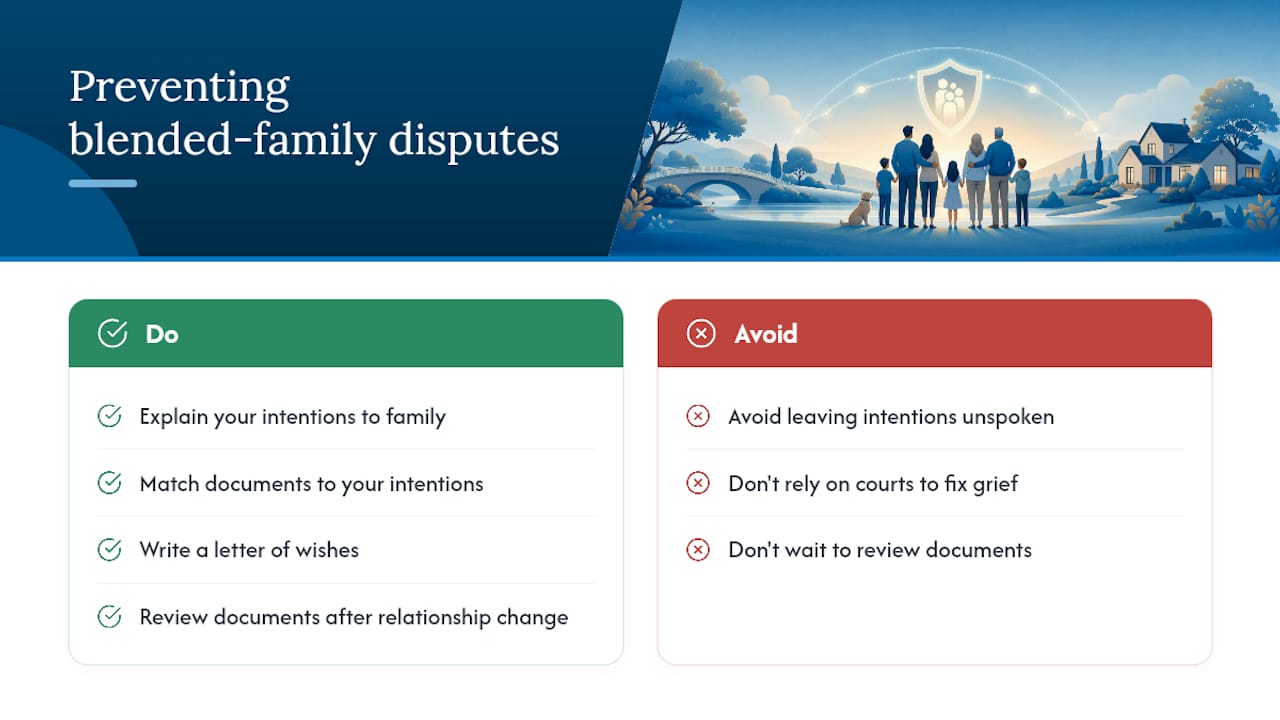
The families that avoid disputes are not necessarily the wealthiest or the most legally sophisticated. They are the ones where someone sat down, explained their reasoning, and made sure the documents matched the intention. A letter of wishes costs nothing to write. Telling your children what you plan and why, while you are alive and well, costs nothing either. The disputes I see most often are the ones where that conversation never happened.
If you are in a blended family and you have not reviewed your estate documents since your last relationship change, that is the single most important thing you can do this week. Not because the law requires it, but because the alternative, a contested estate that splits your family for years, is entirely avoidable.
Book a free case assessment with Simons George Legal. The first conversation is always the most useful one.
Simons George Legal: practical help for blended family estates
Blended family estate planning requires more than a standard will. The competing loyalties, the layered asset structures, and the family provision risk mean that a generic document often creates the very disputes it was meant to prevent.

Simons George Legal offers a complete service for blended families: will drafting that accounts for prior relationships and stepchildren, testamentary trust setup with independent trustee options, family provision claim representation and defence, and executor assistance for complex administrations. The firm operates from Bondi and serves clients across Sydney, the Eastern Suburbs, Northern Rivers, and regional NSW, with virtual appointments available.
New clients receive a complimentary 30-minute consultation. Eligible inheritance disputes can be taken on a No Win, No Fee basis, confirmed at that first meeting. For families dealing with a property dispute as part of estate administration, the estate home sale guide covers practical options for moving quickly when the estate includes real property.
Book your free consultation and get a clear, honest assessment of your situation from a specialist who handles these matters every day.
Useful sources
The following sources informed this guide and are worth reading for further detail.
- Inheritance impatience and contested wills in Australia (Guardian)
- Inheritance disputes in blended families in Australia: Four practical ways to avoid fights over estates after your death
- Inheritance: How blended families can avoid messy will disputes
- Unfulfilled intentions, family provision and notional estate in Boyd v Roberts (Bartier)
- My stepfather didn’t make adequate provision for me in his will.” Which case won? — Wills/ Intestacy/ Estate Planning – Australia (Mondaq)
- Blended families and estate planning: Navigating the competing loyalties of modern life — Genders and Partners
- Blended Families & Estate Disputes | James Hayes Financial Planner
- Estate planning for blended families in Australia (Simons George Legal)
- Inheritance dispute resolution options in NSW: 2026 guide (Simons George Legal)
FAQ
What are the most common issues in blended family estates?
The most common issues are adult children from a prior relationship being excluded from the will, superannuation nominations that contradict the will’s intentions, jointly held property passing by survivorship to the surviving spouse, and ambiguous business or farm succession arrangements. Each can trigger a family provision claim under the Succession Act 2006 (NSW) or equivalent state legislation.
How can blended families avoid an inheritance argument?
Open communication about testamentary intentions, up-to-date wills and superannuation nominations, and a testamentary discretionary trust with an independent trustee are the three most effective tools. SMH reporting consistently identifies communication as the single most important prevention step.
Can a stepchild make a family provision claim in NSW?
Yes. A stepchild who was wholly or partly dependent on the deceased, or who was a member of the deceased’s household, is an eligible person under the Succession Act 2006 (NSW) and can apply for a family provision order. The strength of the claim depends on the degree of dependency, the relationship’s duration, and the size of the estate.
What happens if there is no will in a blended family?
NSW intestacy rules apply, and the outcome often disadvantages children from a prior relationship. The surviving spouse takes a statutory share that may leave those children with little or nothing, depending on the estate’s size. Making a will immediately on remarriage is the simplest way to avoid this outcome.
What signs suggest a blended family estate dispute is likely?
Key warning signs include an outdated will that predates the current relationship, superannuation nominations that have not been reviewed since remarriage, property held as joint tenants with the new spouse, adult children from a prior relationship who were financially dependent on the deceased, and no letter of wishes explaining the testator’s intentions. Simons George Legal offers a free initial consultation to assess whether your estate documents carry these risks.