When it comes to protecting your family’s future, the debate around AI and online wills vs real lawyers is no longer theoretical. Millions of Australians are turning to digital platforms to create their wills, drawn in by the promise of speed and low cost. But the question worth asking is not whether these tools work in principle. It is whether they will hold up when your family needs them most. The answer depends entirely on your circumstances, and the stakes are higher than most people realise.
Table of Contents
- Key takeaways
- AI and online wills vs real lawyers: what you need to know
- The real risks of AI-generated wills
- How lawyers protect your family estate
- Costs: upfront savings vs long-term expenses
- Choosing the right approach for your situation
- My honest take on AI wills
- Protect your family with Simonsgeorgelegal
- FAQ
Key takeaways
| Point | Details |
|---|---|
| AI wills suit simple estates only | Online and AI wills are appropriate for straightforward situations without blended families, trusts, or complex assets. |
| Legal errors carry serious costs | Improperly prepared wills can trigger probate disputes and litigation that far exceed any upfront savings. |
| Lawyers provide capacity documentation | Solicitors create contemporaneous records that protect against will contests, something AI tools cannot replicate. |
| Asset titling can override your will | Beneficiary designations on super and insurance bypass your will entirely, a nuance most AI tools miss. |
| Privacy is not guaranteed online | AI platforms may share your sensitive estate information with third parties, with no attorney-client privilege. |
AI and online wills vs real lawyers: what you need to know
Online will platforms have genuinely changed the accessibility of estate planning. Where once you had to book an appointment and pay hundreds of dollars just to start the conversation, you can now complete a basic will in 40 to 60 minutes for as little as nothing. For many people, that is a genuine improvement on having no will at all.
The typical experience involves answering a series of guided questions about your assets, beneficiaries, and executor. The platform then generates a document for you to sign and witness. Some AI-powered tools go further, attempting to flag gaps or suggest clauses based on your answers. On the surface, it looks like a complete solution.
The online wills benefits are real for a narrow group of users:
- Single individuals with no dependants and straightforward assets
- Young people with modest estates and no property
- Anyone who simply needs a basic document as a placeholder while they arrange professional advice
- Those in low-risk family situations with no blended family complexity
Pro Tip: If your estate involves a property, a business interest, superannuation with dependants, or any form of blended family, an online will is not a safe stopping point. Treat it as a starting point at best.
The limitations become significant the moment your situation departs from the template. AI cannot identify unique family circumstances or detect when questions of undue influence, capacity, or asset complexity exist. It processes patterns, not people. And your family is not a pattern.
The real risks of AI-generated wills
The most dangerous thing about AI wills is not that they are obviously wrong. It is that they look convincing. A document that appears complete can still be fatally flawed in ways that only surface after you are gone and your family is left to deal with the consequences.
Here are the most common failure points:
- Improper execution. Wills in Australia must be signed in the presence of two independent adult witnesses. A misunderstanding of this requirement, or a failure to follow it precisely, can render the document invalid.
- Vague or ambiguous language. Generic templates use broad language that may be interpreted in multiple ways. Courts resolve ambiguity, which costs time and money and rarely produces the outcome you intended.
- Missing asset coverage. AI tools frequently miss the fact that assets held in joint names or with beneficiary designations, such as superannuation and life insurance, operate outside the will entirely. This causes unintended outcomes that your document cannot fix.
- No testamentary capacity record. If anyone challenges the will on the grounds that you lacked capacity when signing it, there is no independent record to rebut that claim. A solicitor creates contemporaneous documentation precisely to address this risk.
- Privacy exposure. AI platforms lack attorney-client privilege and may collect, store, and share your sensitive estate details with third parties or use them for AI training purposes.
“Costly family disputes often arise from vague or improperly executed AI wills, underscoring the value of professional drafting.” ChatGPT Is Not Your Will Creator
The risks of DIY wills extend beyond the document itself. A poorly prepared will invites family provision claims, contested probate, and inheritance disputes that can consume estate assets and fracture family relationships for years.
How lawyers protect your family estate

A solicitor does not just fill in a template with your details. The difference between AI wills and lawyer wills is the difference between a form and a conversation. A qualified estates lawyer analyses your full picture: your family structure, your assets, your debts, your relationship history, and your intentions.
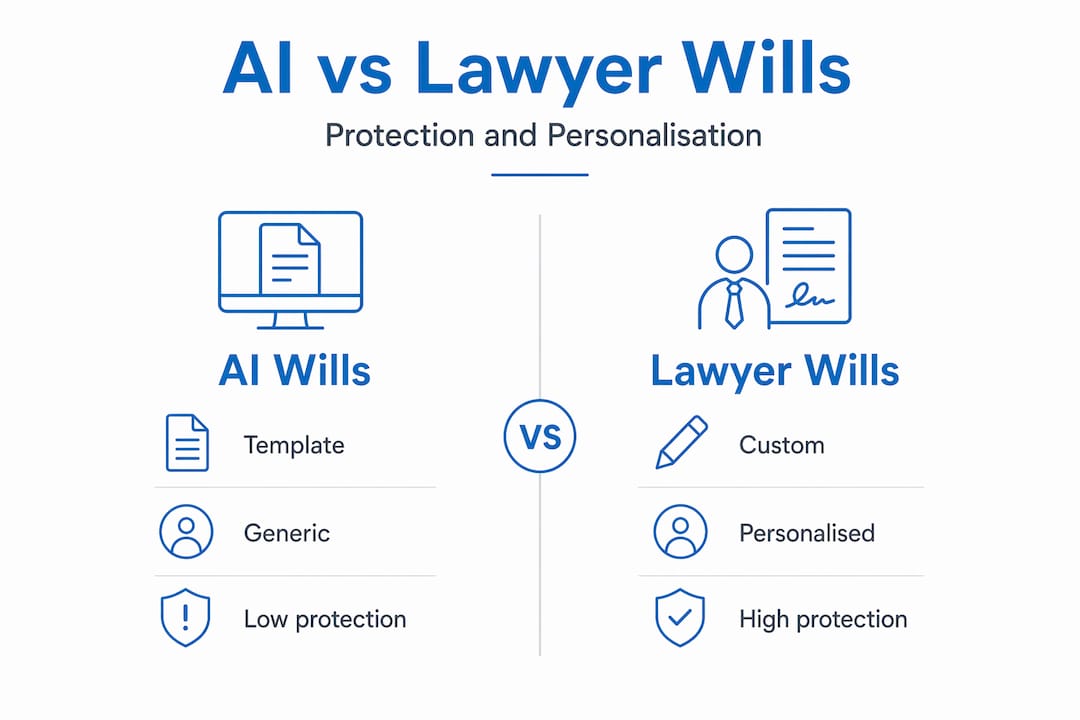
From that analysis comes a document tailored to your circumstances. More importantly, the process itself creates protections that no AI can replicate.
| What AI tools provide | What a lawyer provides |
|---|---|
| Generic document from template | Custom drafted will reflecting your specific wishes |
| No capacity documentation | Contemporaneous notes and affidavits on your capacity and intent |
| No asset coordination advice | Advice on super, insurance, and jointly held assets that fall outside the will |
| No privilege or confidentiality guarantee | Full attorney-client privilege and strict confidentiality |
| No trust or tax planning | Testamentary trusts, tax minimisation strategies, and beneficiary structures |
| No follow-up review | Ongoing review as your circumstances change |
Lawyers create capacity records through interviews and file notes that establish your state of mind at the time of signing. If anyone later attempts to challenge your will on grounds of incapacity or undue influence, that documentation becomes critical evidence. It is a protection that simply does not exist when you use a digital platform alone.
A lawyer also addresses the coordination problem that undoes many otherwise reasonable estate plans. Beneficiary designations override wills in almost every case. If your superannuation names an ex-partner as beneficiary but your will leaves everything to your current spouse, your will is irrelevant for that asset. Proper estate planning closes those gaps.
Pro Tip: Ask your solicitor to review not just your will but also your superannuation binding death benefit nomination, any life insurance policies, and how your property is titled. These elements work together as a system.
Costs: upfront savings vs long-term expenses
The cost comparison between online and lawyer-prepared wills looks straightforward at first. An online will costs between nothing and $200. A solicitor typically charges between $200 and $400 per hour, with a simple will costing anywhere from $300 to over $1,000 depending on complexity.
That upfront gap feels significant. But it becomes much less significant when measured against the cost of things going wrong.
- Probate litigation in Australia can run for years. Simple succession matters take 45 to 90 days even when uncontested. Contested matters consume legal fees that routinely reach tens of thousands of dollars.
- Invalid wills generate costs far exceeding original savings, particularly when the estate is distributed incorrectly and recovery proceedings are required.
- Professional wills reduce challenge risk in ways that DIY options cannot match, a principle that holds across jurisdictions.
- Hidden costs of probate disputes and tax complications routinely outweigh any initial savings from digital platforms.
The financial logic of choosing a lawyer becomes clear when you consider what is at stake. An estate worth $800,000 that falls into dispute over a poorly worded clause can lose more in legal fees than you saved on the original will by a factor of twenty or more.
Choosing the right approach for your situation
The goal is not to tell you that AI tools are always wrong. The goal is to help you make a clear-eyed decision about which approach genuinely protects your family.
Follow these steps when assessing your situation:
- Assess your estate complexity. Do you own property? Do you have a business interest, superannuation with dependants, or a blended family? If yes to any of these, professional advice is not optional.
- Consider your family dynamics. Are there potential disputes between beneficiaries? Do you have children from a previous relationship? Are there family members who might claim they were unfairly left out? These factors dramatically increase the risk of a contested will.
- Evaluate your digital platform’s limitations. Review what the platform actually covers. Most are explicit that professional advice is needed for complex estates and should not be used as a substitute for legal counsel.
- Contact a qualified estates solicitor. Look for someone who specialises in wills and estates, not a generalist. Ask about their experience with contested matters and estate litigation.
- Review your will regularly. Marriage, divorce, the birth of a child, or a significant change in assets all require a will update. A well-drafted and current will is far stronger than an outdated professional one.
Pro Tip: Even if you start with an online will for speed, book a consultation with an estates solicitor within three months. Use the online document as a conversation starter, not a finished product.
My honest take on AI wills
I have seen the aftermath of what happens when families rely on AI and DIY wills for situations those tools were never designed to handle. The pattern is consistent. The person who made the will believed they had covered everything. Their family discovered otherwise, and by that point there was nothing anyone could do to fix it.
What troubles me most is the false confidence these platforms create. When a tool asks you twenty questions and produces a formal-looking document, it feels like the job is done. But the questions it asks are the easy ones. The hard ones, about your family dynamics, your intentions, your capacity, your asset structure, require a human conversation that no algorithm can replicate.
I am not suggesting AI tools have no place in estate planning. For a genuinely simple estate, a digital will is better than no will. But I have yet to see a situation where a family with meaningful assets, any complexity in their relationships, or any real emotional history between potential beneficiaries was well served by an algorithm.
The families who avoid costly inheritance disputes are almost always the ones whose estate planning was done properly from the start. Not because lawyers are infallible, but because the process of working with a lawyer forces you to think through things you would otherwise overlook. That process is the protection. The document is just the result.
— George
Protect your family with Simonsgeorgelegal

If you are weighing up your estate planning options and want genuine clarity on what approach suits your situation, Simonsgeorgelegal offers a complimentary 30-minute consultation for new clients. Based in Bondi and serving families across Sydney, the firm specialises exclusively in wills and estates, including will drafting and estate planning, probate and administration, and complex estate litigation.
Simonsgeorgelegal provides tailored legal advice grounded in your actual family and financial circumstances, not a template response. Whether you need a straightforward will or are dealing with a disputed estate, the firm’s approach combines technical precision with clear, honest advice so you feel confident at every step. Reach out to book your free consultation and understand exactly what it takes to protect the people you care about most.
FAQ
Are online wills legally valid in Australia?
Online wills can be legally valid in Australia if they are signed and witnessed correctly according to state legislation. However, errors in execution or ambiguous drafting frequently make them vulnerable to challenge.
What is the main difference between AI wills and lawyer wills?
The core difference is personalisation and protection. A lawyer analyses your full circumstances, documents your capacity, coordinates your assets, and produces a document tailored to your situation. An AI tool produces a generic document based on your answers to standard questions.
Can an AI will be challenged in court?
Yes. AI-generated wills are more susceptible to challenges on grounds of improper execution, lack of capacity evidence, and ambiguous language. Without contemporaneous documentation from a solicitor, defending the will becomes significantly harder.
When should I use a lawyer instead of an online will?
You should engage a solicitor if your estate includes property, a business, superannuation with dependants, a blended family, or any potential for dispute between beneficiaries. These factors make professional legal advice for online wills or DIY approaches insufficient.
How much does a lawyer-prepared will cost in Australia?
Solicitor fees for a simple will typically range from $300 to over $1,000 depending on complexity. This is considerably more than most online platforms charge but substantially less than the cost of probate litigation if the will is challenged or found invalid.