Advancement in estate law is defined as a lifetime gift made to an heir that is treated as an early payment of that heir’s inheritance. The legal term for the underlying doctrine is the “presumption of advancement,” a common law principle that courts apply when distributing a deceased person’s estate. Under this doctrine, gifts reduce an heir’s share to prevent double inheritance: once from the gift, and again from the estate. Understanding what is advancement in estate law matters enormously for executors, beneficiaries, and anyone planning an estate, particularly given the significant reforms to Australian succession law and trust taxation introduced in 2025 and 2026.
How does the presumption of advancement work in Australian estate law?
The presumption of advancement applies most commonly to transfers from parents to children and from spouses to spouses. Courts treat these lifetime gifts as advances on inheritance unless clear evidence proves otherwise. The burden of proof falls on the person arguing the gift was not an advance.
In practice, this means a parent who gives a child $200,000 to buy a home may have that amount counted against the child’s share of the estate when the parent dies. If the estate is worth $600,000 and there are three children, the child who received the advance would receive less than the others to equalise the distribution. The calculation is called “hotchpot,” a term still used in Australian probate law.

The presumption operates most forcefully in intestate estates, meaning estates where the deceased left no valid will. When a will exists, its terms may override the presumption entirely. A well-drafted will can state explicitly whether a gift is an advance or an outright gift with no effect on the beneficiary’s share.
Key factors courts consider when applying the presumption:
- The relationship between the giver and recipient (parent-child or spouse-spouse relationships attract the presumption most strongly)
- Whether any written acknowledgement of the gift’s nature exists
- The size of the gift relative to the estate
- Statements made by the deceased at the time of the gift
- Whether the gift was recorded in the deceased’s financial records
Pro Tip: Keep a signed letter or statutory declaration at the time of every significant gift, stating clearly whether it is intended as an advance on inheritance or an outright gift. This single document can prevent years of litigation.
What recent changes in estate law affect advancement and estate administration?
Australian estate law has undergone significant reform in 2025 and 2026, and these changes directly affect how executors and beneficiaries must approach advancements and testamentary trusts.
South Australia’s Succession Act 2023 came into effect on 1 January 2025. It repealed three older acts and consolidated succession rules into a single statute. The reforms clarified eligibility for family provision claims and updated intestacy rules, which are the rules that govern how estates are distributed when no valid will exists. These changes affect how advancements are accounted for in South Australian estates.
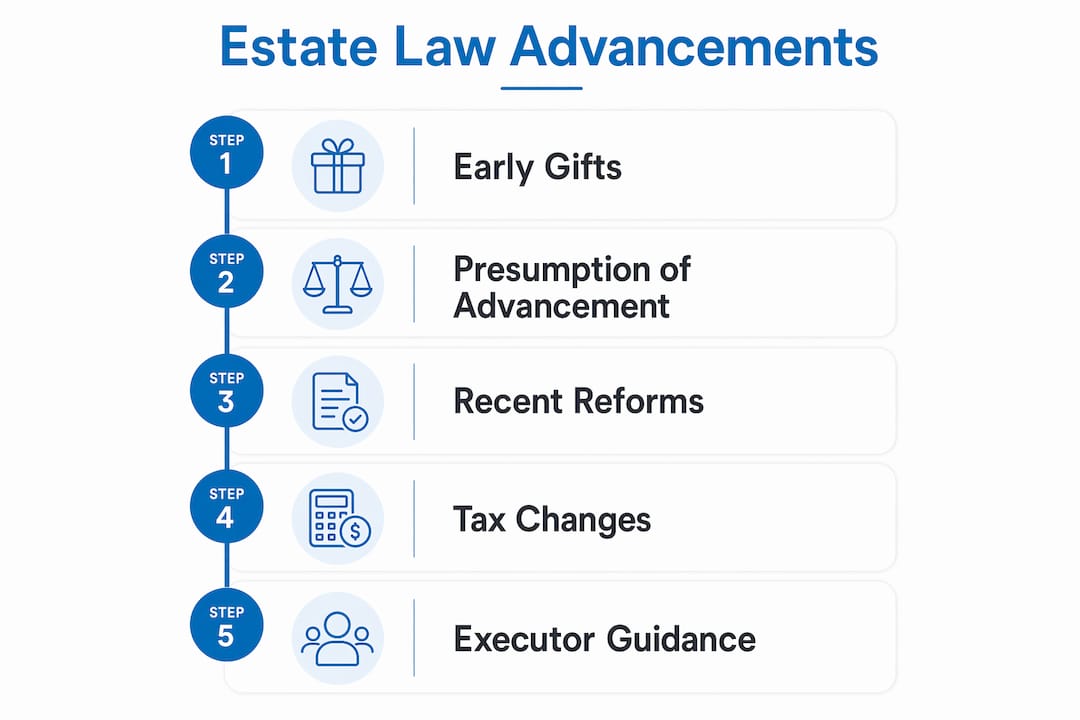
The Federal Budget 2026 introduced a 30% minimum tax on discretionary trusts from 1 July 2028. This is the most significant change to estate planning in a generation. However, discretionary testamentary trusts established for genuine testamentary purposes are exempt from this tax.
The critical date is 12 May 2026. Trusts created before this date retain their exempt status, while trusts created after it will face the 30% minimum tax from 2028. The Australian Taxation Office is expected to scrutinise trust establishment dates closely.
| Reform | Detail | Effect on estates |
|---|---|---|
| SA Succession Act 2023 | In force from 1 January 2025 | Clarifies intestacy and family provision rules |
| Federal Budget 2026 trust tax | 30% minimum tax from 1 July 2028 | Applies to new discretionary trusts |
| Testamentary trust exemption | Trusts established before 12 May 2026 | Exempt from the 30% minimum tax |
| Beneficiary class restrictions | New trusts face tighter definitions | Limits who qualifies as a beneficiary |
Executors administering estates with testamentary trusts must now verify the trust’s establishment date before making any distributions. The 2026 budget changes require estate plans to be reviewed, as new tax costs may alter the advantages previously assumed.
How do advancements interact with testamentary trusts and estate disputes?
A testamentary trust is a trust created by a will that comes into effect when the will-maker dies. It holds assets for beneficiaries rather than distributing them outright. Testamentary trusts are commonly used to protect assets for children, people with disabilities, or beneficiaries who may be financially vulnerable.
When advancements exist alongside a testamentary trust, the accounting becomes complex. A beneficiary who received a large lifetime gift may argue it was unrelated to the trust. Other beneficiaries may argue the advance should reduce that person’s entitlement under the trust. Courts resolve these disputes by examining the will’s language and any documentation of the original gift.
Despite the new trust tax rules, testamentary trusts protect vulnerable beneficiaries such as minors and people with disabilities in ways that go well beyond tax savings. Asset protection, controlled distributions, and shielding inheritance from a beneficiary’s creditors remain powerful reasons to use a testamentary trust. The non-tax benefits have become the primary justification for these structures under the new regime.
Disputes over advancements within testamentary trusts are among the most contested matters in estate litigation. Best practices for executors managing these situations include:
- Obtain a copy of every significant gift record before distributing trust assets
- Commission an independent valuation of any property given as an advance
- Write to all beneficiaries disclosing known advancements before finalising accounts
- Seek legal advice before treating any lifetime gift as an advance without written evidence
- Document every decision in writing and retain records for at least seven years
Pro Tip: If you are an executor and a beneficiary disputes whether a gift was an advance, do not make any distributions until you have legal advice. Distributing incorrectly exposes you to personal liability.
What practical steps should executors and beneficiaries take?
Managing advancements correctly requires a methodical approach. Errors at this stage cause disputes that can take years and significant legal costs to resolve. The following steps apply whether you are an executor or a beneficiary trying to understand your position.
- Gather all gift records. Collect bank statements, transfer records, and any letters or declarations made at the time of the gift. The absence of documentation does not mean a gift was not an advance, but it makes the presumption harder to apply.
- Value the advance at the right time. Australian courts generally value advancements at the date of the gift, not at the date of death. A property given in 2010 is counted at its 2010 value, not its current market value, unless the will specifies otherwise.
- Prepare a hotchpot calculation. Add the value of all advances to the net estate, divide by the number of beneficiaries, then subtract each beneficiary’s advance from their share. This gives the equalised distribution.
- Communicate with beneficiaries early. Disclose all known advancements in writing before finalising the estate accounts. Surprises at distribution stage cause disputes. Early disclosure gives beneficiaries time to raise concerns through proper channels.
- Review the will for explicit directions. A well-drafted will states whether gifts are advances. If the will is silent, the common law presumption applies. Consult a wills and estates lawyer if the will’s language is ambiguous.
- Update existing estate plans. The 2025 and 2026 reforms mean many existing wills and trust structures no longer reflect current law. Anyone with a testamentary trust in their will should review it now, particularly regarding the 12 May 2026 exemption date.
How do advancements differ across Australian states?
Advancement law is not uniform across Australia. Each state and territory has its own succession legislation, and the rules governing how lifetime gifts are treated in intestate estates vary. This creates real complexity for executors and beneficiaries dealing with assets in multiple jurisdictions.
New South Wales applies the presumption of advancement under common law principles, and the intestacy rules in NSW set out how estates are distributed when no valid will exists. South Australia’s position changed materially on 1 January 2025 when the Succession Act 2023 took effect, consolidating and clarifying the rules around family provision claims and intestate succession.
Family provision claims add another layer of complexity. A beneficiary who received a large advance may still bring a family provision claim arguing the estate distribution is inadequate. Courts consider the advance when assessing whether adequate provision has been made, but the advance does not automatically bar a claim. The impact of separation on inheritance adds further complication when family relationships have changed before death.
The practical takeaway is straightforward. Anyone administering or benefiting from an estate with assets in more than one state needs legal advice specific to each jurisdiction. Assuming the rules are the same across Australia is a common and costly mistake.
Key takeaways
Advancement in estate law reduces an heir’s inheritance share by the value of lifetime gifts already received, and proper documentation is the single most effective way to prevent disputes.
| Point | Details |
|---|---|
| Advancement definition | A lifetime gift to an heir treated as an early payment of their inheritance share. |
| Presumption of advancement | Courts assume parent-to-child and spouse-to-spouse gifts are advances unless evidence proves otherwise. |
| 2025 SA reforms | South Australia’s Succession Act 2023 clarified intestacy and family provision rules from 1 January 2025. |
| Trust tax exemption date | Testamentary trusts established before 12 May 2026 are exempt from the 30% minimum trust tax from 2028. |
| Executor duty | Document all advances, value them correctly, and disclose them to beneficiaries before distributing the estate. |
Why advancements deserve more attention than most families give them
I have seen more estate disputes trace back to an undocumented gift than to any other single cause. A parent lends a child money for a house deposit, never writes it down, and dies ten years later. The other children find out at distribution and feel cheated. The executor is caught in the middle with no paperwork and a family in conflict.
The presumption of advancement exists precisely because courts recognised this problem centuries ago. The law tries to fill the gap that families leave open. But the law is a blunt instrument. It cannot know what the deceased actually intended. Only documentation can do that.
The 2025 and 2026 reforms have made this more urgent, not less. Testamentary trusts are now subject to new tax rules that depend on precise establishment dates. Wills that were perfectly adequate two years ago may now produce unintended tax consequences for beneficiaries. Anyone who has not reviewed their estate plan since may 2026 should do so promptly.
My honest view is that most families underestimate how much the law has changed and how quickly those changes affect real distributions. The families who handle estates well are the ones where the deceased left clear records, a current will, and explicit instructions about every significant gift. That is not complicated. It just requires attention while there is still time to act.
— George
Funding your legal matter — no win, no fee
Simons George Legal offers No Win, No Fee arrangements for eligible estate matters, including inheritance disputes and family provision claims. Eligibility is assessed during a free initial consultation, so you know where you stand before committing to anything.
This arrangement removes the upfront cost barrier for people with a legitimate claim who might otherwise feel unable to pursue their rights. If your claim does not succeed, you do not pay legal fees. If it does, fees are agreed in advance and proportionate to the outcome.
Book a free case assessment with Simons George Legal to find out whether your matter qualifies and what your options are.
No Win, No Fee arrangements are subject to case eligibility and a written costs agreement. Liability limited by a scheme approved under Professional Standards Legislation.
Simons George Legal and advancement matters
Simons George Legal advises executors and beneficiaries across Sydney on wills and estate administration, including the accounting and documentation of advancements. The firm handles contested estates, family provision claims, and disputes over lifetime gifts, and provides clear advice on how recent law reforms affect your specific situation.

Whether you need to update a will to reflect the new trust tax rules, resolve a dispute over a lifetime gift, or understand your rights as a beneficiary, Simons George Legal offers a complimentary 30-minute consultation to assess your situation and recommend practical next steps. Contact the firm to book your consultation.
FAQ
What is advancement in estate law?
Advancement in estate law is a lifetime gift to an heir that is treated as an early payment of their inheritance. It reduces the heir’s share of the estate to prevent them from receiving the same value twice.
How does the presumption of advancement work?
Courts presume that significant gifts from parents to children or spouses to spouses are advances on inheritance unless clear evidence proves otherwise. Written documentation at the time of the gift is the most effective way to rebut the presumption.
Do advancements affect family provision claims in Australia?
An advance does not automatically bar a family provision claim, but courts consider it when assessing whether adequate provision has been made. A beneficiary who received a large lifetime gift may still claim if the overall provision is inadequate.
How do the 2026 trust tax changes affect estate planning?
The Federal Budget 2026 introduced a 30% minimum tax on discretionary trusts from 1 July 2028, but testamentary trusts established before 12 May 2026 are exempt. Anyone with a testamentary trust in their will should confirm their trust’s establishment date and review their estate plan.
What should an executor do when an advancement is disputed?
An executor should gather all gift records, obtain independent valuations, and seek legal advice before making any distributions. Distributing an estate incorrectly when an advancement is in dispute can expose the executor to personal liability.