A will can record what you want to happen to your online accounts, digital files and cryptocurrency, but it cannot force a platform to hand them over. In NSW the law is also unsettled on several points, so the way the will is drafted, and what sits alongside it, decides whether an executor can actually reach these assets or ends up in a dispute with beneficiaries. This guide explains what counts as a digital asset, what a will can and cannot do, how executors get access after a death, and where a business power of attorney fits in.
TL;DR
- Digital assets include online accounts, digital files and cryptocurrency, and some have real financial value.
- A will clause records your wishes and strengthens your executor’s position with platforms, but it does not guarantee access.
- Executors should use each provider’s official deceased-person process, never the deceased person’s login.
- A power of attorney ends on death. After that, authority comes from the will and, where needed, probate.
- Unclear or missing instructions are a common trigger for disputes between executors and beneficiaries.
Table of Contents
- What counts as a digital asset
- Are digital assets “property” under NSW law?
- What a will can and cannot do
- Building a digital asset inventory
- How executors access digital assets after a death
- Tax on inherited digital assets
- Business power of attorney in NSW and digital assets
- Where digital assets cause estate disputes
- Practical drafting points
- Our view
- Getting your will and digital estate in order
- Funding Your Legal Matter — No Win, No Fee
- FAQ
- Sources
What counts as a digital asset
Justice Connect treats online accounts, digital files and digital property, including potentially valuable cryptocurrency, as part of a person’s digital legacy. In practice that covers a wide range:
- Email accounts and cloud storage holding documents and photos
- Social media accounts
- Online banking, PayPal-style payment accounts and investment platforms
- Cryptocurrency and the wallets or exchange accounts that hold it
- Online business assets, such as a domain name, an online shop or a customer database
- Loyalty points, gaming accounts and digital media libraries
These fall into two groups. Some have money value (crypto, a business website, a payment account balance). Others have sentimental or practical value (family photos, years of correspondence). Both can cause trouble for an executor, for different reasons. A crypto wallet nobody can open is a lost asset. A locked photo library is a family grievance.
Are digital assets “property” under NSW law?
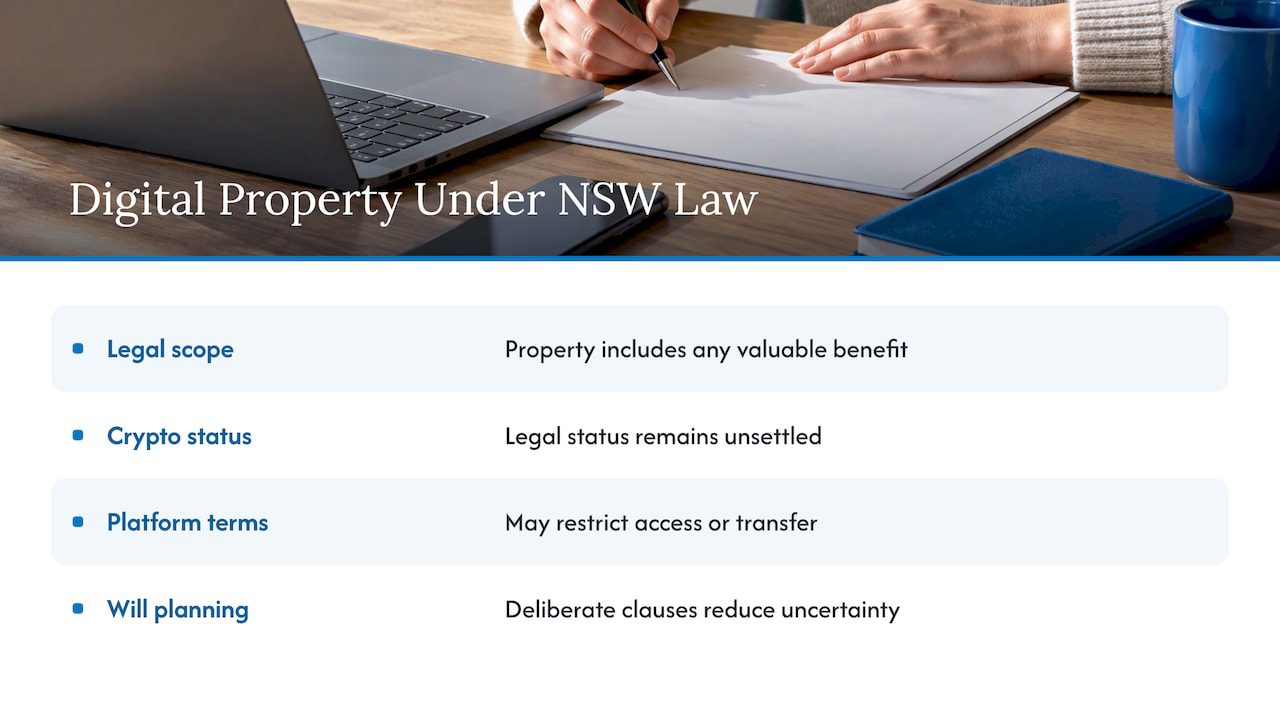
The NSW Succession Act 2006 defines property to include “any valuable benefit” and lets a person dispose by will of property they are entitled to at death. That wording is broad, which helps with assets that have clear value.
The difficulty is the detail. Justice Connect notes that property definitions and the treatment of digital assets can differ by jurisdiction, that platform terms may restrict access or transfer, and that the legal status of cryptocurrency is unsettled. A Law Society Journal discussion from July 2025 makes the same point for NSW: there is no clear statutory guidance aimed specifically at digital assets, so access, control and inheritance can be uncertain.
What does this mean for you? A will that deals with digital assets deliberately, rather than leaving them to a general residuary clause, removes much of that uncertainty. For crypto in particular, see our guide to crypto in your will.
What a will can and cannot do
A digital-specific clause can do several useful things:
- Record your intentions for each category of asset, such as who receives the crypto and who receives the photos.
- Name the person who should deal with your digital accounts.
- Strengthen your executor’s position when they approach a platform.
Justice Connect is clear on the limit: such clauses cannot force a platform to comply. The provider’s terms of service still apply. The ACCAN submission to the NSW Law Reform Commission notes that terms of digital services may prevent account transfer, and that records or media can be lost if post-death access is not permitted.
The NSW Law Reform Commission examined this gap in Report 147 (December 2019). It recommended that access to a deceased user’s digital records go first to a person specifically appointed in the will, then to a nominee named in an online tool, then to the executor, with distinctions for formal and informal wills. Those are recommendations. Until the law catches up, a clearly drafted will plus a well-kept inventory is the practical protection.
Keep passwords out of the will
A will becomes a public document once probate is granted, and passwords change. Justice Connect advises not including passwords in your account inventory. Instead, keep an inventory of accounts somewhere safe and tell a trusted person where it is. The will can then refer to the inventory without reproducing any credentials.
Building a digital asset inventory
An inventory is a list of what exists and where, not how to log in. A useful one includes:
- The name of each service and the email address or username it is registered under.
- Whether the account has financial value or purely personal value.
- For crypto, which exchange or wallet type holds it, and where the recovery material is stored securely, described but not written into the will.
- Who you want to receive or manage each item.
- Any business accounts that keep a company or trading operation running.
If you hold significant online wealth, the security side matters as much as the list. Resources on cybersecurity for high-net-worth individuals cover the exposure that concentrated digital holdings create, which is also the exposure an executor inherits.
The inventory also helps the executor meet their basic duty. The Law Reform Commission’s report states that an applicant for probate or letters of administration must disclose the deceased’s assets and liabilities. An asset the executor never finds cannot be disclosed.
How executors access digital assets after a death
If you are the executor, the sequence below keeps you on the right side of both the platforms and the law.
Step 1: Confirm your authority
Probate confirms that a formal will is valid and that the executor has authority to deal with estate assets. Where there is no will, or no executor able to act, letters of administration give an administrator corresponding authority, as the Law Reform Commission explains. Many providers ask for it. Our step-by-step probate guide walks through the NSW process, and our probate and estate administration team handles the application for executors.
Step 2: Gather the documents
Justice Connect advises executors to collect the death certificate, the will and, where needed, the grant of probate before contacting providers. Different platforms ask for different things, so expect to send the same set of documents several times.
Step 3: Use each provider’s official process
The temptation is to log in with the deceased person’s password, especially when the family knows it. Justice Connect advises against this and recommends contacting providers through their official deceased-person processes. Logging in can breach the platform’s terms, can trigger security locks, and can muddy the record of what you did and when, which matters if a beneficiary later questions your conduct.
Step 4: Expect security to get in the way
Even with a will clause, a platform may refuse access, and passwords, verification codes or biometrics can still block entry. Build time for this into the administration, and tell beneficiaries early so delay is not mistaken for neglect. Our guide to why estate administration is delayed covers how to keep the matter moving.
Step 5: Secure value before you distribute
Crypto and online business assets can lose value or be lost entirely while an executor works through the process. Record what you find, and when. The records are your protection if anyone later asks what happened to an asset.
Tax on inherited digital assets
Tax follows the asset, not the format. The ATO states that capital gains tax treatment depends on the inherited asset and the circumstances of its acquisition and later disposal. Taxation Determination TD 2004/3 states that a CGT asset can pass to a beneficiary under a will and a gain or loss on that passing is generally disregarded, subject to the exception for CGT event K3 involving a tax-advantaged beneficiary.
In plain terms: the transfer to the beneficiary is generally not taxed in itself, but a later sale can be, so the executor needs records of the asset’s history. For the wider picture, see our deceased estate tax obligations guide.
Business power of attorney in NSW and digital assets
People often ask whether a business power of attorney lets someone run their online accounts. Here is the distinction that matters for an estate.
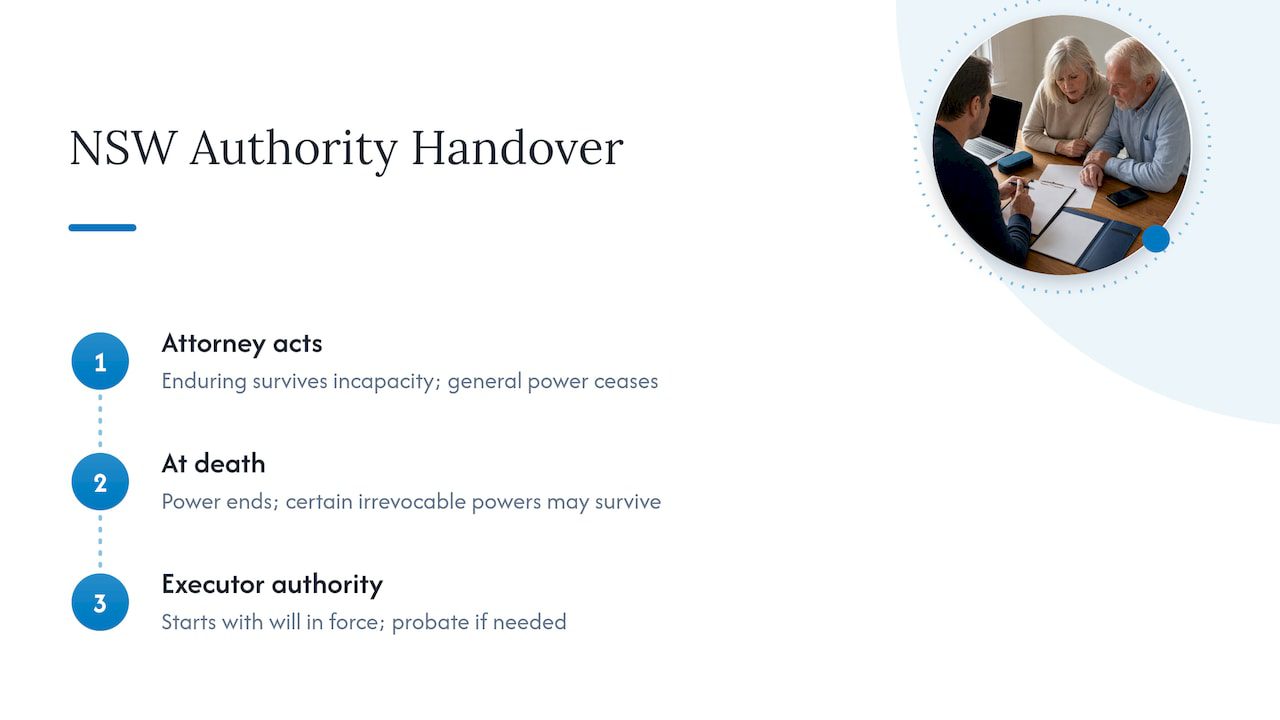
During your life. A power of attorney lets someone act for you. The NSW Government lists paying bills, signing legal documents, buying or selling assets, managing money and accessing bank accounts as typical actions under an enduring power. The Powers of Attorney Regulation 2024 says an enduring power continues through loss of capacity, while a general power ceases if capacity is lost. The same regulation requires attorneys under the prescribed terms to keep your money and property separate, keep reasonable records, act honestly in your best interests and not benefit themselves unless expressly authorised.
Digital wording. Justice Connect says tailored terms can authorise an attorney to identify and manage accounts, contact providers, back up records where legally permitted, protect crypto and request account changes or closure. That wording does not guarantee platform access, and a platform may not recognise the document at all.
After death. Legal Aid NSW states that a power of attorney operates only while the principal is alive and is automatically cancelled on death. There is a narrow exception in the Powers of Attorney Act 2003 for certain irrevocable powers given for valuable consideration, which may survive death unless the instrument says otherwise. For a business owner, the handover from attorney to executor is the moment things go wrong: the attorney’s authority stops, and the executor’s does not start until the will is in force and, where needed, probate is granted.
A business owner should therefore plan both documents together, so the person who keeps the online business running while you are alive is not left with nothing the day after. If a power of attorney is being misused, see our guide to stopping power of attorney abuse in NSW.
Where digital assets cause estate disputes
Beneficiaries rarely fight over a login. They fight over what the login was protecting, or over who got it. The common flashpoints are:
- Silence in the will. Crypto or an online business sits outside any clause, and two beneficiaries each assume it was meant for them.
- Valuation and timing. Digital assets can move in value while an executor is still locating them, and beneficiaries question whether the executor acted quickly enough.
- Executor conduct. An executor who accessed an account informally, or could not account for a wallet, invites a challenge. Choosing the right executor is part of avoiding this.
- Do-it-yourself documents. Online will kits tend to have no digital asset provisions, which we cover in online will inheritance dispute risks.
- Family provision claims. An eligible person who believes they were left too little can claim against the estate, and digital assets form part of the estate pool. See what to do if there is not enough in a will.
If you are a beneficiary and suspect assets were overlooked or mishandled, our estate litigation team can assess your position. If you are an executor facing a claim, the page on how to defend an estate explains what we do.
Practical drafting points
When we prepare a will with digital assets in mind, the points below get attention:
- A definition of digital assets broad enough to cover accounts, files and crypto, including ones that do not yet exist.
- A clause naming who deals with digital accounts and giving the executor authority to contact providers and request closure or transfer.
- A separate direction for crypto, with the gift stated clearly, since its legal status is unsettled.
- A reference to the inventory and where it is kept, with no passwords in it.
- A review whenever you open a major new account, buy crypto or start an online business.
The Law Society Journal’s July 2025 discussion makes the same point from the profession’s side: estate planners should identify digital holdings and tailor wills to address access, ownership and platform terms.
Our view
Most digital asset problems we see discussed in estates come down to one thing: the will treated the estate as if it were all bricks, bank balances and shares.
Our approach is to make the will specific. Name the assets by category, say who is responsible for them, point to an inventory kept apart from the will, and make sure the power of attorney and the will work together rather than leaving a gap. Every matter at our firm is partner-led by a specialist with extensive Supreme and High Court experience, so the advice you get on a digital clause is the same advice we would give if the estate were contested.
If a dispute has already started, the same principle applies: clear records, official processes and early advice keep costs proportionate.
George
Getting your will and digital estate in order
We act for individuals, families, executors and beneficiaries across Sydney, the Eastern Suburbs, Northern Rivers and regional NSW, in person or virtually. If you want your digital assets properly covered, our making and amending a will service is where to start. If you are an executor dealing with an estate that includes online accounts or crypto, we also handle probate and estate administration. New clients are offered a complimentary 30-minute consultation.

For a wider look at how wills, estate plans and powers of attorney fit together, read our overview of estate plans, wills and power of attorneys.
Funding Your Legal Matter — No Win, No Fee
Simons George Legal offers No Win, No Fee arrangements for eligible cases. We check eligibility during a free initial consultation, so you know where you stand before committing to anything. For people with a legitimate claim, this removes the upfront cost barrier that so often stops a valid inheritance dispute from being pursued. Book a free case assessment through our No Win, No Fee page and we will tell you honestly what your options are.
No Win, No Fee arrangements are subject to case eligibility and a written costs agreement. Liability limited by a scheme approved under Professional Standards Legislation.
FAQ
Does a will give my executor automatic access to my online accounts?
No. A will clause records your wishes and strengthens your executor’s position, but it cannot force a platform to comply. Each provider’s terms and security still apply, so the executor should go through the provider’s official deceased-person process.
Is cryptocurrency treated as property in Australia?
The NSW Succession Act defines property to include any valuable benefit, which is broad. Even so, the legal status of cryptocurrency is described as unsettled, so naming it specifically in the will is the safer course.
Can my attorney manage my digital assets after I die?
No. A power of attorney is automatically cancelled on death, apart from a narrow exception for certain irrevocable powers. After death, your executor acts under the will and, where needed, a grant of probate.
Should I put my passwords in my will?
No. A will can become public after probate and passwords change. Keep an inventory of accounts in a safe place, without passwords, and tell a trusted person where it is.
Sources
- How to manage your digital legacy, Justice Connect
- Report 147: Access to digital records upon death and incapacity, NSW Law Reform Commission
- Access to Digital Assets upon Death or Incapacity, ACCAN submission
- Digital assets in wills, Law Society Journal
- Succession Act 2006, NSW Legislation
- How CGT applies to inherited assets, Australian Taxation Office
- TD 2004/3, Australian Taxation Office
- Powers of Attorney Act 2003, NSW Legislation
- Powers of Attorney Regulation 2024, NSW Legislation
- Speaking for myself: making a power of attorney, Legal Aid NSW
- Why planning for end of life is important, NSW Government
- Cybersecurity for High-Net-Worth Individuals