An administration bond is a promise, backed by sureties, that the person running a deceased estate in NSW will collect the assets, pay the debts and distribute the estate according to law. In practice the Supreme Court of NSW most often asks for one when someone applies for letters of administration (the grant used when there is no valid will or no executor) and other people entitled to a share have not agreed to the application. If you are an administrator, a beneficiary or an executor dealing with a family dispute, the bond is the court’s safety net for the shares of people who are not at the table.
This guide explains what the bond covers, when the Court requires it, how the amount is set, who can be a surety, what happens on a breach, and how a contested estate changes the picture.
TL;DR
- Under section 64 of the Probate and Administration Act 1898 (NSW), a person granted administration must execute a bond with one or more sureties before the grant issues.
- The Court’s practice is to require a bond and two sureties where only some entitled people apply and the others cannot or will not consent, covering their shares.
- The bond is a security obligation, not a cash deposit. Court filing fees are separate and depend on the estate’s value.
- The applicant cannot be a surety. Each surety must show real estate they can call upon.
- If the estate is mismanaged, the Court can assign the bond to someone who sues on it for those who lost out, or remove the administrator.
Table of Contents
- What an administration bond is
- When the Supreme Court requires a bond
- How the bond amount is set
- Finding sureties
- Costs to expect
- Probate and administration: why the bond mostly arises with administration
- What happens if the estate is mismanaged
- When the estate is contested
- Family loans and the bond: a related risk
- Promo: help with the bond, the grant and the dispute
- Our perspective
- Funding Your Legal Matter — No Win, No Fee
- FAQ
- Sources
What an administration bond is
When someone dies without a will, or without a person able to act as executor, the Supreme Court appoints an administrator by granting letters of administration. Before that grant issues, section 64(1) of the Probate and Administration Act 1898 (NSW) requires the person to execute a bond to the Crown with one or more sureties. The bond is conditioned on the administrator duly collecting, getting in and administering the deceased’s estate.
A surety is a person who promises to answer for the administrator’s default. If the administrator fails in their duties, the surety can be called on to pay up to the bond’s amount.
The bond protects people who rely on the administrator doing the job properly: other family members entitled on intestacy, creditors, and beneficiaries who are children or otherwise unable to protect their own interests.
Who does not need to give one
The same section provides exceptions. No bond is required from the NSW Trustee, or from a person obtaining administration for the benefit of the Crown. A trustee company need not give a bond either, except for estates worth more than $50,000 where the Court orders otherwise (Probate and Administration Act 1898, s 64(2)–(3)).
When the Supreme Court requires a bond
The Act sets the principle, and the Court’s rules and practice set the detail. Supreme Court Rules 1970, Part 78 rule 23 says that before granting administration the Court may require an administration bond to be filed. Unless the Court orders otherwise, the bond must have two sureties.
In practice, the Court’s guidance on applying for letters of administration (updated 23 March 2026) says that where only some of the entitled people apply and consents cannot be obtained from the rest, the Court requires an administration bond and two sureties covering the shares of those who have not or cannot consent.
Here is a simple example. A man dies without a will, leaving a partner and two adult children. The partner applies for letters of administration. If both children consent, the bond issue generally falls away. If one child cannot be found or refuses to engage, the Court will look at securing that child’s share.
How the rules changed in 2001
The State Library of NSW’s guide to procedure on death without a will explains that before December 2001 an applicant had to lodge a bond securing the entitlements of next of kin who were not parties and had not consented. Since then, an adult beneficiary who is not a party generally needs only to be served with notice. A bond may still be required, for example to secure the entitlement of a beneficiary under 18.
That is why many modern applications proceed without a bond, and why a bond tends to appear when children, incapacity or missing relatives are involved.
Minors and people lacking capacity
The Court’s administration checklist makes three points worth knowing:
- A person under legal incapacity cannot consent to the application.
- A recital that dispenses with a bond has no effect without the consent of the person’s guardian, financial manager or enduring power of attorney.
- The bond will not be dispensed with if the applicant is the person who represents the incapable person.
If a bond cannot be obtained for a minor’s share, the Court’s Protocol for Minors, announced on 6 July 2018, provides for the funds to go to the NSW Trustee & Guardian until the minor reaches adulthood. If a child is involved in your matter, our guide to appointing a testamentary guardian in NSW covers the related planning questions.
How the bond amount is set
Section 65 of the Probate and Administration Act 1898 sets the penalty of the bond equal to the amount under which the deceased’s property is sworn, subject to reduction by the Court. The Court’s checklist, however, focuses on the people who are not applying. For each non-applying beneficiary it asks for a bond and a surety affidavit equal to the value of that person’s share.
So the figure depends on who is not joining the application, not only on the size of the estate.
| Item | What the Court’s checklist asks for |
|---|---|
| Bond | UCPR Form 130, for each non-applying beneficiary, equal to the value of their share |
| Surety affidavit | UCPR Form 131, from each surety |
| Who swears | The applicant and two sureties |
| Real estate | Each surety sets out the real estate they can call upon to service the bond |
| Joint tenancy | A joint tenant’s co-owner must also swear |
| Applicant as surety | Not permitted |
Source: the Supreme Court’s administration checklist.
The bond is not a deposit
The stated amount is a liability the sureties accept if something goes wrong. It is not a sum paid to the Court on day one. Some people assume they need to find tens or hundreds of thousands of dollars in cash. What you need is people with enough real property to stand behind the promise.
Finding sureties
This is where applications stall. A surety must be willing to put their real estate on the line for a stranger’s shares of an estate, and the applicant cannot fill that role.
The State Library’s guide notes that, at the time it was written, no insurance company provided these bonds, and a personal surety was the alternative. That is why a family member or close friend with unencumbered property is typically asked.
Practical points when approaching a surety:
- Explain that the obligation runs jointly and severally. Under UCPR Form 130, the sureties together promise to pay the penalty, or a lesser amount the Registrar may require.
- Be clear about what triggers a claim: failing to collect and administer the estate according to law, failing to pay the deceased’s just debts, preferring one debt over another, or failing to file or pass accounts when the Court has ordered it.
- Check the property is suitable. The surety affidavit requires them to set out the real estate they can call upon, and a co-owner of a joint tenancy must swear as well.
- Consider whether the bond can be avoided altogether by obtaining consents from the other beneficiaries, or by using the Court’s protocol where a minor’s share is involved.
Costs to expect
There is no standard premium for a personal bond. The money you do pay is the Court’s filing fee, which scales with estate value. According to the State Library’s estates guide, with fees accurate as at 1 July 2026, the Supreme Court filing fee is:
| Estate value | Filing fee (2026–27) |
|---|---|
| Under $100,000 | Nil |
| $100,000 to $250,000 | $960 |
| $250,000 to $500,000 | $1,303 |
| $500,000 to $1 million | $1,999 |
| $1 million to $2 million | $2,663 |
| $2 million to $5 million | $4,439 |
| $5 million or more | $7,399 |
The same guide notes that fees change each July, so check the Court’s current schedule before you file. It also says that very small, uncomplicated estates (under $15,000), or estates where all assets are held as joint tenancies, generally do not need a grant at all.
Legal fees for preparing the application, the bond and the affidavits are separate again.
Probate and administration: why the bond mostly arises with administration
When there is a valid will naming an executor, the executor applies for probate. The bond requirement attaches to grants of administration, which is why it is mostly an intestacy topic. If you are not sure which grant applies, our explainer on probate versus administration walks through the difference, and the probate application step by step guide covers the filing process.
What happens if the estate is mismanaged
The bond has teeth. The Court’s checklist and the Act set out the consequences:
- Assignment of the bond (section 67). If the Court is satisfied a bond condition has been broken, it can order the Registrar to assign the bond to a named person, who can sue on it as trustee for the interested persons.
- Revocation, further bond or removal (section 66). On default, the Court can revoke the administration, require a further bond, or remove the administrator.
- Relief for sureties (section 68). A surety can apply for equitable relief if the estate is being, or is in danger of being, wasted, or if the surety is prejudiced.
All three are in the Probate and Administration Act 1898, which NSW Legislation lists as the current version from 28 September 2020.
For an administrator, the lesson is to keep clear records, pay debts in the right order and avoid favouring one creditor. Our guide to creditor claims against an estate explains how debts are handled, and the estate administration steps checklist gives the sequence for the whole job.
When the estate is contested
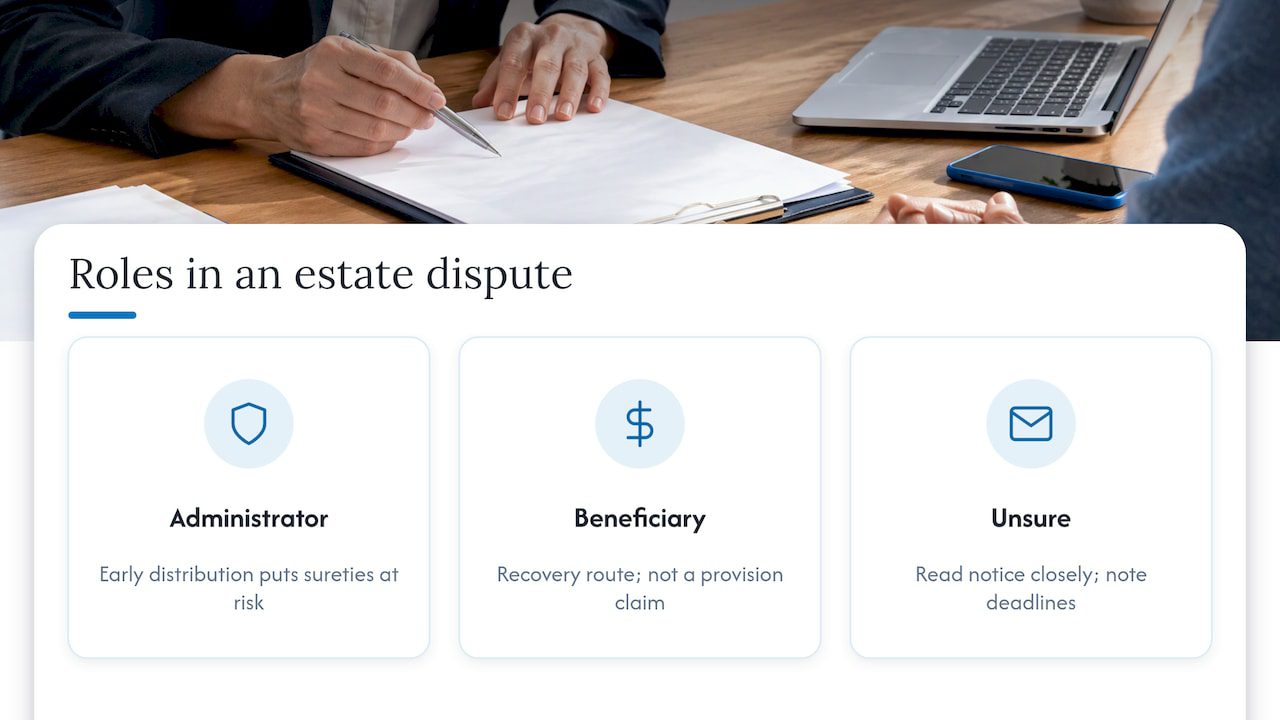
A bond question often surfaces at the same time as a dispute. A relative who has not consented to the application may be the person who wants to challenge the will, bring a claim for provision, or question the administrator’s conduct. Each position looks different:
If you are the administrator. The bond ties you personally to the sureties. If someone disputes the estate, an administrator who distributes early or pays one creditor ahead of others puts those sureties at risk. Take advice before distributing anything while a claim is possible. If a claim is made, our guide to defending a family provision claim sets out the executor’s position.
If you are a beneficiary whose share is secured. The bond gives you a route to recovery if the administrator wastes the estate. It does not replace a family provision claim if you believe the distribution is inadequate. See family provision claims in NSW and, for adult children specifically, adult child claims against a parent’s estate.
If you are unsure whether you have been left out. A person who was not asked to consent may only learn of the application through notice. Read it closely and note the deadlines. Where the question is whether the will itself is valid, the grounds for contesting a will are the place to start.
Family loans and the bond: a related risk
Family loans are a common source of conflict after a death. A parent lends money to a child, or a child lends to a parent, and nothing is written down. After death, one side says it was a gift and the other says it was a debt. A debt owed to the deceased is an asset the administrator must collect, and a debt owed by the deceased is something the administrator must pay, which links directly to the conditions in the bond.
Things that help establish which it was:
- A signed written loan agreement stating the amount, any interest and the repayment terms.
- Bank records showing the advance and any repayments.
- Messages or letters in which the parties describe the money as a loan.
- Any reference in the deceased’s will or earlier documents.
The risk for an administrator is treating an undocumented advance as a gift and not collecting it, or treating it as a debt without evidence. Either could be argued as a failure to collect or administer the estate according to law. Before you decide, get advice on how the evidence stands.
Promo: help with the bond, the grant and the dispute
If you are applying for letters of administration, need to line up sureties, or are caught between an administrator and a family dispute, our probate and estate administration service covers the whole process. Every matter is partner-led by a specialist with extensive Supreme and High Court experience, and new clients receive a complimentary 30-minute consultation so we can assess your situation and recommend practical next steps.

Where the issue has moved into a dispute, our estate litigation team acts for executors, administrators and beneficiaries across Sydney and regional NSW, in person or virtually.
Our perspective
Most bond problems we see described are not really legal problems at first. They are family problems. An administrator cannot find two people willing to stand behind them, a sibling will not sign, or a relative has stopped answering calls. The Court treats the bond as protection for people who are not in the room, and it is right to.
Our approach is to settle the structure early. Who is entitled, who is consenting, whose share needs securing, and whether a dispute is likely. A bond is far easier to arrange when you know the answers before you file, and a dispute is far cheaper to resolve before an administrator has distributed anything.
Every matter at Simons George Legal is partner-led, by a specialist with extensive Supreme and High Court experience. We aim to give clear, honest advice and transparent fees, with fixed-fee or conditional options where possible. If you are an administrator, we help you do the job in a way that protects you and your sureties. If you are a beneficiary, we help you understand what protection you have and what claims are open to you.
George
Funding Your Legal Matter — No Win, No Fee
Simons George Legal offers No Win, No Fee arrangements for eligible cases. We check eligibility during a free initial consultation, so you know where you stand before committing to anything. For people with a legitimate claim, this removes the upfront cost barrier that can otherwise stop a valid inheritance dispute from being heard. Whether you are challenging a will, making a family provision claim or defending one, we can explain which funding option may suit your matter. Book a free case assessment today and talk through your situation with a partner.
No Win, No Fee arrangements are subject to case eligibility and a written costs agreement. Liability limited by a scheme approved under Professional Standards Legislation.
FAQ
Is an administration bond always required in NSW?
No. The Act says a person granted administration must give a bond, but the Court’s practice is to require one mainly where other entitled people are not applying and cannot or will not consent. Rule 78.23 allows the Court to require a bond before granting administration, so the Court has discretion in each case.
How much is an administration bond?
The Court’s checklist asks for a bond for each non-applying beneficiary equal to the value of that person’s share. Section 65 of the Act sets the penalty by reference to the value of the property sworn, subject to reduction by the Court. It is a liability amount, not a cash payment.
Can I be my own surety?
No. The Court’s checklist states the applicant may not be a surety. You need two other people who can each set out real estate they can call upon, and if a property is held as joint tenants, the co-owner must swear as well.
Can a bond be avoided?
Often, yes. If the other people entitled consent to the application, the bond issue may not arise. For a minor’s share where a bond cannot be obtained, the Court’s Protocol for Minors allows the funds to be held by the NSW Trustee & Guardian until adulthood.
How long does the grant take once the bond is filed?
Times vary with the Court’s workload and the completeness of the application. Missing consents, unsworn affidavits or incomplete surety details cause delay. Our guide on estate administration delays covers the common causes.
Sources
- Probate and Administration Act 1898 No 13, NSW Legislation
- Supreme Court Rules 1970, rule 78.23 Administration bonds
- Applying for a grant of letters of administration, Supreme Court of NSW
- Administration checklist, Supreme Court of NSW
- UCPR Form 130, Administration bond
- Procedure on death if there is no will, State Library of NSW
- Estates, State Library of NSW