Probate in New South Wales is granted by one court only: the Supreme Court of NSW. The Supreme Court has jurisdiction over probate where the deceased left assets in NSW, and that applies whether you live in Bondi, Lismore or Broken Hill. There is no separate “probate court”, no local court option and no regional registry to choose. If a will is uncontested, the application is filed online and decided by a registrar. If someone disputes the will, the matter moves to a specialist list within the same court.
This guide explains which part of the Supreme Court does what, how to apply, what the filing fees are, and where an estate dispute is heard.
TL;DR
- The Supreme Court of NSW is the only court that grants probate in NSW. The Probate Registry sits within its Equity Division.
- Most uncontested applications must be filed online, after a notice of intended application has been published for at least 14 days.
- Uncontested applications are decided in chambers by a registrar, so you usually do not attend court.
- Contested wills and family provision claims are managed in the Supreme Court’s Probate and Family Provision List.
- Filing fees depend on estate value and run from nil to $7,399 for the 2026-27 year.
Table of Contents
- The short answer: the Supreme Court of NSW
- Where the Probate Registry fits inside the Supreme Court
- Filing is online for most applications
- How to apply for probate in NSW
- What does it cost?
- How long does probate take?
- Which court if the will is contested?
- Probate granted: what the “six months” people talk about means
- When to get a lawyer involved
- Perspective: why court choice is rarely the hard part
- How we can help
- Funding Your Legal Matter — No Win, No Fee
- FAQ
- Sources
The short answer: the Supreme Court of NSW
Probate is a court order. In NSW it is made by the Supreme Court and confirms that the will is valid, which allows the executor to distribute the estate as the will directs.
Three points trip people up:
- It is not the Local Court or District Court. Those courts cannot grant probate, however small the estate.
- Where the deceased lived does not change the court. What matters is that there are assets in NSW. A person who died in Tweed Heads with a house in Byron Bay still needs the NSW Supreme Court.
- You do not always need probate. Some institutions release modest assets without a grant. Whether one is needed depends on what the estate holds and what each institution requires, so ask them before you apply.
If there is no valid will, the same court grants letters of administration instead. The difference is explained in our piece on probate versus administration.
Where the Probate Registry fits inside the Supreme Court
The Supreme Court is divided into divisions. Probate sits in the Equity Division, which hears equity, probate, commercial, admiralty and protective matters. Within it, a Registrar in Probate manages proceedings in the Probate List and hears applications within the registrar’s delegation.
In practice, you will deal with three layers:
| Layer | What it does | When you meet it |
|---|---|---|
| Probate Registry | Receives and examines applications for grants | Every executor applying for probate |
| Registrar in Probate | Decides uncontested applications in chambers and manages the Probate List | Uncontested applications and early directions in disputes |
| Probate and Family Provision List | Case-manages contested proceedings | Will challenges and family provision claims |
The registry’s counter is at the Law Courts Building, Queens Square, Sydney. The Supreme Court Registry is on Level 5 of that building. Most executors never need to go there, because uncontested applications are considered and determined in chambers by a registrar.
Filing is online for most applications
From 1 August 2023, most applications for an uncontested grant must be applied for and filed online through the NSW Online Registry. For executors outside Sydney, this removes any need to travel. It also means your location, whether Northern Rivers, the Riverina or the Hunter, makes no difference to how your application is handled.
The court publishes which filing dates it is currently working through on its probate page. That moves week to week, so check it for the present position rather than relying on a figure in an article.
How to apply for probate in NSW
The official sequence is to gather supporting documents, publish a probate notice, wait 14 days, submit the application to the Supreme Court and answer any requisitions. In more detail:
- Gather the documents. The court’s checklist lists Form 111 (Summons for Probate), the original will and any codicils, Form 118 (Affidavit of executor), the death certificate (original or certified copy), Form 117 (Inventory of property) and two sets of the draft grant (Form 112).
- Publish the notice. Sections 42 and 109 of the Probate and Administration Act 1898 require at least 14 days’ notice before the summons is filed, and the Supreme Court Rules specify publication on the NSW Online Registry website.
- Wait the 14 days. This gives anyone with an interest the chance to object or lodge a caveat.
- File the application online. Pay the filing fee and upload the documents.
- Respond to requisitions. A requisition is a query from the registry, often about the will’s execution, the inventory or a name that differs between documents. Answering quickly keeps things moving.
Our step-by-step executor’s guide walks through each stage with the documents you will need.
Applying more than six months after death
There is no hard cut-off, but if you file after six months from the date of death you must explain the delay. The explanation can go in the executor’s affidavit or in a separate Affidavit of Delay. A short, honest explanation is usually all that is needed.
What does it cost?
The court’s filing fee for an uncontested application depends on the value of the estate. The figures below are effective from 1 July 2026:
| Estate value | Filing fee |
|---|---|
| Under $100,000 | Nil |
| $100,000 to under $250,000 | $960 |
| $250,000 to under $500,000 | $1,303 |
| $500,000 to under $1,000,000 | $1,999 |
| $1,000,000 to under $2,000,000 | $2,663 |
| $2,000,000 to under $5,000,000 | $4,439 |
| $5,000,000 or more | $7,399 |
Court fees are adjusted each financial year, so confirm the current schedule on the court’s website when you file. If a solicitor administers the estate, reasonable legal costs are met from the estate. Ask for a written costs estimate at the start so you know what to expect.
How long does probate take?
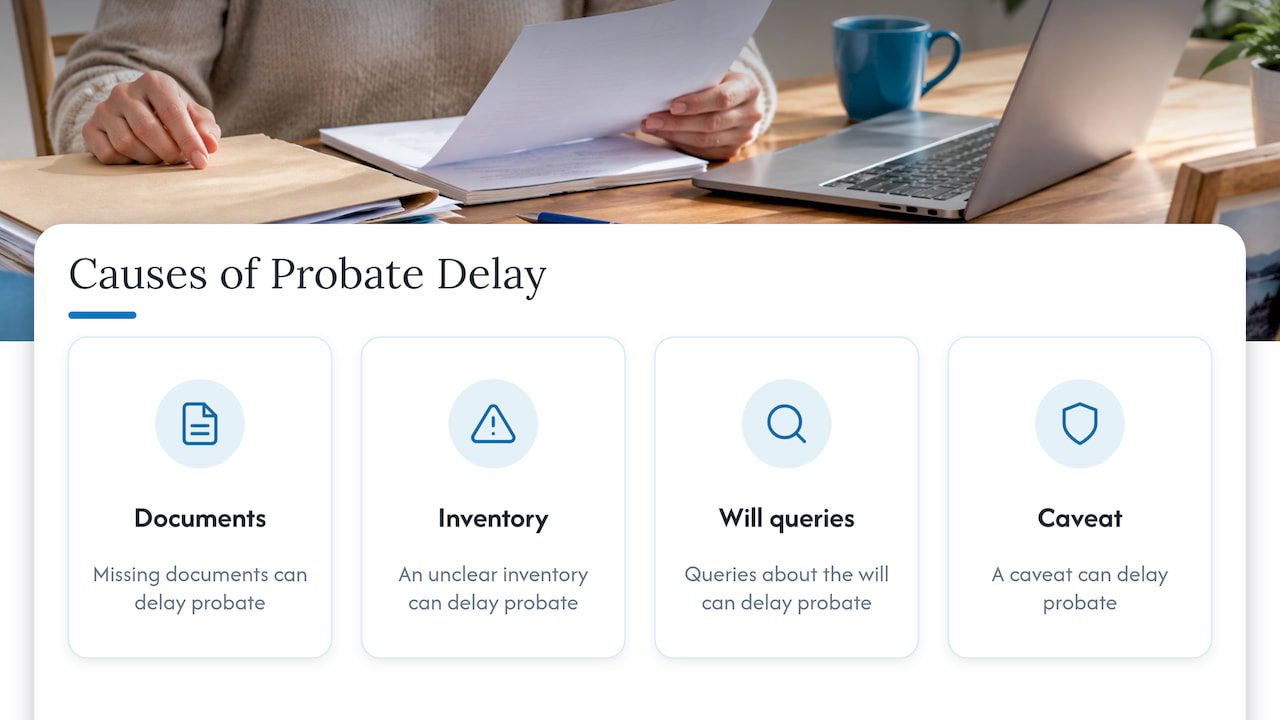
A straightforward application with correct documents moves faster than one that attracts requisitions. The court publishes the filing dates it is currently processing, which is the best guide to its present pace. Delays usually come from missing documents, an unclear inventory, queries about the will, or a caveat.
We have covered this in more depth in probate timelines in NSW and what causes delays. If the estate is stalling after the grant, see estate administration delays and how to fix them.
Which court if the will is contested?
Still the Supreme Court. Contested proceedings are managed in the Probate and Family Provision List under Practice Note SC EQ 07. That practice note sets out how the court case-manages these disputes. Its stated emphasis is on the just, quick and cheap disposal of proceedings, and it expects practitioners to make sure all eligible persons are notified early.
Two kinds of dispute commonly arrive here:
- A challenge to the will’s validity, for example on the basis of lack of capacity or undue influence. These should ideally be raised by a caveat before probate is granted, and a caveat remains in force for six months.
- A family provision claim, where an eligible person says the will (or the intestacy rules) did not make adequate provision for them. An application may be made whether or not a grant has been made, and section 58 of the Succession Act 2006 sets the time limit at 12 months from the date of death, with the court holding a discretion to extend in limited cases. Do not wait for probate before taking advice.
If you are on the executor side, our guide to defending a family provision claim in NSW covers what the role requires. If you think you have been left too little, read not enough in a will in NSW. For the bigger picture, see why estate disputes go to court.
Mediation before a hearing
Most estate disputes do not end in a judgment. Parties often resolve them at mediation or through negotiated settlement, with the court’s case management encouraging early engagement. Our overview of estate litigation settlement options explains how that usually works.
Probate granted: what the “six months” people talk about means
People often say you must wait six months after probate. That is a rule of thumb, not a waiting period imposed by the court. There are two separate six-month ideas that get mixed up:
- The caveat period. A caveat lodged against a grant stays in force for six months.
- The late-application explanation. Filing for probate more than six months after death requires an explanation of the delay.
Neither stops an executor from collecting assets once the grant issues. The more important caution for an executor is the 12-month window in which an eligible person can bring a family provision claim, found in section 58 of the Succession Act 2006. Distributing too early, when a claim is foreseeable, can create personal exposure for the executor. If you suspect a claim is coming, get advice before you distribute. Our estate administration checklist for executors sets out the order of tasks.
When to get a lawyer involved
Many simple estates can be handled by an executor alone. A lawyer earns their place when:
- the will is unclear, handwritten, old or looks informally prepared;
- family members are likely to object or to bring a claim;
- the estate includes a farm, a business, a trust or overseas assets;
- there is a blended family, or a beneficiary with special needs;
- you are an executor and a beneficiary is threatening to have you removed.
For these situations, early advice usually costs less than fixing a mistake later.
Perspective: why court choice is rarely the hard part
Executors ask us which court to use, and the answer is easy: the Supreme Court of NSW. What actually decides how an estate goes is what happens before the filing, and who has been told.
In our experience the estates that run smoothly are the ones where the executor has the original will safe, an honest inventory of assets, and an early conversation with family about what is coming. The ones that turn into litigation usually have a surprise in them: a late will change, a family member left out, or a business that was never properly planned for.
That is why every matter we take on is partner-led, by a specialist with extensive Supreme Court and High Court experience. We would rather talk through risk with you at the start than manage it in a courtroom later. If a dispute is unavoidable, we aim to keep costs proportionate and to tell you plainly where you stand.
George
How we can help
We are a dedicated wills and estates practice based in Bondi, acting for individuals, families, executors and beneficiaries across Sydney, the Eastern Suburbs, the Northern Rivers and regional NSW, in person or virtually. Our probate and estate administration service supports executors from the first notice through to the final distribution.

If the matter is already contested, we act in estate litigation, family provision claims and challenges to a will. New clients are offered a complimentary 30-minute consultation, so we can assess your situation and suggest practical next steps.
Funding Your Legal Matter — No Win, No Fee
We offer No Win, No Fee arrangements for eligible cases. We check eligibility during a free initial consultation, so you know where you stand before committing to anything. For people with a legitimate claim, this removes the upfront cost barrier that can otherwise stop a valid case from being heard. You can read more on our No Win, No Fee page. Book your free case assessment today and we will tell you plainly what your options are.
No Win, No Fee arrangements are subject to case eligibility and a written costs agreement. Liability limited by a scheme approved under Professional Standards Legislation.
FAQ
Is there a separate probate court in NSW?
No. Probate is granted by the Supreme Court of NSW, through its Probate Registry in the Equity Division. There is no separate probate court, and no other NSW court can issue a grant.
Do I have to go to court to get probate?
Usually not. Most uncontested applications are filed online and decided in chambers by a registrar. You attend only if the matter is contested and the court lists it for a hearing or directions.
How do I apply for probate in NSW?
Gather the will, death certificate and forms, publish a notice of intended application on the NSW Online Registry, wait at least 14 days, then file online and answer any requisitions. Our executor’s guide covers each step.
What is the cheapest way to do probate?
Filing fees are set by the court according to estate value and are nil for estates under $100,000. Costs beyond that depend on how much help you need. A clear fee estimate from the start keeps them predictable, and fixed-fee options are available for straightforward matters.
Which court hears a will dispute?
The Supreme Court of NSW, in its Probate and Family Provision List. Both challenges to a will’s validity and family provision claims are managed there.
Sources
- Applying for a grant of probate, Supreme Court of NSW
- Grant of probate or letters of administration, NSW Government
- Equity Division, Supreme Court of NSW
- Supreme Court duty registrar services
- Probate, Supreme Court of NSW
- Notice of intended application for probate, administration or reseal
- Probate checklist, Supreme Court of NSW
- Estates, State Library of NSW
- Contested proceedings, Supreme Court of NSW
- Practice Note SC EQ 07
- Succession Act 2006 (NSW) section 58