There are five lawful ways to revoke a will in NSW: making a later will, executing a separate written revocation instrument, destroying the will with clear intent, marriage or divorce operating automatically, or a Supreme Court order. Informal notes, verbal statements, or accidental damage rarely work. Before you act, get the document reviewed by a solicitor, because getting revocation wrong can leave you without a valid will at all.
TL;DR:
- A will can only be revoked legally through a later will, a written revocation instrument, destruction with clear intent, marriage or divorce effects, or a court order.
- Proper formalities must be followed for revocations via written instruments or new wills, including signing in front of two witnesses who don’t benefit.
- Destruction of a will must be deliberate and with the intent to revoke, with witnesses present, as accidental damage does not cancel the will.
- Marriage automatically revokes a pre-existing will unless it was made in anticipation of that marriage, while divorce revokes spouse-specific gifts but often leaves the rest of the will intact.
- Revocations take effect immediately, and any gap before creating a new will risks intestacy, making it crucial to update or replace the will promptly to avoid disputes.
Table of Contents
- Statutory methods under s11: a plain-language breakdown
- How to revoke by a written instrument or new will: checklist of formalities
- Physical destruction and writing on the will: what the court looks for
- Marriage and divorce: automatic effects and what you should do next
- Court orders, minors and people without capacity: when to involve the Supreme Court
- Common mistakes, litigation risks and how to avoid them
- Practical checklist from a Sydney wills specialist
- Effect of codicils on revocation of wills
- Impact of partial revocation or alteration of a will
- How revocation interacts with handwritten wills in NSW
- Timeframes and legal effect after revocation before creating a new will
- Funding Your Legal Matter — No Win, No Fee
- Official NSW legislation and helpful guidance to read next
- Get your will revoked properly, not just informally cancelled
- Sources
- FAQ
Statutory methods under s11: a plain-language breakdown
The Succession Act 2006 sets out an exhaustive list of ways to revoke a will in NSW. If a method isn’t on this list, it doesn’t work, no matter how sincere the intention behind it.
Section 11(1) recognises revocation by:
- A later will that revokes the earlier one, expressly or by inconsistency
- A written instrument executed with the same formalities as a will, declaring an intention to revoke
- Burning, tearing, or otherwise destroying the will, done by the testator (or someone else in their presence and at their direction) with intent to revoke
- Writing on the will that shows a clear intention to revoke it
- The operation of sections 12 and 13, covering marriage and divorce
- A court order made under sections 16 or 18.
Section 11(2) matters just as much as the list itself. It confirms there’s no presumption that a will is revoked simply because your circumstances changed, having a child, buying a house, or falling out with a beneficiary doesn’t touch the document’s validity. A new will with an express revocation clause (“I revoke all former wills and testamentary dispositions”) is the cleanest example. Without that clause, revocation depends on how far the new will actually contradicts the old one.
How to revoke by a written instrument or new will: checklist of formalities
A standalone revocation document isn’t a shortcut. Under section 6 of the Succession Act, it must meet the same formalities as a will: it needs to be in writing, signed by you, and signed by two witnesses who watch you sign and then sign themselves. Skip any of that and the document has no legal effect.
Here’s the practical sequence to follow:
- Draft clear revocation wording, either as a standalone instrument or as an express clause at the start of a new will.
- Sign the document in the physical presence of two witnesses, neither of whom benefits under the will.
- Have both witnesses sign immediately afterward, while all three of you are still in the room.
- Store the original somewhere secure and tell your executor or solicitor exactly where it is.
- Notify your solicitor of the change so your file reflects the current, valid document.
Pro Tip: Don’t write “I revoke my will” on a sticky note and leave it in the drawer with the original. It has zero legal weight and just gives a court something else to argue about. If you want a clean revocation, ask a solicitor to prepare the instrument properly; it’s a short, low-cost job that removes almost all the risk.
Physical destruction and writing on the will: what the court looks for
Burning or tearing a will only revokes it when the testator does the act, or directs someone else to do it in their presence, with a clear intention to revoke. Destruction without that intention, a house fire, a curious toddler, a will accidentally shredded with junk mail, doesn’t cancel anything.
This is where disputes flare up. Courts have to work out:
- Whether the damage was deliberate or accidental
- Whether partial damage (a torn corner, a crossed-out clause) shows intent to revoke the whole will or just part of it
- What happens if a “destroyed” will is later found intact, which can reopen the whole question of validity
If you genuinely intend to destroy a will, do it properly. Have a witness present, or ask your solicitor to make a short-dated note recording what happened and why. That record is often the only thing standing between a clean revocation and a costly family provision claim down the track.
Marriage and divorce: automatic effects and what you should do next
Marriage generally revokes an earlier will automatically, unless the will was expressly made in contemplation of that marriage. Plenty of people don’t realise this until they’re told their pre-marriage will is now worthless.
Divorce works differently. It revokes gifts and executor appointments made to the former spouse, but it doesn’t cancel the rest of the will. That can produce odd results: an outdated will with your ex removed but no updated plan for who actually gets that share.
A few things worth checking straight after either event:
- Whether your current will was made “in contemplation of” your marriage, which is the only exception that keeps it alive
- Whether removing your ex-spouse’s gift under s13 leaves a gap in your estate plan that needs fixing
- Whether your superannuation death benefit nomination still names your former spouse, since super nominations sit outside the will entirely
Making a fresh will after either event, rather than relying on the Act’s default effects, gives you actual control over the outcome.
Court orders, minors and people without capacity: when to involve the Supreme Court
Most revocations happen without ever going near a courtroom. But the Supreme Court of NSW has specific powers under sections 16 and 18 to authorise revocation, or to approve a will for someone who lacks testamentary capacity or is under 18.
You’d typically involve the court when:
- There’s a genuine dispute about whether the testator had capacity when they tried to revoke or change a will
- A document meant to revoke or replace a will wasn’t executed correctly, and someone wants it admitted anyway under the informal will provisions
- A person lacking capacity needs a will made or altered on their behalf, which requires court authorisation
These applications aren’t DIY territory. If capacity or informal documents are in play, get a solicitor involved early, before positions harden and costs climb.
Common mistakes, litigation risks and how to avoid them
The revocations that end up in court almost always trace back to the same handful of errors. Relying on an informal note instead of a properly executed document. Destroying an old will without making a replacement, which can trigger intestacy if nothing new is in place. Keeping multiple versions of a will in different locations, so nobody’s sure which one is current.
To avoid becoming a cautionary tale:
- Always pair revocation with a properly executed replacement will, not a gap
- Use an express revocation clause rather than relying on implied inconsistency
- Keep one original in a known, secure location and tell your executor where it is
- Review superannuation nominations and powers of attorney alongside your will, since revoking a power of attorney follows its own separate process
Pro Tip: If your family situation is complicated, blended family, estranged children, a business, or significant assets, don’t treat revocation as a form-filling exercise. That’s exactly the profile of estate that ends up in a family provision dispute.
— George
Practical checklist from a Sydney wills specialist
A revocation matter typically follows a consistent process designed to close off the usual gaps. It begins with confirming identity and capacity, then searching for any existing wills that might still be held elsewhere. From there, a revocation instrument or a replacement will with an express clause is drafted, executed correctly with two independent witnesses, and a clear file note is kept of what was revoked and why.
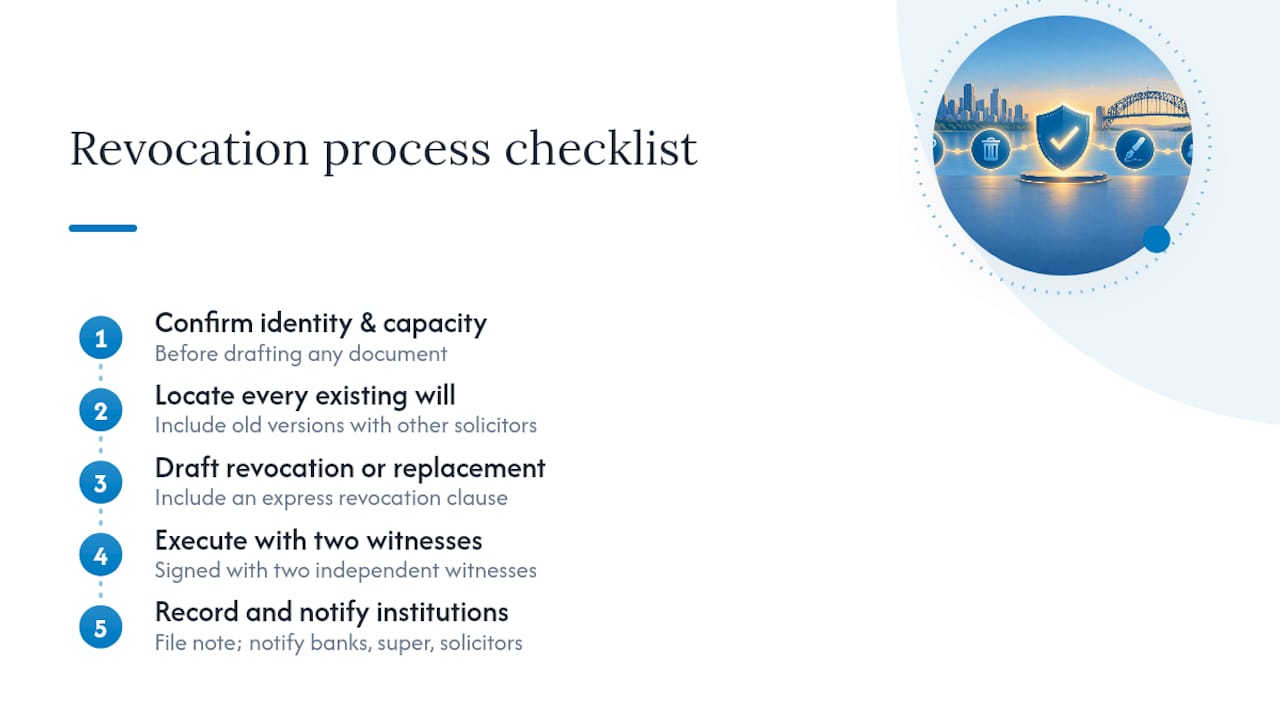
Typical steps clients go through include confirming capacity and identity before any document is drafted, searching for and accounting for every existing will, including old versions with other solicitors, drafting the revocation or replacement with an express clause, executing with two witnesses present for signing, and notifying relevant institutions, superannuation funds, banks, and previous solicitors of the change. New clients are offered a free initial consultation to work through exactly where they stand. It’s also worth knowing that contested wills and family provision claims are a core focus of the practice, which matters if your revocation is likely to upset someone’s expectations.
Effect of codicils on revocation of wills
A codicil doesn’t revoke your will. It amends it. Think of a codicil as a formal footnote: a short, separately executed document that changes one or two provisions while leaving the rest of the will standing.
That distinction causes real confusion. People assume that adding a codicil somehow “refreshes” or replaces the whole will, but it doesn’t. The original will and every codicil attached to it are read together as one testamentary package, unless the codicil itself contains language that revokes part or all of the earlier document.
A codicil must be executed with the same formalities as a will: in writing, signed by the testator, witnessed by two people who watch the signing. Get that wrong and the codicil fails, but the underlying will usually survives intact, since the two documents are legally distinct.
The practical risk is inconsistency. If a codicil changes an executor appointment but the will’s original wording assumes the old executor is still in charge, you’ve created ambiguity that a court, or worse, a disgruntled beneficiary, may need to resolve. This is one of the more common triggers for informal disputes that never needed to happen. If you’re amending a will more than once, it’s often cleaner to revoke the old will entirely and start fresh, rather than stacking codicil on codicil until nobody can say with confidence what the current terms actually are.
Impact of partial revocation or alteration of a will
Not every revocation wipes the whole document. Section 11 also permits partial revocation, cancelling or striking out a specific clause, gift, or appointment while leaving the rest of the will operative. Writing on the will with clear intent to revoke a portion of it falls squarely within that section.
The problem is proving which part was meant to go. A line crossed out with a pen, a beneficiary’s name blacked out, an interlineation squeezed into the margin, all of these raise the same question a court eventually has to answer: did the testator intend to revoke just that clause, or was it the first step toward revoking the whole will?
Alterations made after a will is signed generally need to be executed with the same formalities as the original document to take effect, initialled by the testator and witnessed again. An alteration that doesn’t meet those formalities is usually read as if it were never made, meaning the original wording stands, even if it’s crossed out on the page.
This is precisely why solicitors advise against handwritten edits to an executed will. If you want to change a gift amount or swap an executor, the safer and ultimately cheaper path is a codicil or a fresh will, both properly witnessed. A pen stroke through a beneficiary’s name might feel decisive at the time, but it can leave your estate in genuine limbo if a court later can’t work out what you actually intended.
How revocation interacts with handwritten wills in NSW
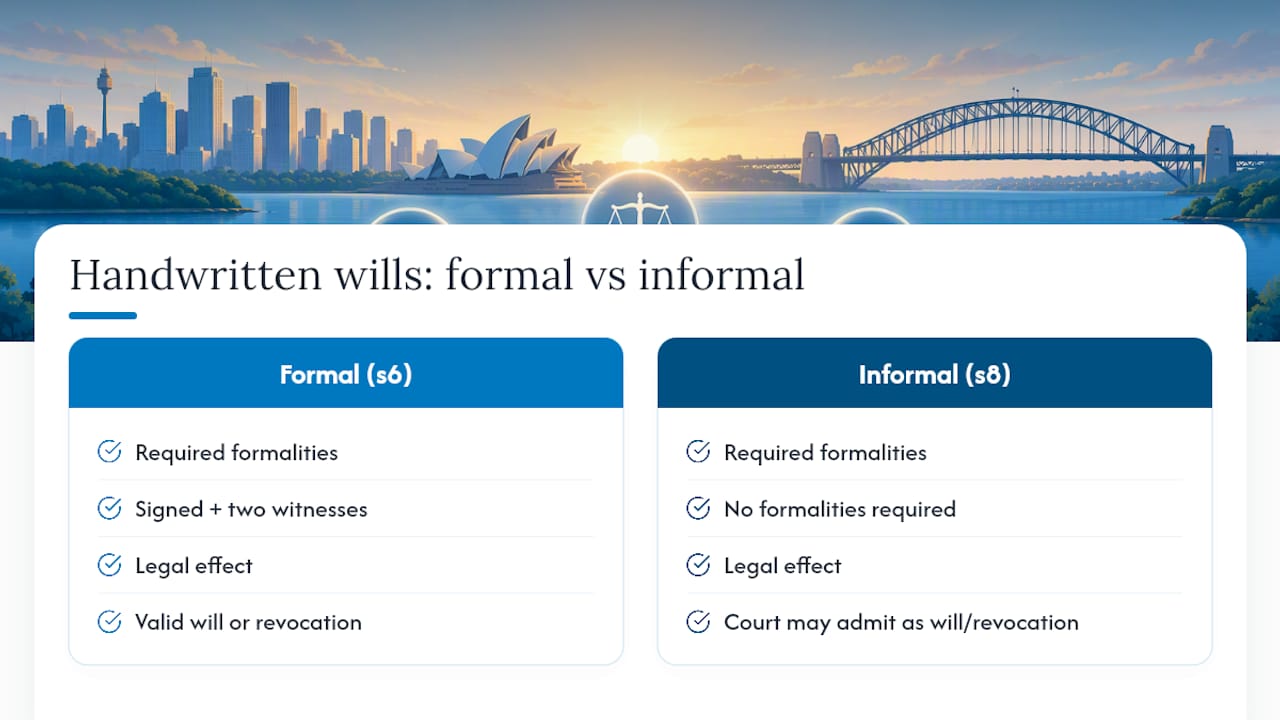
NSW doesn’t recognise “holographic” wills as a separate legal category the way some US states do. A handwritten document can still be a valid will, or a valid revocation, but only if it meets the same formalities under section 6: signed by the testator, witnessed by two people, in writing.
Where handwritten documents cause trouble is the informal will space. Section 8 of the Succession Act allows a court to admit a document that doesn’t meet full formalities, an unwitnessed handwritten note, for instance, if the court is satisfied the deceased intended it to be their will or an amendment to it. That provision exists as a safety net, not a template. Relying on it means asking a court to interpret intention from an imperfect document, which is slower, costlier, and far less certain than doing it properly the first time.
The same logic applies to revocation. A handwritten note scrawled on the back of an envelope saying “this will is cancelled” might, in rare cases, satisfy a court that revocation was intended. It might also be dismissed as inconclusive, leaving the original will standing regardless of what you actually wanted. State Library NSW’s guidance is blunt on this point: a will stays in force until it’s formally changed or revoked, and informal documents are inherently unreliable tools for either job. If you’ve written something by hand and you’re not certain it meets the formalities, treat it as unfinished business, not a done deal, and get it formalised properly.
Timeframes and legal effect after revocation before creating a new will
Revoking a will takes effect the moment the revoking act is validly completed, whether that’s signing a new will, executing a written instrument, or destroying the old document with intent. There’s no waiting period and no cooling-off window under NSW law.
That immediacy is exactly what makes the gap between revocation and replacement dangerous. The instant your old will is revoked and no new will exists, you’re intestate. If you die during that gap, your estate is distributed under the intestacy rules in the Succession Act, not according to anything you intended, and not necessarily to the people you’d have chosen.
There’s no statutory rule dictating how quickly you must make a new will after revoking an old one, but the practical advice from every wills solicitor is the same: don’t create the gap at all. The safest sequence is to have your new will drafted, reviewed, and ready to sign in the same appointment where you revoke the old one, so the revocation and the replacement happen back to back. If circumstances mean you genuinely can’t finalise a new will straight away, keep the old one in force until you can, an imperfect will still beat no will at all.
Funding Your Legal Matter — No Win, No Fee
If a revoked or contested will has left you facing a dispute, cost shouldn’t be the reason you don’t pursue a legitimate claim. Simons George Legal offers No Win, No Fee arrangements for eligible cases, with eligibility assessed during a free initial consultation. That removes the upfront cost barrier for people with a genuine claim who might otherwise walk away simply because they can’t afford hourly billing upfront.
If you think you have grounds to challenge a will, defend an estate, or pursue a family provision claim, book a free case assessment and find out where you stand before spending a dollar.
No Win, No Fee arrangements are subject to case eligibility and a written costs agreement. Liability limited by a scheme approved under Professional Standards Legislation.
Official NSW legislation and helpful guidance to read next
For the actual statute text, read the Succession Act 2006 on Legislation NSW. For a more readable version of section 11 specifically, the AustLII consolidation is easier to navigate. For plain-language context on what revocation actually means day to day, State Library NSW’s guide is a solid starting point. If you need practical, no-cost help navigating a lost or disputed will, Legal Aid NSW is worth contacting.
Get your will revoked properly, not just informally cancelled
Simons George Legal drafts and executes will revocations for clients across Sydney, the Eastern Suburbs, and regional NSW, and the firm’s focus on contested wills and family provision claims means you’re not just getting a document drafted, you’re getting it drafted by someone who has seen exactly how badly informal revocations go wrong in litigation.

That’s the practical edge for anyone reading this article: you now know the five lawful ways to revoke a will in NSW, and you know that getting the formalities wrong is what turns a routine update into a courtroom argument. Rather than drafting a revocation instrument yourself and hoping it holds up, a properly prepared document from Simons George Legal’s will drafting service costs little and removes almost all the risk of a failed revocation or an accidental gap into intestacy.
New clients receive a complimentary 30 minute consultation to review their current will, confirm the safest way to revoke or replace it, and flag anything, like an old superannuation nomination or an outdated power of attorney, that needs updating alongside it. Book your consultation and get the revocation done properly, the first time.
This article is general information, not a substitute for advice from a qualified lawyer. Consult a qualified legal professional about your own circumstances before acting on anything here.
Sources
- SUCCESSION ACT 2006 – SECT 11 When and how can a will be revoked?
- Succession Act 2006 No 80 (Legislation NSW)
- Changing or revoking a will (State Library NSW)
- Legal Aid NSW — someone who died
FAQ
How much does it cost to contest a will in NSW?
Costs vary widely depending on complexity, whether the matter settles early, and how contested the facts are, so there’s no single fixed figure that applies to every case. Simons George Legal offers No Win, No Fee arrangements for eligible contested estate matters, assessed during a free initial consultation, which removes much of the upfront cost risk for legitimate claims.
Can you stop someone from contesting a will?
You can’t remove someone’s legal right to bring a family provision claim, but careful estate planning, clear documentation of your intentions, and properly executed revocations and updates reduce the grounds for a successful challenge. A solicitor can also advise on structures that make a challenge less likely to succeed, though no approach guarantees immunity.
Can an executor override a beneficiary in Australia?
An executor must administer the estate according to the terms of the valid will and their legal duties, they can’t simply override a beneficiary’s entitlement because they disagree with it. If an executor acts outside their authority or mismanages the estate, beneficiaries can apply to the Supreme Court for relief, including removal of the executor in serious cases.
Do all wills have to go through probate in NSW?
Not every estate requires probate. Small estates or those where assets pass outside the will (jointly held property, for instance) sometimes avoid the process entirely, but most estates with real property or significant assets in the deceased’s sole name do need a grant of probate before an executor can deal with them.
What happens if I revoke my will and don’t make a new one?
You become intestate, meaning your estate is distributed under NSW’s statutory intestacy rules rather than according to your own wishes. This is one of the most preventable estate problems, and it’s exactly why solicitors recommend having a replacement will ready before, or at the same time as, revoking the old one.