Mutual wills are legally powerful but they carry real risk: once both parties sign, the survivor is usually locked into the agreed terms for the rest of their life, even after remarriage, new children, or financial change. That inflexibility is the single biggest driver of later litigation. If you’re weighing a mutual wills agreement, get specialist advice on asset coverage, drafting and independent counsel for each party before you sign anything.
TL;DR:
- Mutual wills are highly inflexible, locking the survivor into original estate plans for life, which often leads to costly disputes when circumstances change.
- Assets held jointly, in trusts, or with binding death benefit nominations usually sit outside the agreement, limiting its control over the entire estate.
- Enforcing a mutual wills agreement can require years of expensive litigation, especially if assets are spent or restructured before death.
- Poor drafting, such as absence of a formal deed or detailed asset schedules, significantly undermines the enforceability of mutual wills.
- Family provision claims remain possible against estates, even if a mutual wills agreement exists, making it less effective as a sole estate planning tool.
Table of Contents
- What mutual wills pitfalls stem from: the mechanism behind the risk
- The dangers of mutual wills: inflexibility, disputes and what enforcement actually costs
- Which assets can sit outside a mutual wills agreement?
- How enforceable are mutual wills really?
- Drafting and evidence pitfalls that sink mutual wills agreements
- Do family provision claims still apply to mutual wills?
- Safer alternatives and drafting safeguards worth considering
- When does a mutual wills agreement still make sense?
- What a wills lawyer checks before recommending a mutual wills agreement
- Author perspective: when I recommend mutual wills and when I don’t
- How Simons George Legal can help with mutual wills and safer alternatives
- Funding Your Legal Matter — No Win, no fee
- Selected primary sources and further reading
- Sources
- FAQ
What mutual wills pitfalls stem from: the mechanism behind the risk
A mutual wills arrangement is two people (usually spouses or partners) agreeing to make wills in agreed terms, on the understanding that neither will change their will after the other dies, and often that neither will change it during both their lifetimes without the other’s consent. That agreement, not just the wills themselves, is what makes mutual wills different from ordinary estate planning.
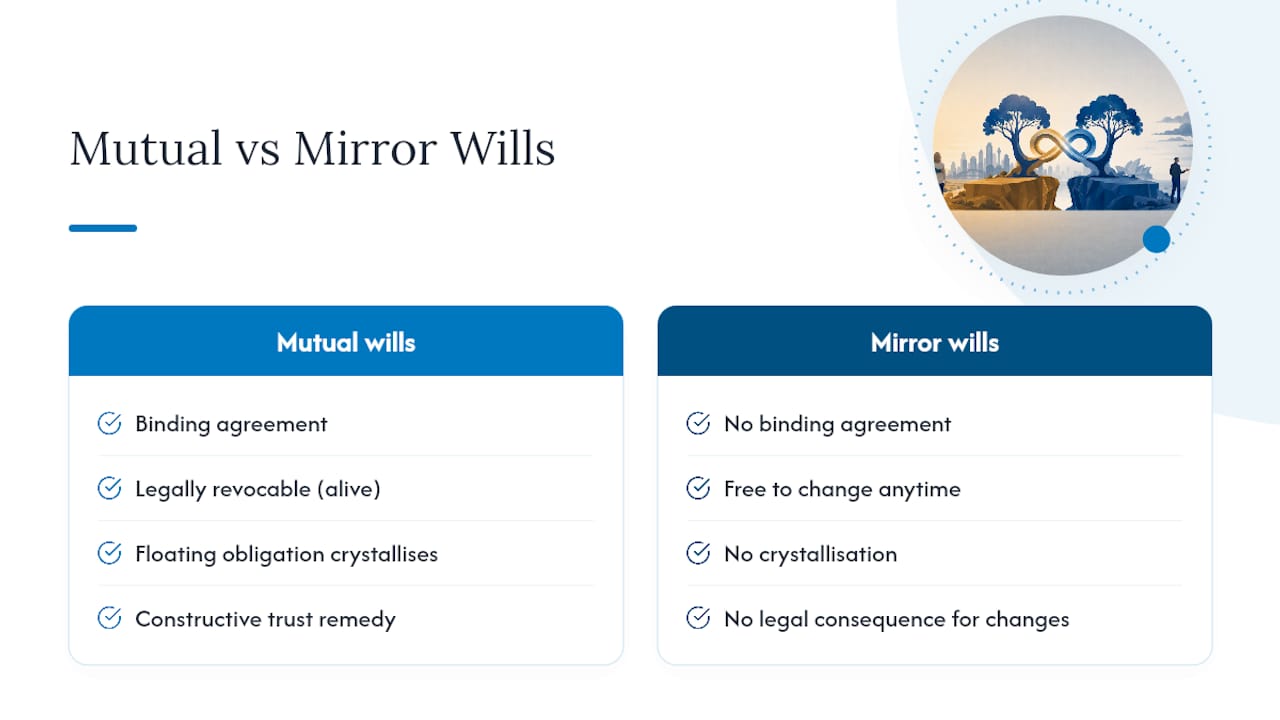
The agreement creates what equity calls a floating obligation. While both parties are alive, each retains legal freedom to revoke their will, but the promise not to hangs over the arrangement. Once the first party dies without the survivor having broken the agreement, that floating obligation crystallises into something a court can enforce. If the survivor then tries to rewrite their will in breach of the deal, a court can impose a constructive trust over the estate, enforcing the original arrangement despite any later changes to the will. This mechanism, explained in detail in the Deakin Law Review’s analysis of mutual wills, is what gives mutual wills their bite and their danger.
Mirror wills work completely differently, and the distinction matters more than most people realise. Mirror wills are two separate wills that happen to say the same thing (often “everything to my spouse, then to our children equally”), but each person remains free to change their will at any time, for any reason, without needing the other’s consent or facing any legal consequence. Most couples who ask about mutual wills actually want the simplicity of mirror wills without realising there’s a binding agreement attached to the mutual version. If you want shared intentions today with room to adapt later, a mirror wills arrangement usually serves the purpose better and avoids most of the pitfalls covered below.
The dangers of mutual wills: inflexibility, disputes and what enforcement actually costs
The core problem with mutual wills is timing. Life rarely stays static for the decades that can pass between signing an agreement and the second death, yet the agreement assumes it will. A couple who agree in their 50s that “everything goes to our combined four children equally” may find, many years later, that one of them has remarried, had a falling out with a stepchild, or watched their financial circumstances change dramatically. None of that matters under a binding mutual wills agreement. The survivor is stuck with the original bargain.
This is where disputes escalate fastest. A common pattern: the first spouse dies, the survivor remarries, and years later tries to update their will to provide for the new spouse or additional children. The original beneficiaries, often adult children from the first marriage, discover the new will and argue the survivor breached a binding agreement. What follows is rarely quick or cheap. The ALRC’s commentary on mutual wills describes the doctrine as an ancient one with genuinely modern teeth, precisely because survivors keep getting caught out by obligations they signed up to decades earlier without appreciating how binding they’d become.
The lived consequences go well beyond legal fees. Families split over these disputes in ways that don’t heal. Executors get caught in the middle, trying to administer an estate while beneficiaries threaten or launch proceedings. And because constructive trust claims often require tracing assets years after the fact, working out exactly what should be held on trust can drag on for years.
Typical dispute triggers include:
- Remarriage or a new de facto relationship after the first death
- Birth of additional children or reconciliation with an estranged child
- A significant change in the value or nature of the estate (inheritance, business sale, property boom)
- The survivor genuinely forgetting or misunderstanding the binding nature of the earlier agreement
- Deliberate attempts to defeat the agreement by gifting or restructuring assets before death
Pro Tip: If you’ve already signed a mutual wills agreement and your circumstances have shifted, don’t just quietly change your will and hope nobody notices. Get advice on your options first. Acting on a private assumption that the agreement “doesn’t really count anymore” is exactly how these disputes start.
Which assets can sit outside a mutual wills agreement?
A mutual wills agreement only controls what actually falls into the estate governed by the will. Several categories of asset routinely bypass the will altogether, and if the agreement doesn’t expressly deal with them, the “certainty” the couple thought they’d locked in doesn’t extend nearly as far as they assumed.
Property held as joint tenants passes automatically to the surviving joint owner by survivorship, not under the will. If a couple’s family home is jointly owned and they intend it to eventually pass to combined children under their mutual wills agreement, the joint tenancy needs to be severed and converted to tenancy in common first, or the home will simply belong outright to the survivor with no obligation attaching to it at all. Severing a joint tenancy is a straightforward legal step, but it’s one people frequently overlook when they’re focused on the will itself.
Superannuation, life insurance proceeds, and assets held in a family trust generally sit outside the estate too, governed instead by binding death benefit nominations, policy beneficiary designations, or trust deeds. This is confirmed in guidance on mutual wills in Queensland, which notes these assets routinely pass outside a mutual wills arrangement unless the agreement expressly addresses them. The ATO’s guidance on deceased estates is a useful reference point for understanding how estate assets are treated for tax purposes once probate is granted, and why non-estate assets follow entirely separate rules.
Before relying on a mutual wills agreement, check:
- Whether the family home and other property is held as joint tenants or tenants in common
- Whether superannuation death benefit nominations align with the will’s intentions
- Whether life insurance beneficiary nominations need updating
- Whether any assets sit in a trust structure the agreement doesn’t mention
How enforceable are mutual wills really?
Courts can enforce a mutual wills agreement, but the remedies come with real limits. The floating obligation crystallises on the first death (assuming the agreement wasn’t broken before then), and from that point the survivor holds the relevant estate assets subject to the agreement. If the survivor breaches it, typically by making a new will that departs from the deal, a court can impose a constructive trust over the assets caught by the agreement, effectively enforcing the original bargain despite a later will’s differing terms.
Beyond the constructive trust itself, courts have a small toolkit: injunctions to stop a threatened breach before it happens, orders requiring the survivor’s estate to disgorge assets improperly dealt with, and in some cases damages where a trust remedy isn’t practical because the assets have been dissipated or mixed beyond tracing. In practice, disgorgement and tracing get complicated fast, especially if the survivor lived another many years and spent, invested, and gifted parts of the estate along the way.
Courts generally allow a survivor to spend and deal with assets normally during their lifetime. Ordinary living expenses, reasonable gifts, and everyday financial decisions are not treated as a breach. What crosses the line is a survivor deliberately depleting or restructuring assets specifically to defeat the agreement, such as gifting the bulk of an estate to a new partner shortly before death. Courts distinguish intent this way, but proving that intent, years after the fact, against an estate that may no longer hold the original assets, is exactly why enforcement proceedings run long and cost a great deal. Litigation of this kind regularly stretches into years rather than months, with legal costs eating into whatever the original beneficiaries were meant to inherit.
Drafting and evidence pitfalls that sink mutual wills agreements
Most mutual wills disputes don’t come down to whether the doctrine applies. They come down to whether anyone can actually prove what was agreed, and that’s where poor drafting causes the real damage.
- No formal Deed of Mutual Wills. Many couples rely on the wills themselves containing a clause referring to an “agreement” without ever documenting that agreement in a separate, detailed deed. Without a deed setting out precisely what was promised, courts are left inferring intention from fragments.
- Vague or missing asset schedules. An agreement that says “our assets” without a schedule identifying exactly what’s covered leaves enormous room for argument about whether a particular bank account, property, or business interest was ever meant to be caught.
- No record of independent legal advice. If each party didn’t get separate, documented legal advice before signing, a survivor (or their new family) can later argue the agreement was never properly understood or was unfairly imposed on one party.
- Reliance on implied or verbal agreements. Some mutual wills claims succeed even without a written deed. A widely discussed Victorian decision involving the enforceability of a verbal mutual wills agreement found a decades-old spoken agreement binding, but that outcome is the exception, not the rule, and it took extensive evidence to get there. Betting on a court reconstructing your intentions from memory and inference is a poor substitute for a signed deed.
Do family provision claims still apply to mutual wills?
Yes, and this surprises a lot of people who assume a binding agreement shuts the door on challenges. It doesn’t. Eligible applicants, spouses, children, and other dependants depending on the jurisdiction, retain the right to bring a family provision claim against an estate regardless of whether the will was made under a mutual wills agreement.
According to commentary in the Deakin Law Review on mutual wills, courts treat the existence of a mutual wills agreement as a relevant factor when assessing a family provision application, but it is not an absolute defence. A court weighing whether adequate provision has been made for an eligible applicant can, and does, still order provision out of the estate even where doing so cuts across what the deceased and their late spouse agreed decades earlier.
For families relying on mutual wills to guarantee a particular outcome, this is a genuine gap between expectation and reality. The agreement might bind the survivor as between the two original parties, but it does nothing to insulate the estate from a claim by, say, an estranged adult child or a financially dependent stepchild who was left out. Anyone drafting or relying on a mutual wills agreement should assume family provision risk sits alongside it, not underneath it. Where that risk is live, understanding how inheritance disputes typically play out is worth doing before, not after, a claim is filed.
Safer alternatives and drafting safeguards worth considering
Given how often mutual wills backfire, many practitioners now reach for structures that achieve similar goals with far less litigation risk. Commentary from firms working in this space consistently favours testamentary trusts and life interests over binding mutual wills agreements for blended families specifically, because these structures protect the survivor’s needs while still directing capital to intended beneficiaries eventually, without requiring an irrevocable lifetime promise.
A life interest lets the survivor use an asset (commonly the family home) for their lifetime, with the capital passing to named beneficiaries on the survivor’s death. A testamentary trust achieves something similar with more flexibility around income and capital distributions, and can be varied by a trustee within the terms the willmaker set, rather than being frozen entirely.
If you do proceed with a mutual wills agreement despite the risks, the following materially reduces your exposure:
- Sever any joint tenancy over property you want the agreement to cover
- Update superannuation binding death benefit nominations and life insurance beneficiaries to match the agreement’s intent
- Draft a standalone Deed of Mutual Wills with a detailed, dated asset schedule
- Get independent legal advice recorded in writing for each party, ideally with separate solicitors
- Review the arrangement periodically while both parties still have capacity
Pro Tip: If you’re not certain whether your situation calls for a mutual wills agreement or a more flexible structure, ask your solicitor to model both outcomes against a hypothetical remarriage or estrangement scenario. Seeing the practical difference in black and white usually settles the question fast.
When does a mutual wills agreement still make sense?
Mutual wills aren’t wrong for everyone. They tend to work where both parties have a genuinely shared, long-term objective, a couple with no children from prior relationships who simply want to guarantee that whichever of them dies first, the survivor can’t later disinherit their combined children, for instance, and where the likelihood of major life changes (remarriage, estrangement, new dependants) is genuinely low.
Before choosing this path, be honest about a few things: how likely is either of you to remarry or start a new relationship if the other dies first? Are your children from a single relationship, or could future stepchildren or estrangements complicate things? Is your asset base stable, or likely to shift substantially over the coming decades?
If you’re uncertain about any of those questions, that uncertainty is itself the answer, and it points towards a more flexible structure. Where the facts genuinely support a shared, unlikely-to-change intention, a properly drafted mutual wills agreement can deliver real certainty. Where they don’t, it’s usually a slow-motion setup for a dispute nobody saw coming many years later.
What a wills lawyer checks before recommending a mutual wills agreement
When a legal firm advises on a proposed mutual wills arrangement, the process starts with evidence gathering, not drafting. That means confirming exactly what each party intends, checking how the family home and other property are held, reviewing superannuation nominations and life insurance beneficiaries, and identifying any trust structures that might sit outside the agreement entirely.
From there, drafting focuses on the details that hold up under later challenge: a standalone Deed of Mutual Wills, a specific, dated schedule of covered assets, and separate, documented independent advice for each party so neither can later claim they didn’t understand what they signed. Where a mutual wills agreement isn’t the right fit, the same process usually points towards a testamentary trust or life interest structure instead.
Clients may be offered an initial consultation, generally enough time to map out assets, flag anything sitting outside a proposed agreement, and outline the realistic path forward.
Author perspective: when I recommend mutual wills and when I don’t
In most blended-family situations I come across, I lean towards more flexible instruments, a testamentary trust or a life interest, over a binding mutual wills agreement. The certainty mutual wills promise rarely survives contact with real family change over twenty or thirty years, and I’ve seen how the cost of enforcing that certainty falls hardest on the people it was meant to protect.
Where I do think mutual wills earn their place is when both parties genuinely have capacity, no history of estrangement, and a plan they’re both prepared to review together while they’re still able to. Test your assumptions against a specialist before you sign. A conversation now is far cheaper than a constructive trust claim later.
— George
How Simons George Legal can help with mutual wills and safer alternatives
Deciding between a mutual wills agreement, a testamentary trust, or a straightforward mirror will isn’t something to work out alone from a checklist. Simons George Legal drafts and reviews wills, testamentary trusts, and mutual wills deeds for clients across Sydney, and acts in contested will and family provision disputes when agreements like these end up challenged years down the track.

If you’re weighing up a mutual wills agreement, or you’ve inherited one from a previous relationship and aren’t sure where you stand, the firm’s will drafting and amendment service covers everything from severance of joint tenancy to properly documented independent advice certificates. Clients may be offered a consultation to map out assets, flag anything that might sit outside a proposed agreement, and get a clear view of what a safer structure would look like. If a dispute has already arisen over an existing mutual wills arrangement, the estate litigation team can assess your position early, before costs escalate. Book a consultation through the wills and estates page to get started.
Funding Your Legal Matter — No Win, no fee
Cost is often the biggest barrier stopping people with a legitimate claim from getting advice, particularly in contested mutual wills or family provision disputes where litigation risk is already high. Simons George Legal offers No Win, no fee arrangements for eligible cases, removing that upfront cost barrier for clients with a genuine claim.
Eligibility isn’t assumed. It’s assessed during a free initial consultation, where the firm looks at the strength of your position and whether a conditional fee arrangement is appropriate for your matter. If you’re facing a dispute over a mutual wills agreement or believe you have grounds for a family provision claim, book a free case assessment to find out where you stand.
No win, No Fee arrangements are subject to case eligibility and a written costs agreement. Liability limited by a scheme approved under Professional Standards Legislation.
Selected primary sources and further reading
The ALRC’s briefing on mutual wills explains the doctrine’s modern enforcement risk. The Deakin Law Review article by Cassidy sets out the floating obligation and constructive trust mechanics in detail. The ATO’s deceased estates guidance covers how assets and tax obligations are treated once probate is granted. For international context on why legal advice reduces estate litigation risk generally, see this overview of estate legal consultation.
This article is general information, not a substitute for advice from a qualified lawyer. Consult a qualified legal professional about your own circumstances before acting on anything here.
Sources
- ALRC — mutual wills discussion
- Exploring the benefits and pitfalls of using mutual wills — Deakin Law Review (Cassidy)
- ATO — deceased estates
FAQ
What are the disadvantages of a mutual wills agreement?
The main disadvantage is extreme inflexibility. The survivor is locked into the original terms for potentially decades, and that rigidity is what most often triggers disputes and litigation when circumstances like remarriage or new children arise.
What is the most common mistake people make with mutual wills?
The most common mistake is signing a mutual wills agreement without a formal deed, a detailed asset schedule, or documented independent legal advice for each party, leaving the arrangement vulnerable to challenge or misunderstanding years later.
Are mutual wills legally enforceable?
Yes. Courts can enforce a mutual wills agreement by imposing a constructive trust over assets if a survivor breaches the deal, but enforcement often requires long, expensive proceedings, especially where assets have been spent, mixed, or restructured over time.
Can a surviving spouse change a mutual will after the first death?
A survivor can physically make a new will, but doing so in breach of a binding mutual wills agreement exposes their estate to a constructive trust claim from the original intended beneficiaries. Mutual wills also don’t block eligible applicants from bringing a family provision claim regardless of the agreement’s terms.