Probate confirms a valid will and hands legal power to the executor named in it. Letters of administration do the same job when there’s no valid will, or when the named executor can’t or won’t act. That single distinction, whether a valid will exists and someone is ready to act under it, decides which grant you need and where you start.
Before you go further, do two things:
- Check whether a valid will exists and, if so, who is named as executor.
- Identify the key assets (any property held solely in the deceased’s name, large bank accounts, superannuation, shares) and contact each asset holder to ask whether they’ll require a grant before releasing or transferring anything.
The Supreme Court in each state (the Supreme Court of Victoria is one example), issues both types of grant, and NSW Trustee & Guardian can step in as administrator when no family member is willing or able to act. Get those two facts settled first. Everything else in estate administration flows from them.
Key takeaways
The distinction between probate and administration comes down to one fact: whether a valid will exists and its named executor can act, or whether the court must appoint someone under intestacy or annexed-will rules instead.
| Point | Details |
|---|---|
| Core distinction | Probate applies where a valid will names a willing executor; administration applies where there’s no will, or the executor can’t act. |
| First action | Check for a valid will and its named executor, then contact asset holders to confirm whether a grant is required. |
| Filing window | Apply within 6 months of death where possible; full administration typically runs around 12 months. |
| Multi-state assets | Grants often need resealing interstate, adding time and cost to the process. |
| Get help early | Simons George Legal offers a free 30-minute consultation and No Win, No Fee options for eligible contested matters. |
Table of Contents
- Probate vs administration: the legal distinction explained
- What are letters of administration, with and without the will annexed?
- When do you actually need probate or administration?
- Who can apply: priority, renunciation, and caveats
- How to apply: the step-by-step process
- When you might not need a court grant at all
- Executor vs administrator: duties and personal liability
- How long does it take, and what does it cost?
- Red flags: when you should get a lawyer involved
- How Simons George Legal supports executors and administrators
- Funding Your Legal Matter — No Win, No Fee
- A note from the firm
- Sources
- FAQ
Probate vs administration: the legal distinction explained
A grant of probate is the Supreme Court’s formal recognition that a person died leaving a valid will, and that the executor named in it has the legal authority to administer the estate. It’s not a rubber stamp. The court examines the will, confirms it was properly signed and witnessed, and satisfies itself the document reflects the deceased’s actual wishes before issuing the grant.
Practically, probate does three things. It confirms the will is valid. It gives the executor legal title to deal with the deceased’s assets. And it gives banks, land titles offices, and share registries the paperwork they need before they’ll act on the executor’s instructions.
Certain assets almost always trigger the need for probate. Real estate held solely in the deceased’s name is the classic example, since the land titles office won’t transfer or sell the property without it. Large bank accounts held in one name, share portfolios, and some superannuation death benefits (particularly where there’s no binding nomination in place) usually sit in the same category.
Not everything needs a grant, though. Jointly held property, small accounts, and assets with a nominated beneficiary often transfer without court involvement at all. The Supreme Court of Victoria makes clear that whether a grant is required always comes down to what each individual asset holder demands, so the safest move is to ring the bank or fund directly and ask.
What are letters of administration, with and without the will annexed?
Letters of administration cover two quite different scenarios, and the naming convention trips a lot of people up.
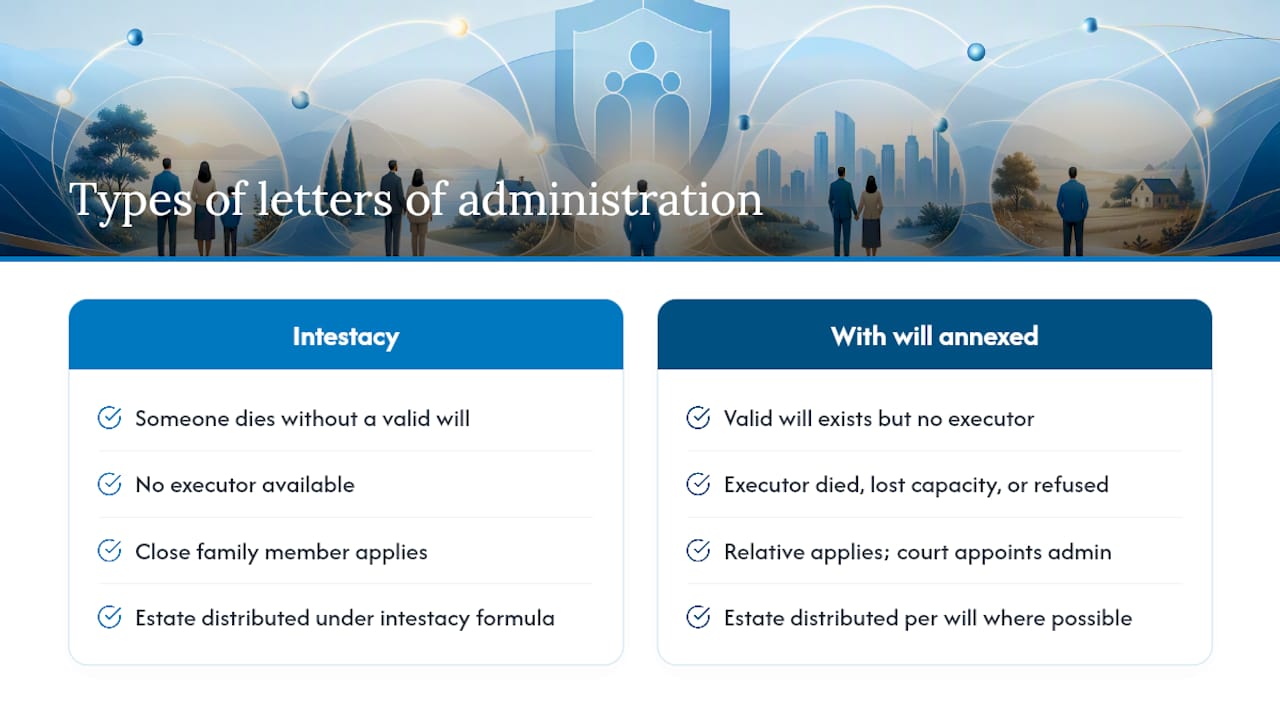
Letters of administration (intestacy) apply when someone dies without a valid will at all. Queensland Courts confirms this is the pathway when someone dies without a valid will: a close family member applies, and the resulting grant authorises them to collect assets and distribute them under the intestacy formula.
Letters of administration with the will annexed cover a trickier middle ground: a valid will exists, but no one can step in as executor. Maybe the named executor died first, maybe they’ve lost capacity, or maybe they’ve simply refused to take on the job. Here, the court appoints an administrator to carry out the estate’s affairs, using the will’s own terms as the guide wherever that’s possible.
A simple contrast: a man dies with no will, survived by a spouse and two adult children. His spouse applies for letters of administration and the estate is split according to the state’s intestacy formula. Compare that with a woman who left a clear, valid will but named her elderly brother as sole executor, and he passed away two years before her. Her niece then applies for letters of administration with the will annexed, honouring the will’s distribution wishes even though she wasn’t the one named to carry them out.
When do you actually need probate or administration?
Three questions decide almost every case:
- Is there a valid will, and does it name an executor who is willing and able to act? If yes, you’re almost certainly heading toward probate.
- Are the significant assets solely owned, particularly real estate, or are they jointly held? Sole ownership usually forces the issue; joint ownership often avoids it.
- Do the specific banks, super funds, or the land titles office actually require a grant before they’ll act? This varies by institution and by the size of the balance involved.
A few realistic scenarios show how these tests play out. An estate consisting of nothing but a jointly held bank account and a house owned as joint tenants with a surviving spouse will often need no grant at all. The property passes automatically by survivorship, and the bank may release joint funds on production of a death certificate alone.
Contrast that with a deceased person who owned their home outright in their sole name, with a $400,000 balance in a personal savings account. The land titles office will not transfer that property, and the bank will not release those funds, without a court grant in hand. That’s a probate application if there’s a valid will naming an executor, or a letters of administration application if there isn’t.
Thresholds and forms differ from state to state, so always check your own state Supreme Court registry (NSW, Victoria, Queensland, and South Australia each publish their own guidance) rather than assuming a rule you’ve read applies everywhere.
Who can apply: priority, renunciation, and caveats
The law doesn’t let just anyone apply for a grant. There’s a clear pecking order, and understanding it saves a lot of confusion when multiple family members think they should be in charge.
For probate, the named executor in the will has first right to apply. Simple as that, assuming they’re willing and able. For intestacy, most states follow a similar hierarchy: a surviving spouse or de facto partner comes first, then adult children, then more distant relatives such as siblings or parents, following the statutory order set out in each state’s succession legislation.
Renunciation happens when a person entitled to apply, most often a named executor, formally declines to take on the role. It’s a legal document lodged with the court, and once it’s filed, that person is out of the picture entirely. The right to apply then passes to whoever is next in line, which is often how a letters of administration with the will annexed situation arises in the first place.
A caveat is a formal notice lodged at the Supreme Court by someone with a genuine interest in the estate, warning the court not to issue a grant without first notifying them. It might come from a family member who disputes the will’s validity, or from someone concerned the wrong person is applying. Once lodged, a caveat effectively freezes the process until it’s resolved, either by negotiation between the parties or by a court hearing. If you’re facing a caveat, or considering lodging one, getting legal advice early is far cheaper than letting the dispute drag on.
How to apply: the step-by-step process
Applying for a grant, whether probate or administration, follows a broadly similar path across Australian states, with variations in forms and fees.
- Locate the original will (if one exists) and compile a full list of the deceased’s assets and liabilities.
- Obtain the death certificate from Births, Deaths and Marriages.
- Publish a probate notice on the relevant state online registry, giving the required notice period before lodging the application.
- Prepare the court application, including affidavits from the executor or administrator confirming the details of the estate.
- Lodge the application, along with supporting documents and the filing fee, with your state Supreme Court registry.
- Respond promptly to any requisitions, which are the registry’s requests for extra information or corrections.
- Receive the grant and begin dealing with asset holders using the court-issued document.
Before you start, gather:
- The original will (not a photocopy, where one exists)
- The death certificate
- A full asset and liability list, including account numbers and property titles
- Identification documents for the executor or administrator
- Recent bank statements and property title searches
Each state Supreme Court runs its own registry system with its own forms, so check the specific requirements for NSW, Victoria, Queensland, or South Australia before you lodge anything. For NSW applicants specifically, a detailed probate application checklist can help you avoid the most common lodging mistakes.
Pro Tip: Publish your probate notice and wait out the required notice period before you touch a single dollar of estate assets. Distributing early, before the challenge window closes, is one of the fastest ways executors expose themselves to personal liability later.
When you might not need a court grant at all
Plenty of estates never touch a courtroom. Common exceptions include:
- Assets held as joint tenants, such as a family home or joint bank account, which pass automatically to the surviving owner.
- Small-value accounts, where the institution’s internal threshold allows release without a grant (thresholds vary bank to bank, so always ask).
- Assets that pass by direct nomination, such as life insurance with a named beneficiary.
- Superannuation with a binding death benefit nomination, which the fund can pay out directly to the nominated person.
- Assets already sitting inside a trust structure, which typically fall outside the deceased’s personal estate entirely.
If you think your situation fits one of these, the action is straightforward: contact each asset holder directly, get their release policy confirmed in writing, and keep that correspondence on file. Institutions differ enormously in what they’ll accept, and the Supreme Court of Victoria is blunt about this: some organisations release small amounts without a grant and others simply won’t, so get it in writing before you rely on it.
Queensland offers a specific carve-out worth knowing about: where the gross value of the deceased’s Queensland assets is $300,000 or less, property can sometimes be transferred without letters of administration, according to the Queensland Law Handbook. Be careful with mixed-title estates, though. A single sole-owned property, even alongside otherwise joint assets, is usually enough to force a full grant regardless of the total estate value.
Executor vs administrator: duties and personal liability
Executors and administrators carry near-identical day-to-day responsibilities. Where they differ is in whose instructions they follow, and that difference matters more than most people expect.
Both roles are expected to:
- Locate and prove the validity of the will, or confirm intestacy applies.
- Collect and protect all estate assets, including insuring property and securing valuables.
- Pay outstanding debts and settle any tax obligations, including the deceased’s final tax return.
- Distribute the estate strictly according to the will’s terms, or the intestacy rules where no will exists.
- Keep clear, accurate financial accounts of every transaction made on the estate’s behalf.
Executors work from a clear script, the will itself. Administrators, by contrast, must follow the statutory intestacy rules without the benefit of the deceased’s personal instructions. As Queensland Courts notes, that gap can produce distributions the deceased may never have intended, which is part of why intestate estates sometimes generate more family friction than estates with a clear will in place.
Both roles carry real personal liability. Distributing estate funds before debts, tax, and potential claims are sorted out can leave an executor or administrator personally on the hook if something goes wrong later. The safest approach is to hold funds until the statutory challenge period has passed, or until you’ve received written confirmation from relevant asset holders and, where there’s any doubt, legal clearance. An estate administration checklist can help keep the sequence of tasks straight, particularly on larger or more complex estates.
How long does it take, and what does it cost?
Aim to lodge your application within six months of the date of death. Miss that window and the NSW Government’s executor guide notes you’ll typically need to explain the delay to the court, which adds an extra layer of paperwork nobody wants. From lodgement to final distribution, a full estate administration commonly takes around 12 months in Australia, sometimes longer where assets are complex or contested.
| Factor | Typical detail |
|---|---|
| Recommended filing window | Within 6 months of death |
| Typical full administration time | Around 12 months |
| Queensland property transfer exception | Gross estate value up to $300,000 (in some circumstances) |
| Multi-state assets | May require resealing the grant in each additional state |
Several things push fees and timeframes up. Court registry filing fees scale with the value of the estate, so a larger estate costs more to lodge than a modest one. Solicitor fees, professional property or business valuations, and the cost of publishing the required probate notice all add to the total. If the deceased held assets in more than one state, expect to budget for resealing the grant in each additional jurisdiction, which can add several weeks and extra registry fees on top of the original application.
Delays most often come from incomplete documentation, a lodged caveat, difficulty tracking down all the deceased’s assets, or the need to reseal a grant interstate. Building buffer time into your expectations from day one saves a lot of frustration later, and our guide to NSW probate delays covers the most common sticking points in more detail.
Red flags: when you should get a lawyer involved
Most straightforward estates, valid will, cooperative family, modest assets, don’t need a litigator. But certain situations should send you looking for legal advice immediately, not after things escalate.
- Two or more people are each claiming the right to apply for the grant.
- A caveat has been lodged, or someone has threatened a family provision claim.
- The estate includes a business, a farm, or other complex or illiquid assets.
- You suspect the will was forged, altered, or signed under undue influence.
- Assets sit across multiple states, tightening an already narrow filing window.
If you’re the executor and genuinely unsure of your duties, or beneficiaries are disputing how the estate is being handled, get advice sooner rather than later. Contested probate, caveat disputes, and family provision claims can all end up before a judge, but most are resolved through negotiation once both sides have proper legal representation. Removing a caveat, defending an executor’s decisions, or bringing a family provision claim are all matters our estate litigation team handles regularly for clients across NSW.
How Simons George Legal supports executors and administrators
Simons George Legal works with executors and administrators at every stage of the process, from the first application through to final distribution. That includes interpreting ambiguous will clauses, preparing and lodging probate and administration applications, tracing assets that aren’t immediately obvious, liaising with the Australian Taxation Office on outstanding obligations, and resealing grants where a deceased person held property across more than one state.
Where things turn contested, whether that’s a caveat, a disputed executor appointment, or a full family provision claim, the firm also acts in estate litigation, aiming to protect a client’s position while keeping legal costs proportionate to what’s actually at stake.
New clients start with a complimentary 30-minute consultation, which is enough time to map out the estate, flag any complications, and outline the realistic next steps. Simons George Legal is based in Bondi and works with clients across Sydney, the Eastern Suburbs, and regional NSW, in person or remotely, so location is rarely a barrier to getting proper advice early. If you’re ready to start that conversation, the firm’s probate and estate administration page outlines exactly what’s involved.
Funding Your Legal Matter — No Win, No Fee
Cost is often the biggest thing standing between an executor or beneficiary and the legal help they actually need, particularly in contested matters. Simons George Legal offers No Win, No Fee arrangements for eligible cases, including many contested estate and family provision matters, so a legitimate claim isn’t shelved simply because the upfront cost feels out of reach.
Eligibility is assessed during your free initial consultation, where the firm reviews the merits of your situation before any funding arrangement is confirmed. There’s no obligation attached to that first conversation, only clarity on where you stand and what your options are. If you think you may have a claim worth pursuing, book a free case assessment through the firm’s estate litigation team and find out where you stand.
No Win, No Fee arrangements are subject to case eligibility and a written costs agreement. Liability limited by a scheme approved under Professional Standards Legislation.
A note from the firm
We’ve sat across the table from enough executors to know the hardest part usually isn’t the paperwork, it’s making decisions while grieving, often with family watching every move. If that’s where you are, we offer remote appointments and tailored support so you’re never navigating it entirely on your own.
Sources
- How to determine if a grant of probate or administration is required | The Supreme Court of Victoria
- Grant of probate or letters of administration | NSW Government
- Wills and estates (probate) | Queensland Courts
- Probate and Letters of Administration – Queensland Law Handbook Online
Fees, forms, and thresholds vary by state, so always check your own state Supreme Court registry or speak with a lawyer if you’re unsure which rules apply to your situation.
This article is general information, not a substitute for advice from a qualified lawyer. Consult a qualified legal professional about your own circumstances before acting on anything here.
FAQ
Do you need probate if you have letters of administration?
No. Letters of administration and a grant of probate serve the same practical purpose but apply to different situations, so you’ll only ever need one or the other for the same estate, not both.
Do banks require probate to release funds in Australia?
Often, yes, particularly for large balances held solely in the deceased’s name, though smaller amounts may be released with just a death certificate depending on the bank’s own policy. Always confirm requirements directly with the institution holding the funds.
What is the difference between probate and administration?
Probate is granted when a valid will exists and its named executor applies; administration is granted when there’s no valid will, or the will exists but no executor is available to act, as the Supreme Court of Victoria explains.
Is an executor the same as an administrator?
They’re not the same role, though their day-to-day duties overlap heavily. An executor is named in a valid will and follows its instructions; an administrator is appointed by the court and follows statutory intestacy rules, or the will’s terms where one exists but no executor can act.