Yes, you can include cryptocurrency in your Australian will. The Australian Taxation Office treats crypto as property, which means it can be gifted, inherited, and taxed like any other asset. The catch is that a will alone is not enough. Without a separate access plan covering your private keys, seed phrases, and two-factor authentication details, your executor may be legally entitled to your crypto but technically unable to reach it.
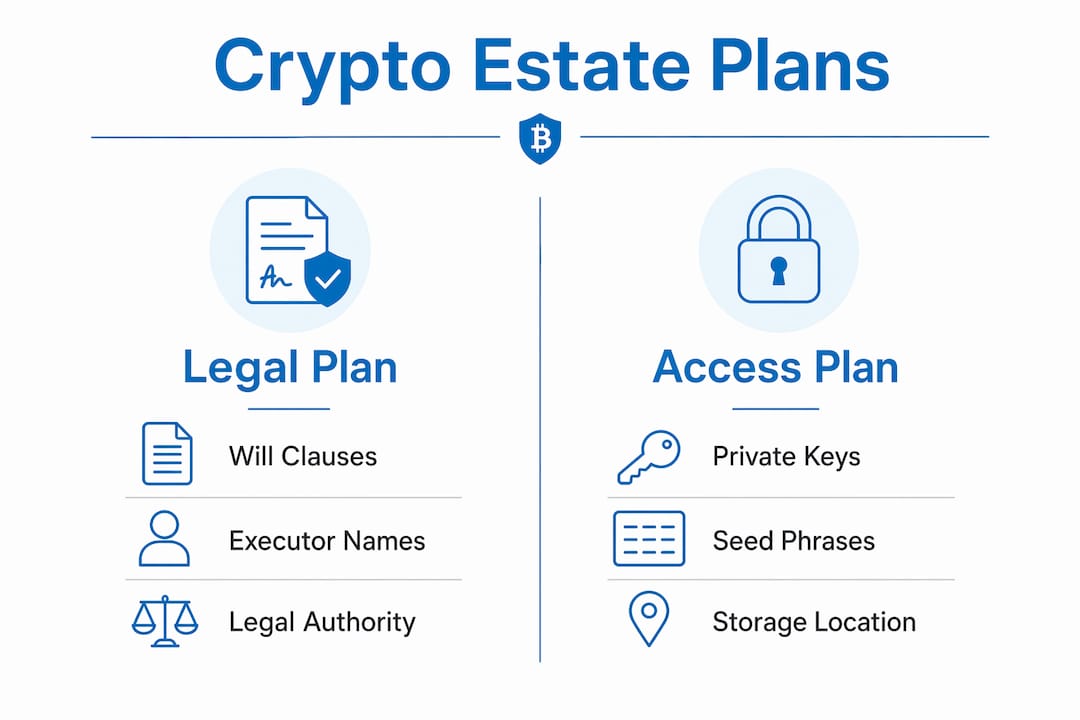
The single most important step: pair your will with a written access plan stored securely away from the will itself. These two documents work together. Neither works without the other.
- Legal plan: will clauses identifying your digital assets, executor powers, and gifting instructions
- Access plan: a separate document recording wallet locations, hardware devices, password manager details, and 2FA procedures
- Tax note: the ATO applies capital gains tax (CGT) to crypto transfers and sales from an estate, so executors need tax advice early
- Practitioner resource: Simons George Legal assists Sydney families with both the legal drafting and secure custody of digital asset memoranda
Table of Contents
- How Australian law treats crypto in wills and probate
- Key concepts every Australian crypto holder must understand
- Two plans you must prepare: the legal plan and the access plan
- Practical sample will clauses for Australian wills
- How to choose an executor for crypto-heavy estates
- Executor’s step-by-step checklist for administering crypto
- Where to store the access plan securely in Australia
- Common mistakes Australian crypto holders make in estate planning
- When to consider trusts or other ownership structures for crypto
- Funding your legal matter — No Win, No Fee
- Key takeaways
- A solicitor’s perspective on crypto wills
- How Simons George Legal can help with crypto estate planning
- Useful sources and further reading
- FAQ
How Australian law treats crypto in wills and probate
Cryptocurrency is treated as property under Australian law, which means the standard rules for wills, probate, and estate administration apply; for an overview of why probate is necessary in these processes, see Why Is Probate Necessary? A Clear Guide for New Hampshire. An executor must obtain a grant of probate (or letters of administration where there is no will) before dealing with estate assets, including crypto.
The practical complication is custody. Exchange-held crypto, such as holdings on CoinSpot, Independent Reserve, or BTC Markets, sits with the exchange, which controls the private keys and has its own deceased-user policies. Self-custody holdings, stored on a Ledger or Trezor hardware wallet, are controlled entirely by whoever holds the seed phrase. These two scenarios require completely different administration steps.
Valuation at the date of death is not optional. CGT calculations depend on it, and getting it wrong exposes the estate to penalties. Executors should engage a tax adviser before transferring or selling any crypto.
Pro Tip: Name the ATO’s crypto guidance and your state Supreme Court’s probate jurisdiction in your will’s recitals. It signals to your executor that specialist advice is expected and may reduce disputes later.
Key concepts every Australian crypto holder must understand
Before you can draft sensible clauses or choose an executor, you need a working understanding of how crypto is held and accessed.
Custody models determine who controls the private keys. Self-custody means you hold the keys yourself, typically via a hardware wallet (Ledger, Trezor) or software wallet secured by a seed phrase. Custodial exchanges (CoinSpot, Independent Reserve, BTC Markets) hold the keys on your behalf. Multisig arrangements split control across multiple keys or parties.
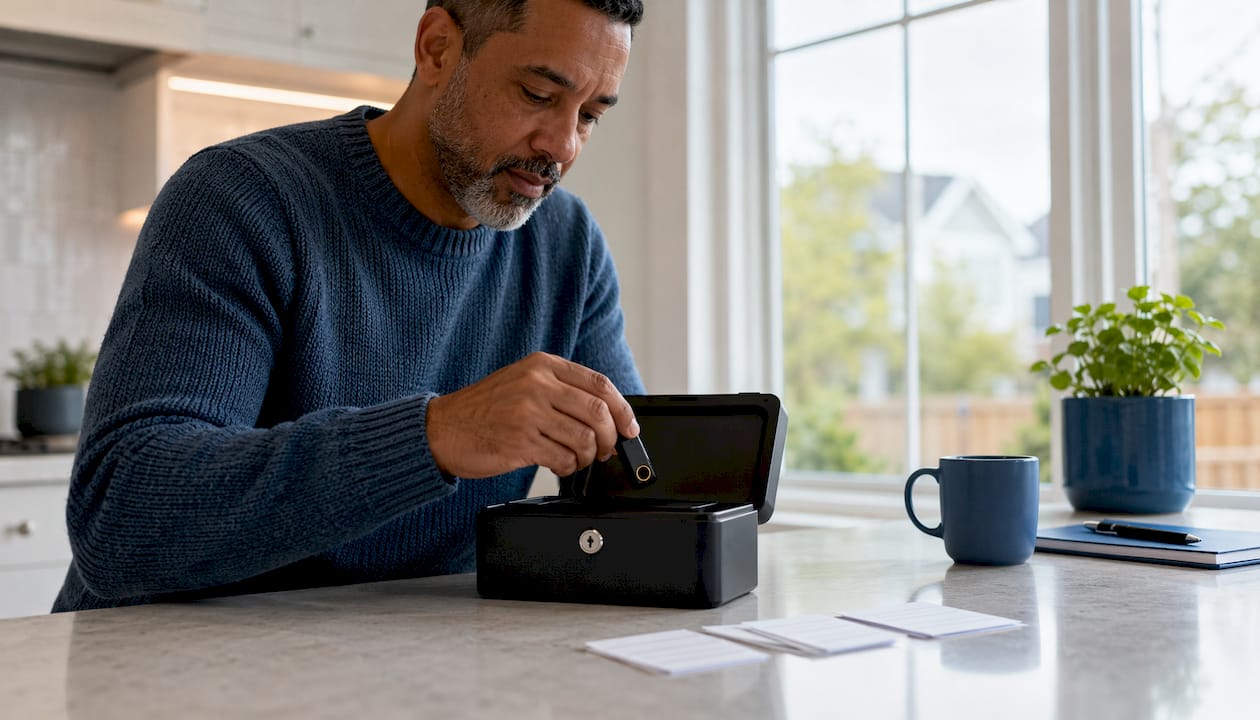
Access elements are what your executor actually needs: the private key or seed phrase, the hardware wallet device and its PIN, login credentials for exchange accounts, the master password for a password manager such as 1Password or Bitwarden, and instructions for any 2FA or MFA app.
| Custody model | Executor accessibility | Recoverability trade-off | Specialist help needed? |
|---|---|---|---|
| Self-custody (hardware wallet) | Low without seed phrase | High security, total loss if seed lost | Often yes |
| Self-custody (software wallet) | Low without private key | Moderate; device-dependent | Sometimes |
| Custodial exchange | Moderate with probate docs | Exchange policies apply; may be slow | Rarely for access; yes for tax |
| Multisig | Complex; requires multiple keyholders | Resilient if quorum survives | Usually yes |
A secure, confidential inventory recording wallet addresses, provider names, usernames, and where the access plan is stored is the foundation of any workable crypto estate plan.
Two plans you must prepare: the legal plan and the access plan
Practitioners consistently recommend pairing a legal plan with a functional access plan. One without the other fails the beneficiary.
Legal plan checklist:
- Identify all digital assets by category (Bitcoin, Ethereum, NFTs, exchange accounts, SMSF-held crypto)
- Specify gifting instructions: in-kind transfer or sale and distribution of proceeds
- Grant the executor express power to access, copy, transfer, sell, or otherwise deal with digital assets
- Include a power-to-hire clause authorising the executor to engage technical experts and tax advisers
- Address exchange-held crypto and any SMSF holdings separately
- Update your enduring power of attorney to cover digital assets during incapacity
Access plan checklist:
- Inventory every wallet and exchange account with account identifiers (not passwords)
- Record the physical location of hardware wallet devices and seed phrase storage
- Specify which password manager (1Password, Bitwarden) holds credentials and how to access it in an emergency
- Detail 2FA procedures: which app, which phone, and what to do if the device is unavailable
- Nominate a technical contact or co-executor with written authority to hire specialist help
- Store the access plan with your solicitor or in a secure vault, and reference its location in the will
Pro Tip: Set a calendar reminder to review both plans annually and after any major portfolio change. An outdated access plan is almost as dangerous as no plan at all.
Practical sample will clauses for Australian wills
These templates are starting points. A solicitor should adapt them to your specific holdings and family circumstances.
Digital assets clause:
“I give all my digital assets, including but not limited to cryptocurrency, non-fungible tokens, and exchange account balances, to [Beneficiary Name]. My executor may transfer these assets in kind or sell them and distribute the proceeds, as my executor considers appropriate having regard to market conditions and tax advice received.”
Executor power clause:
“My executor has authority to access, copy, transfer, sell, convert, or otherwise deal with any digital asset forming part of my estate, and to appoint and pay from the estate any technical expert, cryptocurrency specialist, or tax adviser reasonably required to administer these assets.”
Memorandum reference clause:
“Details of my digital asset holdings, wallet locations, and access procedures are recorded in a Digital Asset Memorandum held at [law firm / secure location]. My executor should obtain that document before taking any steps to administer my digital assets.”
Warning: Never include private keys, seed phrases, passwords, or PINs in your will. Wills become public documents on probate. Any credential in the will is exposed to anyone who searches the probate registry.
Pro Tip: For SMSF-held crypto, the trust deed and investment strategy must expressly permit the holdings. A will clause alone cannot override the SMSF’s governing rules — check both documents.
How to choose an executor for crypto-heavy estates
The core principle: choose an executor with genuine technical capability, or give them explicit written power to hire someone who has it. A legally valid will means nothing if the executor cannot locate or access the assets.
- Technical literacy: can they navigate an exchange interface, connect a hardware wallet, or follow seed-phrase recovery instructions without panicking?
- Trustworthiness: crypto is bearer-like in nature; an executor with access has effective control
- Geographic reach: some exchanges require in-person identity verification or notarised documents
- Willingness to engage specialists: the power-to-hire clause only helps if the executor uses it
- Capacity to manage CGT: crypto estates often involve complex tax calculations at date of death
Red flags to avoid:
- Naming a sole executor who is the only person with access information and no written backup
- Appointing a beneficiary as sole executor where independence matters
- Choosing someone who refuses to learn or engage specialists
- Leaving no documented access plan for the executor to follow
For guidance on executor selection and technical capability, Simons George Legal covers this in detail for Australian will-makers.
Executor’s step-by-step checklist for administering crypto
Discovery and security come first — before any transfer, sale, or notification to beneficiaries.
- Discovery (first 48–72 hours): search physical possessions for hardware wallets, USB sticks, paper wallets, and printed seed phrases; check email for exchange account notifications
- Confirm legal authority: obtain probate or letters of administration before contacting exchanges or moving assets; see the NSW probate process for step-by-step guidance
- Secure hardware wallets: do not connect devices to unknown computers; store securely until you have legal authority and technical assistance
- Contact custodial exchanges: notify CoinSpot, Independent Reserve, BTC Markets, or any overseas platform with certified probate documents and follow their deceased-user procedures
- Obtain date-of-death valuations: document the method and source used; this figure drives CGT calculations
- Engage tax advice: CGT applies to disposals from the estate; get written advice before selling
- Transfer or sell per will instructions: follow the gifting clause; keep records of every transaction
- Estate accounting: document all steps, costs, and distributions for beneficiaries and the court if required
If the executor lacks the technical skill to complete any step, the power-to-hire clause should be invoked immediately. Specialist costs are a legitimate estate expense.
Where to store the access plan securely in Australia
Store the access plan somewhere secure, discoverable, and separate from the will. The options each carry different trade-offs.
Law firm document vault: Simons George Legal holds Digital Asset Memoranda in secure custody for clients. The executor knows exactly where to go, and the document is protected from fire, theft, and accidental disclosure.
Physical safe or safe-deposit box: reliable for hardware wallets and printed seed phrases, but the executor must know the location and have access. A single safe-deposit box with no named deputy is a single point of failure.
Password manager emergency access: 1Password and Bitwarden both offer emergency access features that allow a nominated person to request access after a waiting period. This works well for exchange credentials but requires the master password to be stored separately.
The highest-security option (air-gapped storage, split-seed or multisig) reduces recoverability. A seed phrase split across three locations is safe from theft but may be unrecoverable if one location is lost. Balance security against the practical reality of estate administration.
Pro Tip: Combine two methods: store the physical seed phrase and hardware wallet details with your solicitor, and set up password manager emergency access for exchange credentials. Document both in the Digital Asset Memorandum.
Common mistakes Australian crypto holders make in estate planning
- Putting private keys or seed phrases in the will. The will becomes a public document on probate. Any credential listed there is permanently exposed.
- Single point of failure. One person who alone knows everything, with no written backup, means the estate loses assets if that person is unavailable or uncooperative.
- Outdated access plans. Sold hardware wallets, changed 2FA devices, new exchange accounts, and rotated passwords all break an access plan that was accurate twelve months ago.
- Assuming exchanges follow Australian probate processes automatically. Each exchange has its own deceased-user policy, and overseas platforms may require additional steps. Document which exchange holds which account and where the KYC documents are stored.
- Naming a beneficiary as sole executor without independence safeguards. Where the estate includes high-value crypto, conflicts of interest can lead to estate disputes that cost far more than a well-drafted will.
When to consider trusts or other ownership structures for crypto
A simple bequest works for straightforward holdings. For larger or more complex crypto estates, other structures deserve consideration.
Testamentary trusts can manage CGT timing, protect beneficiaries who are not yet capable of holding crypto safely, and delay distribution until a beneficiary reaches a specified age or milestone. They also offer creditor protection that a direct bequest does not.
| Structure | Best suited for | Key advantage | Key drawback |
|---|---|---|---|
| Direct bequest | Small holdings, tech-savvy beneficiaries | Simple, low cost | No CGT management, no protection |
| Testamentary trust | High-value holdings, young or vulnerable beneficiaries | CGT flexibility, creditor protection | Administration cost and complexity |
| Joint ownership | Couples with shared holdings | Automatic survivorship | Risk of unintended consequences |
| SMSF succession | SMSF-held crypto | Structured succession | SMSF deed and investment strategy must permit it |
Joint ownership and automatic survivorship can simplify transfers between spouses, but they can also create unintended outcomes where the surviving owner’s estate then passes to unintended beneficiaries. Get legal advice before relying on survivorship as a planning tool.
Funding your legal matter — No Win, No Fee
Simons George Legal offers No Win, No Fee arrangements for eligible cases, assessed during a free initial consultation. For families dealing with contested crypto estates, disputed access to digital assets, or inheritance claims where the estate includes significant cryptocurrency holdings, this arrangement removes the upfront cost barrier that often prevents people with legitimate claims from seeking help.
Eligibility is straightforward to check. Book a free case assessment with Simons George Legal, describe your situation, and the firm will advise whether your matter qualifies and what the next steps look like. There is no obligation and no cost to find out where you stand.
Book your free case assessment with Simons George Legal today.
No Win, No Fee arrangements are subject to case eligibility and a written costs agreement. Liability limited by a scheme approved under Professional Standards Legislation.
Key takeaways
A will that names crypto without a separate access plan is incomplete — the legal right to inherit means nothing if the executor cannot reach the assets.
| Point | Details |
|---|---|
| Will plus access plan | Both documents are required; a will alone cannot give an executor practical access to self-custody crypto. |
| Never put keys in the will | Private keys, seed phrases, and passwords must be stored separately; wills become public on probate. |
| Executor capability matters | Appoint a technically capable executor or include an explicit power to hire crypto-literate specialists. |
| Tax advice is non-negotiable | CGT applies to crypto disposals from an estate; obtain a date-of-death valuation and written tax advice before selling. |
| Simons George Legal | Simons George Legal drafts tailored digital asset clauses, holds memoranda in secure custody, and offers a free 30-minute consultation. |
A solicitor’s perspective on crypto wills
The gap between what a will says and what an executor can actually do is where most crypto estates fall apart. Legally, the position is clear: crypto is property, it can be gifted, and the executor has authority to deal with it. Practically, that authority is worthless without the seed phrase, the hardware wallet PIN, or the exchange login.
What concerns me most is not the legal drafting — that is the straightforward part. It is the access plan. Most clients who come to Simons George Legal with crypto holdings have never written down where their seed phrases are stored, let alone told their executor. Some have 2FA set up on a phone that will be locked or wiped before probate is granted.
The habit that makes the biggest difference is annual review. Crypto portfolios change fast. A hardware wallet purchased three years ago may have been replaced. An exchange account opened for a specific token may have been forgotten. A password manager master password may have changed. None of that matters if the access plan is updated every year and the executor knows where to find it.
Simons George Legal stores Digital Asset Memoranda in secure document custody for clients. The executor receives a single instruction: contact the firm. Everything else follows from there. That is the model that actually works in practice.
How Simons George Legal can help with crypto estate planning
Crypto estate planning in Australia requires more than a standard will update. Simons George Legal drafts tailored digital asset clauses, executor power provisions, and memorandum reference clauses suited to your specific holdings, whether that is self-custody Bitcoin, exchange-held altcoins, or SMSF crypto.

The firm holds Digital Asset Memoranda in secure document custody, so your executor has a single, reliable point of contact after your death. For executors already administering an estate that includes crypto, Simons George Legal assists with probate and estate administration, tax liaison, and distribution.
New clients receive a complimentary 30-minute consultation. Book through the wills and estates service page to assess your crypto holdings, review your current will, and get a clear plan for what needs to change.
Useful sources and further reading
- Australian Taxation Office: ATO guidance on cryptocurrency and tax — the primary source for CGT treatment of crypto in Australian estates
- Law Society of Tasmania: Crypto-Assets 101 — practitioner-level guide to crypto in estate planning
- Law Handbook (South Australia): Cryptocurrency and estate access — explains the risk of inaccessible assets and key management
- QLD Estate Lawyers: Digital assets in modern estate plans — guidance on Digital Asset Memoranda and safe storage
- Capital Five Partners: Digital assets in your estate plan — practical inventory and storage recommendations
- Ledger and Trezor: hardware wallet manufacturers with published guides on seed phrase backup and recovery
- 1Password and Bitwarden: password managers with emergency access features suitable for estate planning
- CoinSpot, Independent Reserve, BTC Markets: Australian exchanges with published deceased-user policies — contact each directly for current procedures
- Simons George Legal: digital estate planning services including will drafting, memorandum custody, and executor support
This article is general information, not legal or tax advice. Confirm the current rules with the ATO and a qualified solicitor or tax adviser for your specific situation.
FAQ
Can you legally include cryptocurrency in an Australian will?
Yes. The ATO treats cryptocurrency as property, so it can be gifted in a will like any other asset. A will clause identifying the digital assets and granting executor powers is the correct starting point.
What happens to crypto if there is no access plan?
Without access to private keys or recovery phrases, crypto in an estate can be permanently inaccessible, regardless of what the will says. The legal right to inherit does not help if the executor cannot reach the assets.
Should private keys go in the will?
Never. Wills become public documents on probate, so any credential listed in the will is permanently exposed. Store private keys and seed phrases in a separate Digital Asset Memorandum held securely with your solicitor or in a physical vault.
How does CGT apply to inherited crypto in Australia?
CGT applies when the executor or beneficiary disposes of the crypto. The cost base is typically the market value at the date of death. Executors should obtain a formal valuation and written tax advice before selling any holdings.
Does Simons George Legal handle crypto estate planning?
Yes. Simons George Legal drafts digital asset will clauses, holds Digital Asset Memoranda in secure custody, and assists executors with probate and tax liaison for estates that include cryptocurrency. New clients can book a free 30-minute consultation to assess their situation.