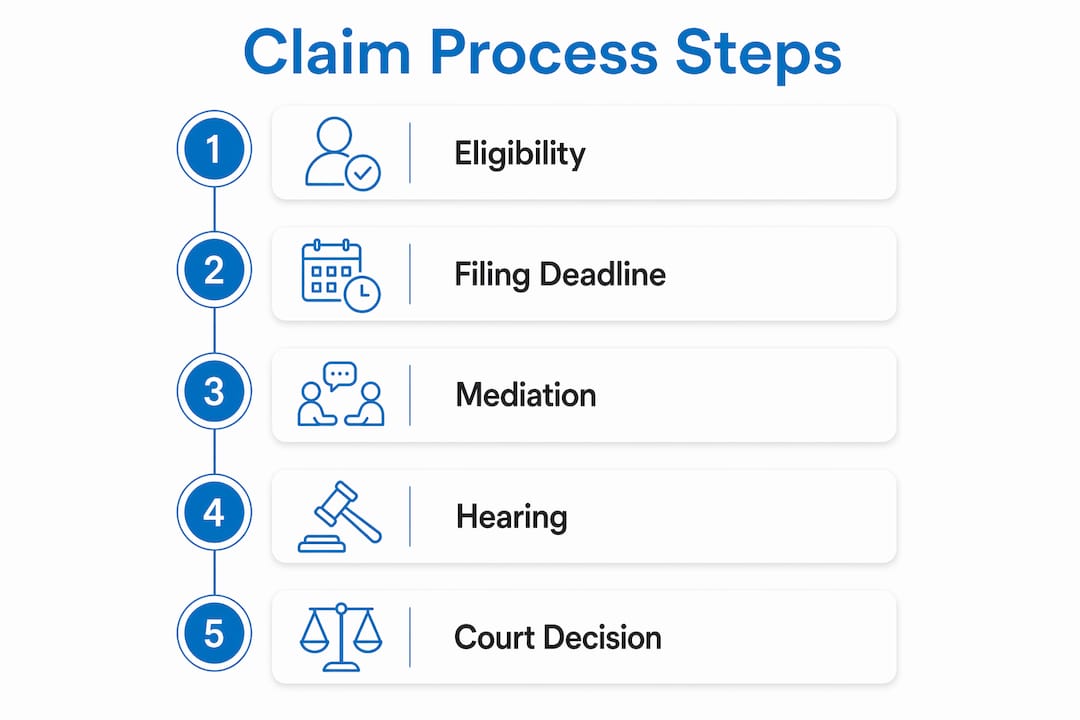
A family provision claim in NSW is a formal legal application to the Supreme Court of New South Wales, made under the Succession Act 2006 (NSW), by which an eligible person seeks adequate provision from a deceased person’s estate for their maintenance, education, or advancement in life. The family provision claim process is governed by strict eligibility rules, hard deadlines, and a 16-factor statutory test that judges apply when deciding whether the will, or the rules of intestacy, have left someone without enough. If you believe a deceased person’s estate has failed to provide for you properly, understanding each stage of this process is the difference between a claim that succeeds and one that never gets off the ground.
Who qualifies as an eligible person for a family provision claim in NSW?
Eligibility is a legal gateway; even strong moral grounds do not permit a claim if statutory eligibility is lacking. Under section 57 of the Succession Act 2006 (NSW), only six categories of person can bring a family provision claim. Knowing which category applies to you is the first thing any family provision claim lawyer will assess.
The six eligible categories are:
- Spouse or de facto partner of the deceased at the time of death
- Child of the deceased, including adopted children
- Former spouse of the deceased (subject to additional hurdles)
- Grandchild who was wholly or partly dependent on the deceased
- Member of the household who was wholly or partly dependent on the deceased
- Person in a close personal relationship with the deceased at the time of death
For categories such as former spouses, dependent grandchildren, and persons in close personal relationships, meeting eligibility alone is not enough. The Court also requires “factors warranting” the claim, a discretionary gatekeeping step that prevents claims from persons the deceased owed no genuine testamentary obligation to. A former spouse who remarried and had no ongoing financial connection to the deceased, for example, will struggle to clear this hurdle.
If you fall outside all six categories, you cannot make a family provision claim regardless of how unfair the will appears. In that situation, a family provision claim lawyer can advise on alternative remedies, such as challenging the will’s validity on grounds of lack of testamentary capacity or undue influence. You can read more about contesting a will in NSW to understand where those alternative paths lead.
Pro Tip: If you are unsure whether you qualify as an eligible person, get legal advice before the 12-month deadline passes. Waiting to confirm eligibility is one of the most common reasons people miss their window to claim.
What are the time limits for filing a family provision claim in NSW?
Family provision claims in NSW must be commenced within 12 months of the date of the deceased’s death. This is not 12 months from when probate was granted, nor from when you discovered the contents of the will. The clock starts on the date of death, and it does not pause.
Missing this deadline does not automatically end your claim, but it makes everything significantly harder. Late claims require leave of the Court, and judges apply a demanding test before granting it. You must explain the delay, show the estate has not been fully distributed, and demonstrate that granting leave would not cause undue prejudice to beneficiaries who have already received their share.
The procedural steps for filing are:
- File a Summons in the Supreme Court of New South Wales naming the executor or administrator as the respondent.
- Prepare a supporting affidavit setting out your relationship with the deceased, your current financial position, your needs, and the reasons you say the will (or intestacy) has failed to make adequate provision for you.
- Serve the Summons and affidavit on the executor or administrator within the time required by the Supreme Court rules.
- Attend a directions hearing where the Court sets a timetable for the exchange of evidence and referral to mediation.
The affidavit is not a formality. It is the foundation of your entire claim. Every financial detail, every aspect of your relationship with the deceased, and every competing need must be documented clearly and completely from the outset.
Pro Tip: Gather bank statements, tax returns, medical records, and any correspondence with the deceased before you see a lawyer. The more organised your financial picture, the stronger your affidavit will be.
How does mediation fit into the family provision claim process?
Most NSW family provision claims are resolved through court-annexed mediation before they ever reach a hearing. The Supreme Court refers the majority of claims to mediation as a standard step in the timetable, and for good reason. Mediation is faster, cheaper, and less emotionally draining than a contested hearing before a judge.

What many claimants do not realise is that mediation in family provision disputes is not a casual conversation. It is an evidence-and-negotiation phase where legal strategies are tested with prepared financial and relationship evidence. Walking into mediation without complete documentation is the equivalent of going to a court hearing without a brief.
Effective mediation preparation includes:
- A complete financial disclosure showing your current assets, liabilities, income, and expenses
- Evidence of your relationship with the deceased, including letters, photographs, and witness statements
- A clear articulation of why the current provision is inadequate by reference to the section 60(2) statutory factors
- A realistic settlement range agreed with your lawyer before the day
The benefits of settling at mediation are real. You avoid the cost and delay of a Supreme Court hearing, you preserve some control over the outcome, and you reduce the emotional toll on everyone involved. For guidance on negotiation in family disputes, understanding how to prepare for settlement discussions makes a measurable difference to outcomes.
If mediation fails, the matter proceeds to a contested hearing before a Supreme Court judge.
What happens at a court hearing and how does the court decide?
A contested family provision hearing is heard by a judge of the Supreme Court of New South Wales, who applies the statutory 16-factor test under section 60(2) of the Succession Act 2006 (NSW) to decide whether adequate provision has been made. The judge does not simply ask whether the outcome feels fair. The question is whether a wise and just testator, aware of all the circumstances, would have made greater provision for the applicant.
The key factors the Court weighs include:
| Factor | What the Court Examines |
|---|---|
| Nature of the relationship | Duration, closeness, and quality of the relationship with the deceased |
| Financial resources and needs | The applicant’s current assets, income, liabilities, and future needs |
| Estate size | The total value of the estate and what is available for distribution |
| Competing claims | The needs and circumstances of other beneficiaries |
| Contributions by the applicant | Financial, domestic, or personal contributions made to the deceased or the estate |
| Conduct of the applicant | Any conduct that might disentitle the applicant to provision |
“Adequate provision” is a legal standard, not a moral one. A court may find that a child received something under the will but still award additional provision if that amount falls short of what the statutory factors require. Conversely, a child who was estranged from the deceased for decades and has substantial independent wealth may receive nothing, even if they are technically eligible. You can read more about estranged family member rights in NSW to understand how courts treat those cases.
Pro Tip: Evidence of financial need is the single most persuasive factor in most claims. A detailed budget showing your monthly shortfall, combined with medical evidence of ongoing expenses, carries far more weight than general statements about hardship.
Common mistakes that undermine a family provision claim
Poor financial disclosure or incomplete evidence weakens claims significantly. Executors and administrators actively defend these proceedings, and they will scrutinise every gap in your affidavit. The mistakes below are the ones Simons George Legal sees most often.
- Missing the 12-month deadline. This is the most damaging mistake. Late claims require court leave and many fail at that hurdle alone.
- Underestimating the affidavit. Vague statements about your relationship with the deceased or your financial position give the executor’s legal team easy targets for cross-examination.
- Treating mediation as informal. Arriving at mediation without complete financial evidence and a clear legal position wastes the opportunity and forces a costly hearing.
- Overestimating moral entitlement. Courts apply the statutory factors, not a general sense of fairness. A claim built on “I deserved more” without financial need evidence rarely succeeds.
- Delaying legal advice. The earlier you engage a specialist family provision claim lawyer, the more time there is to gather evidence, prepare affidavits, and meet procedural deadlines.
“Eligibility gets you through the door. Evidence wins the case.” This is the reality of family provision litigation in NSW, and it is why preparation matters more than passion.
For a broader picture of family provision claims in NSW, including how courts have decided recent cases, Simons George Legal’s 2026 guide covers outcomes across a range of claim types.
Funding your legal matter — no win, no fee
The cost of litigation should not prevent a person with a legitimate claim from seeking their rights. Simons George Legal offers No Win, No Fee arrangements for eligible family provision claims. Eligibility is assessed during a free 30-minute initial consultation, giving you a clear picture of your prospects before you commit to anything.
Under a No Win, No Fee arrangement, you pay no legal fees unless your claim succeeds. This removes the upfront cost barrier that stops many eligible claimants from acting. Simons George Legal will assess your claim honestly, advise you on the strength of your evidence, and recommend practical next steps without any financial pressure on you at the outset.
Book a free case assessment with Simons George Legal today to find out whether your claim qualifies.
No Win, No Fee arrangements are subject to case eligibility and a written costs agreement. Liability limited by a scheme approved under Professional Standards Legislation.
Key takeaways
The family provision claim process in NSW requires meeting strict eligibility criteria, filing within 12 months of death, preparing thorough affidavit evidence, and engaging seriously with mediation before any court hearing.
| Point | Details |
|---|---|
| Eligibility is a legal threshold | Only six categories under s57 of the Succession Act 2006 (NSW) can bring a claim. |
| The 12-month deadline is strict | Claims filed after 12 months require court leave, which is difficult to obtain. |
| Affidavit quality determines outcomes | Complete financial disclosure and relationship evidence are the foundation of a strong claim. |
| Mediation is a serious legal stage | Arrive with full documentation and a clear settlement position, not just a willingness to talk. |
| The s60(2) test governs court decisions | Judges apply 16 statutory factors, not general fairness, to decide what adequate provision means. |
What i’ve learned after years of family provision work
After handling family provision claims across a wide range of family circumstances, the pattern I see most often is this: people come to us with a genuine grievance and a strong emotional case, but they have waited too long and prepared too little.
The 12-month deadline is the first thing I check. Not because it is a technicality, but because it defines whether we have a case at all. I have seen people with compelling claims lose their right to proceed simply because they spent months hoping the family would resolve things informally. That hope is understandable. Acting on it without legal advice is costly.
The second thing I have learned is that mediation is where most of these matters are actually decided. Judges in the Supreme Court are experienced and efficient, but a contested hearing is expensive, slow, and unpredictable. The clients who come to mediation with organised financial evidence, a realistic view of their claim, and a clear settlement range almost always do better than those who arrive expecting the mediator to sort things out for them.
The hardest conversation I have with clients is about the difference between moral entitlement and legal entitlement. A parent who worked hard their whole life and left everything to one child may have been unfair. But if the other children are financially secure and had a difficult relationship with the deceased, the statutory factors may not support a large award. The law asks what a wise and just testator would have done, not what a loving one should have done. Those are different questions, and understanding that distinction early saves a great deal of disappointment later.
— George
Ready to assess your claim?
If you believe a deceased person’s estate has not made adequate provision for you, the time to act is now. Simons George Legal is a dedicated wills and estates practice based in Bondi, serving clients across Sydney with a strong focus on family provision claims and estate litigation.

New clients receive a complimentary 30-minute consultation where Simons George Legal will assess your eligibility, review your circumstances, and give you an honest view of your prospects. There are no obligations and no upfront costs for eligible matters. Contact Simons George Legal today to take the first step toward protecting your rights under the Succession Act 2006 (NSW).
FAQ
What is a family provision order in NSW?
A family provision order is a court order made by the Supreme Court of New South Wales directing that additional provision be made for an eligible person from a deceased estate. The order is made under the Succession Act 2006 (NSW) when the court finds the existing provision is inadequate.
Who can make a family provision claim in NSW?
Only persons who qualify as an eligible person under s57 of the Succession Act 2006 (NSW) can bring a claim. The six categories include spouses, de facto partners, children, former spouses, dependent grandchildren, household members, and persons in close personal relationships.
How long do i have to make a family provision claim in NSW?
You have 12 months from the date of the deceased’s death to file your claim in the Supreme Court. Claims filed after this period require court leave, which is difficult to obtain and not guaranteed.
Does a family provision claim go to court?
Most claims are resolved through court-annexed mediation before reaching a hearing. If mediation does not produce a settlement, the matter proceeds to a contested hearing before a Supreme Court judge who applies the 16-factor test under section 60(2) of the Succession Act 2006 (NSW).
How much does a family provision claim cost?
Costs vary depending on the complexity of the claim and whether it settles at mediation or proceeds to a hearing. Simons George Legal offers No Win, No Fee arrangements for eligible matters, removing the upfront cost barrier for claimants with a legitimate case.