When you are facing an inheritance dispute or managing a contested estate, the question of whether you need an estate litigation lawyer or can sort this out yourself is not always straightforward. Many people assume estate matters are mostly paperwork and that a calm, reasonable approach will be enough to resolve disagreements. That assumption can be costly. The reality is that estate disputes range from genuinely manageable to deeply complex, and the line between those two categories is not always obvious until you are already in trouble.
Table of Contents
- Key takeaways
- Do I need an estate litigation lawyer or can I handle this myself?
- When self-representation might actually work
- The real risks of handling estate disputes without a lawyer
- When to hire an estate attorney and how to keep costs manageable
- Steps to take if you decide to self-represent
- My honest view on the DIY versus lawyer question
- How Simons George Legal can help
- FAQ
Key takeaways
| Point | Details |
|---|---|
| DIY suits simple estates | Self-representation works best when assets are straightforward and all parties are cooperative. |
| Courts show no leniency | Pro se litigants face the same procedural rules as lawyers, regardless of experience. |
| Missed deadlines are fatal | Will contest and probate deadlines are strict, and missing them typically forfeits your rights permanently. |
| A hybrid approach saves money | Combining DIY administration with targeted legal help reduces costs without sacrificing protection. |
| Early advice prevents escalation | Consulting a lawyer at the first sign of dispute is far cheaper than fixing mistakes later. |
Do I need an estate litigation lawyer or can I handle this myself?
Estate litigation covers any formal legal dispute arising from a deceased person’s estate. That includes contesting a will on grounds of lack of testamentary capacity or undue influence, challenging an executor’s conduct, disputing a family provision claim, and resolving creditor claims against an estate.
Disputes arise for many reasons. Blended families create competing loyalties and expectations. Ageing testators sometimes sign documents under pressure or when their mental capacity is questionable. Executors occasionally act in their own interests rather than those of the beneficiaries. These situations are not rare. They are among the most common reasons families end up in court.
Common dispute types include:
- Will contests based on capacity, fraud, or undue influence
- Executor misconduct or breach of fiduciary duty
- Family provision claims by eligible persons who were left out or inadequately provided for
- Disputes between beneficiaries over the interpretation of will clauses
- Creditor claims that reduce the estate available for distribution
The complexity of a dispute determines almost everything about how it should be handled. A disagreement between two cooperative siblings over a minor asset is a very different matter from a contested will involving multiple parties, a large estate, and allegations of elder abuse. Estate and trust fiduciary litigation often involves discovery, motion practice, mediation, and trial preparation. That is not territory where good intentions substitute for legal expertise.
When self-representation might actually work
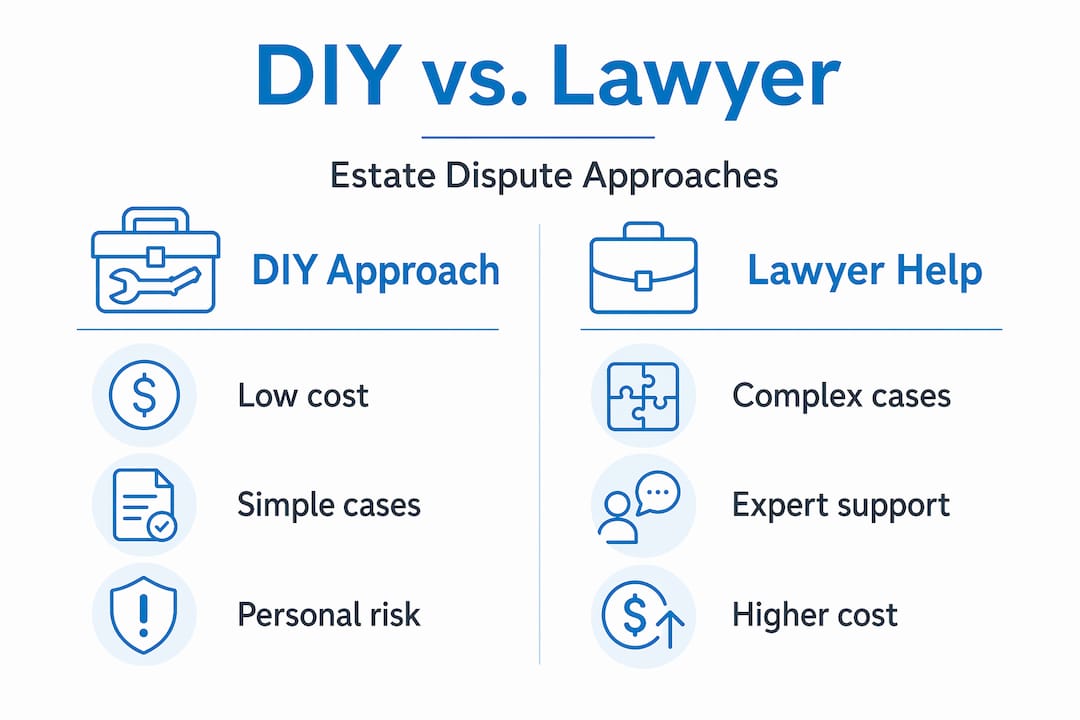
Not every estate matter requires a lawyer from day one. For genuinely straightforward situations, handling things yourself is a reasonable choice. The key word is straightforward.
Self-representation tends to be feasible when:
- The estate consists of simple, identifiable assets such as a family home, a bank account, and personal belongings.
- There is a valid, unambiguous will that all beneficiaries accept without question.
- All beneficiaries are adults who communicate respectfully and agree on the distribution.
- There are no creditor disputes, tax complications, or business interests involved.
- The deceased did not have assets in multiple jurisdictions.
In these cases, the executor’s role is largely administrative. You are gathering documents, notifying relevant parties, applying for probate and estate administration, paying debts, and distributing assets according to the will. These tasks require care and attention to detail, but they do not necessarily require a lawyer at every step. DIY probate can be reasonable for straightforward estates, provided no disputes arise.
The honest downside of going it alone, even in simple cases, is that you carry full personal responsibility for any errors. Executors have legal obligations, and a mistake made in good faith can still result in personal liability. The administrative burden is also real. Formal petitions for administration require verified identity details, accurate asset descriptions, and proof of qualifications to serve. Getting that wrong delays everything.
Pro Tip: Before deciding to self-represent, write down every asset, every potential beneficiary, and every person who might have a grievance. If that list produces any surprises or uncertainty, treat it as a signal to at least consult a lawyer before proceeding.
The real risks of handling estate disputes without a lawyer
Here is where the stakes change significantly. Once a dispute becomes adversarial, the rules of the game shift in ways that catch self-represented parties off guard.

The most important thing to understand is that courts do not make allowances for people who represent themselves. No procedural exceptions exist for lay litigants in probate contexts. You are expected to know the rules, meet the deadlines, and present your case with the same competence as a qualified solicitor. That is a high bar for someone managing grief, family conflict, and an unfamiliar legal system simultaneously.
Deadlines are particularly unforgiving. Will contest deadlines are strict, and missing them typically forfeits your right to challenge permanently. In New South Wales, family provision claims must generally be filed within 12 months of the date of death. Miss that window and you will need to apply for an extension, which is not guaranteed and adds cost and delay.
The risks of self-representation in contentious matters include:
- Filing documents incorrectly or in the wrong court, which can result in dismissal
- Failing to comply with discovery obligations, which can damage your credibility
- Making admissions in correspondence that harm your legal position
- Misunderstanding the burden of proof required to establish undue influence or lack of capacity
- Overlooking tax implications that reduce the estate or create personal liability
“Treating probate as just paperwork when disputes are adversarial leads to costly errors that may require professional intervention to fix, often at greater cost.” Source: SwiftProbate
There is also the growing problem of DIY and AI-generated estate documents that fail to meet legal requirements. Documents that look complete and professional can be invalid if they do not comply with execution requirements or if capacity and intention are not properly documented. Fixing those problems after the fact often costs far more than getting them right the first time. The risks associated with DIY wills extend well beyond the document itself and into the litigation that follows.
When to hire an estate attorney and how to keep costs manageable
The good news is that hiring a lawyer does not have to mean handing over every aspect of the matter and receiving a large bill at the end. There is a practical middle path.
Executors can handle most administrative tasks themselves but should seek legal help for complex legal decisions. The tasks that genuinely require expertise include drafting court petitions, interpreting ambiguous will clauses, responding to creditor disputes, handling tax matters, and managing contested hearings. Everything else, gathering documents, communicating with beneficiaries, organising valuations, can often be done by the executor directly.
This is sometimes called limited scope representation or unbundled legal services. You pay for specific legal tasks rather than full representation. It is a cost-effective way to access the importance of legal advice in estates without committing to full retainer fees from the outset.
| Approach | Best suited to | Key benefits | Key risks |
|---|---|---|---|
| Full DIY | Simple, uncontested estates | Low cost, full control | Personal liability, procedural errors |
| Hybrid (DIY + targeted legal help) | Moderately complex or early-stage disputes | Cost-effective, expert input where needed | Requires good judgement on when to escalate |
| Full legal representation | Contested, complex, or high-value disputes | Maximum protection, professional advocacy | Higher cost, less personal control |
When selecting a lawyer for estate disputes, look for someone who specialises specifically in wills and inheritance law rather than a generalist. Estate litigation has its own procedural rules, its own body of case law, and its own strategic considerations. A specialist will identify issues early that a generalist might miss.
Pro Tip: Ask any lawyer you consult whether they offer fixed-fee or limited scope services for specific tasks. Many estate lawyers will review a document, advise on a single issue, or draft a specific letter for a set fee. This gives you expert input without the cost of full representation.
Steps to take if you decide to self-represent
If you have assessed your situation and decided to proceed without a lawyer, at least initially, here is how to do it as safely as possible.
- Gather and verify all key documents before taking any action. This means the original will, death certificate, asset records, and any correspondence from beneficiaries or creditors.
- Map all deadlines relevant to your jurisdiction. Note the date of death and calculate when limitation periods expire for family provision claims, will contests, and creditor notifications.
- Communicate in writing with all beneficiaries and creditors. Keep copies of everything. Verbal agreements in estate matters are almost impossible to enforce and easy to dispute later.
- Watch for warning signs that the matter is escalating. These include a beneficiary engaging their own solicitor, any suggestion that the will was signed under duress, or a creditor threatening formal action.
- Consult a lawyer at the first sign of conflict. A single consultation at an early stage is far cheaper than trying to undo a procedural mistake or recover from a missed deadline later.
- Keep a running record of every decision you make as executor, including why you made it. This documentation protects you if your conduct is ever challenged.
The pattern that causes the most damage is a reactive one. People wait until a dispute has escalated before seeking advice, at which point the options are narrower and the costs are higher. Being proactive is not just good advice. It is genuinely protective.
My honest view on the DIY versus lawyer question
I have seen both ends of this spectrum up close. There are estates where a capable, organised executor manages the process well without legal help, and everyone walks away satisfied. Those situations exist. But they are less common than people expect.
What I have noticed is that most people who end up in costly litigation did not set out to create a dispute. They made reasonable-sounding decisions early on, without understanding the legal consequences, and those decisions compounded. A letter sent without legal advice that inadvertently acknowledged a debt. An executor who distributed assets before resolving a creditor claim. A beneficiary who missed the window to challenge a will because they did not know the deadline existed.
The complexity of estate and trust fiduciary litigation is routinely underestimated. People compare it to resolving a disagreement between reasonable adults, when in practice it involves evidentiary standards, procedural rules, and strategic decisions that take years of practice to understand well.
My genuine recommendation is the hybrid approach. Do the administrative work yourself where you are confident. But bring in a specialist for anything that involves a court, a formal legal claim, or a situation where another party has already engaged legal representation. The cost of targeted legal advice is almost always less than the cost of fixing a mistake made without it. Think of it as an investment in keeping the family out of a courtroom altogether.
— George
How Simons George Legal can help

If you are dealing with an inheritance dispute, a contested will, or the complexities of estate administration in Sydney, Simons George Legal offers the kind of practical, honest guidance that makes a real difference. The firm specialises exclusively in wills and estates, which means you are not getting a generalist’s opinion on a specialist’s problem.
Whether you need full representation in estate litigation or targeted advice on a specific issue, Simons George Legal works with you to find an approach that fits your situation and your budget. New clients receive a complimentary 30-minute consultation, so you can get a clear picture of where you stand before committing to anything. Reach out to the team at Simons George Legal to take the first step.
FAQ
What does an estate litigation lawyer actually do?
An estate litigation lawyer represents clients in disputes arising from a deceased person’s estate, including will contests, executor challenges, family provision claims, and creditor disputes. They handle court filings, evidence, strategy, and negotiation on your behalf.
Can I contest a will without a lawyer in Australia?
You can technically self-represent in a will contest, but courts apply the same procedural and evidentiary rules to you as they would to a qualified solicitor. Given the strict deadlines and complexity involved, most people benefit significantly from legal representation in contested matters.
How long do I have to contest a will in New South Wales?
In New South Wales, family provision claims must generally be filed within 12 months of the date of death. Other types of will challenges have their own timeframes. Missing these deadlines can permanently forfeit your right to challenge.
What is limited scope legal representation in estate matters?
Limited scope representation, sometimes called unbundled legal services, allows you to hire a lawyer for specific tasks only, such as drafting a court petition or reviewing a document, while managing other aspects yourself. It is a cost-effective option for people who want expert input without full representation fees.
When should I stop handling an estate dispute myself?
You should seek legal advice immediately if another party engages a solicitor, if allegations of undue influence or fraud arise, if a creditor threatens formal action, or if you are approaching a limitation deadline. Early legal involvement at these points almost always reduces the overall cost and risk.