New South Wales law requires two adult witnesses, present at the same time, to watch you sign your will and then sign it themselves in your presence, under Succession Act 2006 (NSW) s6. Get this wrong and the will can fail entirely, or a gift to a witness who happens to be a beneficiary can become void. If you have any doubt about how a will was signed, work through the checklist below or get a lawyer to check the execution before it becomes a problem for your executor.
TL;DR:
- Witnesses must be adults capable of observing the signing in the same room at the same time, with signing occurring in their presence.
- Beneficiaries should never act as witnesses, as their gift risks becoming void; family members not named as beneficiaries are usually suitable.
- Signing a will without both witnesses present at the same time can invalidate the document, and using a beneficiary as a witness can void their gift.
- Proper execution requires a final, printed version, a private setting, full identity and capacity checks, and signatures completed consecutively in the same session.
- If a witness turns out to be a beneficiary or the signing was done improperly, early legal review and accurate record-keeping are crucial to prevent future disputes.
Table of Contents
- What the Succession Act 2006 (NSW) requires for a valid signing
- Who can (and should not) act as a witness in NSW
- Common execution mistakes and the legal consequences
- Step by step: signing and witnessing a will correctly in NSW
- If a witness turns out to be a beneficiary, or the signing went wrong
- Practitioner tips: how lawyers reduce risk at signing
- A short practitioner note on why careful execution matters
- Funding your legal matter — No Win, No Fee
- Sources
- FAQ
What the Succession Act 2006 (NSW) requires for a valid signing
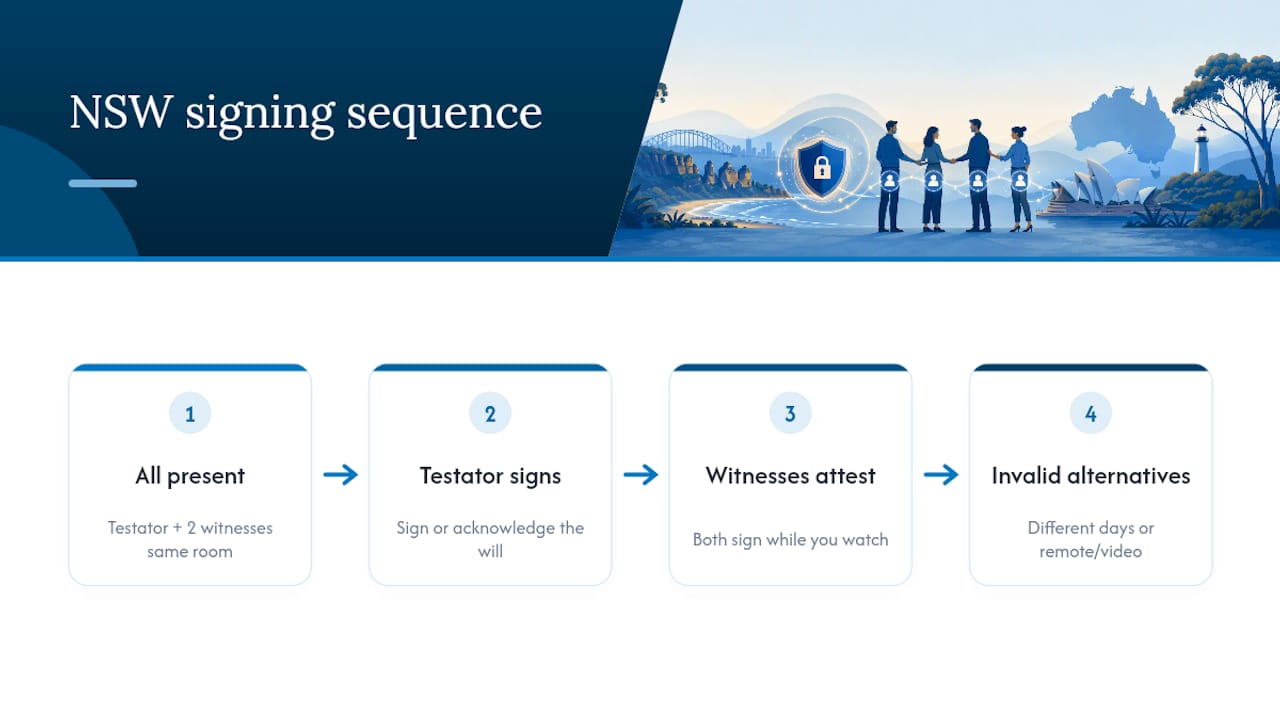
A will has to be in writing, and you (the testator) sign it, or someone else signs it for you at your direction and in your presence. That signature must be made or acknowledged in front of two or more witnesses who are both there at the same time, and at least two of those witnesses then have to attest and sign the will while you watch, under Succession Act 2006 No 80. That’s the whole test. Miss any piece of it and you’ve got a document that might not hold up.
Your signature doesn’t have to sit at the very bottom of the last page. Courts care more about whether the mark you made shows you intended the document to operate as your will, not exactly where on the page it lands. A signature squeezed into a margin because the page ran out of room isn’t automatically fatal, though it’s obviously better practice to leave room and sign cleanly at the end.
“Present at the same time” is where most confusion creeps in, and it’s worth being precise about it. It means all three people, you and both witnesses, are in the same room when you sign. It does not mean the witnesses need to sign at that exact moment too; the State Library of New South Wales notes witnesses can attest and sign afterwards, as long as it’s still done in your presence. What can’t happen is one witness watching you sign on Tuesday and the other witnessing it on Thursday from memory, or over a video call while you’re in a different location. Same room, same moment for the act of signing, is the safest reading of the rule.
Who can (and should not) act as a witness in NSW
Witnesses need to be adults, capable of seeing what’s happening, and mentally capable of understanding they’re witnessing a legal document. Beyond that, NSW law is less about a formal checklist and more about avoiding people whose involvement could later be picked apart in court.
- Witnesses must be 18 or over and able to observe the signing (so someone who is blind or who can’t reasonably see the act of signing shouldn’t be used).
- They need enough mental capacity to understand what they’re attesting, not to understand the will’s contents, just that they’re confirming they saw you sign it.
- A beneficiary named in the will should never act as a witness. Under NSW guidance, a gift to a witness who is also a beneficiary can be void, and the exceptions that might save it are narrow and risky to rely on, per NSW Government guidance.
- Family members who aren’t beneficiaries are usually fine, but independent witnesses (a colleague, neighbour, or your solicitor’s staff) avoid any suggestion of influence.
- Pick witnesses you can actually track down years later. A will might not go to probate for a decade or more, and a witness who’s moved overseas or can’t be located makes your executor’s job much harder.
Common execution mistakes and the legal consequences
The single most common error is signing without both witnesses in the room, then getting them to sign later “to save time.” It feels harmless. It isn’t. If the witnesses weren’t present when you signed, the will may not meet the statutory requirements at all.
The second most common mistake is using a beneficiary, often a spouse or adult child, as a witness because they’re conveniently in the house. That can void their own gift under the will. Other frequent problems: unsigned or missing pages in a multi-page will, initials that don’t match the final signature, or a signature that’s ambiguous about whether it was meant to finalise the document.
The consequences range from annoying to catastrophic. A defective execution can mean the whole will is treated as invalid, sending the estate into intestacy rules instead of your actual wishes. It can also trigger family provision claims, contested probate applications, and months of delay and legal cost that a properly witnessed document would have avoided entirely.
Step by step: signing and witnessing a will correctly in NSW
Getting the mechanics right takes fifteen minutes if you plan the session properly. Here’s the order that keeps you inside the law and gives your executor the least amount of trouble later.
- Finalise and print the will first. Don’t sign a draft, and don’t make handwritten changes on the day; get a clean final version printed.
- Book a private, uninterrupted time and place with your two chosen witnesses, ideally somewhere quiet enough that nobody’s rushing.
- Confirm everyone’s identity and capacity before you start; a quick chat about who’s who avoids disputes months down the track.
- Check neither witness is a beneficiary under the will, and that both are adults capable of observing the signing.
- Sign the will (or direct someone to sign for you) with both witnesses watching, in the same room, at the same time.
- Have both witnesses attest and sign in your presence, immediately after, using the same signing session, per the State Library’s guidance.
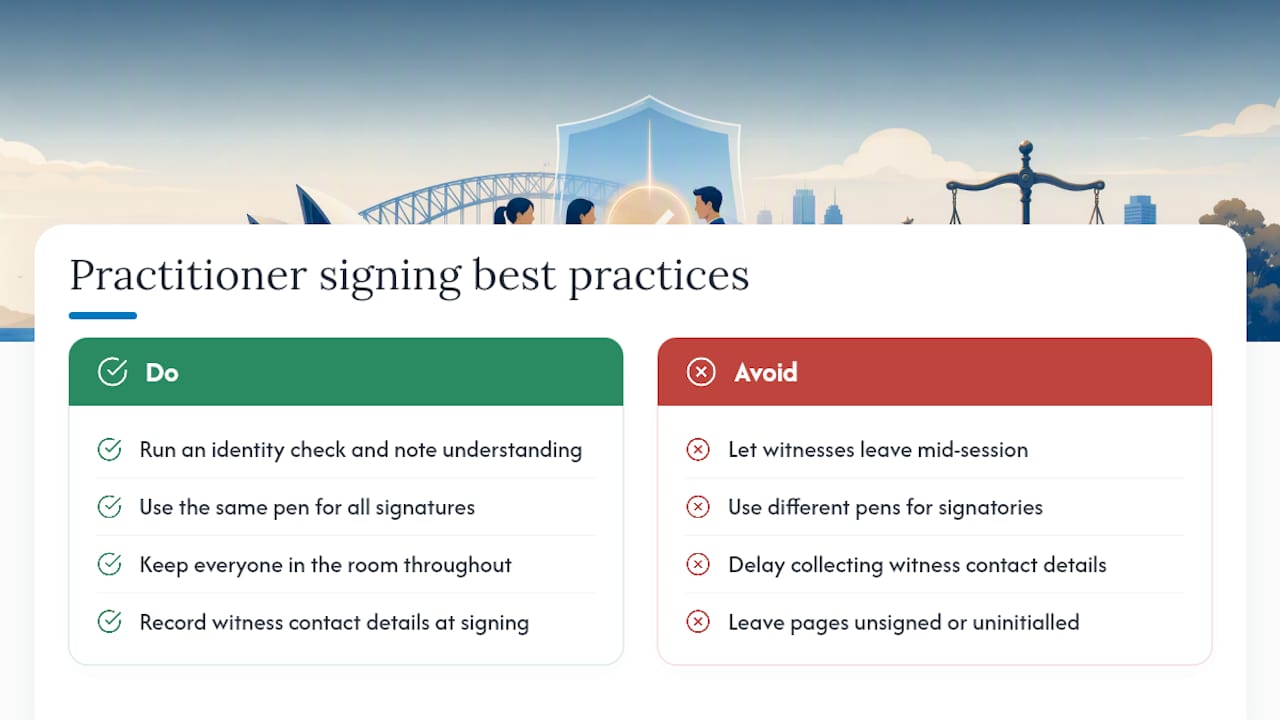
- Use one pen for all three signatures, initial each page if the will runs multiple pages, and note the date and place on the document.
- Record both witnesses’ contact details and keep that note with the will, not loose in a drawer somewhere else.
- Store the signed original securely (a solicitor’s safe, bank deposit box, or trusted custodian) and tell your executor exactly where it lives.
Pro Tip: Don’t let witnesses leave the room between your signature and theirs. A five minute gap where someone answers the phone or steps outside is exactly the kind of detail that gets picked apart if the will is ever challenged.
If a witness turns out to be a beneficiary, or the signing went wrong
If you’ve realised after the fact that a beneficiary witnessed the will, don’t panic, but don’t ignore it either. The gift to that witness can be void unless very specific statutory conditions apply, and relying on those exceptions is a genuine gamble rather than a safety net.
An improperly witnessed will doesn’t automatically get thrown out, but it does open the door to contest or to a court application seeking to validate it despite the defect, and either path means added time and legal fees for everyone involved.
If you suspect something was done wrong at signing, three things matter most: keep the original document exactly as it is, write down the witnesses’ current contact details while you still can, and get a wills and estates lawyer to review the execution early. Catching a defect before probate is far cheaper than fixing it after someone contests the estate.
Practitioner tips: how lawyers reduce risk at signing
When a solicitor sits in on a will signing, they’re not just there for formality. They run an identity check, jot a short note confirming the testator appeared to understand what they were doing, and make sure both witnesses are independent of the will’s contents.
A few habits practitioners rely on are simple enough for anyone to copy. Using the same pen for all three signatures, keeping everyone in the room for the entire session rather than splitting it up, and recording witness contact details at the time rather than trying to track people down years later, per practical guidance from the State Library. Initialling each page or signing at the bottom of every sheet closes off arguments about substituted pages.
The contactability point deserves more weight than it usually gets. If your witnesses have moved, changed their name, or can’t be located when probate is eventually lodged, your executor may need to file extra affidavit evidence just to prove the will was signed properly, adding cost and delay to a process that should have been straightforward.
A short practitioner note on why careful execution matters
Two of the messiest estate disputes I’ve seen both started the same way: a rushed signing, a spouse who witnessed instead of an independent adult, and nobody thinking twice about it until probate. By then it’s a court matter, not a five-minute fix. If you’re unsure whether a will was signed correctly, work through the checklist above, and if any doubt remains, get it checked before it becomes someone else’s fight.
— George
Funding your legal matter — No Win, No Fee
If you’ve discovered a defective signing, or a family provision claim looks likely because a gift to a witness was voided, cost shouldn’t stop you from getting proper advice. Simons George Legal helps with will preparation, execution checks, and contested will matters across NSW.
For eligible cases, Simons George Legal offers No Win, No Fee arrangements, so you’re not carrying upfront legal costs while a legitimate claim is assessed. Eligibility is worked out during a free initial consultation, which means you find out where you stand before committing to anything. That removes the biggest barrier for people with a real claim but limited cash flow to fund it.
Book a free case assessment with Simons George Legal to find out where your matter stands.
No Win, No Fee arrangements are subject to case eligibility and a written costs agreement. Liability limited by a scheme approved under Professional Standards Legislation.
Sources
The exact statutory text on execution and witnessing sits in Succession Act 2006 No 80, section 6. For plain-language summaries, the NSW Government’s “Learn about wills” page and Legal Aid NSW’s wills guidance both cover witnessing rules and the risks of DIY will kits.
This article is general information, not a substitute for advice from a qualified lawyer. Consult a qualified legal professional about your own circumstances before acting on anything here.
- Succession Act 2006 No 80
- Learn about wills | NSW Government
- Making a valid will | State Library of New South Wales
FAQ
Who can witness the signing of a will in NSW?
Any adult who can see the signing take place and understands what they’re attesting can witness a will, as long as they’re not a beneficiary named in that will.
What are the general requirements for witnessing signatures in NSW?
Two witnesses need to be present at the same time as the testator’s signature, and both must then attest and sign the document in the testator’s presence, per section 6 of the Succession Act.
Can a family member be a witness to a will?
Yes, a family member can witness a will as long as they aren’t named as a beneficiary, though many practitioners still prefer an independent witness to avoid any suggestion of influence.
Who cannot witness a will in Australia?
A beneficiary named in the will generally shouldn’t act as a witness, since their gift can be voided; minors and anyone lacking the mental capacity to understand what they’re signing also can’t validly witness a will.